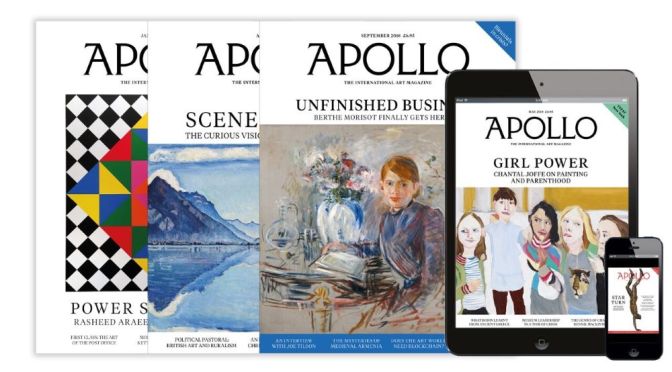
• Jil Sander refashions the English garden in Hamburg
• Annette Messager on the art of making the strange familiar
• A dazzling Medici table-top in focus
• On Jeju Island, the Hawaii of South Korea
Plus: the restored Galleria Nazionale dell’Umbria, Inigo Jones’s Banqueting House, Joseph Wright of Derby’s brush with the divine, and reviews of Cézanne in Chicago, Milton Avery in London and a history of fancy dress
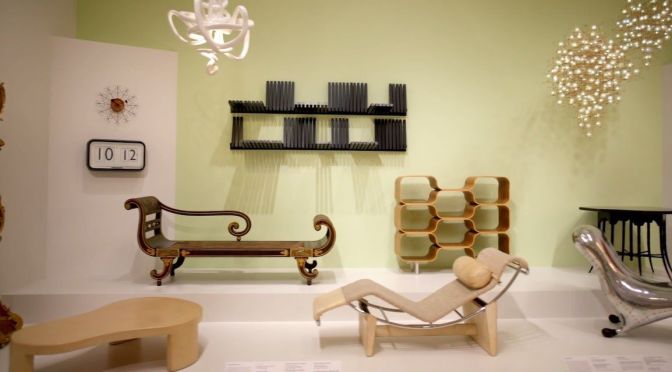
Extraordinary Ordinary Things, Carnegie Museum of Art’s latest decorative arts and design exhibition, features more than 300 objects from our expansive collection, which dates back to the founding of the museum in 1895.
In this video, the museum team takes you behind the scenes for a look at how this exhibition came to be, while sharing stories about a few of the remarkable objects in the show! Spanning some of the most significant design developments of the past three centuries, the works on view in Extraordinary Ordinary Things offer boundless inspiration and present the endless possibilities for functional design for visitors to learn about, consider, and enjoy.
Picasso & Braque: Radicals highlights significant work by the two pioneers of the Cubist art movement—Pablo Picasso and Georges Braque. Cubism, one of the most influential artistic developments of the twentieth century, challenged traditional perspectives of how we see the world. The movement is characterized by fractured viewpoints and abstracted forms and defies established notions of three-dimensionality. Cubism can be intellectually challenging but beautifully reflects the dynamism, rhythm, and innovation of the early 1900s.
Although there is debate on who developed Cubism first, Picasso and Braque are credited with establishing this new visual language that presented infinite possibilities and catalyzed future developments in the visual arts. This exhibition features work by twentieth-century artists who took inspiration from these revolutionary ideas and practices, including American artists Fannie Hillsmith and John Marin, and Texas artist Bill Reily, among others. Paintings, drawings, sculptures, and prints demonstrate how Cubism transcended time and space.
Picasso & Braque: Radicals is organized for the McNay Art Museum by Lyle W. Williams, Curator of Prints and Drawings, Curator of Modern Art; and Rafael Fernando Gutierrez Jr., the inaugural Douglass Foundation Intern in Curatorial Studies.
With nearly 1,500 artworks on display, there is a lot to see at the Royal Academy of Arts (RA) Summer Exhibition 2022. If you want a taste of what’s on show then here is a quick tour. The theme chosen by the exhibition’s coordinator, Alison Wilding RA, is Climate. It begins outside, where a large-scale immersive installation by Spanish artist Cristina Iglesias brings nature and water to the courtyard. Inside, the artworks are spread over 11 rooms, including two galleries of prints selected by Grayson Perry RA.
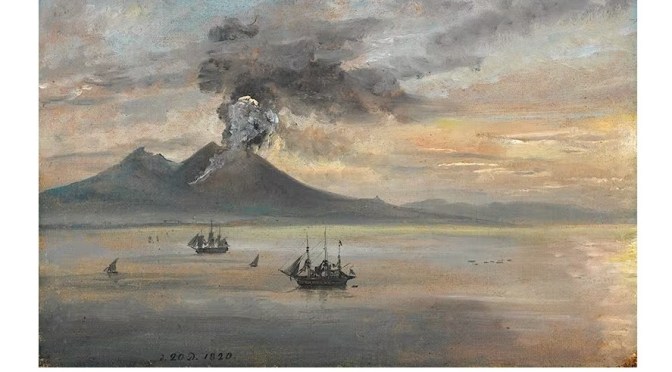
‘It is desirable for a Painter, at least once in his life, to witness the Eruption of a volcano.’ – Pierre-Henri de Valenciennes (1799). Join exhibition contributor Clive Oppenheimer, Professor of Volcanology at the Department of Geography at the University of Cambridge, and explore the ‘Volcanoes’ section of True to Nature. #TrueToNature is open at the Fitzwilliam Museum until 29 August 2022 https://fitz.ms/ttn
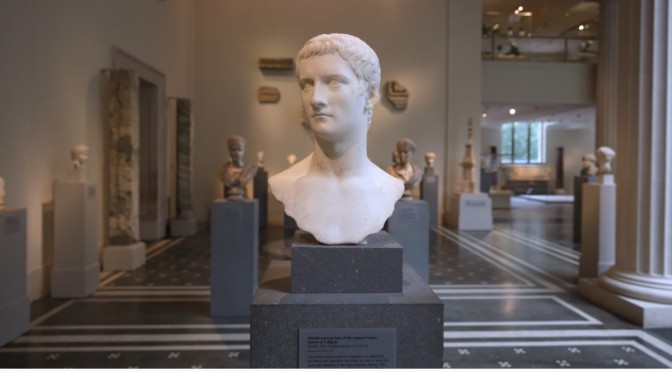
Archaeologists Vinzenz and Ulrike Koch Brinkmann have spent the last 40 years dedicated to the study of polychromy—or “many colors” in Greek—in ancient sculpture. Once a fringe area of study, their research combats the misconception of white purity in ancient Greece and Rome. They reflect on the marble bust of Caligula and how the reconstruction of its former color can help us better understand history.
“The underworld, the afterlife, is fairly dank, dark, shadowy; quite frankly, it’s a bit boring. Somewhat like waiting at a bus depot.”
Homer’s Odyssey depicts an afterlife that is relatively dull, with heroic actions and glory reserved for the living. Nonetheless, people in Southern Italy in the fourth century BCE were captivated by the underworld and decorated large funerary vases with scenes of the afterlife—the domain of Hades and Persephone, where sinners like Sisyphus are tortured for eternity and heroes like Herakles and Orpheus performed daring feats.
Little is known about precisely how these vases were used and seen in death rituals. A new book by Getty Publications, Underworld: Imagining the Afterlife in Ancient South Italian Vase Painting, brings together 40 such vases and explores new research on them.
In this episode, Getty Museum curator of antiquities David Saunders discusses these enormous and often elaborate vases, explaining the myths they depict and what is known about the ways in which they were used. Saunders is editor of Underworld.
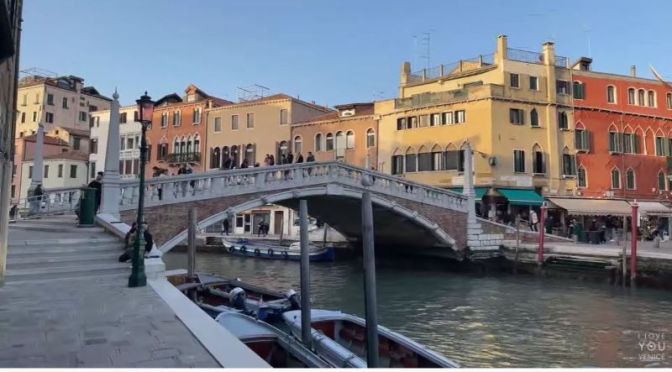
Santa Croce is a laid-back, slightly off-the-beaten-track area with a local vibe. After school, kids play in Campo San Giacomo dall’Orio, and this square and nearby streets are home to casual eateries serving global cuisine. On the Grand Canal, the imposing Fondaco dei Turchi features exhibits on natural history while the nearby Ca’ Pesaro palace showcases contemporary art and Asian decorative arts.
Lively Cannaregio is known for the 16th-century Jewish Ghetto. The Strada Nova is a popular local shopping thoroughfare, and the backstreets are a destination for crafts and vintage goods. Casual canalside restaurants and bars line nearby Fondamenta della Misericordia and Fondamenta dei Ormesini. The stately Ca’ d’Oro palace displays a Renaissance art collection.
Attirement of the Bride is an example of Max Ernst’s veristic or illusionistic Surrealism, in which a traditional technique is applied to an incongruous or unsettling subject. The theatrical, evocative scene has roots in late nineteenth-century Symbolist painting, especially that of Gustave Moreau. It also echoes the settings and motifs of sixteenth-century German art. The willowy, swollen-bellied figure types recall those of Lucas Cranach the Elder in particular. The architectural backdrop with its strong contrast of light and shadow and its inconsistent perspective shows the additional influence of Giorgio de Chirico, whose work had overwhelmed Ernst when he first saw it in 1919.
News, Views and Reviews For The Intellectually Curious





 Boomers Daily