
Architectural Digest (September 7, 2023) – Today AD joins architect Nick Potts in New York City for a walking tour of the Upper West Side. At the turn of the century, apartment hotels such as The Dakota and The San Remo started populating the Upper West Side.
Servants’ quarters, elevators, and the realization of views were making apartment living more appealing to the upper middle classes and increasing the value of the top floors. Join Nick for an in-depth look at how the Upper West Side revolutionized apartment living and became the birthplace of the penthouse in Manhattan.
FRANCE 24 English Films (September 7, 2023) – Deep in France’s Burgundy region lies the Boutissaint wildlife park. Within its 400 hectares of forest, several hundred animals roam free: stags, roe deer and boars, which visitors can observe as they wander through this natural setting with very few fences.
The park is the brainchild of the Borione family, which purchased this former priory and its vast abandoned estate in the early 20th century. When it opened in 1968, it was France’s very first wildlife park. FRANCE 24 takes you on a tour.
Architectural Digest (August 29, 2023) – Today AD travels to the rugged shores of Malibu, California to tour Sandcastle House, the remarkable family home of architect Harry Gesner. This stunning property was born from a promise to Gesner’s wife to build her dream house on the shores of Malibu.
This one-of-a-kind home is made almost entirely from reclaimed materials salvaged from surrounding areas and inspired by the structural design of a sandcastle. But what makes Sandcastle House so special is Gesner built it with his own two hands for his family, making it a true labor of love.
KPIX | CBS NEWS BAY AREA (August 27, 2023) – ‘Vertigo’, one of the enduring classics of American cinema, was Alfred Hitchcock’s love letter to the Bay Area many of the views he recorded in 1957 are little changed 65 years on.
Vertigo is a 1958 American psychological thriller film directed and produced by Alfred Hitchcock. The story was based on the 1954 novel D’entre les morts (From Among the Dead) by Boileau-Narcejac. The screenplay was written by Alec Coppel and Samuel A. Taylor. The film stars James Stewart as former police detective John “Scottie” Ferguson, who has retired because an incident in the line of duty has caused him to develop acrophobia (an extreme fear of heights) and vertigo, a false sense of rotational movement. Scottie is hired by an acquaintance, Gavin Elster, as a private investigator to follow Gavin’s wife, Madeleine (Kim Novak), who is behaving strangely.
The film was shot on location in the city of San Francisco, California, as well as in Mission San Juan Bautista, Big Basin Redwoods State Park, Cypress Point on 17-Mile Drive, and Paramount Studios in Hollywood. It is the first film to use the dolly zoom, an in-camera effect that distorts perspective to create disorientation, to convey Scottie’s acrophobia. As a result of its use in this film, the effect is often referred to as “the Vertigo effect”. In 1996, the film underwent a major restoration to create a new 70 mm print and DTS soundtrack.
The Huntington (August 25, 2023) – The history of printing has many missing pages. Li Wei Yang, Curator of Pacific Rim Collections, searched the library for the first documented connections between the great printing cultures of China and Europe.
The oldest printed book in The Huntington’s collection, the Scripture of the Great Flower Ornament of the Buddha, is on display in “Printed in 1085: The Chinese Buddhist Canon from the Song Dynasty” in the Library West Hall.
The exhibition delves into the circumstances of the book’s creation and its religious significance while broadening visitors’ understanding of Chinese textual tradition. Additional materials related to the text are on display to provide historical context.
The book is in a specially designed display case that allows Huntington visitors to have a unique experience when viewing the sacred text. Though the book was meant to be read by flipping from one page to the next, in the exhibition it is expanded in a custom case designed for maximum visibility, offering a rare opportunity to view the miraculously preserved relic and observe its unique bibliographic characteristics and exquisiteness.
More than 900 years old, the book is part of the 5,850-volume Great Canon of the Eternal Longevity of the Chongning Reign Period. Produced during the Song dynasty (960–1279) between 1080 and 1112, the accordion-style book fully unfolds to a length of 31 feet. It is one of the longest sutras, or collections of aphorisms, in the Buddhist canon and is a compendium of doctrines and ritual practices widely followed throughout East Asia.
The text presents a vision of the entire universe as consisting of elements that all interpenetrate (like mirrors reflecting in mirrors) within the body of the Cosmic Buddha. According to Li Wei Yang, curator of Pacific Rim Collections at The Huntington, it reflects the notion that “I am you, you are me; we all are Buddha.” It is not known whether the Buddha himself actually spoke the words found in the Scripture of the Great Flower Ornament.
Rather, it is likely that his followers, over centuries of adaptation and interpretation, incorporated the essence of his teachings into this and many other Buddhist works that have survived.
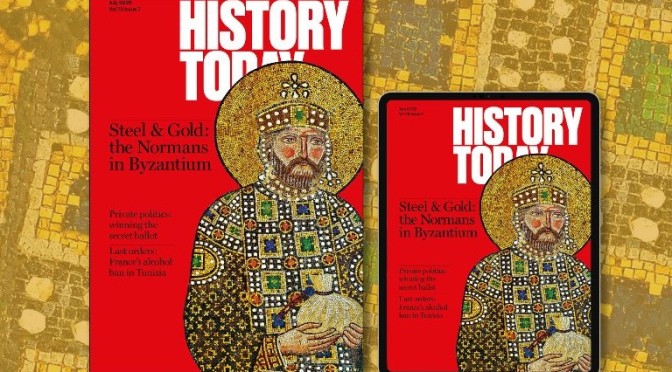
HISTORY TODAY MAGAZINE (SEPTEMBER 2023) – This issue features Lee Kuan Yew’s Singapore story, conquistador Hernán Cortés’ on trial, the fascist plot to kill the king, the fascinating fusion of Old English names, and sharpshooter Marjorie Foster’s battle with the War Office. Plus: reviews, opinion, crossword and much more!
Faced with a jumble of bewildering ruins, modern visitors to Hisarlik in northwest Turkey, the site of ancient Troy, may find themselves perplexed and sometimes disappointed. The wide bay where the Greeks so famously beached 1,000 ships is gone, buried in silt from a local river, while beyond the fine sloping walls, a palimpsest of settlements spanning 4,000 years lies scarred and disfigured by the deep trench gouged by Heinrich Schliemann, its first archaeologist, during two decades of digging in the 19th century. Schliemann had been drawn to Hisarlik, and also to mainland Greece, by his passion for the Homeric poems, the Iliad and Odyssey, and his conviction that they described or reflected real societies and events, not least the decade-long Trojan War.
Balen Shah, the 33-year-old rapper and mayor of Kathmandu, is a man on various missions. Since his unlikely victory in 2022, he has waged war on government ministries, landlords, Nepal’s civil aviation authority, roadside hawkers and landless slum dwellers. Now he is taking on Bollywood because of a supposed historical slight.
FRANCE 24 English Films (August 24, 2023) – The Seine is literally the center of life in Paris, flowing right through the heart of the capital. Considered one of the most romantic rivers in the world, the Seine is overflowing with history and is a great way to discover the city of light.
More recently, officials have given the Seine a facelift, making the banks more accessible and improving the quality of the water. Join Florence Villeminot and Genie Godula for this aquatic episode of French Connections Plus where they dive into the wondrous waters of the river Seine.
Great works of literature are sly and powerful beasts that pounce on their readers, grabbing them by the neck and shaking them back and forth. The young Augustine looks like a typical victim of Vergil’s Aeneid. The schoolboy being brought up as a Christian in fourth-century CE North Africa found the first-century BCE epic poem of pagan Rome the most impressive thing in his cultural life to date. Tellingly, his reaction shows no interest in the poem’s theme of individual sacrifice in the name of imperial destiny; rather, into middle age, the great theologian and founder of institutional Catholic monasticism remembered weeping for Dido, who commits suicide after her lover, Aeneas, abandons her at the end of Book IV.
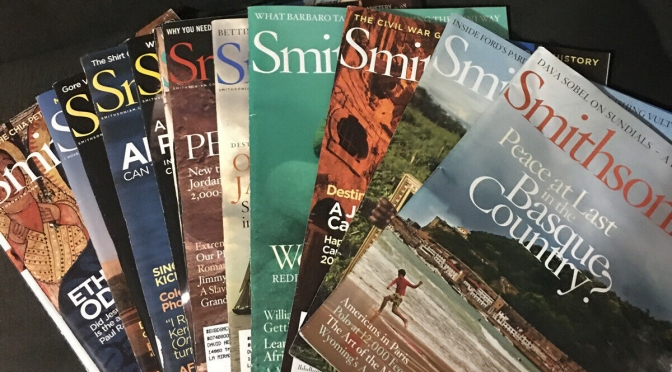
Smithsonian Magazine (September/October Issue) – Journey to Spain’s last Moorish Kingdom – From the magical Alhambra to desert backcountry and hidden coastal glories…welcome to Andalusia; Saving the world’s most coveted Chocolate; Mead – it’s not just for Vikings, and more…
Ötzi, the 5,300-year-old mummy found murdered high in the Alps with an arrow in his back, is a prehistoric celebrity who attracts 300,000 visitors a year to his custom cooling chamber in the South Tyrol Museum of Archaeology in Bolzano, Italy. Years of studies have revealed much about the Iceman, from his last meal—dried ibex and deer meat with einkorn wheat—to the distant Tuscan origins of his copper ax. But while the wizened mummy is extraordinarily well preserved for its age, it gives little impression of how Ötzi would have appeared in life. Now, a detailed genetic study has revealed much more about what the Iceman looked like—and traces the Copper Age corpse’s ancestral lineage back to Anatolia, an area that is now the Asian portion of Turkey.
Scientists have newly sequenced Ötzi’s genome a decade after an earlier effort, using modern techniques and comparative data to produce a much higher-quality result than ever before. The study published Wednesday in Cell Genomics reveals that Ötzi had dark eyes and skin pigmentation darker than that commonly seen among modern inhabitants of Greece or Sicily, though he’s previously been depicted with lighter skin more akin to that of Europeans living in the Alps today. And contrary to most artists’ interpretations, it also appears that he suffered from an age-old affliction still troublesome today—he was going bald.
Architectural Digest (August 17, 2023) – Today Michael Wyetzner of Michielli + Wyetzner Architects joins AD for an in-depth look at how bridges transformed New York City into the thriving metropolis we know today.
Once upon a time, ferries were the only way to travel between New York’s five boroughs but thanks to the construction of major bridges, like the Brooklyn Bridge and George Washington Bridge, the city became connected. Join Michael for a closer look at how five bridges helped shape NYC into the bustling city we know today.
News, Views and Reviews For The Intellectually Curious