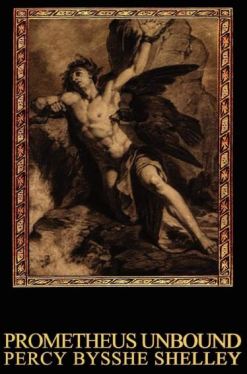
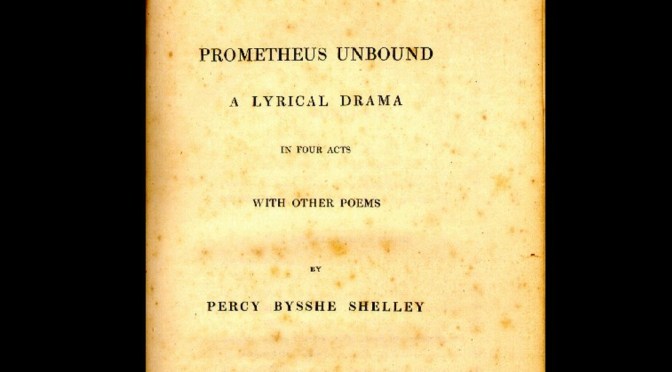
 Prometheus Unbound is a four-act lyrical drama by Percy Bysshe Shelley, first published in 1820. It is concerned with the torments of the Greek mythological figure Prometheus, who defies the gods and gives fire to humanity, for which he is subjected to eternal punishment and suffering at the hands of Zeus. It is inspired by the classical Prometheia, a trilogy of plays attributed to Aeschylus. Shelley’s play concerns Prometheus’ release from captivity, but unlike Aeschylus’ version, there is no reconciliation between Prometheus and Jupiter (Zeus). Instead, Jupiter is abandoned by his supportive elements and falls from power, which allows Prometheus to be released.
Excerpt:
As you speak, your words
Fill, pause by pause, my own forgotten sleep
With shapes. Methought among these lawns together
We wandered, underneath the young gray dawn,
And multitudes of dense white fleecy clouds
Were wandering in thick flocks along the mountains
Shepherded by the slow, unwilling wind;
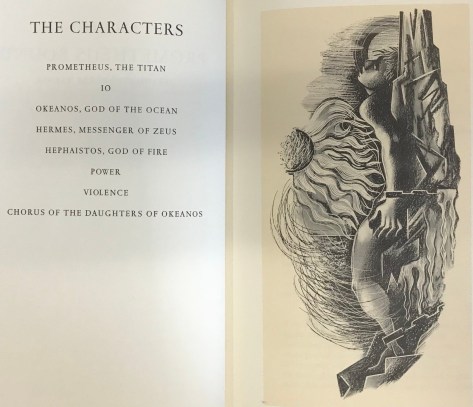
Political – Prometheus, then, is also Shelley’s answer to the mistakes of the French Revolution and its cycle of replacing one tyrant with another. Shelley wished to show how a revolution could be conceived which would avoid doing just that, and in the end of this play, there is no power in charge at all; it is an anarchist’s paradise.
Shelley finishes his “Preface” to the play with an evocation of his intentions as a poet:
My purpose has hitherto been simply to familiarize the highly refined imagination of the more select classes of poetical readers with beautiful idealisms of moral excellence; aware that, until the mind can love, and admire, and trust, and hope, and endure, reasoned principles of moral conduct are seeds cast upon the highway of life which the unconscious passenger tramples into dust, although they would bear the harvest of his happiness.
From Wikipedia

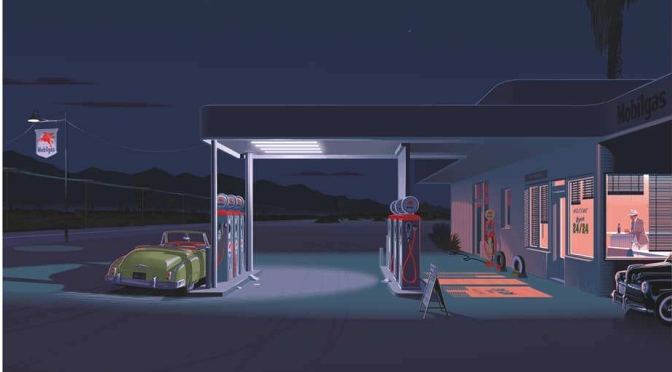
 Laurent Durieux is a famous Belgian illustrator well known to lovers of pop culture and collectors for his reinterpretations of posters of cult films. Each of his American exhibitions was sold out during the opening night and in the presence of thousands of enthusiastic fans.
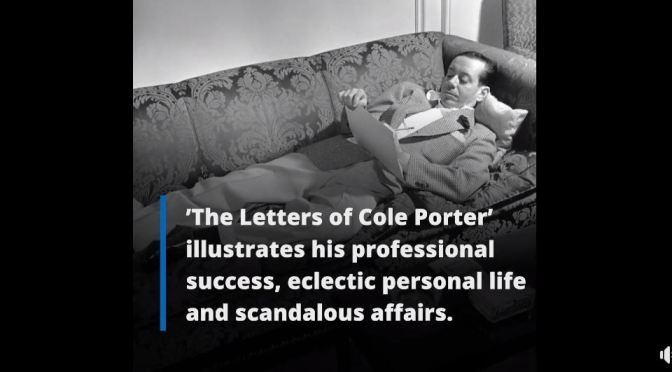
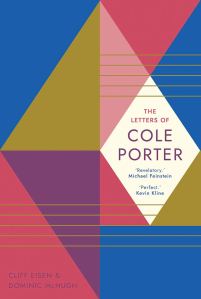 Beneath his smooth, genial, almost inhumanly productive and evasive surface, there were turbulent waters. His very name, for all its air of Ivy League ease, represents a burdened legacy. The Porters were his difficult, scapegrace father’s family; the Coles were his mother’s rich and ambitious Indiana family. He was a Porter by birth but, if his mother had anything to do with it, would be a Cole for life.
 De Beauvoir and Beckett despised each other – and lived essentially on the same street. While quite literally dodging one subject or the other, and sometimes hiding out in the backrooms of the great cafés of Paris, Bair learned that what works in terms of process for one biography rarely applies to the next. Her seven-year relationship with the domineering and difficult de Beauvoir required a radical change in approach, yielding another groundbreaking literary profile.

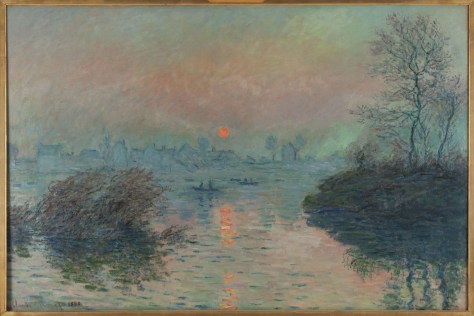
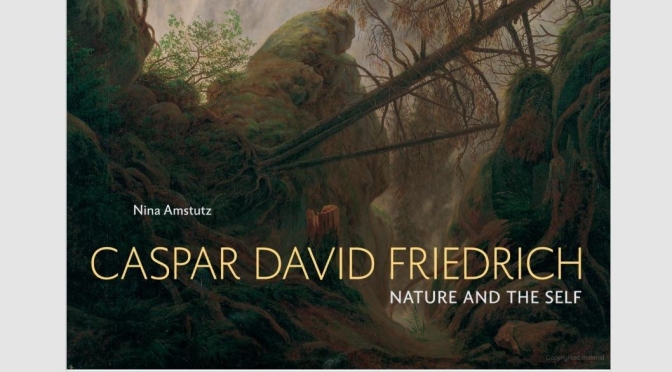
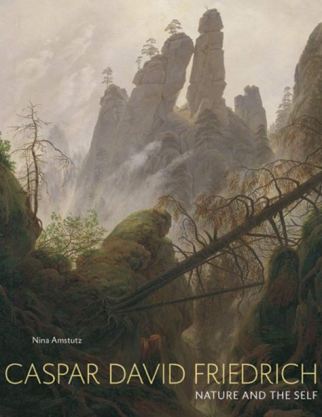 In this revelatory book, Nina Amstutz combines fresh visual analysis with broad interdisciplinary research to investigate the intersection of landscape painting, self-exploration, and the life sciences in Friedrich’s mature work. Drawing connections between the artist’s anthropomorphic landscape forms and contemporary discussions of biology, anatomy, morphology, death, and decomposition, Amstutz brings Friedrich’s work into the larger discourse surrounding art, nature, and life in the 19th century.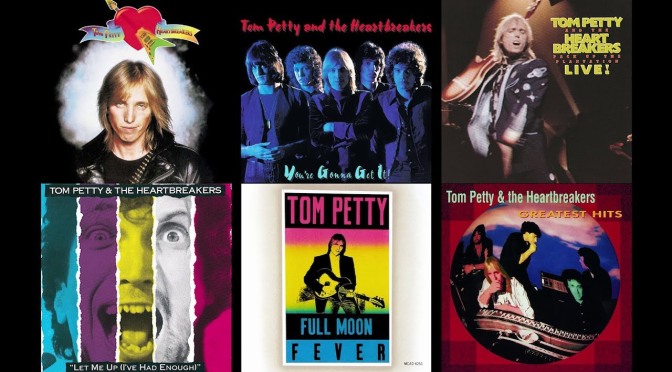
 Author Paul Zollo conducted a series of in-depth discussions with Tom about his career, with special focus on his songwriting. The conversations are reprinted here with little or no editorial comment and represent a unique perspective on Tom’s entire career. Originally published in 2005 (also by Omnibus Press), Tom’s wife Dana has fully approved this updated edition, which retains its foreword by Petty, adds additional interview material, an expanded introduction as well as additional photos from Petty’s last ever live performance. This is, perhaps, as close as you can get to an autobiography by the great man.
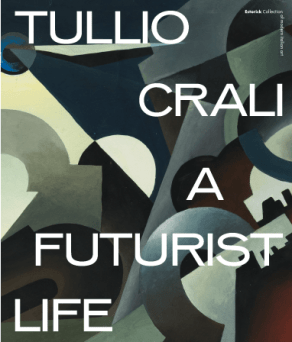 London – For Tullio Crali (1910-2000) Futurism was not just a school of painting, but an attitude to life itself. Reflecting the movement’s enthusiasm for the modern world, his imagery embraced technology and the machine as important sources of creative inspiration. However, with its particular focus on “the immense visual and sensory drama of flight”, Crali’s work is most closely associated with the genre of ‘aeropainting’, which dominated Futurist research during the 1930s.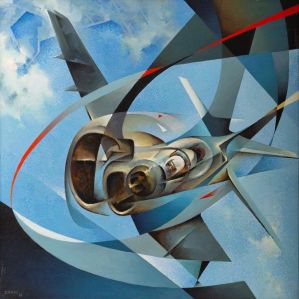
 Boomers Daily