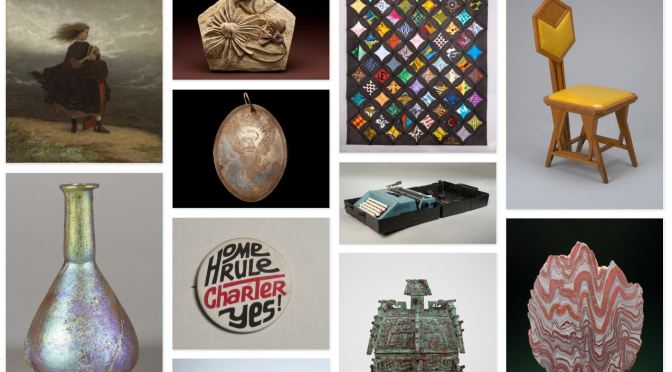
People everywhere can now download, remix and share Smithsonian Open Access content for any purpose, for free, from portraits of historic Americans to 3D scans of dinosaur fossils. What will you create, imagine and discover?

People everywhere can now download, remix and share Smithsonian Open Access content for any purpose, for free, from portraits of historic Americans to 3D scans of dinosaur fossils. What will you create, imagine and discover?
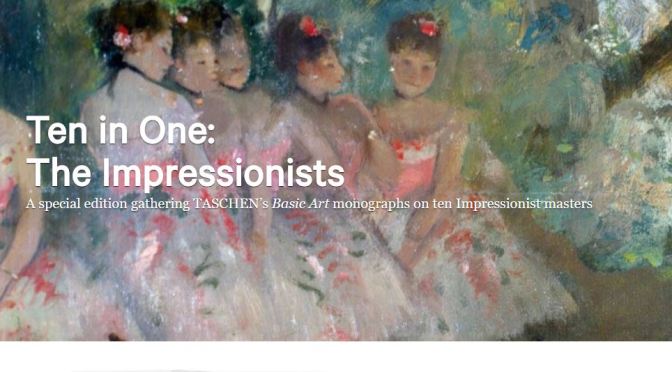
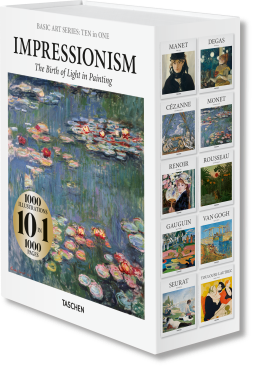 The lives and oeuvres of Impressionist pillars Cézanne, Degas, Gauguin, Manet, Monet, Renoir, Rousseau, Seurat, Toulouse-Lautrec, and van Gogh are each explored in-depth in TASCHEN’s Basic Art series. Now, this volume combines all 10 monographs into one for the price of three.
“These seductive books have slick production values, excellent illustrations, and smart texts. Each one is a fast-food, high-energy fix on the topic at hand.” – The New York Times Book Review
This book gathers ten Basic Art monographs into one volume featuring:
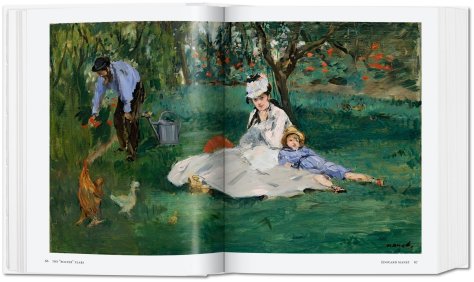
With blockbuster exhibitions, record-breaking auction prices, and packed museums, Impressionism remains close contender for the world’s favorite period of painting. Its favorite subjects— from dappled harbor scenes and summer days to vibrant Parisian salons and gardens—brim with optimism and joie de vivre. The works once dismissed as unfinished or imprecise are now beloved for their atmospheric evocation of time and place, as well as the stylistic flair of rapid brushstrokes upon canvas.
What we take for granted today—the relativity of perception depending on the viewer, lighting mood, or location to the object—was then the inspiration for some of the finest paintings in art history. Consider Monet’s 30+ variations of the Rouen Cathedral, Cézanne’s dazzling experimentation with color, Gauguin’s primitivist innovations, or Manet’s scandalous nudes: rarely has a single genre produced so many brilliant artists in such a short time.
Since 1985, TASCHEN’s Basic Art series has published some 200 individual volumes, making it the world’s most successful art-book series. Each title contains an extensive text on the artist’s life and work, a detailed biography, and some 100 high-quality color illustrations with explanatory captions. With Ten in One, TASCHEN now presents ten Basic Art monographs in one volume. A must for every art lover!
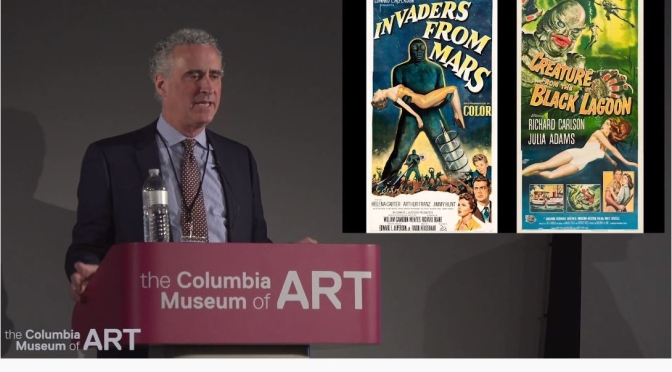
Recorded February 14, 2020 at the Columbia Museum of Art.
Daniel Finamore, curator of It’s Alive! Classic Horror and Sci-Fi Art from the Kirk Hammett Collection talks about the exhibition and where these posters fit into the canon 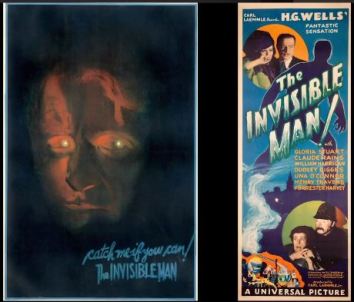 of art history. Finamore is the curator of Maritime Art and History at the Peabody Essex Museum. Best known as lead guitarist of the famed rock band Metallica, Kirk Hammett is also an obsessive collector of visually arresting horror and sci-fi film art and has dedicated the last three decades to creating one of the world’s most important collections.
It’s Alive! features more than 100 pieces of graphic art, many hailing back to the days of Boris Karloff and Bela Lugosi, that have seeped into the public imagination and reflected society’s deepest fears and anxieties for nearly a century. Not only do these objects explore the power of graphic art in its own right, they have inspired Hammett’s work throughout his own artistic career.
Organized by the Peabody Essex Museum, Salem, Massachusetts.

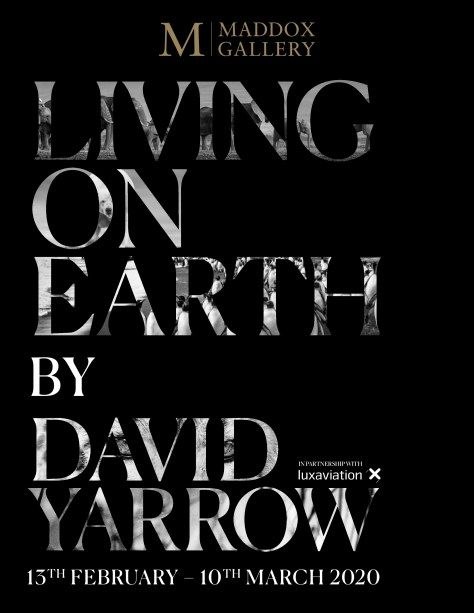
For more than two decades, legendary British photographer David Yarrow has been putting himself in harm’s way to capture immersive photography of the world’s most revered and endangered species.
Featuring a selection of Yarrow’s most iconic photographs, ‘Living On Earth’ highlights the beauty of the endangered planet and the art of narrative as conveyed by one of the most relevant fine art photographers in the world.
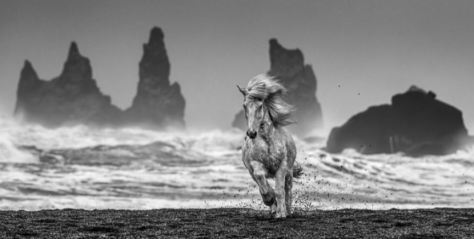
David Yarrow’s commitment to ‘capturing the splendour of what remains wild and free in our world’ allowed him to transcend wildlife photography and become one of the world’s leading fine art photographers. He has travelled pole to pole, to the world’s most remote habitats to allow us a glimpse of the truly untamed. The resulting images are unerringly iconic and connect with us on a primal level; of curiosity, desire, and fear.
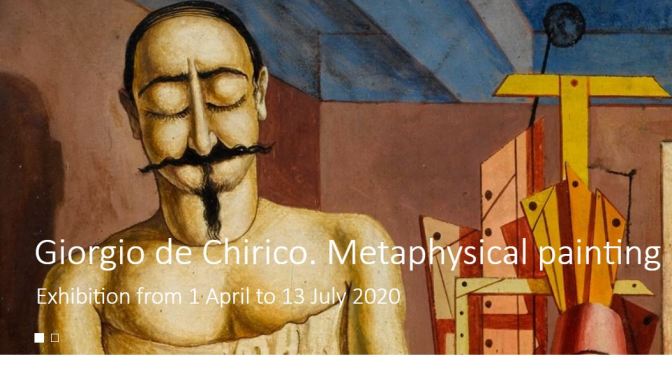
The exhibition Giorgio de Chirico. Metaphysical painting retraces the career and the artistic and philosophic influences of the artist Giorgio de Chirico from Munich to Turin, then to Paris where he discovered the artistic avant-garde of his era, and lastly Ferrare. The connections between the painter – discovered by Apollinaire and 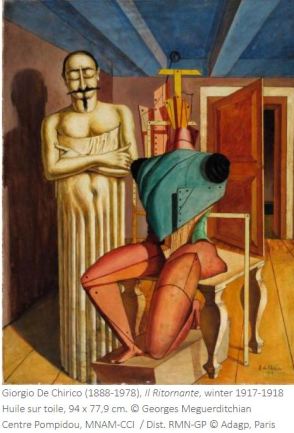 subsequently backed by the art dealer Paul Guillaume – and the Parisian cultural and literary circles will be highlighted as never before.
Born in Greece and trained in the fount of classical culture and late German Romanticism, de Chirico developed the foundations of a new artistic exploration alongside his younger brother Alberto Savinio. A student at the Academy of Fine Arts in Munich as of 1908, he discovered the thinking of Nietzsche and Schopenhauer as well as the works of Böcklin and Klinger. After travelling to Milan then Florence, it was in France, and more specifically Paris, as of autumn 1911, that he established his unique visual vocabulary through contact with the modernist artistic revolutions. He was quickly noticed by numerous artistic celebrities of the time, among whom Guillaume Apollinaire, Maurice Raynal, André Salmon, André Breton, Paul Éluard and Jean Paulhan were the first to take an interest in and promote his work.
 The exhibition thus comes into its own at the Musée de l’Orangerie alongside the figure of Paul Guillaume, the first art dealer to work with Giorgio de Chirico. On his return to Italy in 1915, he and his brother Savinio were sent to Ferrare for military reasons, where he continued his artistic research. This period (June 1915-December 1918) provided an opportunity for painters Carlo Carrà and Giorgio Morandi to get to know the two brothers, thus resulting in the creation of what was later to be known as the “metaphysical movement” which brings the exhibition to a close.
Exhibition organised by the Musée d’Orsay and the Musée de l’Orangerie, Paris and the Hamburger Kunsthalle, Hamburg
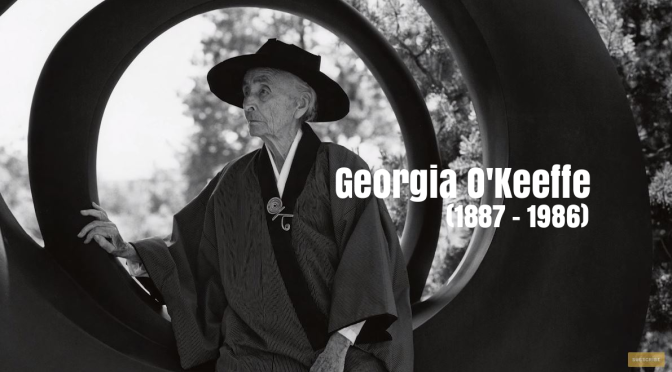
 In the final years of Georgia O’Keeffe’s nearly century-long life, she employed and befriended the young sculptor Juan Hamilton. The two would become inseparable, and upon her death in 1986, Hamilton inherited fine art and personal affects from the artist’s estate, including rarely seen pieces from the estate of O’Keeffe’s late husband, Joseph Stieglitz.
This March, Sotheby’s is honored to present these works in Alfred Stieglitz, Georgia O’Keeffe, Juan Hamilton: Passage, a dedicated auction in New York on 5 March 2020. In this episode of Expert Voices, Head of American Art Kayla Carlsen explores the stories behind this remarkable collection while highlighting exceptional works, including O’Keeffe’s Nature Forms – Gaspé, Stieglitz’s Hand and Wheel and Hamilton’s Untitled (Red Form).
(New York | 5 March 2020)
The British Museum has been collecting artworks made by Japanese Living National Treasures since 2007, but what is a Living National treasure and why are they so important to Japanese Cultural Heritage? In this film Nicole Rousmaniere, research director of SISJAC and Hayashida Hiyaki of the Japan Kōgei Association talk all about the Living National treasures programme and highlight some of the most beautiful pieces of Japanese craftsmanship collected by the Museum.
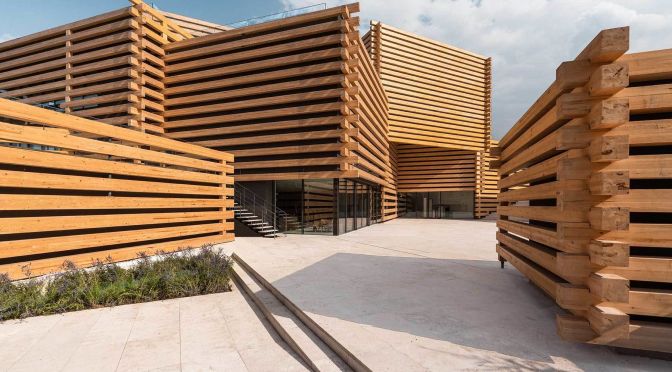
 We visit a Kengo Kuma-designed art museum in Eskisehir that’s set to become Turkey’s new cultural hotspot.
Odunpazarı Modern Museum is designed by the internationally acclaimed Japanese architecture firm Kengo Kuma and Associates.
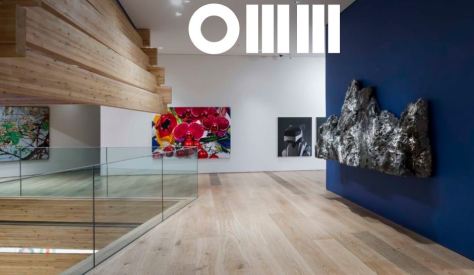
Kengo Kuma and Associates describes its philosophy as “Amalgamating nature and architecture in a manner that creates a strong bond between the ‘building’ and its ‘location’.” In his design of the OMM building, the architect thus reinterprets the historic fabric of the Odunpazarı district with a contemporary perspective. Paying homage to the local architecture of Odunpazarı, Ottoman dome architecture, and traditional Japanese architecture, OMM’s design is highlighted by four major components: geometry, light, stacking, and timber. Breaking away from conventional design through the transformation of simple geometric lines into complex images, the high-quality light entering the building, and the non-linear forms, the architectural stacking and the timber construction system alluding to the historic fabric of Odunpazarı constitute the sources of inspiration for the architecture of the museum building.
OMM – Odunpazarı Modern Art Foundation was founded in 2019 with the aim of contributing towards the development of cultural, social, and artistic life through events and activities centered on the familiarization and popularization of culture and arts in society, the advancement of art education, the support for artistic and cultural production, and the transmission of cultural values to future generations. OMM – Odunpazarı Modern Museum operates under the auspices of this foundation.
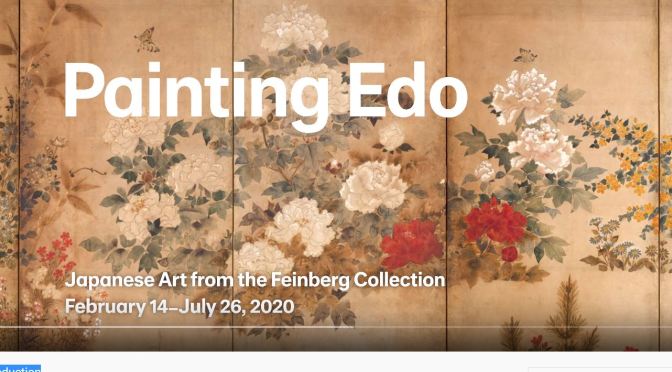
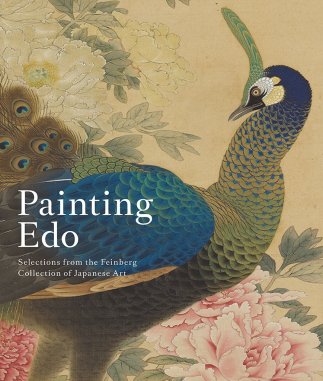 Painting Edo — the largest exhibition ever presented at the Harvard Art Museums — offers a window onto the supremely rich visual culture of Japan’s early modern era. Selected from the unparalleled collection of Robert S. and Betsy G. Feinberg, the more than 120 works in the exhibition connect visitors with a seminal moment in the history of Japan, as the country settled into an era of peace under the warrior government of the shoguns and opened its doors to greater engagement with the outside world. The dizzying array of artistic lineages and studios active during the Edo period (1615–1868) fueled an immense expansion of Japanese pictorial culture that reverberated not only at home, but subsequently in the history of painting in the West.
By the early 18th century, the new shogunal capital of Edo (present-day Tokyo) was the largest city in the world. After centuries of conflict and unrest, the growing stability and affluence of the period encouraged an efflorescence in the arts. Artists creatively juxtaposed past and present, eternal and contingent, elegant and vulgar in a wide range of formats and styles, from brilliant polychrome compositions to monochromatic inkwork. Painting Edo explores how the period, and the city, articulated itself by showcasing paintings in all the major formats—including hanging scrolls, folding screens, sliding doors, fan paintings, and woodblock-printed books—from virtually every stylistic lineage of the era, to tell a comprehensive story of Edo painting on its own terms.
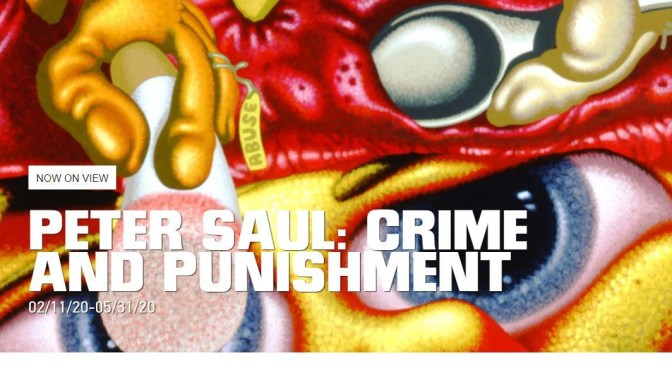
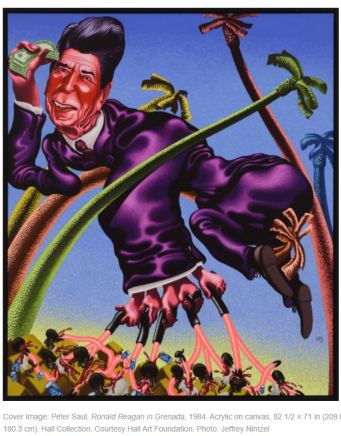 Beginning in the early 1960s, Peter Saul began to incorporate imagery borrowed from a range of pop-cultural sources into his exuberant, brightly colored paintings, adopting a style that has proven to be far ahead of its time. His work developed independently from concurrent art historical movements like Pop art, with which it shares some superficially similar concerns. Instead of the cool detachment of Andy Warhol and Roy Lichtenstein, however, Saul crafted his own unique blend of Surrealism, history painting, vernacular illustration, and the real-life shock and horror of current events.
Marking the artist’s first New York museum survey, this exhibition will bring together approximately sixty paintings from across his long career.
Saul’s earliest paintings, which he created in Paris, demonstrate a loose, gestural style of abstraction, yet he began to incorporate text, recognizable characters, and consumer products into his works as early as 1960. Around this time, he plucked figures like Donald Duck and Superman from the pages of comic books and deposited them into chaotic scenes representative of the avarice and violence of America. In the late 1960s and early 1970s, Saul created some of his most shocking and indelible works in response to the Vietnam War, with a series that captured the conflict’s grotesque brutality, racism, and destruction. A later group of paintings, which examines the chaotic sociopolitical fabric of urban life in California, reflects the dissolution of 1960s counterculture and the corruption, racism, and greed of US politics.
Saul extended his interrogation of American history in his portraits of infamous criminals like John Wayne Gacy, archetypes like cowboys and businessmen, and US presidents such as Ronald Reagan, George W. Bush, and Donald Trump, whom Saul depicts with disdain and condemnation. He has also looked further back to reimagine supposedly triumphant scenes from America’s past—including Columbus’s arrival in America, Washington crossing the Delaware, and Custer’s Last Stand—as moments of comical failure or disgrace. With a caustic sense of humor, Saul has continuously skewered America’s leaders, rendering their stretched, distorted bodies in Day-Glo colors. His disparate influences range from MAD magazine comics to Surrealist fantasies and American social realist painting from the 1930s.
Peter Saul is an American painter. His work has connections with Pop Art, Surrealism, and Expressionism. His early use of pop culture cartoon references in the late 1950s and very early 1960s situates him as one of the fathers of the Pop Art movement. He realised about 800 paintings during his career.


 Boomers Daily