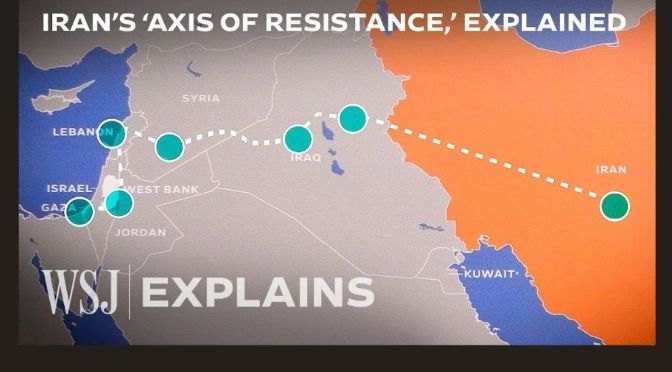
The Wall Street Journal (January 5, 2024) – Iran-backed groups connect to form a land bridge across the Middle East and form an alliance that Tehran calls the ‘Axis of Resistance.’ This land bridge can be used to transport equipment and personnel, but also allows for positions in Iraq and Syria to attack U.S. interests or threaten Israel closer to its borders.
Video timeline: 0:00 ‘Axis of Resistance’ 0:37 Iran’s allies 1:44 Iran’s history 3:22 U.S. in the Middle East 4:14 Attacks since Oct. 7
WSJ explains what to know about the alliance that includes Hamas in Gaza, Hezbollah in Lebanon and the Houthis in Yemen.
The Economist (December 28, 2023) – What are the stories set to shape 2024? From the biggest election year in history, to how to control AI and even taxis that fly, The Economist offers its annual look at the world ahead.
Video timeline: 00:00 – The World Ahead 2024 00:33 – Vital votes 03:34 – Taxis take off 07:10 – AI rules 10:19 – Industry cleans up? 13:48 – BRICS build
Brightline, a private company that completed the final phase of the intercity rail line connecting Miami and Orlando, Fla., this year, secured the U.S. Department of Transportation grant as part of the historic infrastructure package, Nevada’s U.S. senators said. The rest of the funds for the $12-billion project are expected to be raised through private capital and bonds.
The trip on the 218-mile electrified line from Rancho Cucamonga to Las Vegas will take just over two hours, with stops in Hesperia or Apple Valley, according to Brightline. The trains can reach speeds of 200 miles per hour. The company already has the federal permits, the labor agreements and the land — a swath in the wide median of Interstate 15 — to build the line. Construction is expected to begin early next year.
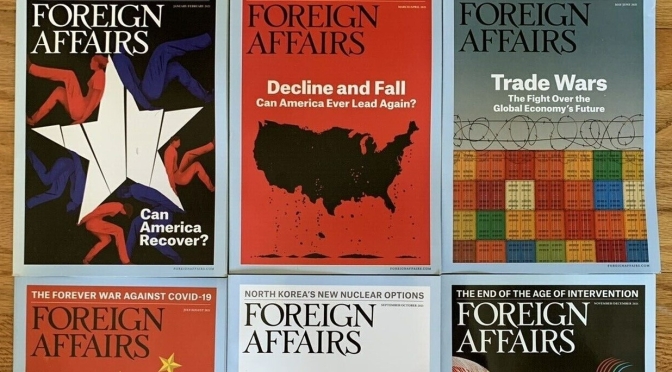
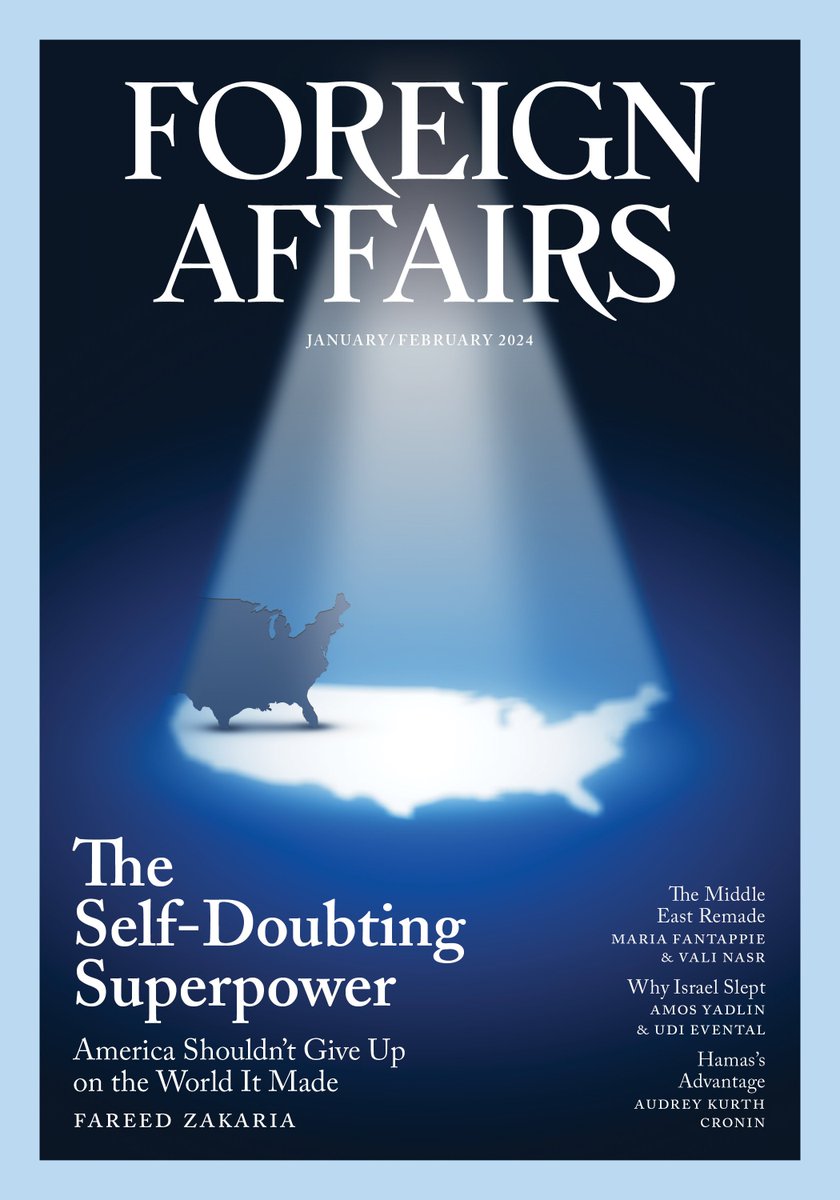
Foreign Affairs (December 13, 2023): The new January/February 2024 issue features ‘The Self-Doubting Superpower’ – America shouldn’t give up on the World It Made; The Middle East Remade; Why Israel Slept; Hamas’s Advantage, and more….
Most Americans think their country is in decline. In 2018, when the Pew Research Center asked Americans how they felt their country would perform in 2050, 54 percent of respondents agreed that the U.S. economy would be weaker. An even larger number, 60 percent, agreed that the United States would be less important in the world. This should not be surprising; the political atmosphere has been pervaded for some time by a sense that the country is headed in the wrong direction. According to a long-running Gallup poll, the share of Americans who are “satisfied” with the way things are going has not crossed 50 percent in 20 years. It currently stands at 20 percent.
In a barbaric surprise attack launched by Hamas on October 7, more Jews were slaughtered than on any day since the Holocaust. Thousands of elite Hamas militants from the Gaza Strip infiltrated small communities and cities in southern Israel, where they proceeded to commit sadistic, repulsive crimes against humanity, filming their vile deeds and boasting about them to friends and family back home.
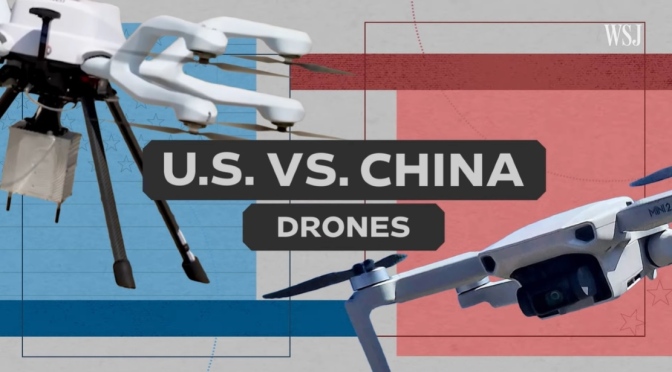
Wall Street Journal (December 6, 2023) – To help counter China, the U.S. military is racing to develop a fleet of next-generation drones. For the Pentagon, it’s not just a matter of gaining the technological edge.
Video timeline: 0:00 Autonomous systems 0:40 The need for next-generation drones 1:49 Scaling up 4:07 Keeping up with China
It’s a race against the clock, as Beijing has militarized islands in the South China Sea, and President Xi Jinping has ordered his military to be ready to invade Taiwan by 2027. Some experts are skeptical the U.S. military can work fast enough to meet its goals.
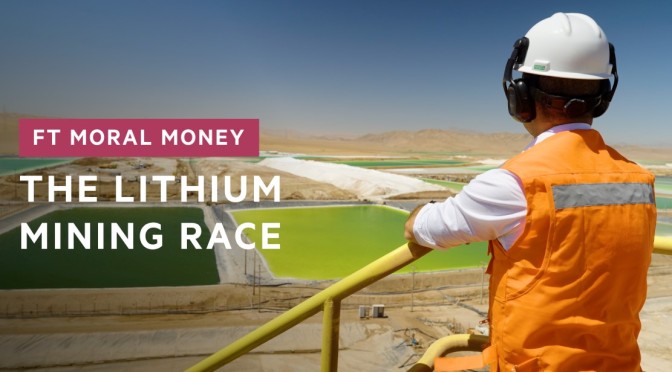
Financial Times (November 19, 2023) – Lithium is the ‘new oil’ of the clean energy era, crucial to the production of batteries for electric vehicles. The FT investigates this booming industry – and the controversies surrounding it – on a journey from Chile to Norway and the UK.
Video timeline: 00:00 Lithium and the energy transition 01:13 Global lithium reserves 01:33 The process 03:03 The communities 04:05 Water reserves 05:29 The investors 07:40 Lithium supply and China 08:41 The policymakers 09:35 Cornish mining revival 12:16 The markets 15:28 Chile’s lithium policy 18:02 Direct lithium extraction 19:54 The indigenous perspective 22:58 Recycling batteries 25:30 The future
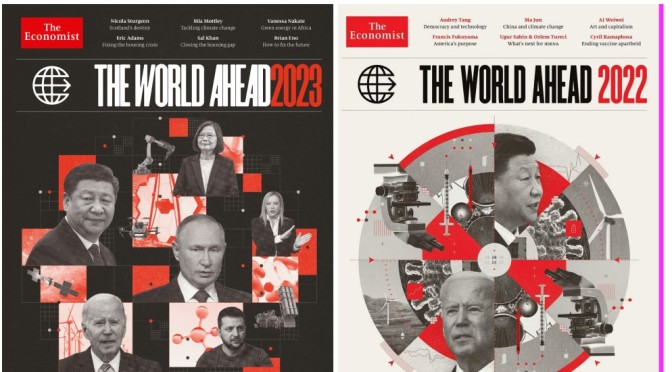
The Economist The World Ahead 2024 (November 14, 2023) – Future-gazing analysis, predictions and speculation including Ten trends to watch in 2024; 2024 will be stressful for those who care about liberal democracy; America will need a new vocabulary to discuss its presidential election; Europe needs to step up support for Ukraine; Don’t give up on peace in the Middle East, and more…
Life comes at you fast. Whether it’s the upsurge in armed conflict, the redrawing of the global energy-resources map or rapid progress in artificial intelligence (ai), the world is changing at mind-boggling speed. From the situation in the Middle East to the adoption of electric vehicles to the treatment of obesity, things look very different from the way they did just a year or two ago. Our aim is to help you keep your worldview up to date—and tell you what might be coming next. To kick things off, here are ten themes to watch in the coming year.
In theory it should be a triumphant year for democracy. In practice it will be the opposite
By Zanny Minton Beddoes
More than half the people on the planet live in countries that will hold nationwide elections in 2024, the first time this milestone has been reached. Based on recent patterns of voter turnout, close to 2bn people in more than 70 countries will head to the polls. Ballots will be cast from Britain to Bangladesh, from India to Indonesia. Yet what sounds like it should be a triumphant year for democracy will be the opposite.
The fragility of the Western coalition is a crucial weakness
By Patrick Foulis
As 2023 drew to a close, wars were raging in Africa, Israel and Gaza, and Ukraine. These crises are explosive in their own right. Combine them with a presidential race in America and 2024 promises to be a make-or-break year for the post-1945 world order.
The 2020s were destined to be dangerous. The West’s share of world gdp has fallen towards 50% for the first time since the 19th century. Countries such as India and Turkey believe the global institutions created after 1945 do not reflect their concerns. China and Russia want to go further and subvert this system.
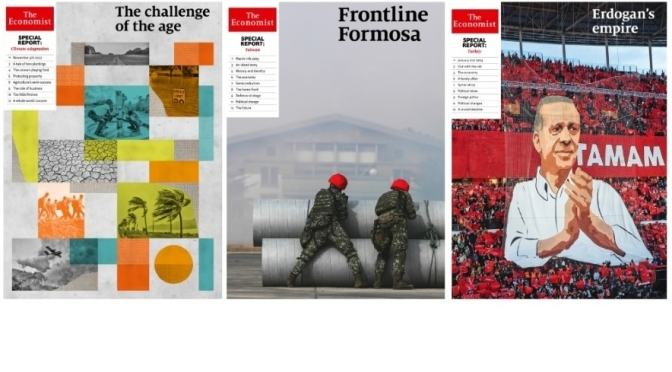
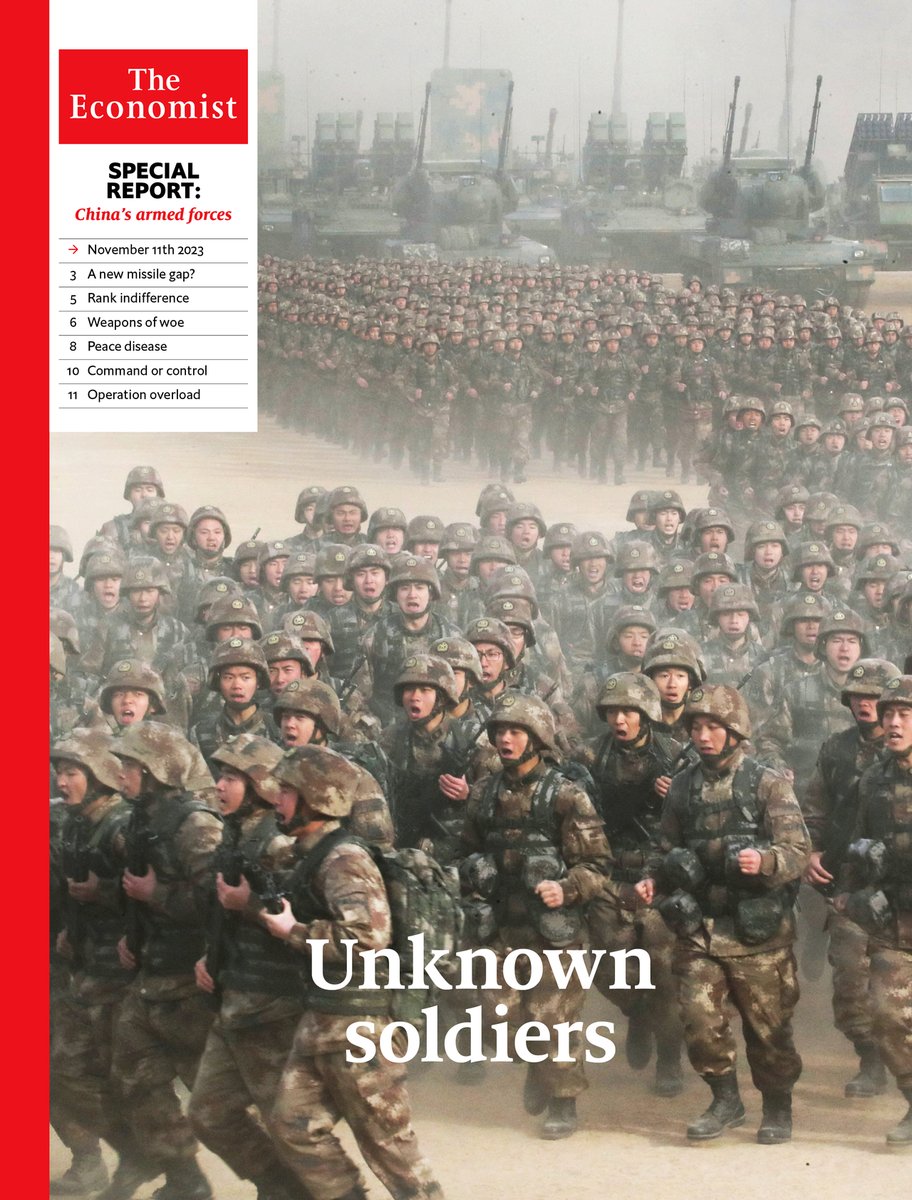
The Economist SPECIAL REPORTS – CHINA’S ARMED FORCES (NOVEMBER 11, 2023): Overestimating China’s armed forces would be dangerous; Unknown soldiers – The People’s Liberation Army is not yet as formidable as the West fears; Rank indifference – China is struggling to recruit enough highly skilled troops; Weapons of woe – From hypersonic missiles to undersea drones, the PLA is making leaps…
Overestimating China’s armed forces would be dangerous, argues Jeremy Page
In 1957 america was gripped by fears of a “missile gap” with the Soviet Union. The Kremlin had stunned the world with a test flight of an intercontinental ballistic missile (icbm) and the launch of Sputnik. An American intelligence report predicted that by 1962, the Soviets could have 500 icbms, outstripping America’s arsenal. When word of that leaked, a political furore erupted. Eyeing the presidency from his Senate seat, John F. Kennedy demanded action to prevent a Soviet “shortcut to world domination”.
The Economist (October 27, 2023) – Hizbullah has been shooting rockets across the Israel-Lebanon border. If it intervenes in the Israel-Hamas conflict, it could lead to serious escalation.
Video timeline:00:00 – The origins of Hizbullah 01:06 – Its political rise 02:00 – How big a threat is it?
News, Views and Reviews For The Intellectually Curious

















 Boomers Daily