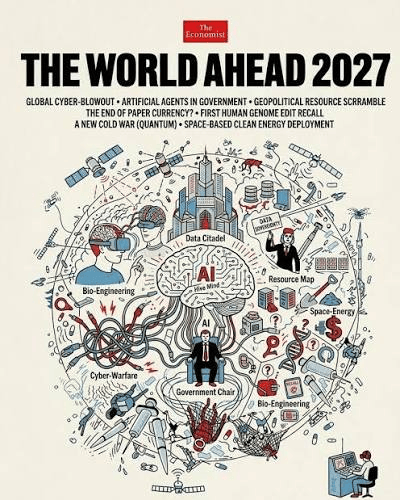
Focus centers on the next paradigm of technology, such as advanced AI chips, robotics, and the economic infrastructure behind massive AI model rollouts.
Geopolitics & Social Unrest
Major themes include global security, currency volatility (across the Dollar, Euro, and Yen), public health resilience, and shifting spheres of influence—particularly between the U.S. and China.
Climate & Energy Dynamics
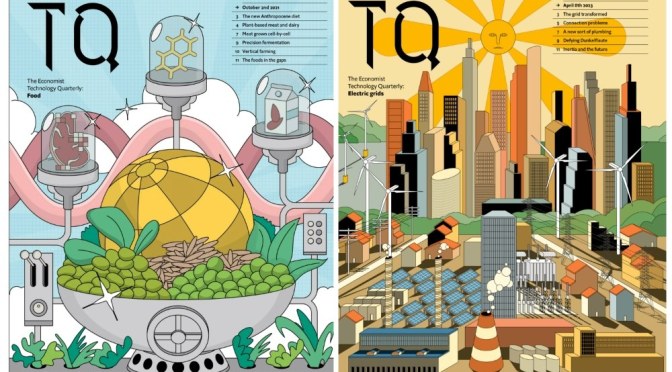
Predictive coverage features regional climate shifts, extreme weather management (like wildfires), and a massive transition toward renewable energy infrastructure, such as Europe’s expanding solar-battery hybrid grids.
Global Milestones
The year will also track major demographic shifts, including the second phase of India’s first national census since 2011.
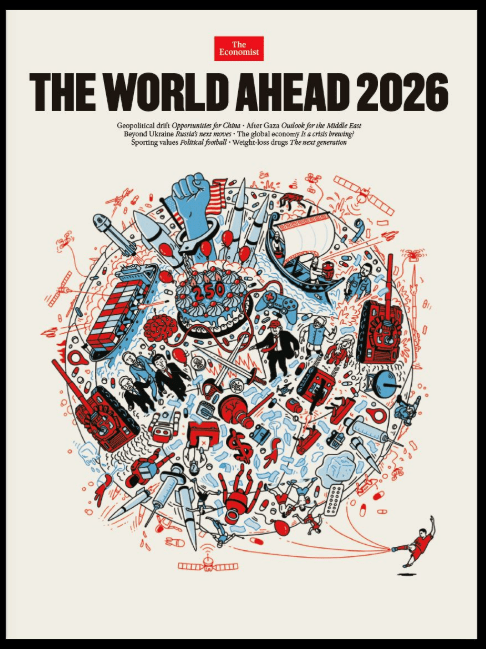
This is Donald Trump’s world—we’re all just living in it. The disruptor-in-chief was the biggest factor shaping global affairs in 2025, and that will be the case for as long as he remains in the White House. His norm-shattering approach has caused turmoil in some areas (as in trade) but has also delivered diplomatic results (as in Gaza) and forced necessary change (as with European defence spending). As the Trumpnado spins on in 2026, here are ten trends and themes to watch in the coming year.
Expect to hear wildly diverging accounts of America’s past, present and future, as Republicans and Democrats describe the same country in irreconcilably different terms to mark the 250th anniversary of its founding. Voters will then give their verdict on America’s future in the midterm elections in November. But even if the Democrats take the House, Mr Trump’s rule by bullying, tariffs and executive orders will go on.
Foreign-policy analysts are divided: is the world in a new cold war, between blocs led by America and China, or will a Trumpian deal divide the planet into American, Russian and Chinese “spheres of influence”, in which each can do as they please? Don’t count on either. Mr Trump prefers a transactional approach based on instinct, not grand geopolitical paradigms. The old global rules-based order will drift and decay further. But “coalitions of the willing” will strike new deals in areas such as defence, trade and climate.
With luck, the fragile peace in Gaza will hold. But conflicts will grind on in Ukraine, Sudan and Myanmar. Russia and China will test America’s commitment to its allies with “grey-zone” provocations in northern Europe and the South China Sea. As the line between war and peace becomes ever more blurred, tensions will rise in the Arctic, in orbit, on the sea floor and in cyberspace.
All this poses a particular test for Europe. It must increase defence spending, keep America on side, boost economic growth and deal with huge deficits, even though austerity risks stoking support for hard-right parties. It also wants to remain a leading advocate for free trade and greenery. It cannot do all of these at once. A splurge on defence spending may lift growth, but only slightly.
China has its own problems, with deflation, slowing growth and an industrial glut, but Mr Trump’s “America First” policy opens up new opportunities for China to boost its global influence. It will present itself as a more reliable partner, particularly in the global south, where it is striking a string of trade agreements. It is happy to do tactical deals with Mr Trump on soyabeans or chips. The trick will be to keep relations with America transactional, not confrontational.With rich countries living beyond their means, the risk of a bond-market crisis is growing
So far America’s economy is proving more resilient than many expected to Mr Trump’s tariffs, but they will dampen global growth. And with rich countries living beyond their means, the risk of a bond-market crisis is growing. Much will depend on the replacement of Jerome Powell as chair of the Federal Reserve in May; politicising the Fed could trigger a market showdown.
Rampant spending on infrastructure for artificial intelligence may also be concealing economic weakness in America. Will the bubble burst? As with railways, electricity and the internet, a crash would not mean that the technology does not have real value. But it could have wide economic impact. Either way, concern about AI’s impact on jobs, particularly those of graduates, will deepen.
Limiting warming to 1.5°C is off the table, and Mr Trump hates renewables. But global emissions have probably peaked, clean tech is booming across the global south and firms will meet or exceed their climate targets—but will keep quiet about it to avoid Mr Trump’s ire. Geothermal energy is worth watching.
Sport can always be relied upon to provide a break from politics, right? Well, maybe not in 2026. The football World Cup is being jointly hosted by America, Canada and Mexico, whose relations are strained. Fans may stay away. But the Enhanced Games, in Las Vegas, may be even more controversial: athletes can use performance-enhancing drugs. Is it cheating—or just different?
Better, cheaper GLP-1 weight-loss drugs are coming, and in pill form, too. That will expand access. But is taking them cheating? GLP-1s extend the debate about the ethics of performance-enhancing drugs to a far wider group than athletes or bodybuilders. Few people compete in the Olympics. But anyone can take part in the Ozempic games.
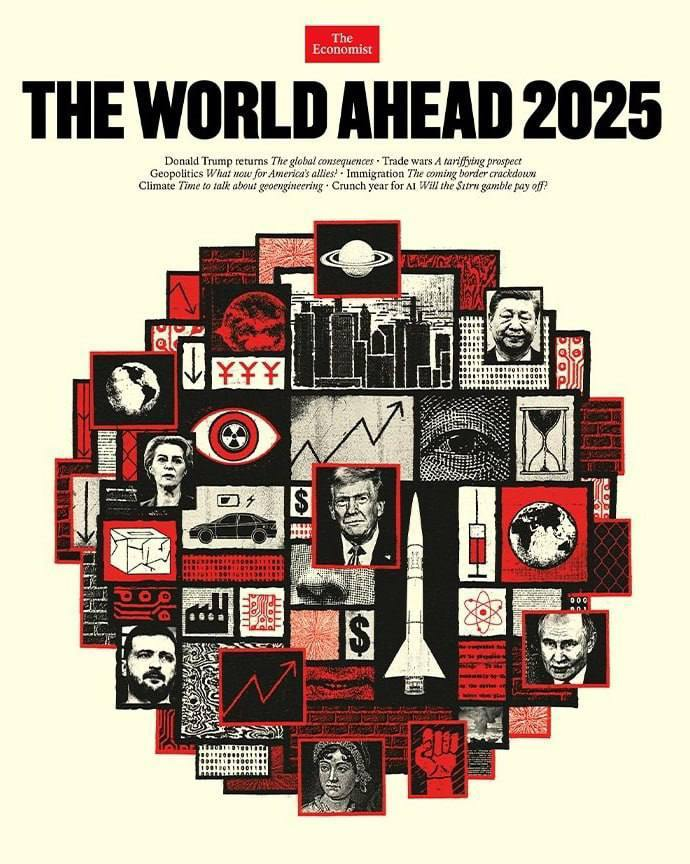
The Economist The World Ahead 2025 (November 20, 2024) : In 2025, as seen on the cover, the main event is Trump’s return to the White House and the global consequences of his policies, such as a new wave of trade wars with China. There is also an expected rise in technologies such as artificial intelligence and autonomous vehicles.
Watch the interplay between Donald Trump, technology and radical uncertainty
The cover mentions climate issues and hints at a new phase in the fight for social equality, especially among women. Last year, the cover predicted geopolitical instability, an economic crisis, climate disasters, and the g
And so has the world in which they are used, says Shashank Joshi
Afew years ago intelligence analysts observed that internet-connected cctv cameras in Taiwan and South Korea were inexplicably talking to vital parts of the Indian power grid. The strange connection turned out to be a deliberately circuitous route by which Chinese spies were communicating with malware they had previously buried deep inside crucial parts of the Indian grid (presumably to enable future sabotage). The analysts spotted it because they were scanning the internet to look for “command and control” (c2) nodes—such as cameras—that hackers use as stepping stones to their victims.
The American-led financial order is giving way to a more divided one
Ten years ago your correspondent was fidgeting nervously in a meeting room at vtb Capital, the investment-banking arm of Russia’s second-biggest bank, just across the road from the Bank of England. During the recruitment process for a graduate job, things had taken a worrying turn. A Russian missile had shot down mh17, a passenger flight from Amsterdam to Kuala Lumpur, while it was passing over Ukraine. Plenty of Russian firms were already under Western sanctions owing to the annexation of Crimea earlier that year. Now sanctions were being ramped up, and vtb Capital’s parent bank was a prime target. Hence the fidgeting: how to ask the slightly alarming man across the table whether there would even be a vtb in a few months’ time?
With the right changes, it can continue as an engine of global growth, say Arjun Ramani and Thomas Easton
The consecration of the Ram temple in Ayodhya, a city in Uttar Pradesh, in January was a matter of supreme importance to Narendra Modi, India’s prime minister; attendance was thus de rigueur for those seeking his approval. The attendant courtiers included not just politicians, officials and foreign dignitaries but also India’s biggest corporate bosses. Uttar Pradesh is not their normal stamping ground, and Ayodhya has not until recently been much of a destination for tycoons. Now it has 115 hotels under construction, and some of those January visitors may soon be finding reasons to return.





 Boomers Daily