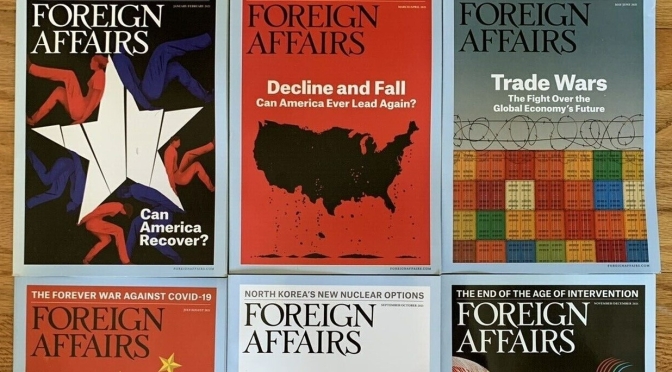


The Perils of Isolationism
The World Still Needs America—and America Still Needs the World by Condoleezza Rice
America Isn’t Ready for the Wars of the Future
And They’re Already Here by Mark A. Milley and Eric Schmidt

The World Still Needs America—and America Still Needs the World by Condoleezza Rice
And They’re Already Here by Mark A. Milley and Eric Schmidt


Schools in rich countries are making poor progress. They need to get back to basics, argues Mark Johnson
Hanging on to the best of them is getting harder


And so has the world in which they are used, says Shashank Joshi
Afew years ago intelligence analysts observed that internet-connected cctv cameras in Taiwan and South Korea were inexplicably talking to vital parts of the Indian power grid. The strange connection turned out to be a deliberately circuitous route by which Chinese spies were communicating with malware they had previously buried deep inside crucial parts of the Indian grid (presumably to enable future sabotage). The analysts spotted it because they were scanning the internet to look for “command and control” (c2) nodes—such as cameras—that hackers use as stepping stones to their victims.

Biden and the Search for a New American Strategy
“America is back.” In the early days of his presidency, Joe Biden repeated those words as a starting point for his foreign policy. The phrase offered a bumper-sticker slogan to pivot away from Donald Trump’s chaotic leadership. It also suggested that the United States could reclaim its self-conception as a virtuous hegemon, that it could make the rules-based international order great again. Yet even though a return to competent normalcy was in order, the Biden administration’s mindset of restoration has occasionally struggled against the currents of our disordered times. An updated conception of U.S. leadership—one tailored
Making the Case for Trump’s Foreign Policy
Si vis pacem, para bellum is a Latin phrase that emerged in the fourth century that means “If you want peace, prepare for war.” The concept’s origin dates back even further, to the second-century Roman emperor Hadrian, to whom is attributed the axiom, “Peace through strength—or, failing that, peace through threat.”
And China Is Reaping the Benefits


The American-led financial order is giving way to a more divided one
Ten years ago your correspondent was fidgeting nervously in a meeting room at vtb Capital, the investment-banking arm of Russia’s second-biggest bank, just across the road from the Bank of England. During the recruitment process for a graduate job, things had taken a worrying turn. A Russian missile had shot down mh17, a passenger flight from Amsterdam to Kuala Lumpur, while it was passing over Ukraine. Plenty of Russian firms were already under Western sanctions owing to the annexation of Crimea earlier that year. Now sanctions were being ramped up, and vtb Capital’s parent bank was a prime target. Hence the fidgeting: how to ask the slightly alarming man across the table whether there would even be a vtb in a few months’ time?

And What America Should Learn From It
By now, Chinese President Xi Jinping’s ambition to remake the world is undeniable. He wants to dissolve Washington’s network of alliances and purge what he dismisses as “Western” values from international bodies. He wants to knock the U.S. dollar off its pedestal and eliminate Washington’s chokehold over critical technology. In his new multipolar order, global institutions and norms will be underpinned by Chinese notions of common security and economic development, Chinese values of state-determined political rights, and Chinese technology. China will no longer have to fight for leadership. Its centrality will be guaranteed.
America’s Competition With China Must Be Won, Not Managed


With the right changes, it can continue as an engine of global growth, say Arjun Ramani and Thomas Easton
The consecration of the Ram temple in Ayodhya, a city in Uttar Pradesh, in January was a matter of supreme importance to Narendra Modi, India’s prime minister; attendance was thus de rigueur for those seeking his approval. The attendant courtiers included not just politicians, officials and foreign dignitaries but also India’s biggest corporate bosses. Uttar Pradesh is not their normal stamping ground, and Ayodhya has not until recently been much of a destination for tycoons. Now it has 115 hotels under construction, and some of those January visitors may soon be finding reasons to return.

AIs will make health care safer and better, reports Natasha Loder. It may even get cheaper too
‘Editor’s Picks’ Podcast (March 25, 2024): A selection of three essential articles read aloud from the latest issue of The Economist. This week, as the death toll climbs in Israel’s war on Gaza, we argue that the country looks deeply vulnerable. Plus, we consider Britain as an unexpected beacon of immigration. And finally, as Elon Musk’s Starship reaches space, we examine SpaceX’s approach to rocket development.


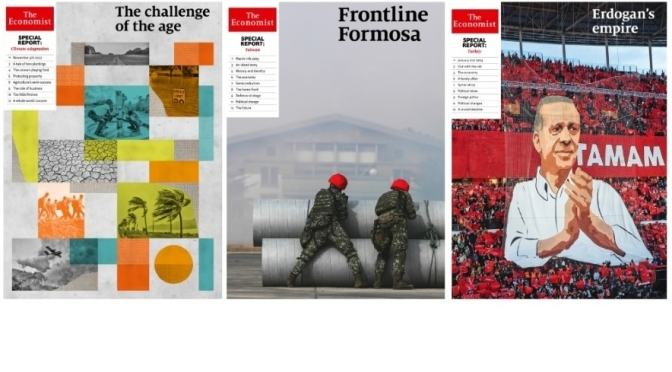
Fly west across the United Arab Emirates from Fujairah, a tanker-filled port on the Gulf of Oman, towards the Persian Gulf and you get a sense of the vulnerability arid lands have to climate change. The farms around Dhaid provide a splash of green, but homegrown food is scarce, homegrown staples next to non-existent. Drinkable water comes mostly from desalination plants. The heat is growing inhumane; outside work is banned during the hottest hours of summer afternoons.
 Boomers Daily