
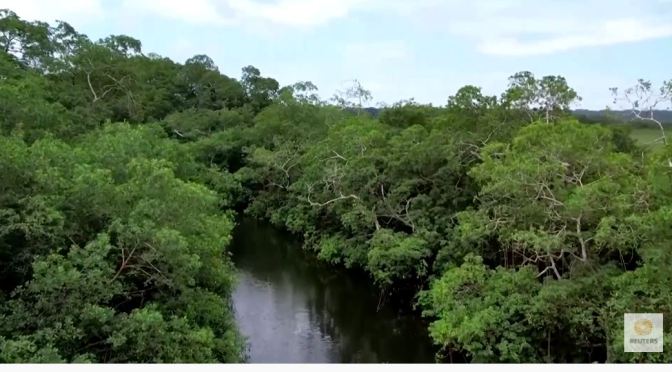
The towering trees in Gabon’s mangrove swamps have helped to make the Central African country one of the world’s few net absorbers of carbon. However, many are under threat from urbanization, with former swamps being illegally cleared for construction.
All posts by She Seeks Serene
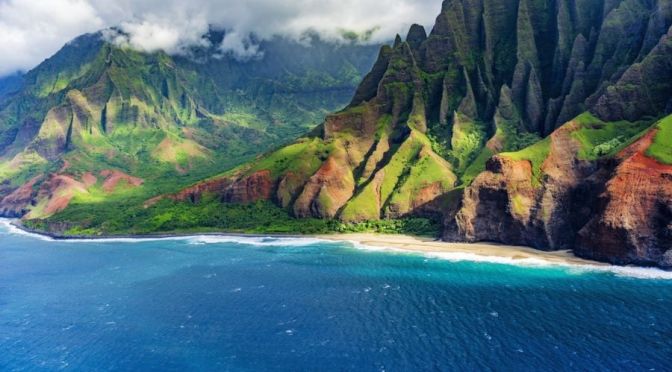
8K Views: Hawaiian Islands Coastlines & Landscapes
The Hawaiian Islands are an archipelago of eight major islands, several atolls, numerous smaller islets, and seamounts in the North Pacific Ocean, extending some 1,500 miles from the island of Hawaiʻi in the south to northernmost Kure Atoll.
Chapters: 00:00–00:05 Intro 00:06–01:14 Honolulu at night, Oahu 01:15–02:15 Honolulu, Oahu island 02:16–02:28 Diamond Head lighthouse in Oahu 02:29–02:33 Tropical Landscape 02:34–02:40 Mokoliʻi islet in Kaneohe Bay 02:41–02:50 Coconut islands, Oahu 02:51–02:56 Hanauma Bay and Koko Crater, Oahu 02:57–03:02 Byodo-In Temple, Oahu 03:03–03:17 Highway H3, Oahu 03:18–03:25 Oahu island coastline 03:26–03:50 Na Pali coast, Kauai 03:51–04:35 Mountains of Kauai 04:36–05:18 Na Pali waterfalls, Kauai 05:19–05:28 Na Pali coast, Kauai 05:29–05:51 Kīlauea Lighthouse, Kauai 05:52–06:11 Princeville, Kauai 06:12–06:26 Hanalei Bay, Kauai 06:27–06:34 Na Pali coast, Kauai 06:35–06:39 Waimea Canyon, Kauai 06:40–07:39 Molokai island landscape 07:40–07:51 Papalaua Falls, Molokai 07:52–08:07 Moaula Falls, Halawa Valley, Molokai island 08:08–08:21 Molokini island volcanic crater 08:22–09:18 Maui coastline 09:19–09:34 Maui watefalls 09:35–09:42 Honokohau Falls, Maui 09:43–09:49 Road along Maui coastline 09:50–10:26 Hotel resorts along Maui shoreline 10:27–10:35 Poipu Beach, Koloa, Kauaʻi County, Hawaiʻi 10:36–10:55 Hawaian Nature 10:56–11:05 Kilauea volcano, Big Island of Hawaiʻi 11:06–11:43 Waikiki Beach, Honolulu, Oahu, Hawaii 11:44–11:50 Port of Honolulu 11:51–12:02 Hawaiian Hotels and Resorts 12:03–15:00 Honolulu, Oahu

Previews: London Review Of Books – November 4

Analysis: Food’s Future In A More Sustainable World
Over one-third of greenhouse-gas emissions come from food production. For a greener future, this urgently needs to change. What’s the future of food in a more sustainable world? Our experts answer your questions.
Video timeline: 00:00 – Food’s environmental impact 00:44 – Why it’s important to make food sustainable 01:34 – Will everyone have to give up meat? 02:13 – Can lab-grown meat be scaled up? 03:32 – Could nutrients and vitamins be added to new foods? 04:52 – Will insects become a new staple food? 05:35 – Why small-scale farming isn’t the main solution 06:51 – Is vertical farming more sustainable? 07:36 – Will consumers accept new foods?
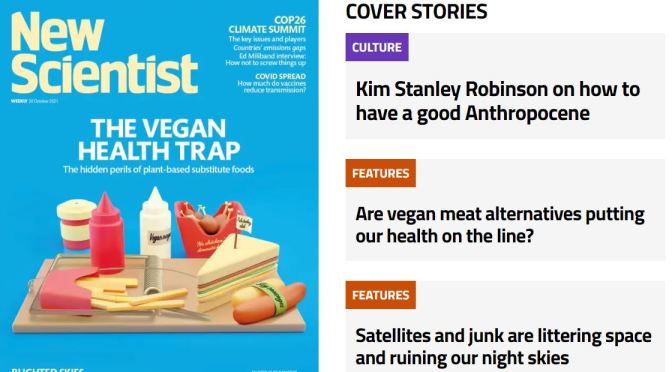
Previews: New Scientist Magazine – October 30
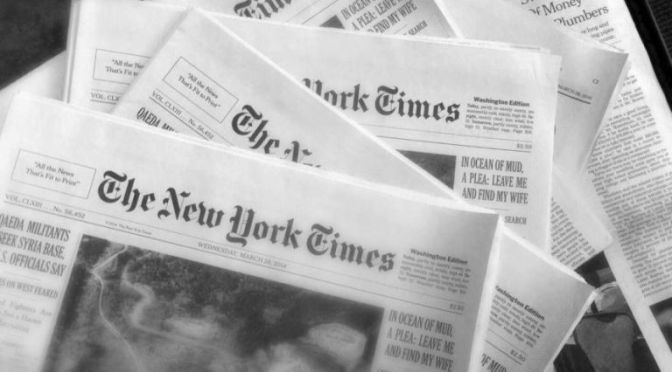
Front Page Views: The New York Times – October 28


Morning News: President Biden Heads To Europe, U.S. Economic Growth, Prison
President Biden will make a delayed departure for Europe as Democratic lawmakers spar over his spending agenda. Economic forecasters predict lackluster U.S. quarterly growth numbers. And a federal parole commission creates unique challenges for prisoners seeking release from “hard time” in the nation’s capital.

Aerial Views: Scenic Rim – Queensland, Australia (4K)
The Scenic Rim Region is a local government area in West Moreton region of South East Queensland, Australia. Established in 2008, it was preceded by several previous local government areas with histories extending back to the early 1900s and beyond. The main town of the region is Beaudesert.

Science: 4000-Year-Old Mummies, Digital-Hygiene Checks, Ancient Snakes
The unexpected origins of a 4000-year-old people, protecting your ‘digital presence’ and what to expect from COP26.
In this episode:
00:48 The origins of the mysterious Tarim mummies
For decades there has been debate about the origins of a group of 4000-year-old individuals known as the Tarim Basin mummies. Their distinct appearance and clothing has prompted scientists to hypothesise they had migrated from the North or West. Now, a team of researchers have used modern genomics to shed new light on this mystery and reveal that migration was not the mummies’ origin.
Research article: Zhang et al.
News and Views: The unexpected ancestry of Inner Asian mummies
08:59 Research Highlights
Making wood mouldable, and how ancient snakes diversified their diets.
Research Highlight: Moulded or folded, this wood stays strong
Research Highlight: Finicky no more: ancient snakes ate their way to success
11:09 How a regular ‘digital-hygiene’ check can protect your reputation
Attaching a researcher’s name to a paper without them knowing is an unscrupulous practice that can have serious repercussions for the unwitting academic. To prevent this, computer scientist Guillaume Cabanac is advocating a once-a-month ‘digital-hygiene’ check, to identify incorrect acknowledgements, and help prevent research malpractice.
World View: This digital-hygiene routine will protect your scholarship
18:51 What to expect from COP26
This week sees the start of the 26th UN Climate Change Conference (COP26), with an estimated 20,000 people — including world leaders, scientists and activists — expected to be in attendance. Jeff Tollefson, senior reporter at Nature, joins us to explain what’s on the agenda for the conference.
News Explainer: COP26 climate summit: A scientists’ guide to a momentous meeting

Views: Bordeaux & Limoges In Nouvelle-Aquitaine, Southwestern France (4K)
This video is about things to do in Bordeaux and Limgoes in Nouvelle-Aquitaine, France. It has what really matters in Bordeaux and Limoges, wine tasting in Margaux, and castles and museums in Haute-Vienne.
Nouvelle-Aquitaine or New Aquitaine, is the largest administrative region in France, spanning the west and southwest of the mainland. The region was created by the territorial reform of French regions in 2014 through the merger of three regions: Aquitaine, Limousin and Poitou-Charentes.
 Boomers Daily