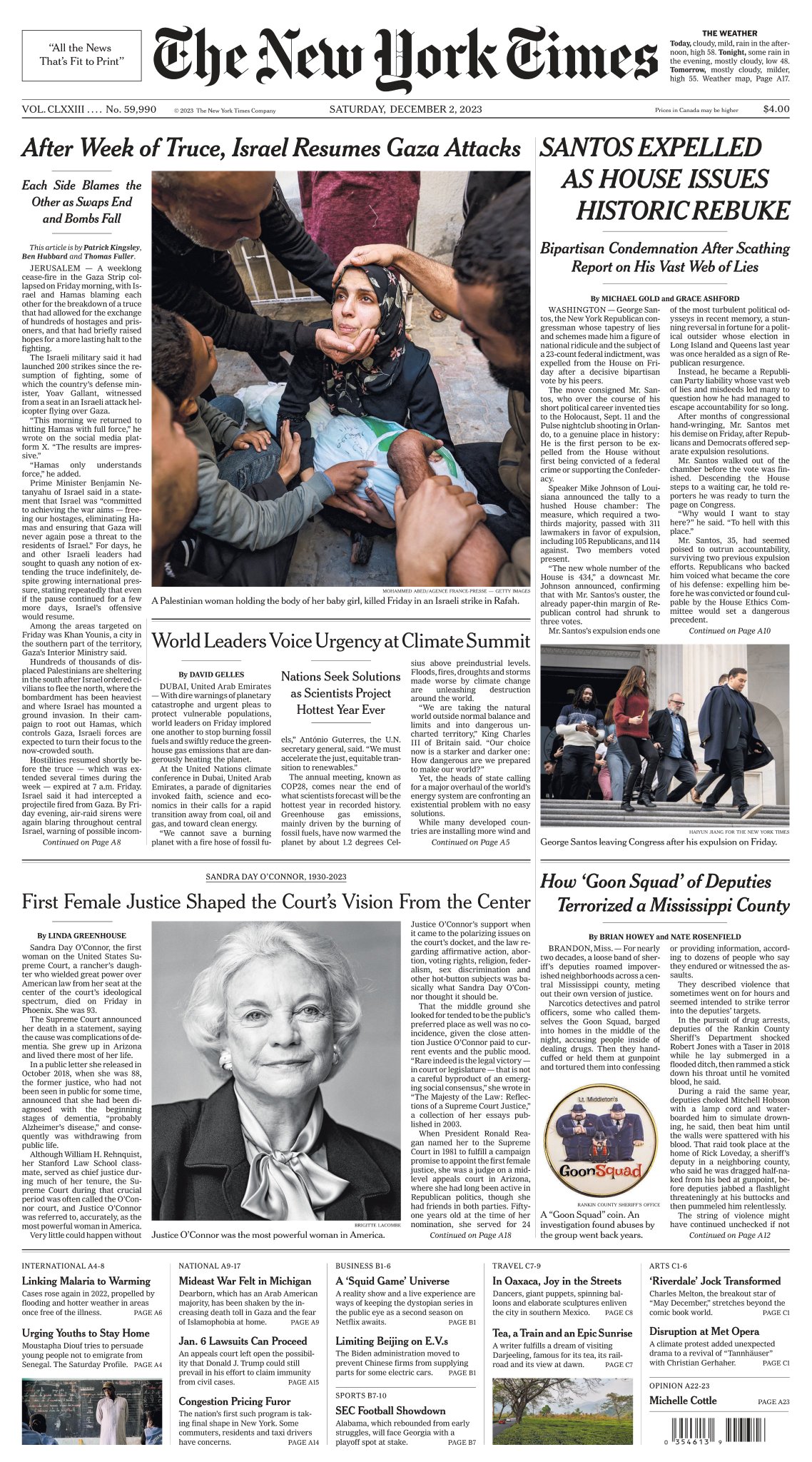
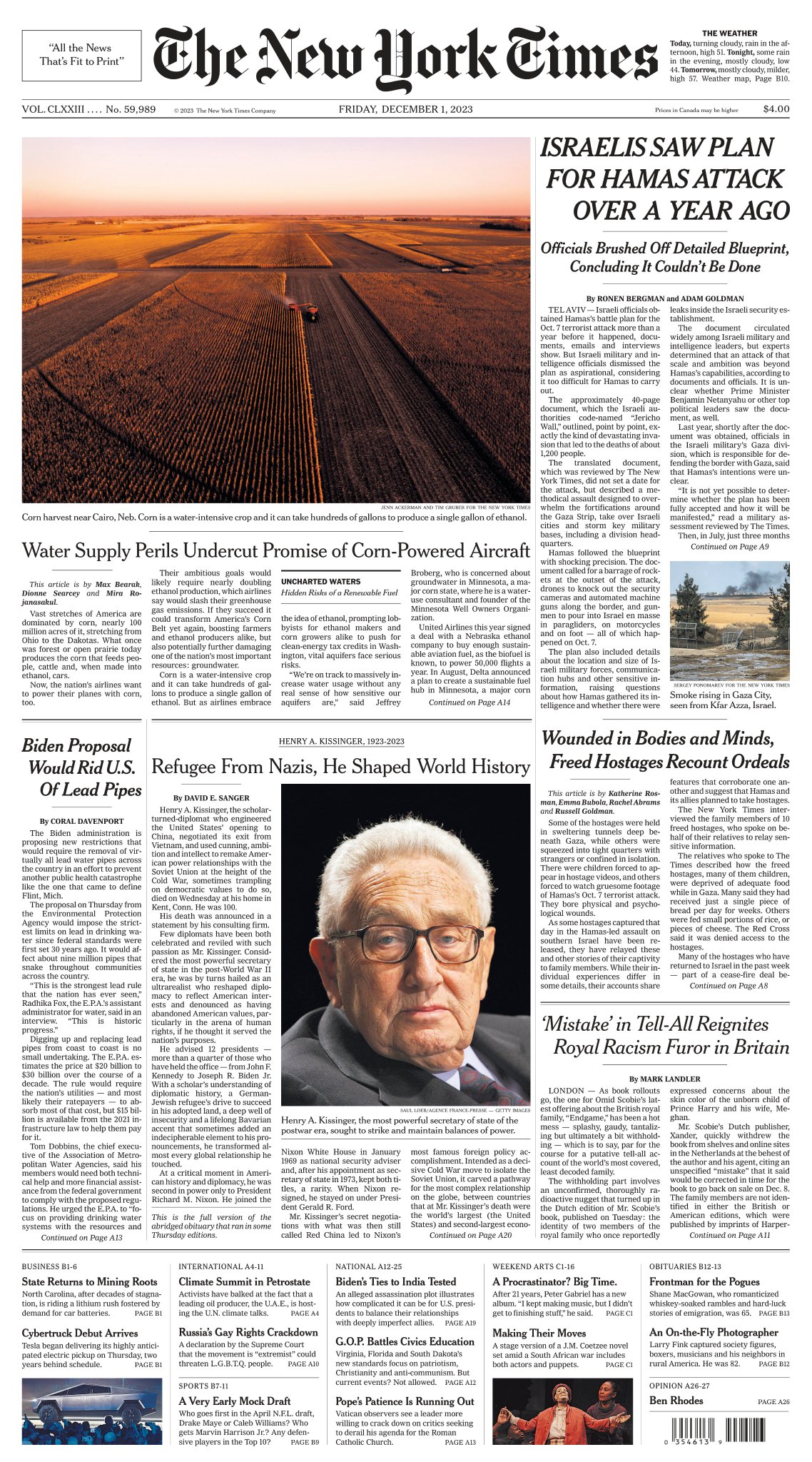
Talks on extending a weeklong cease-fire broke down, with each side blaming the other. The truce had included the release of hostages held in Gaza for people in Israeli prisons.
Nearly half of the G.O.P. House delegation voted to expel Mr. Santos, a remarkable rebuke of a colleague who had survived two prior expulsion bids.
Blinken Urges Israel to Take Concrete Steps to Aid Civilians as More Hostages Are Freed
Secretary of State Antony J. Blinken met with Israeli officials and a Palestinian leader on Thursday to seek improved conditions for Gaza’s civilians and to try to exert influence over Israel’s expected military offensive.
A Tense Climate Summit Begins Against a Backdrop of War and Record Heat
World leaders at climate talks in Dubai invoked faith, science and economics in their calls for a rapid transition away from fossil fuels.
Nvidia is the clear—and most obvious—beneficiary from the AI buildout but there are two other companies that are less well known to investors that should equally benefit in the year ahead.
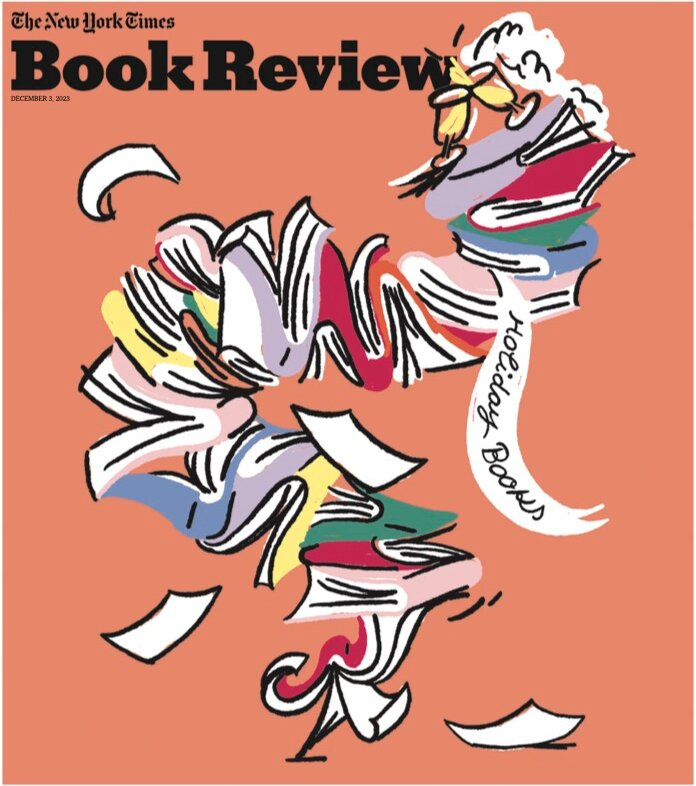
THE NEW YORK TIMES BOOK REVIEW (December 3, 2023): This week features the Holiday Books issue that lands with a thump, a 56-page behemoth crammed with reviews, coffee-table book spreads, recommendations from our genre columnists, a children’s book gift guide and our 100 Notables list.
Each year, we pore over thousands of new books, seeking out the best novels, memoirs, biographies, poetry collections, stories and more. Here are the standouts, selected by the staff of The New York Times Book Review.
As long as people have been buying gifts for the holidays, they have been buying books. Books offer infinite variety, are easily wrapped, can be personalized for the recipient and displayed as a signifier of one’s own identity. They are, in many respects, the quintessential Christmas — or Hanukkah or Kwanzaa or other December celebration — gift.
France-Amérique Magazine – December 1, 2023 – The new issue features the foundations that are keeping the French-American friendship alive, from New Orleans to Washington D.C. to Paris, and pay a visit to the newly renovated Cartier Mansion – the Fifth Avenue palace where Pierre Cartier mingled with celebrities, titans of industry, and U.S. presidents. Also in this issue, read about the success of Rémy Martin in America as the iconic Cognac house is turning 300, and discover why, since the pandemic, so many Americans are putting up the “For Sale” sign and hopping on a plane to Paris, Lyon, or Marseille!
AU REVOIR, AMERICA
Is the Grass Greener on the Other Side of the Atlantic?
For ideological, financial, or health care reasons, more and more Americans are moving to France (12,200 first-time residence granted in 2022, up 9,214 on 2021). But la vie is not always en rose.
By Anthony Bulger
RÉMY MARTIN
A French-American Heritage
Three hundred years after it was founded, the Cognac house renowned for its flagship Louis XIII sells half its bottles in America while continuing to uphold its tradition of excellence.
By Benoît Georges
THE FOUNDATIONS – of French-American Friendship
From Washington D.C. to New York City and from New Orleans to Paris, many philanthropic organizations continue to nurture the bonds connecting France and the United States through history, politics, economics, language, and culture.
By Roland Flamini
PIERRE CARTIER – The Man Who Made Jewelry for American Presidents
In the early 20th century, the three grandsons of the founder of Cartier were busy building their family name. Louis was in Paris, Jacques in London, and Pierre in New York City. To sell his jewelry in the United States, the latter sibling mingled with celebrities, titans of industry, and presidents, and created a network of alliances.
The Globalist Podcast (December 1, 2023) – After three people were shot by Hamas in Jerusalem, we discuss the latest from the Israel-Hamas conflict in the Middle East. Bloomberg’s Akshat Rathi examines how an agreement on a key climate deal was reached on the first day of Cop 28.
Plus: The EU announces new Slapp protections, the latest film news and a look at who topped ArtReview’s Power 100 list.
Hostages who have returned to Israel in the past week have come home malnourished, ill, injured and bearing psychological wounds.
Airlines Race Toward a Future of Powering Their Jets With Corn
Carriers want to replace jet fuel with ethanol to fight global warming. That would require lots of corn, and lots of water.
Biden Administration to Require Replacing of Lead Pipes Within 10 Years
The proposal to rip out nine million pipes across the country could cost as much as $30 billion but would nearly eliminate the neurotoxin from drinking water.
Science Magazine – November 30, 2023:The new issue cover features a chinstrap penguin (Pygoscelis antarcticus) cares for a chick while its partner catches a quick nap.
The Economist Magazine (November 30, 2023): The latest issue features ‘Blue-Collar Bonanza’ – Why conventional wisdom on inequality is wrong; Is Putin winning?; America’s most conservative court; Political Islam after Gaza, and more…
Few ideas are more unshakable than the notion that the rich keep getting richer while ordinary folks fall ever further behind. The belief that capitalism is rigged to benefit the wealthy and punish the workers has shaped how millions view the world, whom they vote for and whom they shake their fists at. It has been a spur to political projects on both left and right, from the interventionism of Joe Biden to the populism of Donald Trump. But is it true?
Old stereotypes are haunting the Middle East once more. The biggest butchery of Israeli civilians since the state’s creation, carried out on October 7th, has been followed by a slaughter of Palestinian civilians. America, which has funded, armed and defended Israel is again an object of ire. So are its Western allies. Together they are blamed for facilitating Gaza’s pummelling and the displacement of its people. A truce which began on November 24th, and which was set to expire as The Economist went to press, had led to the release of 81 hostages and 180 Palestinian detainees as of November 28th.
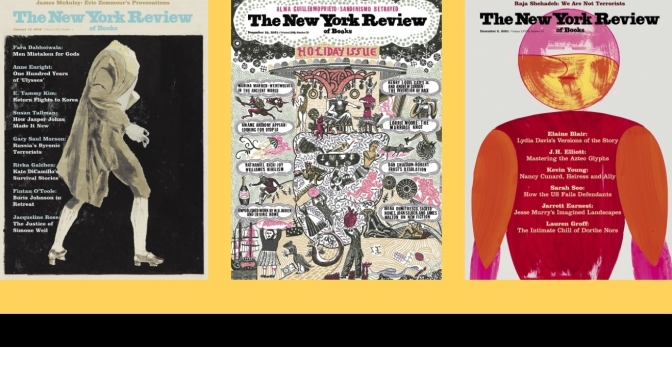
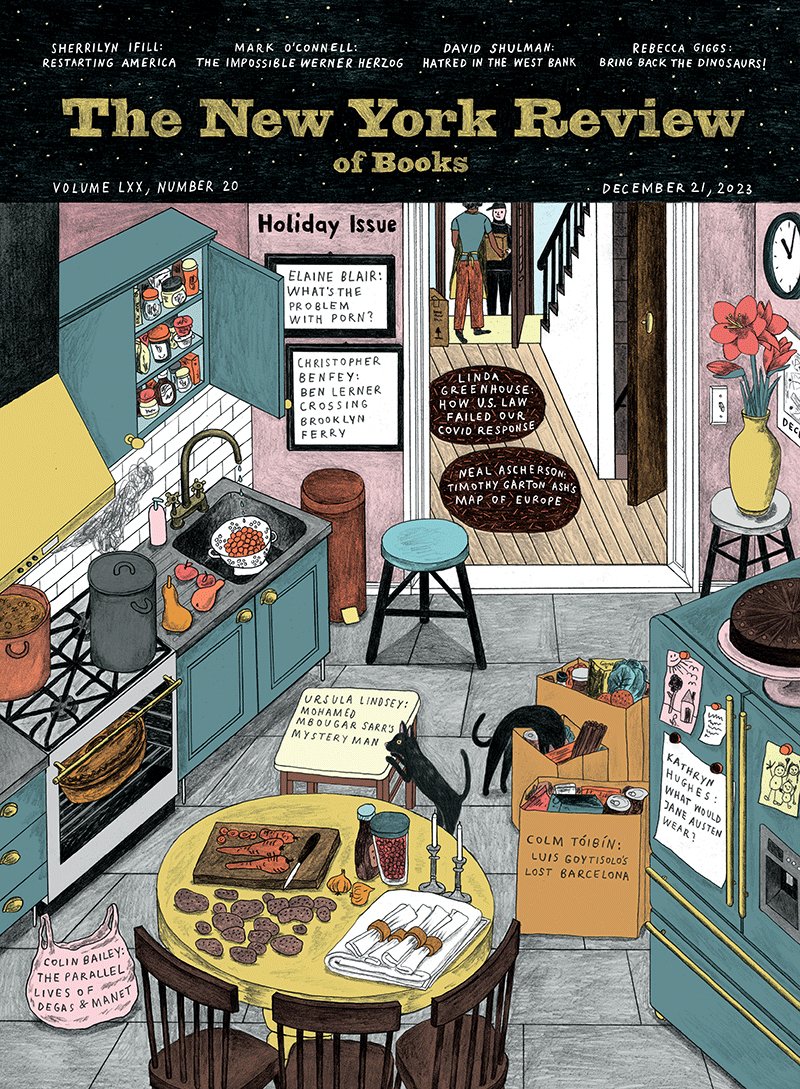
The New York Review of Books (December 21, 2023 Issue) – The latest issue features—the Holiday Issue—with Susan Tallman on William Kentridge, David Shulman on violence in the West Bank, Neal Ascherson on Timothy Garton Ash’s Europe, Elaine Blair on what we talk about when we talk about porn, Rebecca Giggs on the return of dinosaurs, Kathryn Hughes on Jane Austen’s fashion, Mark O’Connell on Werner Herzog, Linda Greenhouse on Covid in the courts, Gabriel Winslow-Yost on Bill Watterson’s first book since Calvin and Hobbes, John Banville on liberalism after Hobbes, poems by Lindsay Turner and Greg Delanty, and much more.
Imagine a festive dinner near Topeka during the fall of 1879 to celebrate the twenty-fifth anniversary of the founding of the Kansas Territory, with Walt Whitman as a featured speaker. Partially paralyzed by a stroke and described as “reckless and vulgar” by The New York Times—Leaves of Grass was soon to be banned for indecency by the Boston district attorney—Whitman, who had just turned sixty, may well have wondered why he, instead of some respectable graybeard like Emerson, was invited. Was it because he had defended John Brown, the hero of free-soil Kansas? Or was it hoped that a visit might inspire something like his 1871 “Song of the Exposition,” in which Whitman admonished the Muse:
Migrate from Greece and Ionia, Cross out please those immensely overpaid accounts, That matter of Troy and Achilles’ wrath… For know a better, fresher, busier sphere, a wide, untried domain awaits, demands you.
Hatzegopteryx, a giant pterosaur that lived around 66 million years ago on a subtropical island in what is now Romania; from Prehistoric Planet
Nature documentary has of late become a haunted genre. Not so Prehistoric Planet, which revels in portraying that which is already dead and gone, no longer our responsibility.
One early myth about the dinosaurs was that they would return. In 1830 Charles Lyell—earth scientist, Scot—gazed into the far future and posited as much in his Principles of Geology, arguing that since the planet’s climate was cyclical (or so he believed), vanished creatures could yet be revived, along with their habitats, when the right conditions came back around: “The huge iguanodon might reappear in the woods, and the ichthyosaur in the sea, while the pterodactyl might flit again through umbrageous groves of tree-ferns.” As to whether people would get to witness the spectacle of this resurrected bestiary—well, if Lyell was never drawn to that question, it was because the answer was not up for debate. His was an age in which the prospect of Earth bereft of human occupancy was too abominable, too sacrilegious, to contemplate.
PBS NewsHour (November 29, 2023) – The great painter John Singer Sargent, an American expat, is the subject of a new show at Boston’s Museum of Fine Arts. It reveals much about his methods and why his work remains relevant more than a hundred years later.



























 PBS NewsHour
 Boomers Daily