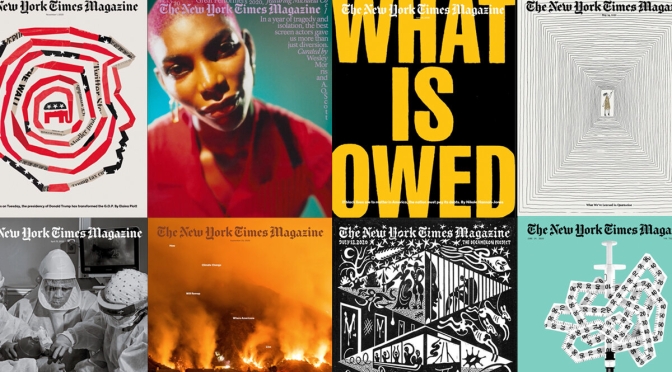

Views: The New York Times Magazine – July 30, 2023

Image

THE NEW YORK TIMES MAGAZINE (July 30, 2023) – In this week’s cover story, David Quammen reports on the ongoing mystery of Covid’s origin, what we do know — and why it matters. Plus, a profile of a poet who was kidnapped from his Black father by his white grandparents and a look at a group of English activists’ fight for the right to access public lands.

The Ongoing Mystery of Covid’s Origin

An illustration of a face with red dots surrounding the mouth.

We still don’t know how the pandemic started. Here’s what we do know — and why it matters.

By David Quammen

Where did it come from? More than three years into the pandemic and untold millions of people dead, that question about the Covid-19 coronavirus remains controversial and fraught, with facts sparkling amid a tangle of analyses and hypotheticals like Christmas lights strung on a dark, thorny tree. One school of thought holds that the virus, known to science as SARS-CoV-2, spilled into humans from a nonhuman animal, probably in the Huanan Seafood Wholesale Market, a messy emporium in Wuhan, China, brimming with fish, meats and wildlife on sale as food. Another school argues that the virus was laboratory-engineered to infect humans and cause them harm — a bioweapon — and was possibly devised in a “shadow project” sponsored by the People’s Liberation Army of China. 

The Fight for the Right to Trespass

A wealthy couple bought an estate inside Dartmoor National Park and then successfully sued to bar campers from using their land. That ruling is now being appealed.

A group of English activists want to legally enshrine the “right to roam” — and spread the idea that nature is a common good.

By Brooke Jarvis

The signs on the gate at the entrance to the path and along the edge of the reservoir were clear. “No swimming,” they warned, white letters on a red background.

On a chill mid-April day in northwest England, with low, gray clouds and rain in the forecast, the signs hardly seemed necessary. But then people began arriving, by the dozens and then the hundreds. Some walked only from nearby Hayfield, while others came by train or bus or foot from many hours away. In a long, trailing line, they tramped up the hill beside the dam and around the shore of the reservoir, slipping in mud and jumping over puddles. Above them rose a long, curving hill of open moorland, its heather still winter brown. When they came to a gap between a stone wall and a metal fence, they squeezed through it, one by one, slipping under strings of barbed wire toward the water below.
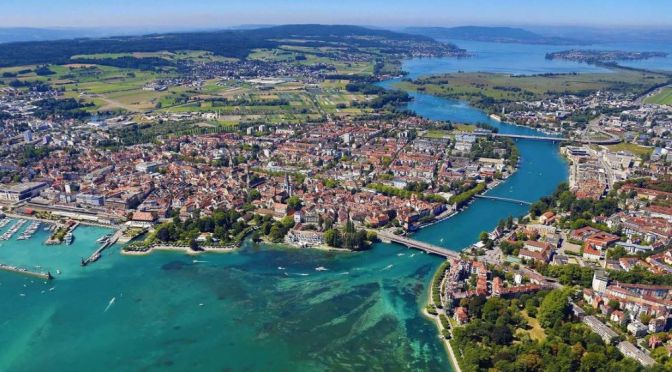
Travel Tour: Konstanz On Lake Constance, Germany

Moveora Films (July 27, 2023) – Konstanz is a city on Lake Constance (Bodensee), in southern Germany. Its preserved medieval district of Niederburg includes the Romanesque Konstanz Cathedral, known for its mix of decorative styles and a Gothic spire.

The town hall is covered in delicate frescoes and has a Renaissance-style courtyard. The Rosgartenmuseum chronicles the region’s cultural history, exhibiting prehistoric to 20th-century objects.

Classical Piano: Alice Sara Ott – Beethoven “Für Elise”

Deutsche Grammophon (July 28, 2023) – Earlier this year, pianist Alice Sara Ott became the face of the Apple Music Classical app when she starred in its launch video, performing Beethoven’s Piano Concerto No. 1, Op. 15 with the Netherlands Radio Philharmonic Orchestra and its Chief Conductor Karina Canellakis.

Beethoven: Für Elise, WoO 59 - YouTube

The recording of it now becomes the headline work in Ott’s latest Deutsche Grammophon album, Beethoven. The pianist has paired it with a series of solo works, including “Für Elise” and the “Moonlight” Sonata.

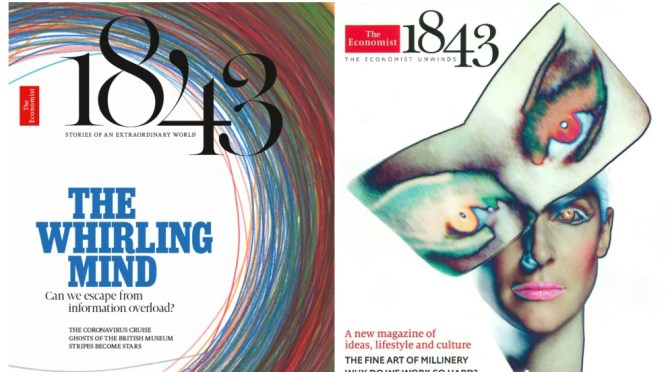
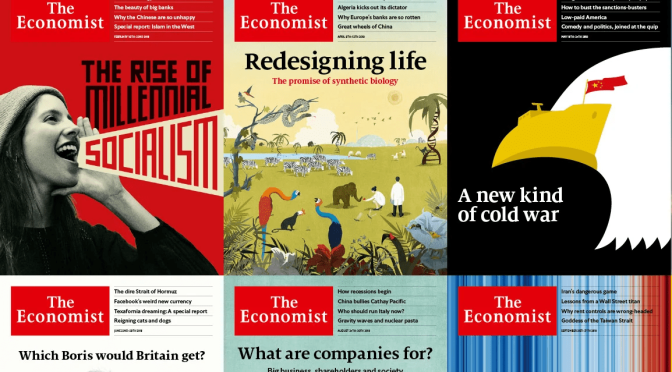
SUMMER STORIES 2023 – THE ECONOMIST 1843 MAGAZINE

Image

1843 MAGAZINE – SUMMER STORIES 2023:

Who will succeed the Dalai Lama?

As rival candidates are lined up, the Tibetan spiritual leader tells Brook Larmer what he really thinks of China

Rum and coke and automatic rifles: Myanmar’s Gen Z guerrillas

Young soldiers have buoyed the country’s fight for freedom, but at great cost. Irena Long meets them in their jungle hideout

The Baghdad job: who was behind history’s biggest bank heist?

Criminals stole $2.5bn from Iraq’s largest state bank in broad daylight. Nicolas Pelham follows their trail

News: Ukraine Military Gains, Moldova To Expel Russians, Taiwan’s Defense

The Globalist Podcast, Friday, July 28, 2023: President Putin concedes that Ukraine has intensified its counteroffensive as Moldova expels 45 Russian diplomatic staff over “unfriendly actions”.

Plus, Taiwan’s efforts to bolster its defense capabilities, updates on the Niger coup and an ode to the pleasures of skinny dipping.

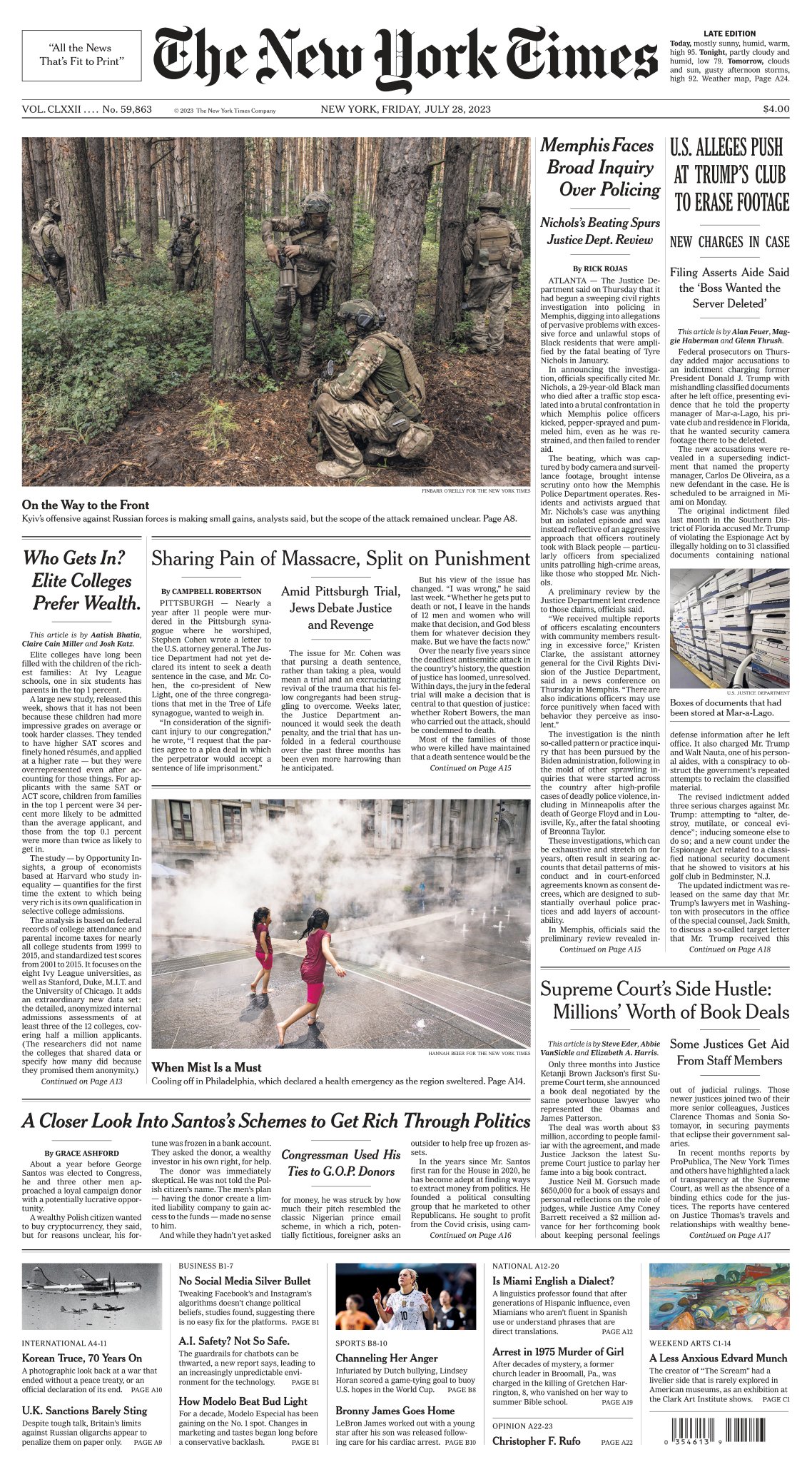
The New York Times — Friday, July 28, 2023

Image

Trump Faces Major New Charges in Documents Case

The revised indictment added three serious charges against former President Donald J. Trump, including attempting to “alter, destroy, mutilate, or conceal evidence.”

The office of the special counsel accused the former president of seeking to delete security camera footage at Mar-a-Lago. The manager of the property, Carlos De Oliveira, was also named as a new defendant.

Justice Dept. Opens Civil Rights Investigation of Memphis Police

Kristen Clarke, the assistant attorney general for the Civil Rights Division of the Justice Department, announced on Thursday an investigation into the practices of the Memphis Police Department.

The department will examine allegations of pervasive problems with excessive force and unlawful stops of Black residents that were amplified by the fatal beating of Tyre Nichols.

Study of Elite College Admissions Data Suggests Being Very Rich Is Its Own Qualification

Elite colleges have long been filled with the children of the richest families: At Ivy League schools, one in six students has parents in the top 1 percent.

Amid Shared Pain Over Synagogue Massacre, Divisions on Death Penalty

Since the 2018 attack that left 11 people dead, Jews in Pittsburgh have weighed whether the government should seek the execution of the killer.

Research Preview: Science Magazine – July 28, 2023

Image

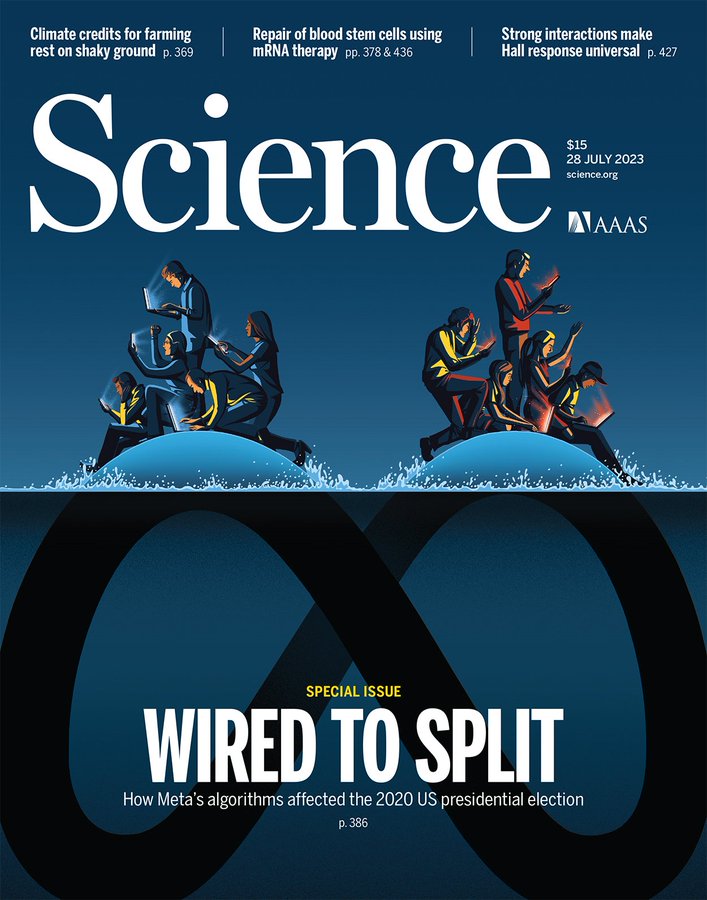
Science Magazine – July 28, 2023 issue: This artwork depicts social media users that are engaged (and often enraged) from the “left” (liberals, blue) and the “right” (conservatives, red) perched on Meta’s logo. Social media algorithms personalize users’ online experiences, recommending engaging content that will interest them and possibly spark outrage.

Social media and elections

The advent of social media forever changed how we consume news. At least half of Americans rely on it for news, and Facebook (owned by parent company Meta) is the most popular. Meta’s Facebook and Instagram platforms are funded through advertisements and generate more revenue when users spend more time on their platforms. To make platforms alluring and increase screen time, tech companies operate on business models that incentivize algorithms that are designed to elevate eye-catching content to the top of users’ feeds—content that captures attention and may go “viral” by stimulating “engagement” through comments, likes, and resharing.

Origin of diamond-bearing eruptions revealed

Deep mantle waves from continental rifting trigger mysterious kimberlite volcanoes

‘I should have done better.’ Stanford head steps down

Probe clears Marc Tessier-Lavigne of misconduct but criticizes lab culture and lack of “appetite” for corrections

Previews: The Economist Magazine – July 29, 2023

The overstretched CEO | Jul 29th 2023 | The Economist

The Economist Magazine (July 29, 2023 issue): The overstretched CEO; Larry Fink demonised – All he wanted to do was save the planet while making his firm a fortune. Henry Tricks meets the face of woke capitalism; The greatest bank heist ever – Criminals stole $2.5bn from Iraq’s largest state bank in broad daylight. Nicolas Pelham follows their trail, and more…

The overstretched CEO

Companies are increasingly caught up in governments’ competing aims. What to do?

The world should not let Vladimir Putin abandon the grain deal

Here is how to get him to sign up again

Israel has lurched closer to constitutional chaos

But there are still ways to step back from the brink

Analysis: Ukraine Drones Destroying Russian Tanks

Wall Street Journal (July 27, 2023) – Since the Ukrainian counteroffensive against Russian forces began, there’s been a dramatic increase in Ukraine’s use of FPV, or first person view drones to execute kamikaze-style attacks on Russian tanks, troop positions and other large-scale weapons.

Video timeline: 0:00 Increase in use of FPV drones 1:01 The kamikaze drone process 2:15 Destroying targets

The aim is to operate cheaply and to make the military less dependent on Western weapons. WSJ gathered dozens of videos from Ukrainian units on the frontlines, to break down how their drone teams execute these attacks on Russia’s military.

#Russia #Ukraine #WSJ

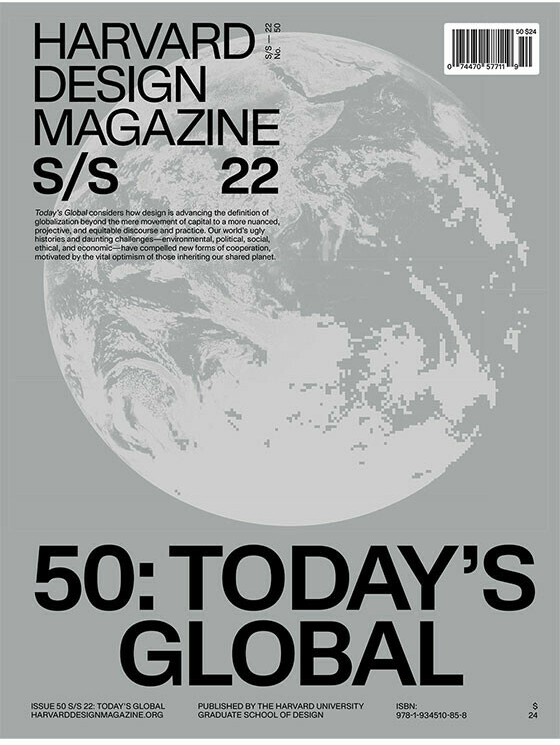
HARVARD DESIGN MAGAZINE S/S 22 – SUMMER 2023 ISSUE

Image

Harvard GSD – HARVARD DESIGN MAGAZINE S/S 22 (SUMMER 2023) – ISSUE 50: TODAY’S GLOBAL – How is design advancing the definition of globalization beyond the mere movement of capital to a more nuanced, projective, and equitable discourse and practice? Our world’s ugly histories and daunting challenges—environmental, political, social, ethical, and economic—have compelled new forms of cooperation, motivated by the vital optimism of those inheriting our shared planet.

THE WORLD-CITIES OF THE GLOBAL AGE

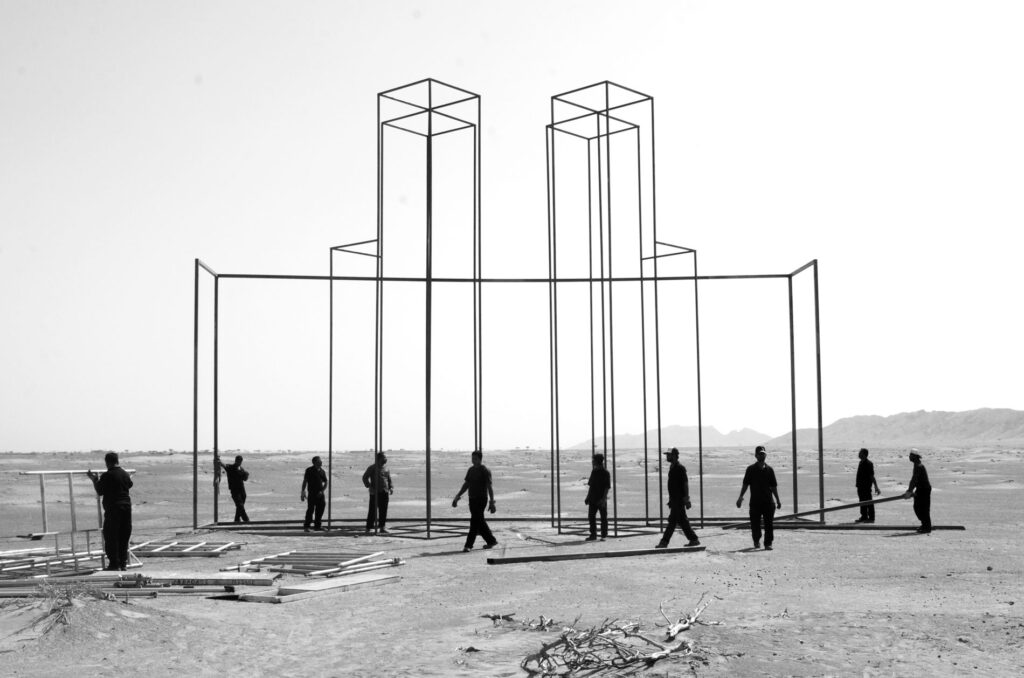
Black and white photograph of men in a desert building a tall scaffold inthe shape of a building.

By Diana L. Eck

Lewis Mumford in introducing his now-classic study The City in History wrote, “This book opens with a city that was, symbolically, a world: it closes with a world that has become, in many practical aspects, a city.”1 He saw among the chief functions of the city the conversion of energy into culture. Indeed, the city of old was the anchor of the surrounding culture and synonymous with it. However in the decades since he wrote, the energies of cities have been fueled by an increasingly diverse population with increasingly diverse cultures. Cities are the very places where we see the effects of global migration and face the questions of identity in a complex multicultural society. Today there are a multitude of cities that are, symbolically, the world with all its diversity. Not just New York and London, but Minneapolis and Leeds are today’s world-cities. And the globalization of people, communications, and transportation has created a world that is, in many ways, a city.

READING ARCHITECTURE IN AN ERA OF GLOBALIZATION

Arial view of the top of a building with a diamond shaped, recessed  outdoor space with people standing

By Nicolai Ouroussoff

The architectural profession is in the midst of a long-overdue ethical reckoning. For years, it could ride the tidal wave of globalization to bigger and better commissions while still claiming that it was fighting the good fight. Nowadays, architects are more likely to be on the defensive. Our most celebrated architectural minds are routinely chastised in the media for placing personal vanity above the interests of the general public. And the fact that many of them have been far too willing to brush aside a client’s dubious ethics for the right commission has done little to dispel that perception.

O