Tag Archives: Technology

Top Stories Of The Week: World Economic Forum

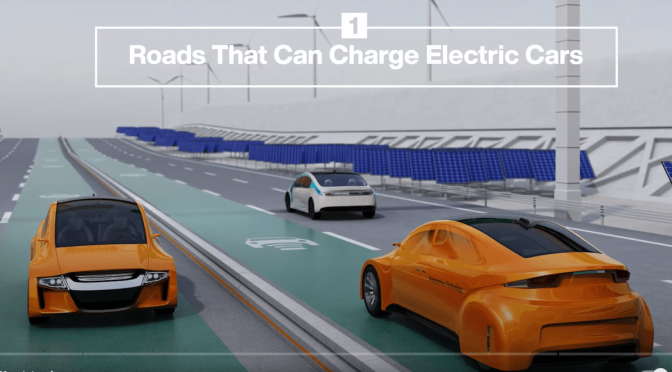
This week, the World Economic Forum is highlighting 4 key stories – roads that charge electric cars reducing the need for charging points, a false banana that could feed 100 million people, solar farms on superstore roofs and 3 reasons that economic growth will be slower in 2022.

Timeline: 00:00 – Intro 0:14 – Electric Roads 01:24 – False Banana 04:04 – Slow Economic Growth

The World Economic Forum is the International Organization for Public-Private Cooperation.

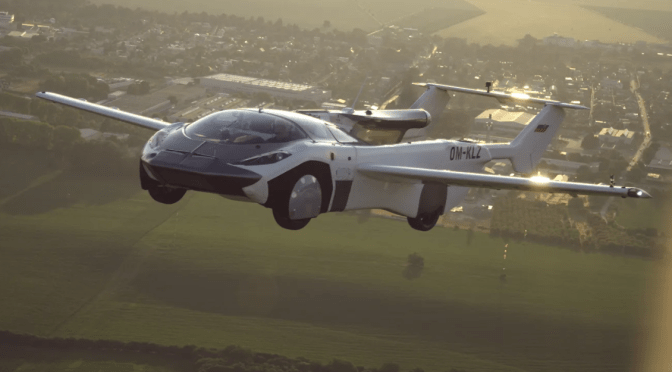
Design & Aviation: ‘AirCar’ Is Certified To Fly (Video)

AirCar the dual-mode car-aircraft vehicle has been issued the official Certificate of Airworthiness by the Slovak Transport Authority, following the successful completion of 70 hours of rigorous flight testing compatible with European Aviation Safety Agency (EASA) standards, with over 200 takeoffs and landings.

The challenging flight tests included the full range of flight and performance manoeuvres and demonstrated an astonishing static and dynamic stability in the aircraft mode. AirCar flew 70+ hours of test flights, incl. cross country with 200 takeoffs and landings.

Read more

Sustainability: Fertilizers From Biomass In France

As the world’s population grows, the need to feed billions of mouths mean our use of synthetic fertilisers will almost certainly increase significantly. The FT’s Anna Gross explores two innovative French companies that could ultimately reduce our reliance on artificial fertilisers by offering less carbon-intensive options. But how viable are these alternatives?

Tech: Digital Property Boom In The Metaverse

Real-estate transactions in the metaverse are reaching record highs. We spoke with companies investing in digital real estate to understand the economic model, and why investors are spending millions on virtual property. Photo: Republic Realm

Ecosystems: Seed-Firing Drones Planting Trees

2022: Top 5 Stories For The New Year (The Economist)

What will be the biggest stories of 2022? As the pandemic continues to wreak havoc across the globe, President Xi will cement his power as leader of China, tech giants will coax more of us into virtual worlds and the space race reaches new heights. The Economist is back with its annual look at the top stories of the year ahead. Film supported by @TeneoCEOAdvisory

Timeline: 00:00 The World Ahead 2022 00:40 China revels in democracy’s failings 04:11 Hybrid working becomes the new normal 07:48 The metaverse expands 11:26 An African fashion boom 14:12 The space race picks up

Technology: The Rise Of Robotic Working Dogs

A number of four-legged robot dogs made by companies like Boston Dynamics, Anybotics and Ghost Robotics have been deployed in the workforce already for applications like inspections, security and public safety among others. At their core, these four-legged robots are mobility platforms that can be equipped with different payloads depending on the type of information that companies want to gather.

Experts predict the insurance industry alone will spend $1.7 billion on robotics systems in 2025. And other industries may follow suit. Amid the pandemic, a tight job market is forcing many companies to turn to automation. A survey done in December of 2020 by McKinsey, showed that 51 percent of respondents in North America and Europe said they had increased investment in new technologies during 2020, not including remote-work technologies.

Technology: Caltech In 2021 – The Year In Review

In January, researchers developed a cage-like vaccine platform called a mosaic nanoparticle that could help protect against multiple strains of coronavirus; obtained new insights into human decision-making using AI-trained networks playing video games; learned how tiny plants changed the planet nearly half a billion years ago; and studied chaotic systems using a camera that can take up to 70 trillion frames per second.

Meanwhile, the Institute announced that it would remove the names of known eugenics proponents from its buildings, honors, and assets.

February saw the historic landing of NASA’s Mars rover Perseverance on the Red Planet. The 2,263-pound rover, designed and operated by JPL, which Caltech manages for NASA, will spend two years investigating Mars’s Jezero crater, and will collect and cache samples of rocks and sediment for recovery by a subsequent mission.

Here on Earth, seismologists worked with optics experts to develop a method to use existing underwater telecommunication cables to detect earthquakesphysicists advanced the use of exotic materials for future ultrafast computers; and engineers perfected methods to place molecules in particular orientations at specific locations—work that paves the way for the integration of molecules with computer chips.

In March, Caltech researchers announced a non-invasive method that uses ultrasound to read and interpret brain activity related to the intent to move, a major step toward the creation of noninvasive brain–machine implants that can restore movement to paralyzed individuals; located Mars’s missing water; described a long-sought solution to “one of the most stubborn problems in math”; and explained how bacteria evolve resistance to antibiotics and how antibiotics help bacteria eat when nutrients are scarce.

Read more

Education: Can Science Help Poor Kids Earn More?

The wide gap in development between rich and poor children could be closed with the help of neuroscience. Might a controversial focus on genetics also help? Film supported by @Mishcon de Reya LLP

Video timeline: 00:00– The achievement gap between rich and poor kids 00:55 – Words matter in childhood development 03:16 – Conversation can combat childhood inequality 05:09 – Can genetics help close the achievement gap? 07:30 – Genetics can be controversial