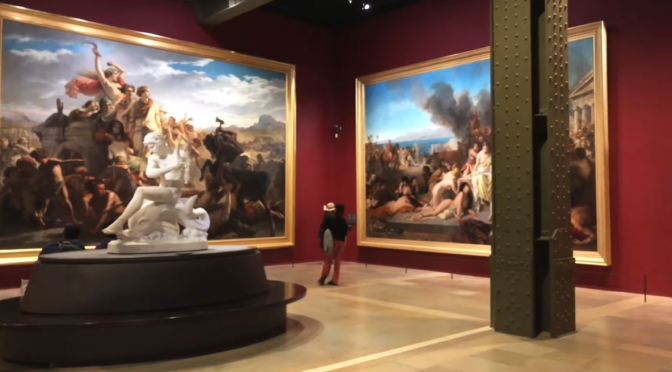
Musée d’Orsay, (French: “Orsay Museum”) national museum of fine and applied arts in Paris that features work mainly from France between 1848 and 1914. Its collection includes painting, sculpture, photography, and decorative arts and boasts such iconic works as Gustave Courbet’s The Artist’s Studio (1854–55), Édouard Manet’s Le Déjeuner sur l’herbe (1863; Luncheon on the Grass), and Pierre-Auguste Renoir’s Dance at Le Moulin de la Galette (1876; Bal du moulin de la Galette).
The Musée d’Orsay is housed in the former Gare d’Orsay, a railway station and hotel that was designed by Victor Laloux and located on the Left Bank of the Seine River opposite the Tuileries Gardens. At the time of its completion in 1900, the building featured an ornate Beaux Arts façade, while its interior boasted metal construction, passenger elevators, and electric rails.
Because of changes in railway technology, however, the station soon became outdated and was largely vacant by the 1970s. Talks to transform the builing into an art museum began early in the decade and were finalized in 1977 through the initiative of Pres. Valéry Giscard d’Estaing. With government funds, the building was restored and remodeled in the early 1980s by ACT architecture group.
The interior was designed by Gaetana Aulenti, who created a complex layout of galleries that occupied three main levels surrounding the atrium beneath the building’s iconic iron-and-glass barrel vault. On the ground floor, formerly the building’s train platforms, extensive stone structures broke up the cavernous space and created a central nave for the sculpture collection and gallery spaces for painting and decorative arts.
This week’s @TheTLS , featuring @RichardEvans36 on German militarism; Laura Thompson on Raine Spencer; A. N. Wilson on Turgenev; @colincraiggrant on Eureka Day; Claire Lowdon on Kamila Shamsie; @rauchway on interest rates – and more.
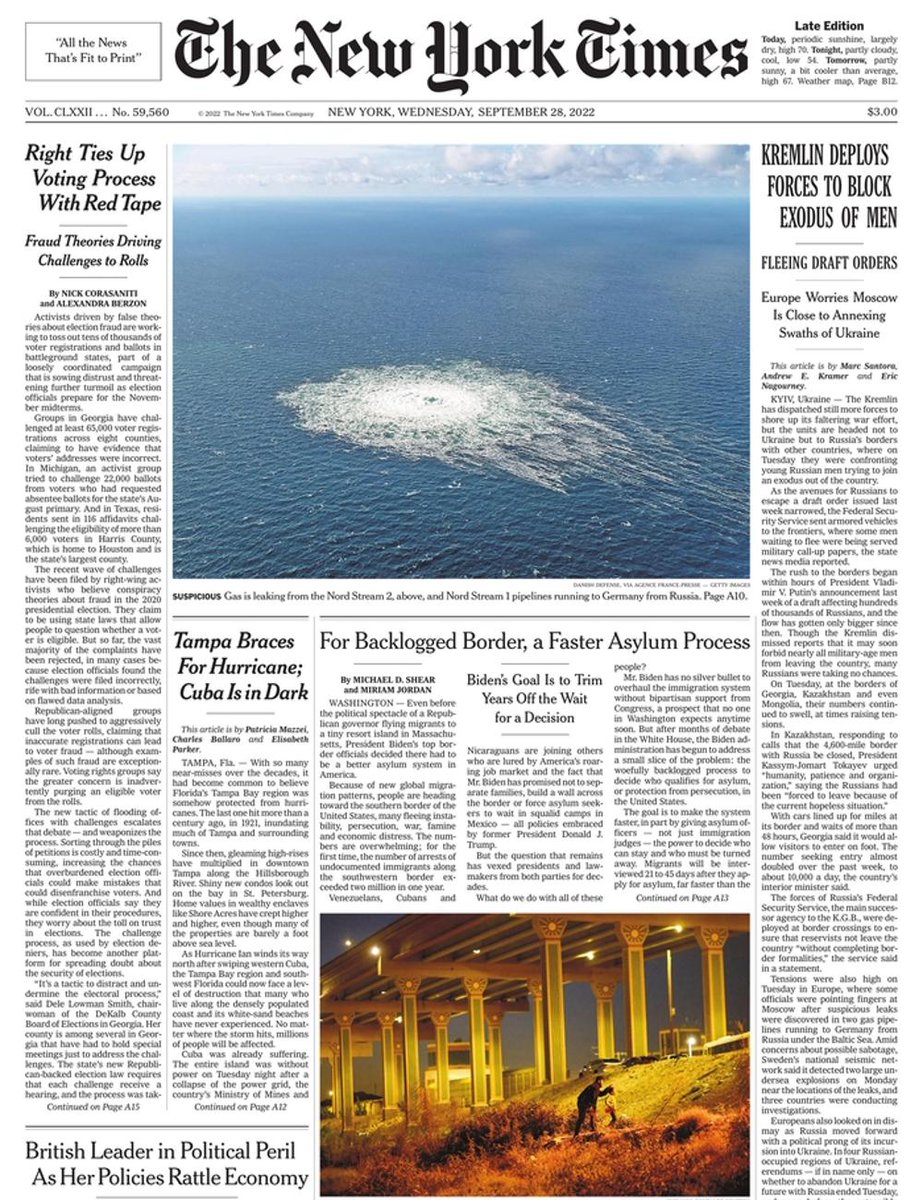
Hurricane Ian is making its presence known on Florida’s Gulf Coast after knocking out power all over Cuba. Two and a half million people are under evacuation orders across the state.
There are a lot of questions about leaks at two offshore pipelines that transport Russian gas to Europe. Several nations have called the leaks suspicious and point the finger at Moscow. And what’s the Biden administration’s plan to get Americans better access to healthy food?
The Kremlin dispatched federal security forces to frontier border crossings packed with Russian men trying to escape the draft by entering countries like Georgia, Kazakhstan and Mongolia.
Groups fueled by right-wing election conspiracy theories are trying to toss tens of thousands of voters from the rolls. “They are just going to beat the system into the ground,” said one election official.
A selection of three essential articles read aloud from the latest issue of The Economist. This week, a new-look Gulf, Vladimir Putin’s partial mobilization (10:45), and the Google-Meta advertising duopoly (15:00).
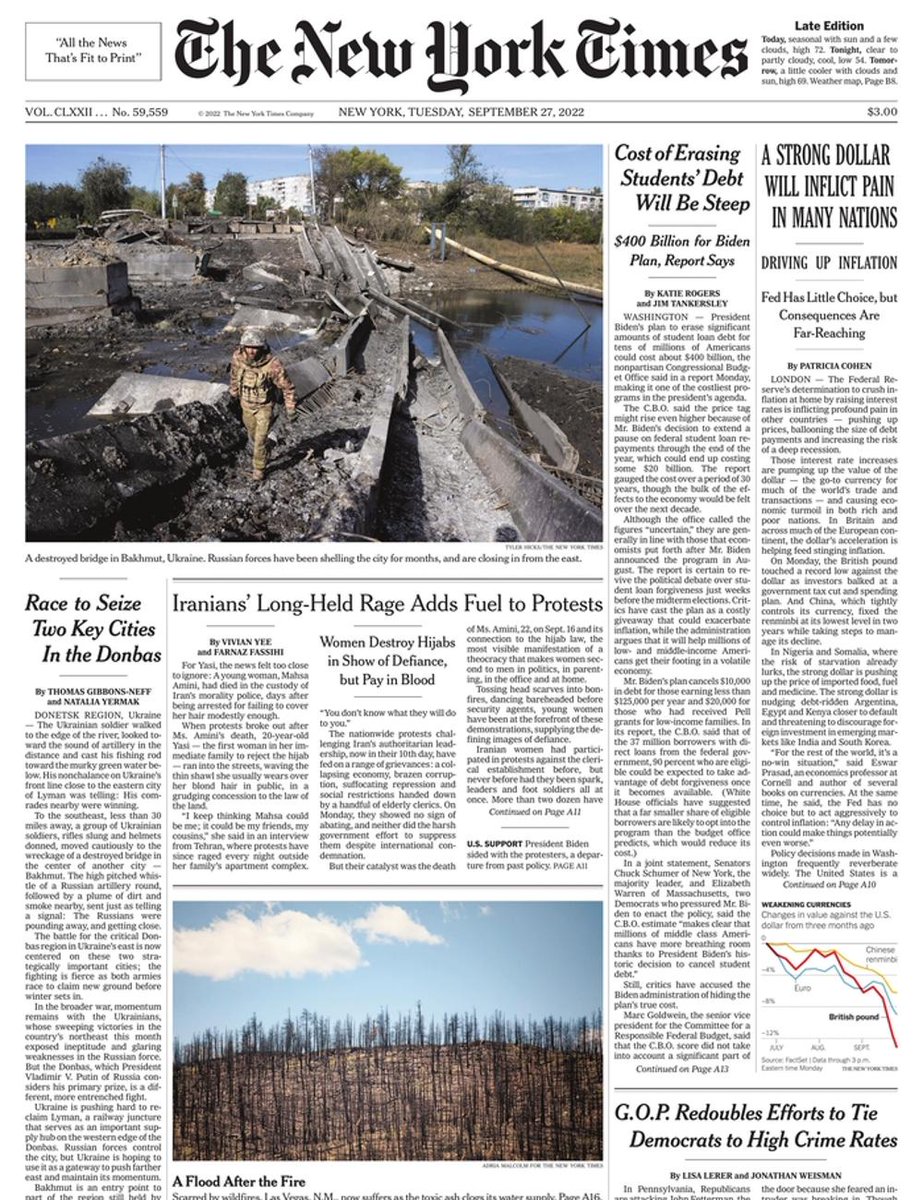
The Federal Reserve may have no choice but to wage a relentless inflation fight, but countries rich and poor are feeling the pain of plunging currencies.
The estimate by the nonpartisan Congressional Budget Office gauged the cost over 30 years, though the bulk of the effects to the economy would be felt over the next decade.
A far-right nationalist is on track to become Italy’s first female prime minister. What led Italians to back a candidate who is accused of spreading white supremacist ideas?
Also, thousands of Russian men are fleeing the country to avoid military service under President Putin’s mobilization order. Plus, why NASA scientists are getting ready to slam one of their spacecrafts into an asteroid.
Her nationalist party was the top vote-getter, leaving Ms. Meloni poised to be Italy’s first female prime minister and the first with post-Fascist roots.











 Boomers Daily