Tag Archives: Reviews

APOLLO MAGAZINE – SEPTEMBER 2025

September 2025

APOLLO MAGAZINE: The latest issue features The singular art of Georges de La Tour | Britain’s place in the soft-power race | Alec Cobbe’s masterful collecting | the Mona Lisa of medieval manuscripts

When American modernism planted its flag in London

Eero Saarinen’s US embassy building in Mayfair has long been undervalued, but its conversion into a luxury hotel may help revive its reputation

When British sculpture became modern

Henry Moore and Barbara Hepworth are ever in demand, but the market for their lesser-known contemporaries is growing too


Élisabeth Vigée Le Brun’s Roman holiday

While exiled in the city, Marie Antoinette’s favourite artist stuck up a close friendship with her own idol, Angelica Kauffman

TOMORROW’S INNER VOICE

The wager has always been our way of taming uncertainty. But as AI and neural interfaces blur the line between self and market, prediction may become the very texture of consciousness.

By Michael Cummins, Editor, August 31, 2025

On a Tuesday afternoon in August 2025, Taylor Swift and Kansas City Chiefs tight end Travis Kelce announced their engagement. Within hours, it wasn’t just gossip—it was a market. On Polymarket and Calshi, two of the fastest-growing prediction platforms, wagers stacked up like chips on a velvet table. Would they marry before year’s end? The odds hovered at seven percent. Would she release a new album first? Forty-three percent. By Thursday, more than $160,000 had been staked on the couple’s future, the most intimate of milestones transformed into a fluctuating ticker.

It seemed absurd, invasive even. But in another sense, it was deeply familiar. Humans have always sought to pin down the future by betting on it. What Polymarket offers—wrapped in crypto wallets and glossy interfaces—is not a novelty but an inheritance. From the sheep’s liver read on a Mesopotamian altar to a New York saloon stuffed with election bettors, the impulse has always been the same: to turn uncertainty into odds, chaos into numbers. Perhaps the question is not why people bet on Taylor Swift’s wedding, but why we have always bet on everything.


The earliest wagers did not look like markets. They took the form of rituals. In ancient Mesopotamia, priests slaughtered sheep and searched for meaning in the shape of livers. Clay tablets preserve diagrams of these organs, annotated like ledgers, each crease and blemish indexed to a possible fate.

Rome added theater. Before convening the Senate or marching to war, augurs stood in public squares, staffs raised to the sky, interpreting the flight of birds. Were they flying left or right, higher or lower? The ritual mattered not because birds were reliable but because the people believed in the interpretation. If the crowd accepted the omen, the decision gained legitimacy. Omens were opinion polls dressed as divine signs.

In China, emperors used lotteries to fund walls and armies. Citizens bought slips not only for the chance of reward but as gestures of allegiance. Officials monitored the volume of tickets sold as a proxy for morale. A sluggish lottery was a warning. A strong one signaled confidence in the dynasty. Already the line between chance and governance had blurred.

By the time of the Romans, the act of betting had become spectacle. Crowds at the Circus Maximus wagered on chariot teams as passionately as they fought over bread rations. Augustus himself is said to have placed bets, his imperial participation aligning him with the people’s pleasures. The wager became both entertainment and a barometer of loyalty.

In the Middle Ages, nobles bet on jousts and duels—athletic contests that doubled as political theater. Centuries later, Americans would do the same with elections.


From 1868 to 1940, betting on presidential races was so widespread in New York City that newspapers published odds daily. In some years, more money changed hands on elections than on Wall Street stocks. Political operatives studied odds to recalibrate campaigns; traders used them to hedge portfolios. Newspapers treated them as forecasts long before Gallup offered a scientific poll.

Henry David Thoreau, wry as ever, remarked in 1848 that “all voting is a sort of gaming, and betting naturally accompanies it.” Democracy, he sensed, had always carried the logic of the wager.

Speculation could even become a war barometer. During the Civil War, Northern and Southern financiers wagered on battles, their bets rippling into bond prices. Markets absorbed rumors of victory and defeat, translating them into confidence or panic. Even in war, betting doubled as intelligence.

London coffeehouses of the seventeenth century were thick with smoke and speculation. At Lloyd’s Coffee House, merchants laid odds on whether ships returning from Calcutta or Jamaica would survive storms or pirates. A captain who bet against his own voyage signaled doubt in his vessel; a merchant who wagered heavily on safe passage broadcast his confidence.

Bets were chatter, but they were also information. From that chatter grew contracts, and from contracts an institution: Lloyd’s of London, a global system for pricing risk born from gamblers’ scribbles.

The wager was always a confession disguised as a gamble.


At times, it became a confession of ideology itself. In 1890s Paris, as the Dreyfus Affair tore the country apart, the Bourse became a theater of sentiment. Rumors of Captain Alfred Dreyfus’s guilt or innocence rattled markets; speculators traded not just on stocks but on the tides of anti-Semitic hysteria and republican resolve. A bond’s fluctuation was no longer only a matter of fiscal calculation; it was a measure of conviction. The betting became a proxy for belief, ideology priced to the centime.

Speculation, once confined to arenas and exchanges, had become a shadow archive of history itself: ideology, rumor, and geopolitics priced in real time.

The pattern repeated in the spring of 2003, when oil futures spiked and collapsed in rhythm with whispers from the Pentagon about an imminent invasion of Iraq. Traders speculated on troop movements as if they were commodities, watching futures surge with every leak. Intelligence agencies themselves monitored the markets, scanning them for signs of insider chatter. What the generals concealed, the tickers betrayed.

And again, in 2020, before governments announced lockdowns or vaccines, online prediction communities like Metaculus and Polymarket hosted wagers on timelines and death tolls. The platforms updated in real time while official agencies hesitated, turning speculation into a faster barometer of crisis. For some, this was proof that markets could outpace institutions. For others, it was a grim reminder that panic can masquerade as foresight.

Across centuries, the wager has evolved—from sacred ritual to speculative instrument, from augury to algorithm. But the impulse remains unchanged: to tame uncertainty by pricing it.


Already, corporations glance nervously at markets before moving. In a boardroom, an executive marshals internal data to argue for a product launch. A rival flips open a laptop and cites Polymarket odds. The CEO hesitates, then sides with the market. Internal expertise gives way to external consensus. It is not only stockholders who are consulted; it is the amorphous wisdom—or rumor—of the crowd.

Elsewhere, a school principal prepares to hire a teacher. Before signing, she checks a dashboard: odds of burnout in her district, odds of state funding cuts. The candidate’s résumé is strong, but the numbers nudge her hand. A human judgment filtered through speculative sentiment.

Consider, too, the private life of a woman offered a new job in publishing. She is excited, but when she checks her phone, a prediction market shows a seventy percent chance of recession in her sector within a year. She hesitates. What was once a matter of instinct and desire becomes an exercise in probability. Does she trust her ambition, or the odds that others have staked? Agency shifts from the self to the algorithmic consensus of strangers.

But screens are only the beginning. The next frontier is not what we see—but what we think.


Elon Musk and others envision brain–computer interfaces, devices that thread electrodes into the cortex to merge human and machine. At first they promise therapy: restoring speech, easing paralysis. But soon they evolve into something else—cognitive enhancement. Memory, learning, communication—augmented not by recall but by direct data exchange.

With them, prediction enters the mind. No longer consulted, but whispered. Odds not on a dashboard but in a thought. A subtle pulse tells you: forty-eight percent chance of failure if you speak now. Eighty-two percent likelihood of reconciliation if you apologize.

The intimacy is staggering, the authority absolute. Once the market lives in your head, how do you distinguish its voice from your own?

Morning begins with a calibration: you wake groggy, your neural oscillations sluggish. Cortical desynchronization detected, the AI murmurs. Odds of a productive morning: thirty-eight percent. Delay high-stakes decisions until eleven twenty. Somewhere, traders bet on whether you will complete your priority task before noon.

You attempt meditation, but your attention flickers. Theta wave instability detected. Odds of post-session clarity: twenty-two percent. Even your drifting mind is an asset class.

You prepare to call a friend. Amygdala priming indicates latent anxiety. Odds of conflict: forty-one percent. The market speculates: will the call end in laughter, tension, or ghosting?

Later, you sit to write. Prefrontal cortex activation strong. Flow state imminent. Odds of sustained focus: seventy-eight percent. Invisible wagers ride on whether you exceed your word count or spiral into distraction.

Every act is annotated. You reach for a sugary snack: sixty-four percent chance of a crash—consider protein instead. You open a philosophical novel: eighty-three percent likelihood of existential resonance. You start a new series: ninety-one percent chance of binge. You meet someone new: oxytocin spike detected, mutual attraction seventy-six percent. Traders rush to price the second date.

Even sleep is speculated upon: cortisol elevated, odds of restorative rest twenty-nine percent. When you stare out the window, lost in thought, the voice returns: neural signature suggests existential drift—sixty-seven percent chance of journaling.

Life itself becomes a portfolio of wagers, each gesture accompanied by probabilities, every desire shadowed by an odds line. The wager is no longer a confession disguised as a gamble; it is the texture of consciousness.


But what does this do to freedom? Why risk a decision when the odds already warn against it? Why trust instinct when probability has been crowdsourced, calculated, and priced?

In a world where AI prediction markets orbit us like moons—visible, gravitational, inescapable—they exert a quiet pull on every choice. The odds become not just a reflection of possibility, but a gravitational field around the will. You don’t decide—you drift. You don’t choose—you comply. The future, once a mystery to be met with courage or curiosity, becomes a spreadsheet of probabilities, each cell whispering what you’re likely to do before you’ve done it.

And yet, occasionally, someone ignores the odds. They call the friend despite the risk, take the job despite the recession forecast, fall in love despite the warning. These moments—irrational, defiant—are not errors. They are reminders that freedom, however fragile, still flickers beneath the algorithm’s gaze. The human spirit resists being priced.

It is tempting to dismiss wagers on Swift and Kelce as frivolous. But triviality has always been the apprenticeship of speculation. Gladiators prepared Romans for imperial augurs; horse races accustomed Britons to betting before elections did. Once speculation becomes habitual, it migrates into weightier domains. Already corporations lean on it, intelligence agencies monitor it, and politicians quietly consult it. Soon, perhaps, individuals themselves will hear it as an inner voice, their days narrated in probabilities.

From the sheep’s liver to the Paris Bourse, from Thoreau’s wry observation to Swift’s engagement, the continuity is unmistakable: speculation is not a vice at the margins but a recurring strategy for confronting the terror of uncertainty. What has changed is its saturation. Never before have individuals been able to wager on every event in their lives, in real time, with odds updating every second. Never before has speculation so closely resembled prophecy.

And perhaps prophecy itself is only another wager. The augur’s birds, the flickering dashboards—neither more reliable than the other. Both are confessions disguised as foresight. We call them signs, markets, probabilities, but they are all variations on the same ancient act: trying to read tomorrow in the entrails of today.

So the true wager may not be on Swift’s wedding or the next presidential election. It may be on whether we can resist letting the market of prediction consume the mystery of the future altogether. Because once the odds exist—once they orbit our lives like moons, or whisper themselves directly into our thoughts—who among us can look away?

Who among us can still believe the future is ours to shape?

THIS ESSAY WAS WRITTEN AND EDITED UTILIZING AI

SHADOW GOVERNANCE, ACCELERATED

How an asynchronous presidency exploits the gap between platform time and constitutional time to bend institutions before the law can catch up.

By Michael Cummins, Editor, August 30, 2025

On a sweltering August afternoon in Washington, the line to the federal courthouse wraps around the block like a nervous necklace. Heat shimmers off the stone; gnats drift in lazy constellations above the security checkpoint. Inside, air-conditioning works harder than dignity, and the benches fill with reporters who’ve perfected the face that precedes calamity. A clerk calls the room to order. The judge adjusts her glasses. Counsel step to the lectern as if crossing a narrow bridge over fast water. Then the question—plain, improbable—arrives: can a president’s social-media post count as legal notice to fire a governor of the Federal Reserve?

What does it mean when the forum for that answer is a courtroom and the forum for the action was a feed? The gulf is not merely spatial. One realm runs on filings, exhibits, transcripts—the slow grammar of law. The other runs on velocity and spectacle, where a single post can crowd out a dozen briefings. The presidency has always tested its borders, but this one has learned a new technique: act first in public at speed; force the law to catch up in private at length. It is power practiced asynchronously—governance that unfolds on different clocks, with different rewards.

Call it latency as strategy. Declare a cause on a platform; label the declaration due process; make the firing a fact; usher the lawyers in after to domesticate what has already happened. The point is not to win doctrine immediately. The point is to harvest the days and weeks when a decision stands as reality while the courts begin their pilgrimage toward judgment. If constitutional time is meticulous, platform time is ruthless, and the space between them is policy.

In the hearing, the administration’s lawyer stands to argue that the Federal Reserve Act says “for cause” and leaves the rest to the president’s judgment. Why, he asks, should a court pour old meanings into new words? The statutory text is lean; executive discretion is broad. On the other side, counsel for Lisa Cook speaks a language almost quaint in the rapid glare of the moment: independence, notice, a chance to be heard—dignities that exist precisely to slow the hand that wields them. The judge nods, frowns, asks what independence means for an institution the law never designed to be dragged at the pace of a trending topic. Is the statute a rail to grip, or a ribbon to stretch?

When the hearing breaks, the stream outside is already three headlines ahead. Down the hill, near the White House, a combat veteran strikes a match to the hem of a flag. Fire crawls like handwriting. Two hours earlier, the president signed an executive order urging prosecutions for acts of flag “desecration” under “content-neutral” laws—no frontal attack on the First Amendment’s protection of symbolic speech, only an invitation to ticket for the flame, not the message. Is that a clever accommodation to precedent, or a dare?

The veteran knows the history; anyone who has watched the long argument over Texas v. Johnson does. The Supreme Court has repeatedly said that burning the flag as protest, however detestable to many, is speech. Yet symbolic speech lives in real space, and real space has ordinances: no open flames without a permit, no fires on federal property, no damage to parks. The order makes a temporal bet: ticket now; litigate later. The government may lose the grand constitutional fight, but it may win smaller battles quick enough to chill an afternoon’s protest. In the gap between the moment and the merits, who blinks first?

Back at the courthouse, a reporter asks a pragmatic question: even if the president can’t fire a Fed governor for mere allegations, will any of this matter for interest rates? Not in September, the expert shrugs. The committee is larger than one vote, dissent is rare. But calendars have leverage. February—when reappointments can shift the composition of the body that sets the price of money—looms larger than any single meeting. If the decision remains in place long enough, the victory is secured by time rather than law. Isn’t that the whole design?

Administration lawyers never say it so plainly. They don’t have to. The structure does the talking. Announce “cause” in a forum that rewards proclamation; treat the announcement as notice; act; then invite the courts to reverse under emergency standards designed to be cautious. Even a win for independence later may arrive late enough to be moot. In the arithmetic of acceleration, delay is not neutral; it is bounty.

If this sounds like a single episode, it is not. The same rhythm animates the executive order on flag burning. On paper, it bows to precedent; in practice, it asks police and prosecutors to find neutral hooks fast enough to produce a headline, a citation, an arrest photo. Months later, the legal machine may say, as it must, that the burning was protected and the charge pretextual. But how many will light a match the next day, knowing the ticket will be instant and the vindication slow?

And it animates something quiet but immense: the cancellation of thousands of research grants at the National Institutes of Health because proposals with words like “diversity,” “equity,” or “gender” no longer fit the administration’s politics. A district judge calls the cuts discriminatory. On the way to appeal, the litigation splits like a river around a rock: one channel to test the legality of the policy guidance, another to ask for money in a tribunal known mostly to contractors and procurement lawyers. The Supreme Court steps in on an emergency basis and says, for now, the money shouldn’t flow. Why should taxpayers pay today for projects that might be unlawful tomorrow?

Because science does not pause on command. Because a lab is not a spreadsheet but a choreography of schedules and salaries and protocols that cannot be put on ice for a season. Because a freeze that looks tidy in a docket entry becomes layoffs and abandoned lines of research in ordinary rooms with humming incubators. The Court’s concern is neat—what if the government cannot claw back dollars later?—but the neatness ignores what time does to fragile ecosystems. What is a remedy worth when the experiment that needed it has already died?

It is tempting to divide all this along ideological lines, to tally winners and losers as if the story were primarily about whose agenda prevails. But ideology is not the tool that fits. Time is. One clock measures orders, posts, firings, cancellations—the moves that define a day’s narrative. Another measures notice, hearing, record, reason—the moves by which a republic persuades itself that force has been tamed by law. When the first clock is always fast and the second is always slow, acceleration becomes a kind of authority in itself. Isn’t that the simplest way to understand what’s happening—that speed is taking up residence where statute once did?

Consider again the hearing. The administration’s brief is lean, the statute is shorter still, and the claim is stark: “for cause” is what the president says it is. To demand more—to import the old triad of “inefficiency, neglect of duty, or malfeasance in office,” to insist on a pre-removal process—is, in this telling, to romanticize independence and hobble accountability. Yet independence is not romance. It is architecture—an effort to keep central banking from becoming another branch of daily politics. If “for cause” becomes a slogan that can be made true after the fact by the simple act of saying it early and everywhere, what remains of the cordon the law tried to draw?

The judge knows this, and also knows the constraints of her role. Emergency relief is meant to preserve the status quo, not rewrite the world. But what is the status quo when the action has already been taken? How do you freeze a river that has been diverted upstream? The presidency practices motion, and then asks the judiciary for patience. Can a court restore a person to an office as easily as a timeline restored a post? Can an injunction rewind a vote composition that turned while the case wound its way forward?

Meanwhile, in the park across from the White House, the veteran’s fire has gone out. The citations are not for speech, officials insist, but for the flame and the scarring of public property. Somewhere between these statements and the executive order that prompted them sits the puzzle of pretext. If a president announces that he seeks to stop a type of speech and urges prosecutors to deploy neutral laws to do so, isn’t the neutrality already contaminated? The doctrine can handle the distinction. But the doctrine’s victory will arrive, at best, months later, and the message lands now: the state is watching, and the nearest hook will serve.

The research world hears its own version of that message. Grants are not gifts; they are contracts, explicit commitments that enable work across years. When a government cancels them mid-stream for political reasons and the courts respond by asking litigants to queue in separate lines—legality here, money there—the signal is not subtle. A promise from the state is provisional. A project can become a pawn. If the administration can accelerate the cut, and the law can only accelerate the analysis, who chooses a life’s work inside such volatility?

There are names for this pattern that sound technocratic—“latency arbitrage,” “platform time versus constitutional time”—and they are accurate without being sufficient. The deeper truth is simpler: a republic’s most reliable tools to restrain power are exactly the tools an accelerated executive least wants to use. Notice means warning; hearing means friction; record means reasons; reason means vulnerability. If you can do without them today and answer for their absence tomorrow, why wouldn’t you?

Well, because the institutions you bend today may be the ones you need intact when the wind shifts. A central bank nudged toward loyalty ceases to be ballast in a storm and becomes a sail. A public square patrolled by pretext breeds fewer peaceful protests and more brittle ones. A research ecosystem that learns that politics can zero out the future will deliver fewer cures and more exits. Isn’t it a curious form of victory that leaves you poorer in the very capacities that make governing possible?

Which brings the story back, inevitably, to process. Process is dull in the way bridges are dull—unnoticed until they fail. The seduction of speed lies in its drama: the crispness of the order, the sting of the arrest, the satisfying finality of a cancellation spreadsheet. Process is the opposite of drama. It is the insistence that power is obliged to explain itself before it acts, to create a record that can be tested, to bear, on the front end, the time it would rather push to the back. Why does that matter now? Because the tactic on display is not merely to defeat process, but to displace it—to make its protections arrive as afterthoughts, paper bandages for facts on the ground.

There are ways to close the gap. The law can require that insulated offices come with front-loaded protections: written notice of cause, an opportunity to respond, an on-the-record hearing before removal becomes effective, and automatic temporary relief if the dispute proceeds to court. The Department of Justice can be made to certify, in writing and in real time, that any arrest touching expressive conduct was green-lighted without regard to viewpoint, and courts can be given an expedited path to vacate citations when pretext is shown—not in a season, but in a week. Mid-cycle grant cancellations can trigger bridge funding and a short status-quo injunction as the default, with the government bearing the burden to prove genuine exigency. Even the Supreme Court can add small guardrails to its emergencies: reasoned, public minutes; sunset dates that force merits briefing on an actual clock rather than letting temporary orders congeal into policy by inertia. Would any of this slow governance? Yes. That is the point.

These are technical moves to answer a political technique, temporal fixes for a temporal hack. They do not hobble the presidency; they resynchronize it with the law. More than doctrine, they aim to withdraw the dividend that acceleration now pays: the days and weeks when action rules unchallenged simply because it happened first.

The images persist. A clerk emerges from chambers carrying two cardboard boxes heavy enough to bow in the middle: motions, exhibits, transcripts—the record, dense and unglamorous, the way reality usually is. The clerk descends the marble steps carefully because there is no other way to do it without spilling the case on the stairs. Across town, another draft order blinks on a screen in a bright room. One world moves on arms and gravity; the other moves on keystrokes and publish buttons. Which will shape the country more?

It is easy to say the law can win on the merits—often, it can. It is harder to say the law can win on time. If we let the presidency define the day with a cascade of acts and then consign the republic’s answer to months of briefs and polite argument, we will continue to confuse the absence of immediate correction with consent. The choice is not between nimbleness and stodginess; it is between a politics that cashes the check before anyone can read it and a politics that pauses long enough to ask what the money is for.

And so, one more question, the kind that lingers after the cameras have left: in a government becoming fluent in acceleration, can we persuade ourselves that synchronization is not obstruction but care? The future of independence, of speech, of public knowledge may turn less on who writes the next order than on whether we are willing to match speed with proportionate process—so that when power moves fast, law is not a distant echo but a present tense. Outside the courthouse, the air is still hot. The boxes are still heavy. The steps are still steep. There is a way to carry them, and there is a way to drop them, and the difference, just now, is the measure of our self-government.

THIS ESSAY WAS WRITTEN AND EDITED UTILIZING AI

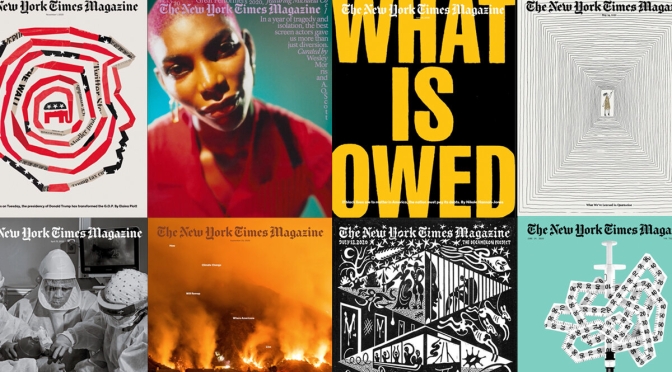
THE NEW YORK TIMES MAGAZINE – August 31, 2025

Current cover

THE NEW YORK TIMES MAGAZINE: The 8.31.25 Issue features Nathiel Rich on the Calabasas landfill following the Los Angeles fires; Scott Anderson on Georgia’s turn toward Russia; Marcela Valdes on in-home care for disabled Americans; and more.

What Does It Take to Get Men to See a Doctor?

Men in the United States live around five years less than women. One clinic is trying to persuade men that getting checked out could save their life. By Helen Ouyang

The Gold Digger Was an Archvillain. Now She’s an Aspiration.

What do men and women really want in our fraught new mating economy?

The New Dream Guy Is Beefy, Placid and … Politically Ambiguous

Amid pitched debates about masculinity, the “himbo” stands stoically above it all. By Casey Michael Henry

THE MAN WHO INVENTED THE MODERN THRILLER

Before Hitchcock or Highsmith, there was Pietro Aretino—Renaissance Venice’s scandalous satirist who turned gossip into cliffhangers and obscenity into art. The man who terrified popes may also have invented the modern thriller.

By Michael Cummins, Editor, August 29, 2025

Venice, 1537

The candle gutters in its brass dish, casting a crooked halo on the damp walls of a salon off the Grand Canal. Pietro Aretino leans back in his chair, one boot propped on a velvet footstool, his voice curling through the smoke like a blade. He does not write—he dictates. A scribe, young and ink-stained, hunches over parchment, trying to keep pace. The letter—addressed, perhaps, to a cardinal, perhaps to a painter—will contain more than pleasantries. It will contain a threat, veiled as an observation, wrapped in a joke.

“Princes fear me more than the plague,” Aretino murmurs, eyes half-lidded. “For I do not kill bodies—I murder reputations.”

The scribe pauses, startled. Aretino waves him on. “Write it. Let them tremble.”

Tomorrow, this page will cross the lagoon, board a courier’s horse, and ignite tremors in Rome or Paris. It may be copied, whispered, condemned. It may be burned. But it will be read.

It was Aretino’s genius to recognize that scandal was not merely gossip—it was architecture. A scaffolding of insinuation and revelation designed to leave its victim dangling. In his six volumes of Lettere (1537–1557), he sharpened that architecture to a fine point. Written to popes, kings, artists, and courtesans, the letters are part autobiography, part political commentary, and wholly performance. “I speak to the powerful as I would to a neighbor,” he crowed, “for truth makes no bow.” What terrified his recipients was not what he said but what he withheld. His words worked like cliffhangers: each letter a suspense novel in miniature.

Aretino liked to imagine himself not born in Arezzo, as the records claimed, but in his own tongue. The myth suited him: a man conjured out of ink and scandal rather than flesh and baptismal water. By the 1520s, he was notorious as the flagello dei principi—the scourge of princes. The title was not a label pinned on him by enemies; it was one he cultivated, polished, and wore like armor. “I carry more lives in my inkpot than the hangman in his noose,” he declared, and few doubted it.

His life was a play in which he cast himself as both author and protagonist. When Pope Clement VII hesitated to pay him, Aretino wrote slyly, “Your Holiness, whose charity is beyond compare, surely requires no reminder of the poverty that afflicts your devoted servant.” In another letter, he praised the Pope’s mercy while threatening to reveal “those excesses which Rome whispers but dares not record.” He lived by double edge: each compliment a prelude, each benediction a warning.

The tactic was not confined to popes. To Michelangelo he sent fulsome admiration: “Your brush moves like lightning, striking down the pride of the ancients.” To Titian he became impresario, writing to Francis I of France that no royal gallery could be complete without Titian’s brush. But the same pen could turn against friend or patron in an instant. A single phrase from Aretino could undo a reputation; a withheld rumor could ruin a night’s sleep.

His enemies often answered with violence. In Rome, in 1525, mercenaries burst into his lodgings after he lampooned the papal indulgence sellers in his Frottole. They dragged him into the street and beat him nearly to death. Neighbors recalled him crawling, bloodied, back to his rooms. Later, when asked why he returned to writing almost immediately, he grinned through broken teeth: “Even death cannot silence a tongue as sharp as mine.” The scars became his punctuation. “My scars,” he wrote in the Lettere, “are the punctuation marks of my story.”

Aretino’s letters functioned like serialized thrillers. Each installment built tension, each cliffhanger left its audience half-terrified, half-delighted. He understood that suggestion could be more devastating than revelation, that anticipation was more dangerous than disclosure. He used ambiguity as a weapon, seeding his pages with conditional phrases: “It is said,” “One hears,” “Were I less discreet…” They were not evasions. They were traps.

One courtier compared the experience to “sitting at supper and finding the meat still bleeding.” The reader was implicated, made complicit in the scandal’s unfolding. Aretino’s genius lay in turning the audience into co-conspirators.

And Venice—city of masks, labyrinths, and whispered betrayals—was practically designed as the birthplace of the thriller. Long before the genre had a name, its ingredients were already steeping in the canals: duplicity, desire, surveillance, and the ever-present threat of exposure. Aretino didn’t write thrillers in form, but he mastered their emotional architecture. His letters were suspenseful, his dialogues scandalous, his persona a walking cliffhanger. Venice gave him the perfect mise-en-scène: a place where truth wore a disguise and reputation was currency. The city itself functioned like a thriller plot—beautiful on the surface, treacherous underneath.

And consider the mechanics: the masked ball becomes the thriller’s false identity. The gondola ride at midnight becomes the covert rendezvous. The whispered rumor in a candlelit salon becomes the inciting incident. The Contarini garden becomes the secret meeting place where alliances shift and truths unravel. It is no accident that Henry James, Daphne du Maurier, Patricia Highsmith, and Donna Leon all returned to Venice when they wanted to explore psychological tension and moral ambiguity. The city doesn’t just host thrillers—it is one.

Imagine a summer evening in 1537. The garden is fragrant with jasmine and fig. Aretino reclines beneath a pergola, flanked by Titian and a Greek scholar from Crete. A courtesan named Nanna pours wine into silver cups.

“You paint gods,” Aretino says to Titian, “but I paint men. And men are far more dangerous.”

Titian chuckles. “Gods do not pay commissions.”

The scholar leans in. “And men do not forgive.”

Nanna smirks, leaning on the marble balustrade. “And yet men pay both of you—in gold for their portraits, in secrets for his letters.”

Aretino raises his cup. “Which is why I never ask forgiveness. Only attention.”

Venice itself became a character: beautiful, deceptive, morally ambiguous. Its canals mirrored the duplicity of its citizens. Its masks—literal and figurative—echoed Aretino’s own performative identity.

But letters were only one weapon. In 1527, Aretino detonated another: the Sonetti lussuriosi, written to accompany Giulio Romano’s engravings known as I Modi. The sonnets made no attempt at discretion. In one, a woman gasps mid-embrace, “Oh God, if this be sin, then let me sin forever!” In another, a lover interrupts her partner’s poetic boasting with the sharp command: “Speak less and thrust more.” The verses shocked even worldly Rome. Pope Clement VII banned the work, copies were burned, and Aretino’s name became synonymous with obscenity. Yet suppression only heightened its allure. “My verses are daggers,” he later said, “that caress before they strike.”

He followed with the Ragionamenti (1534–1536), dialogues between prostitutes and matrons that turned confession into carnival. In the Dialogo della Nanna e della Antonia, one woman scoffs, “The cardinals pray with their lips while their hands wander beneath the skirts.” In the Dialogo nel quale la Nanna insegna a la Pippa, the older courtesan instructs a young girl in survival: “A woman must learn to wield her body as men wield their swords.” These were not just bawdy jokes but philosophical inversions. They exposed hypocrisy with laughter and turned vice into discourse.

His comedies struck with equal force. In La Cortigiana (1534), a satire of Roman society, a friar assures his audience: “Do as I say, not as I do—for my sins are a privilege of office.” In Il Marescalco, a groom forced into marriage laments, “Better to wed a sword than a wife, for steel at least does not betray.” In La Talanta, he boasted with characteristic swagger: “My tongue is the scourge of princes and the trumpet of truth.” These plays were not staged fantasies but mirrors held to the world. Rome and Venice recognized themselves, and recoiled.

Even his occasional pieces carried teeth. During the sack of Rome, he penned the Frottole (1527), short verses filled with bitter humor: “The Germans loot the altars, the Spaniards strip the nuns, and Christ hides his face behind the clouds.” Earlier still, in Il Testamento dell’Elefante Hanno (1516), he composed a mock will for Pope Leo X’s pet elephant. The beast bequeathed its tusks to the cardinals and its dung to the faithful: “For the people, my eternal gift, what Rome already feeds them daily.” Juvenile, grotesque, and brilliant, it set the tone for a lifetime of satiric violence.

Was Aretino a moralist or a manipulator? The question haunts his legacy. Like Machiavelli, he understood power. Like Montaigne, he understood performance. His satire was not disinterested—it was strategic. He exposed corruption, yes, but he also profited from it. His critics accused him of blackmail, of cruelty, of vulgarity. But Aretino saw himself as a mirror. “I do not invent,” he wrote, “I reflect.” The discomfort lay not in his words, but in their accuracy.

The dilemma still feels modern. When does exposure serve truth, and when does it become spectacle? Is scandal a form of justice—or just another form of entertainment? To read Aretino is to feel that question sharpen into relevance. He knew the intoxicating pleasure of watching a hypocrite stripped bare, but he also knew the profit of keeping the knife just shy of the skin.

For centuries, Aretino was dismissed as a pornographer and blackmailer, an obscene footnote beside Petrarch and Ariosto. But scandal has a way of surviving. Nineteenth-century Romantics rediscovered him as a prophet of modernity. Today, critics trace his fingerprints across satire, reportage, and fiction. Balzac’s Parisian intrigues, Wilde’s aesthetic scandals, Patricia Highsmith’s Venetian thrillers—all echo Aretino’s mix of desire and dread.

And then there are the heirs who claimed him outright. The Marquis de Sade, that relentless anatomist of transgression, drew directly from Aretino’s playbook. Sade’s philosophical obscenities echo the structures of the Ragionamenti and the Sonetti lussuriosi: dialogues in which sexuality becomes both performance and interrogation, the bed a courtroom, the embrace a cross-examination. Like Aretino, Sade deployed eroticism not only to shock but to dismantle. Both men wielded obscenity as an intellectual weapon, stripping religion and politics of their sanctity by exposing their hypocrisies in the stark light of desire. When Sade has his libertines sneer at clerics who preach chastity while gorging on pleasure, he repeats Aretino’s barbed observation from a century earlier: “The cardinals pray with their lips while their hands wander beneath the skirts.”

Sade shared Aretino’s radical anti-clericalism, his love of dialogue as a tool of exposure, and his cultivation of notoriety as a literary strategy. The “Divine Marquis” may have been locked in the Bastille, but he carried in his cell Aretino’s scandalous legacy: the belief that obscenity could be philosophy, that provocation itself could be a mode of truth-telling.

Three centuries later, Guillaume Apollinaire would rediscover Aretino with a different eye. In the early twentieth century, Apollinaire praised him as a master who combined “the obscene with the sublime.” In works like Les Onze Mille Verges (The Eleven Thousand Rods), Apollinaire blurred the line between pornography and poetry, scandal and art, just as Aretino had done in his Venetian salons. He admired Aretino’s ability to turn audacity into literature, to make provocation itself a kind of aesthetic. “There is,” Apollinaire wrote of Aretino, “a grandeur in obscenity when it reveals the soul of an age.”

Apollinaire saw in Aretino a precedent for his own experiments: erotic audacity, satirical edge, literary innovation, and a fascination with scandal as aesthetic principle. Where Aretino staged dialogues between courtesans and matrons, Apollinaire crafted delirious erotic parables; where Aretino mocked clerics in his comedies, Apollinaire mocked bourgeois morality with surreal extravagance. Both men made literature dangerous again—texts that could be banned, burned, whispered, yet still survive.

In this long genealogy, Aretino is less a Renaissance curiosity than the origin point of a scandalous tradition that threads through Sade’s prisons, Apollinaire’s Paris, and our own scandal-hungry media. Each recognized that literature need not be safe, that scandal could be structure, that provocation could outlast sermons.

Most uncanny is how current Aretino feels. “What is whispered,” he mused in the Ragionamenti, “weighs more than what is spoken.” That line could be Twitter’s motto, or the tagline of an exposé-driven news cycle. Aretino would have thrived online: the cryptic tweet, the artful insinuation, the screenshot without context. He would have understood the logic of cancel culture, the way scandal circulates as performance, the way innuendo becomes currency.

Imagine him at the end, older now, dictating one last letter. The room is quieter, the scars deeper, the city outside still murmuring with intrigue. He knows his enemies wait for him to fall silent, but he also knows the page will outlive him. The candlelight no longer dances—it trembles. His scribe, older now too, no longer rushes. They have learned the rhythm of Aretino’s menace: slow, deliberate, inevitable.

He pauses mid-sentence, gazing out toward the lagoon. The bells of San Zanipolo toll the hour. A gondola glides past, its oars whispering against the water. Somewhere in the Palazzo Contarini dal Zaffo garden, jasmine blooms in the dark.

“Write this,” he says finally. “To be feared is to be remembered. To be remembered is to be read.”

The scribe hesitates. “And to be read?”

Aretino smiles. “Is to survive.”

He signs his name with a flourish—Pietro Aretino—and sets the quill down. The letter will travel, as they always have, faster than truth and deeper than rumor. It will be copied, misquoted, condemned, and preserved. It will be read by those who hate him and those who become him.

Centuries later, in a world of digital whispers and algorithmic outrage, his voice still echoes. In every scandal that unfolds like a story, in every tweet that wounds like a dagger, in every exposé that trembles with withheld revelation—Aretino is there. Not as ghost, but as architect. He understood what we are still learning: that scandal is not the opposite of art. It is one of its oldest forms. And in the hands of a master, it becomes not just spectacle, but structure. Not just provocation, but prophecy.

The trumpet still sounds. The question is not whether we hear it. The question is whether we recognize the tune.

THIS ESSAY WAS WRITTEN AND EDITED UTILIZING AI

SCIENCE MAGAZINE – AUGUST 28, 2025

Science issue cover

SCIENCE MAGAZINE: The latest issue features ‘Return of The Herd’ – Ecosystem effects of migrating bison.

Bison move through Yellowstone’s Lamar Valley at sunrise. Their movements and grazing accelerate the nitrogen cycle, increasing the annual nutrition that plants provide to herbivores. After decades of recovery, bison now add heterogeneity that sustains soil nutrient storage and plant productivity while allowing plant communities to become more diverse, highlighting the importance of restoring native grazers in large numbers and with freedom to move. See page 904.

New clues found about the assembly of life’s first proteins

Lab study shows how RNA could have helped amino acids join up—without preexisting protein machinery

Europe’s biggest quake may foretell Atlantic ‘ring of fire’

Earth’s mantle is peeling from the crust in the eastern Atlantic, a possible sign of the ocean’s eventual closure

THE ECONOMIST MAGAZINE – AUGUST 30, 2025 PREVIEW

THE ECONOMIST MAGAZINE: The latest issue features ‘What Brazil Can Teach America’

Brazil offers America a lesson in democratic maturity

It is a test case for how countries recover from a populist fever

Humiliation, vindication—and a giant test for India

Trump has triggered a trade and defence crisis: how should Modi respond?

How much danger is America’s central bank in?

Whether Lisa Cook stays or goes, important norms have been broken

France’s government is on the brink of collapse, again

Emmanuel Macron looks likely to lose another prime minister over an attempt to curb public debt

Don’t forget the downsides of China’s innovation push

China’s industrial policy attracts fans abroad, critics at home

Möbius Dreams: A Journey Of Identity Without End

From Nietzsche’s wanderings to Brodsky’s winters in Venice, identity loops like a Möbius strip—and augmented reality may carry those returns to us all.

By Michael Cummins, Editor, August 25, 2025

It begins, as so many pilgrimages of mind and imagination do, in Italy. To step into one of its cities—Florence with its domes, Rome with its ruins, Venice with its waters—is to experience time folding over itself. Stones are worn by centuries of feet; bells still toll hours as they did five hundred years ago; water mirrors façades that have witnessed empires rise and fall. Italy resists linearity. It does not advance from one stage to another; it loops, bends, recurs. For those who enter it, identity itself begins to feel less like a straight line than like a Möbius strip—a single surface twisting back on itself, where past and present, memory and desire, fold into one another.

Friedrich Nietzsche felt that pull most keenly. His journeys through Italy in the 1870s and 1880s were more than therapeutic sojourns for his fragile health; they were laboratories for thought. He spent time in Sorrento, where the Mediterranean air and lemon groves framed his writing of Human, All Too Human. In Genoa, he walked the cliffs above the port, watching the sun rise and fall in a rhythm that struck him as recurrence itself. In Turin, under its grand porticoes, he composed letters and aphorisms before his final collapse in 1889. And in Venice, he found a strange equilibrium between the city’s music, its tides, and his own restlessness. To his confidant Peter Gast, he wrote: “When I seek another word for ‘music,’ I never find any other word than ‘Venice.’” The gondoliers’ calls, the bells of San Marco, the lapping water—all repeated endlessly, yet never the same, embodying the thought that came to define him: the eternal return.

For Nietzsche, Italy was not a backdrop but a surface on which recurrence became tangible. Each city was a half-twist in the strip of his identity: Sorrento’s clarity, Genoa’s intensity, Turin’s collapse, Venice’s rhythm. He sensed that to live authentically meant to live as though each moment must be lived again and again. Italy, with its cycles of light, water, and bells, made that philosophy palpable.

Henry James —an American expatriate author with a different temperament—also found Italy less a destination than a structure. His Italian Hours (1909) reveals both rapture and unease. “The mere use of one’s eyes in Italy is happiness enough,” he confessed, yet he described Venice as “half fairy tale, half trap.” The city delighted and unsettled him in equal measure. He wandered Rome’s ruins, Florence’s galleries, Venice’s piazzas, and found that they all embodied a peculiar temporal layering—what he called “a museum of itself.” Italy was not history frozen; it was history repeating, haunting, resurfacing.

James’s fiction reflects that same looping structure. In The Aspern Papers, an obsessive narrator circles endlessly around an old woman’s letters, desperate to claim them, caught in a cycle of desire and denial. In The Portrait of a Lady, Isabel Archer discovers that the freedom she once thought she had secured returns as entrapment; her choices loop back on her with tragic inevitability. Even James’s prose mirrors the Möbius curve: sentences curl and return, digress and double back, before pushing forward. Reading James can feel like walking Venetian alleys—you arrive, but only by detour.

Joseph Brodsky, awarded the 1987 Nobel Prize in Literature after being exiled from the Soviet Union in 1972, found in Venice a winter refuge that became ritual. Each January he returned, until his death in 1996, and from those returns came Watermark (1992), a prose meditation that circles like the canals it describes. “Every January I went to Venice, the city of water, the city of mirrors, perhaps the city of illusions,” he wrote. Fog was his companion, “the city’s most faithful ghost.” Brodsky’s Venice was not Nietzsche’s radiant summer or James’s bustling salons. It was a city of silence, damp, reflection—a mirror to exile itself.

He repeated his returns like liturgy: sitting in the Caffè Florian, notebook in hand, crossing the Piazza San Marco through fog so dense the basilica dissolved, watching the lagoon become indistinguishable from the sky. Each January was the same, and yet not. Exile ensured that Russia was always present in absence, and Venice, indifferent to his grief yet faithful in its recurrence, became his Möbius surface. Each year he looped back as both the same man and someone altered.

What unites these three figures—Nietzsche, James, Brodsky—is not their similarity of thought but their recognition of Italy as a mirror for recurrence. Lives are often narrated as linear: childhood, youth, adulthood, decline. But Italy teaches another geometry. Like a Möbius strip, it twists perspective so that to move forward is also to circle back. An old anxiety resurfaces in midlife, but it arrives altered by experience. A desire once abandoned returns, refracted into new form. Nietzsche’s eternal return, James’s recursive characters, Brodsky’s annual exiles—all reveal that identity is not a line but a fold.

Italy amplifies this lesson. Its cities are not progressions but palimpsests. In Rome, one stands before ruins layered upon ruins: the Colosseum shadowed by medieval houses, Renaissance palaces built into ancient stones. In Florence, Brunelleschi’s dome rises above medieval streets, Renaissance paintings glow under electric light. In Venice, Byzantine mosaics shimmer beside Baroque marble while tourists queue for modern ferries. Each city is a surface where centuries loop, never erased, only folded over.

Philosophers and writers have groped toward metaphors for this looping. Nietzsche’s eternal return insists that each moment recurs infinitely. Derrida’s différance plays on the way meaning is always deferred, never fixed, endlessly circling. Borges imagined labyrinths where every turn leads back to the start. Gloria Anzaldúa’s Borderlands describes identity as hybrid, cyclical, recursive. Italy stages all of these. To walk its piazzas is to feel history as Möbius surface: no beginning, no end, only continuous return.

But the Möbius journey of return is not without strain. Increasing overcrowding in Venice has made Piazza San Marco feel at times like a funnel for cruise-ship day trippers, raising questions of whether the city can survive its admirers. Rising costs of travel —inflated flights, pricier accommodations, surcharges for access—place the dream of pilgrimage out of reach for many. The very recurrence that writers once pursued with abandon now risks becoming the privilege of the few. And so the question arises: if one cannot return physically, can another kind of return suffice?

The answer is already being tested. Consider the Notre-Dame de Paris augmented exhibition, created by the French startup Histovery. Visitors carry a HistoPad, a touchscreen tablet, and navigate 850 years of the cathedral’s history. Faux stone tiles line the floor, stained-glass projections illuminate the walls, recordings of tolling bells echo overhead. With a swipe, one moves from the cathedral’s medieval construction to Napoleon’s coronation, then to the smoke and flames of the 2019 fire, then to the scaffolds of its restoration. It is a Möbius strip of architecture, looping centuries in minutes. The exhibition has toured globally, making Notre-Dame accessible to millions who may never step foot in Paris.

Italy, with its fragile architecture and layered history, is poised for the same transformation. Imagine a virtual walk through Venice’s alleys, dry and pristine, free of floods. A reconstructed Pompeii, where one can interact with residents moments before the eruption. Florence restored to its quattrocento brilliance, free of scaffolding and tourist throngs. For those unable to travel, AR offers an uncanny loop: recurrence of experience without presence.

Yet the question lingers: if one can walk through Notre-Dame without smelling the stone, without hearing the echo of one’s own footsteps, have they truly arrived? Recurrence, after all, has always been embodied. Nietzsche needed the Venetian fog to sting his lungs. James needed to feel the cold stones of a Florentine palazzo. Brodsky needed the damp silence of January to write his Watermark. The Möbius loop of identity was sensory, mortal, physical. Can pixels alone replicate that?

Perhaps this is too stark a contrast. Italy itself has always been both ruin and renewal, both stone and scaffolding, both presence and representation. Rome is simultaneously crumbling and rebuilt. Florence is both painted canvas and postcard reproduction. Venice is both sinking and endlessly photographed. Italy has survived by layering contradictions. Augmented reality may become one more layer.

Indeed, there is hope in this possibility. Technology can democratize what travel once restricted. The Notre-Dame exhibition allows a child in Kansas to toggle between centuries in an afternoon. It lets an elder who cannot fly feel the weight of medieval Paris. Applied to Italy, AR could make the experience of recurrence more widely available. Brodsky’s fog, Nietzsche’s bells, James’s labyrinthine sentences—these could be accessed not only by the privileged traveler but by anyone with a headset. The Möbius strip of identity, always looping, would expand to include more voices, more bodies, more experiences.

And yet AR is not a replacement so much as an extension. Those who can still travel will always seek stone, water, and bells. They will walk the Rialto and feel the wood beneath their feet; they will stand in Florence and smell the paint and dust; they will sit in Rome’s piazzas and feel the warmth of stone in the evening. These are not illusions but recurrences embodied. Technology will not end this; it will supplement it, add folds to the Möbius strip rather than cutting it.

In this sense, the Möbius book of identity continues to unfold. Nietzsche’s Italian sojourns, James’s expatriate wanderings, Brodsky’s winter rituals—all are chapters inscribed on the same continuous surface. Augmented reality will not erase those chapters; it will add marginalia, footnotes, annotations accessible to millions more. The loop expands rather than contracts.

So perhaps the hopeful answer is that recurrence itself becomes more democratic. Italy will always be there for those who return, in stone and water. But AR may ensure that those who cannot return physically may still enter the loop. A student in her dormitory may don a headset and hear the same Venetian bells that Nietzsche once called music. A retiree may walk through Florence’s restored galleries without leaving her home. A child may toggle centuries in Notre-Dame and begin to understand what it means to live inside a Möbius strip of time.

Identity, like travel, has never been a straight line. It is a fold, a twist, a surface without end. Italy teaches this lesson in stone and water. Technology may now teach it in pixels and projections. The Möbius book has no last page. It folds on—Nietzsche in Turin, James in Rome, Brodsky in Venice, and now, perhaps, millions more entering the same loop through new, augmented doors.

The self is not a line but a surface, infinite and recursive. And with AR, more of us may learn to trace its folds.

THIS ESSAY WAS WRITTEN AND EDITED UTILIZING AI

The Envelope of Democracy

How a practice born on Civil War battlefields became the latest front in America’s fight over trust, law, and the vote.

By Michael Cummins, Editor, August 23, 2025

On a raw November morning in 1864, somewhere in a Union encampment in Virginia, soldiers bent over makeshift tables to mark their ballots. The war was not yet won; Grant’s men were still grinding through the trenches around Petersburg. Yet Abraham Lincoln insisted that these men, scattered across muddy fields and far from home, should not be denied the right to vote. Their ballots were gathered, sealed, and carried by courier and rail to their home states, where clerks would tally them beside those cast in person. For the first time in American history, large numbers of citizens voted from a distance—an innovation spread across 19 Union states by hasty wartime statutes and improvised procedures (National Park ServiceSmithsonian).

Lincoln understood the stakes. After the votes were counted, he marveled that “a people’s government can sustain a national election, in the midst of a great civil war” (Library of Congress). To deny soldiers their ballots was to deny the Union the very legitimacy for which it fought. Then, as now, critics fretted about fraud and undue influence: Democrats accused Republicans of manufacturing ballots in the field; rumors spread of generals pressuring soldiers to vote for Lincoln. Newspapers thundered warnings about the dilution of the franchise. But the republic held. Soldiers voted, the ballots were counted, and Lincoln was re-elected.

A century and a half later, the envelope has become a battlefield again. Donald Trump has promised to “end mail-in ballots” and scrap voting machines, declaring them corrupt, even while bipartisan experts explain that nearly all U.S. ballots are already paper, with machines used only for tabulation and auditing (APBipartisan Policy Center). The paradox is striking: modern tabulators are faster and more accurate than human tallies, while hand counts are prone to fatigue and error (Time).

But how did a practice with Civil War pedigree come to be portrayed as a threat to democracy itself? What, at root, do Americans fear when they fear the mailed ballot?

In a Phoenix suburb not long ago, a first-time voter—call her Teresa—dropped her ballot at a post office with pride. She liked the ritual: filling it out at her kitchen table, checking the boxes twice, signing carefully. Weeks later, she learned her ballot had been rejected for a signature mismatch with an old ID on file. She had, without knowing it, missed the deadline to “cure” her ballot. “It felt like I didn’t exist,” one young Arizonan told NPR, voicing the frustration of many. Across the country, younger and minority voters are disproportionately likely to have their mail ballots rejected for administrative reasons such as missing signatures or late arrival. If fraud by mail is vanishingly rare, disenfranchisement by process is not.

Meanwhile, on the factory floor of American vote-by-mail, the ordinary hum of democratic labor continues. Oregon has conducted its elections almost entirely by mail for a quarter century, with consistently high participation and confidence (Oregon Secretary of State). Colorado followed with its own all-mail model, paired with automatic registration, ballot tracking, and risk-limiting audits (Colorado Secretary of State). Washington and Utah have joined in similar fashion. Election officials talk about the efficiency of central counting centers, the ease of auditing paper ballots, the increased access for rural and working-class voters. One clerk described her office during election week as “a warehouse of democracy,” envelopes stacked in trays, staff bent over machines that scan and sort. In one corner, a team compares signatures with the care of art historians verifying provenance. The scene is not sinister but oddly moving: democracy reduced to thousands of small acts of faith, each envelope a declaration that one voice counts.

And yet suspicion lingers. Part of it is ritual. The image of democracy for generations has been the polling place: chalkboard schedules, folding booths, poll books fat with names. The mailed ballot decentralizes the ceremony. It moves civic action into kitchens and break rooms, onto couches and barracks bunks. For some, invisibility breeds mistrust; for others, it is the genius of the thing—citizenship woven into home life, not just performed in public.

Part of the anxiety is legal. The Constitution’s Elections Clause gives the states authority over the “Times, Places and Manner” of congressional elections but empowers Congress to “make or alter such Regulations” (Constitution Annotated). Presidents have no such power. The White House cannot ban absentee ballots by decree. Congress could attempt to standardize or limit the use of mail ballots in federal elections—though any sweeping restriction would run headlong into litigation from voters who cannot be present on Election Day, from soldiers on deployment to homebound citizens.

And we have seen how precarious counting can be when law and logistics collide. In 2000, Florida’s election—and the presidency—turned not on fraud but on ballots: “hanging chads,” the ambiguous punch-card remnants that confounded machines and humans alike. The Supreme Court’s decision in Bush v. Gore halted a chaotic recount and left many Americans convinced that the true count would forever be unknowable (Oyez). The lesson was not that ballots are fraudulent, mailed or otherwise, but that the process of counting and verifying them is fragile, and that the legitimacy of outcomes depends on rules agreed to before the tally begins.

It is tempting, in moments of panic, to look abroad for calibration. In the United Kingdom, postal ballots are an ordinary convenience governed by clear rules (UK Electoral Commission). Canadians deploy a “special ballot” system that lets voters cast by post from the Yukon to Kandahar (Elections Canada). The Swiss have made postal voting a workaday part of civic life (Swiss Confederation). Fraud exists everywhere—but serious cases are exceptional, detected, and punished.

Back home, the research is blunt. The Brennan Center for Justice finds that fraud in mail balloting is “virtually nonexistent.” A Stanford–MIT study found that universal vote-by-mail programs in California, Utah, and Washington had no partisan effect—undercutting claims that the method “rigs” outcomes rather than simply broadening access. And those claims that machines slow results? Election administrators, backed by Wisconsin Watch, explain that hand counts tend to be slower and less accurate, while scanners paired with paper ballots and audits deliver both speed and verifiability.

Still, mistrust metastasizes, not from facts but from fear. A rumor in Georgia about “suitcases of ballots,” long debunked, lingers as a meme. A Michigan voter insists he saw a neighbor mail five envelopes, unaware they were for a household of five registered voters. Conspiracy thrives in the gap between visibility and imagination.

Yet even as the mailed ballot feels embattled, the next frontier is already under debate. In recent years, pilot projects have tested whether citizens might someday cast votes on their phones or laptops, secured not by envelopes but by cryptographic ledgers. The mobile voting platform Voatz, used experimentally in West Virginia and a few municipal elections, drew headlines for its promise of accessibility but also for its flaws: researchers at MIT found vulnerabilities tied to third-party cloud storage and weak authentication, prompting urgent warnings (MIT Technology Review). GoatBytes’ 2023 review noted that blockchain frameworks like Hyperledger Sawtooth and Fabric might one day offer stronger, verifiable digital ballots, and even the U.S. Postal Service has patented a blockchain-based mobile voting system (USPTO Patent). Capitol Technology University traced this shift as the latest stage in the long evolution from paper to punch cards to optical scanners, with AI now assisting ballot tabulation (Capitol Tech University). For proponents, mobile systems are less about novelty than necessity: the disabled veteran, the soldier abroad, the homebound elder—all could vote with a tap.

But here, too, the fault lines are visible. The American Bar Association recently cautioned that while blockchain and smartphone voting might expand access, they raise thorny questions about privacy, coercion, and verification—how to ensure a vote cast on a personal device is both secret and authentic. TIME Magazine spotlighted the allure of digital voting for those long underserved by the system, even as groups like Verified Voting warned that premature adoption could expose elections to risks far graver than those posed by paper mail ballots (TIME). In this telling, technology is Janus-faced: a path to broaden democracy’s reach, and a Pandora’s box of new vulnerabilities. If the mailed envelope embodies trust carried by hand, the mobile ballot would ask citizens to entrust their franchise to lines of code. Whether Americans are ready to make that leap remains an open question.

If there is a flaw to worry about, it is not the specter of rampant fraud, but the small, fixable frictions that disenfranchise well-meaning voters: needlessly strict signature-match policies, short cure windows, postal delays for ballots requested late, confusing instructions, and uneven funding for local election offices. The remedy comes not from abolishing the envelope, but from investing in the infrastructure around it: clear statewide standards for verification and cure; robust voter education about deadlines; modernized voter registration databases; secure drop boxes; and the budget lines that let county clerks hire and train staff.

In the end, the mailed ballot is less a departure from American tradition than a continuation of it. The ritual has changed—less courthouse, more kitchen table—but the bargain is the same. When a soldier in 1864 dropped his folded ballot into a wooden box, he entrusted strangers to carry it home. When a modern voter seals an envelope in Denver or Tacoma, she entrusts a chain of clerks, scanners, and auditors. Trust, not spectacle, is the beating heart of the system.

And perhaps that is why the envelope matters so much now. To defend it is not merely to defend convenience; it is to defend a vision of democracy capacious enough to reach the absent, the disabled, the far-flung, the over-scheduled—our fellow citizens whose lives do not always bend to a Tuesday line at a nearby gym. To reject it is to narrow the franchise to those who can appear on command.

Imagine Lincoln again, weary at the White House in the fall of 1864, reading dispatches about alleged fraud in soldier ballots and still insisting the votes be counted. Imagine a first-time voter in Phoenix who lost her chance over a mismatched squiggle, and the next one who won’t because the state clarified its cure rules. Imagine the county clerk who will never trend on social media, but who builds public confidence day by day with plain procedures and paper trails.

At the end of the day, American democracy may still come down to envelopes—white, yellow, blue—carried in postal bins, stacked in counting rooms, marked by the smudges of human hands. They are fragile, yes, but they are resilient too. The Civil War ballots survived trains and rivers; today’s ballots survive disinformation and delay. The act is the same: a citizen marks a choice, seals it, and sends it forth with faith that it will be received. If democracy is government of, by, and for the people, then every envelope is its emissary.

What would we lose if we tore that emissary up? Not only the votes of those who cannot stand in line, but the habit of trust that keeps the republic breathing. Better, then, to do what we have done at our best moments—to keep counting, keep auditing, keep improving, keep faith. The mailed ballot is not a relic of pandemic panic; it is a tested tool of a sprawling republic that has always asked its citizens to speak from wherever they are.

THIS ESSAY WAS WRITTEN AND EDITED UTILIZING AI

THE REPUBLIC OF VOICES

At the height of its power in 1364, Venice was a republic where eloquence was currency and every piazza a stage.

By Michael Cummins, Editor, August 24, 2025

The bells began before sunrise. Their iron tongues tolled across the lagoon, vibrating against the damp November air, carrying from the Campanile of San Marco to the Arsenal’s yards and into the canals of Cannaregio. This was Venice in 1364—at the height of its power, its fleets unrivaled in the Mediterranean, its markets setting the prices of silk and spice across Europe. The city sat at the hinge of East and West, commanding trade routes between Byzantium, the Mamluk Sultanate, and Western Christendom. Venetian galleys, sleek and maneuverable, patrolled waters thick with pirates, their timbers assembled in the Arsenale di Venezia, a proto-industrial marvel capable of producing a galley in a single day. Venice was wood, stone, and gold, but above all, it was sound. “The city is never silent,” one German pilgrim marveled, “every tongue of Christendom and beyond seems to shout at once.”

Venice’s supremacy was not abstract. Its colonies in Crete and Cyprus served as staging posts; its consulates dotted the Dalmatian coast. In Constantinople and Alexandria, Venetians lived in fortified fondaci—walled compounds where merchants traded under their own laws. The wealth of Murano’s glassmakers, Rialto’s bankers, and San Polo’s textile dyers depended on this vast maritime lattice. Even the Doge—Venice’s elected head of state, chosen for life from among the patrician class, part monarch, part magistrate but hemmed in by councils—was more merchant than monarch. Venetian nobility was not feudal but commercial: a patrician might chair the Senate one year and finance a convoy to the Levant the next. Bills of exchange, maritime insurance, joint-stock ventures—all pioneered here—reduced risk and turned uncertainty into empire.

Yet the republic was also built on voices. Speech was its second currency, flowing through churches, palaces, markets, and courts. Treaties were sealed with words before they were inked; rumors shifted markets as much as cargoes; sermons inflamed consciences long before decrees reached the streets.

In San Marco, the Basilica of mosaics and incense, the preacher’s voice dominated. On feast days friars addressed audiences that blurred patrician and plebeian, women and sailors, artisans and merchants. A Franciscan, recalling the Black Death, likened Venetian greed to “a contagion that spreads from house to house.” Andrea Dandolo, the Doge who also wrote a chronicle of his age, noted the murmurs of unease that followed. A parable about false shepherds might by nightfall become tavern gossip, retooled as an attack on patrician governors.

In 1364, Venice granted Petrarch a palazzo on the Riva degli Schiavoni in exchange for his library, a collection that would become the foundation of the Biblioteca Marciana. Known as the father of Humanism and now often called the father of the Italian Renaissance, he was among Europe’s most influential figures—poet of the Canzoniere, rediscoverer of Cicero’s letters, and advocate for the revival of classical eloquence. From his Venetian residence, he praised the city as “a republic not only of ships and laws, but of eloquence itself, where voices, raised in harmony or dissent, bind the state together.” For him, Venice was not only a naval empire but also a theater of speech.

Across the piazza in the Doge’s Palace, words carried a different weight. The cavernous Sala del Maggior Consiglio could hold a thousand patricians, their decisions shaping treaties and wars. The Doge spoke little, his ritual response to petitions—“Si vedrà”, “It will be seen”—an eloquence of restraint. More dramatic were the relazioni, oral reports of ambassadors returning from Constantinople or Cairo. Though later transcribed, in the fourteenth century they were performances. An envoy describing the Byzantine emperor’s throne gestured so vividly that senators felt transported to the imperial court.

Yet it was in the Rialto that Venice’s speech was most raw, where chatter became commerce and gossip became power. By day, the wooden bridge creaked under merchants and beggars, its planks worn smooth by boots from every corner of Europe. Below, spices from Alexandria, silk from Cathay, and pepper from India changed hands, but so too did stories. “The Rialto is a world itself,” wrote the chronicler Marino Sanudo, “where the news of all Christendom and beyond is traded swifter than spices.” Rumors of Ottoman fleets could shift the price of cinnamon. Satirical verses, recited sotto voce, mocked the deafness of patricians: “A house of nodding heads, deaf to its people.”

And when night fell, the Rialto became something else entirely. Carnival transformed it into a stage where anonymity and satire thrived. Masked singers, some of them patrician youths disguised as artisans, improvised verses lampooning senators and guild leaders. One chronicler described young nobles in Greek disguise singing ballads about the Senate’s obsession with ceremony. The laughter echoed across the Grand Canal, tolerated because, as Venetians said, “the republic breathes satire as easily as air.”

The Grand Canal itself was Venice’s liquid stage. By day it was an artery of commerce, alive with the slap of oars, the curses of gondoliers, the hammering of crates. By dusk the atmosphere shifted. Lanterns swayed from boats, their reflections shimmering across the black water. Gondoliers sang what would one day evolve into the barcarolle. Noble families staged boat processions with lutes and trumpets, music drifting across the canal in competing layers of sound. Commerce by day, serenade by night—the same canal a bazaar and a ballroom.

And then there was the Piazza San Marco, the great stage of the republic. On feast days, choirs filled the basilica, their plainsong swelling into polyphony that ricocheted off Byzantine domes. Trumpeters announced the Doge, banners unfurled, and processions wound through the square until, as Dandolo wrote, “the piazza shone with gold and sounded with voices and trumpets.” During Carnival, the sacred gave way to the profane: jugglers, acrobats, and improvisatori recited comic verses in dialect. A fire-breather might draw crowds near the bronze horses while a masked singer mocked senators. It was noisy, unruly, profoundly Venetian—a place where art, politics, and voice collided.

Artisans, too, had their stages. The scuole, confraternities of tradesmen, were gatherings where chants gave way to orations. Statutes might be inscribed, but obligations were enforced aloud. A shoemakers’ statute from 1360 commanded that “each master shall stand and speak before his fellows, giving account not only of his work but of his conduct.” Eloquence was honor; to falter was to risk shame.

The courts offered a harsher stage. Justice, too, was spoken. The Statuta Veneta emphasized testimony over parchment: “testimony is judged not by parchment but by voice.” In 1362, a fisherman accused of theft protested, “Non rubai, ma trovai.”—“I did not steal, I found.” His trembling voice, the notary observed, betrayed him. Eloquence could acquit; faltering speech could condemn.

And words could also damn. After the plague, prophets thundered in piazzas, sailors cursed saints in taverns, women repeated visions too vividly. One inquisitorial record recalls a woman accused of declaring, “the plague is God’s punishment for the pride of merchants.” Whether prophecy or lament, her words were evidence of heresy.

To live in Venice was to live in a polyphony of languages. From Dalmatia to Crete, Cyprus to Trebizond, the city’s empire infused it with voices. The pilgrim Ludolf of Sudheim marveled that in one square he heard “Latin, Greek, Saracen, and Hebrew, all arguing.” Translators ferried not only goods but ideas—fragments of Averroes, Byzantine theology, Jewish philosophy. Did a spice-seller at the Rialto know he was transmitting the seeds of the Renaissance?

In patrician libraries and monastic scriptoria, another kind of voice was taking shape: Aristotle and Thomas Aquinas, arriving in Latin translation, read aloud in candlelit chambers. By 1364, copies of Aristotle’s Politics and Nicomachean Ethics were circulating among patricians. What did it mean to live a life of virtue? Could the common good outweigh private interest? Such debates mattered in a republic balancing mercantile ambition with civic restraint.

Thomas Aquinas, too, was debated in Dominican houses. His Summa Theologica offered a scaffolding that united reason and faith. Did divine law supersede human law, or did the latter participate in the former? A friar might thunder against usury on Sunday while echoing Aquinas’s careful distinctions on just exchange.

What is striking is that these scholastic voices did not remain confined to cloisters. They mingled with guild disputations, senatorial deliberations, carnival satire. And just beyond the horizon, Humanism was stirring. Petrarch, uneasy yet pivotal, urged Venetians to recover eloquence from Cicero and Livy. The republic was poised between worlds: the scholastic synthesis of Aquinas and the humanist insistence that civic life could be ennobled by rhetoric and classical virtue. Venice in 1364 was thus not only a theater of speech but also a laboratory of ideas.

At dusk, the bells tolled once more. Gondoliers sang across the black canal, masked youths mocked senators in the Rialto, choirs rehearsed in San Marco. Senators lingered in debate, artisans rehearsed speeches, children recited prayers before sleep. Venice in 1364 was not only a republic of ships, coins, and statutes. It was a republic of voices. Andrea Dandolo wrote that “our city is a harmony of voices, discordant yet united, a choir upon the waters.”

Perhaps that is the truest way to understand the city at its zenith. Its power lay not only in fleets or treaties, but in the ceaseless interplay of sound and sense: the preacher stirring unease, the envoy swaying senators, the gondolier echoing Aristotle, the satirist mocking the elite. The same city that hammered out galleys in the Arsenale was also hammering out philosophies in its libraries, rhythms in its shipyards, and laughter in its carnivals. To live in Venice in 1364 was to inhabit a world where speech, spectacle, and speculation were indivisible, where every bridge or piazza might become a stage. The republic endured not because it silenced discord but because it orchestrated it—turning sermon, satire, and song into the polyphony of civic life. Venice was, and remains, a choir upon the waters.

THIS ESSAY WAS WRITTEN AND EDITED UTILIZING AI