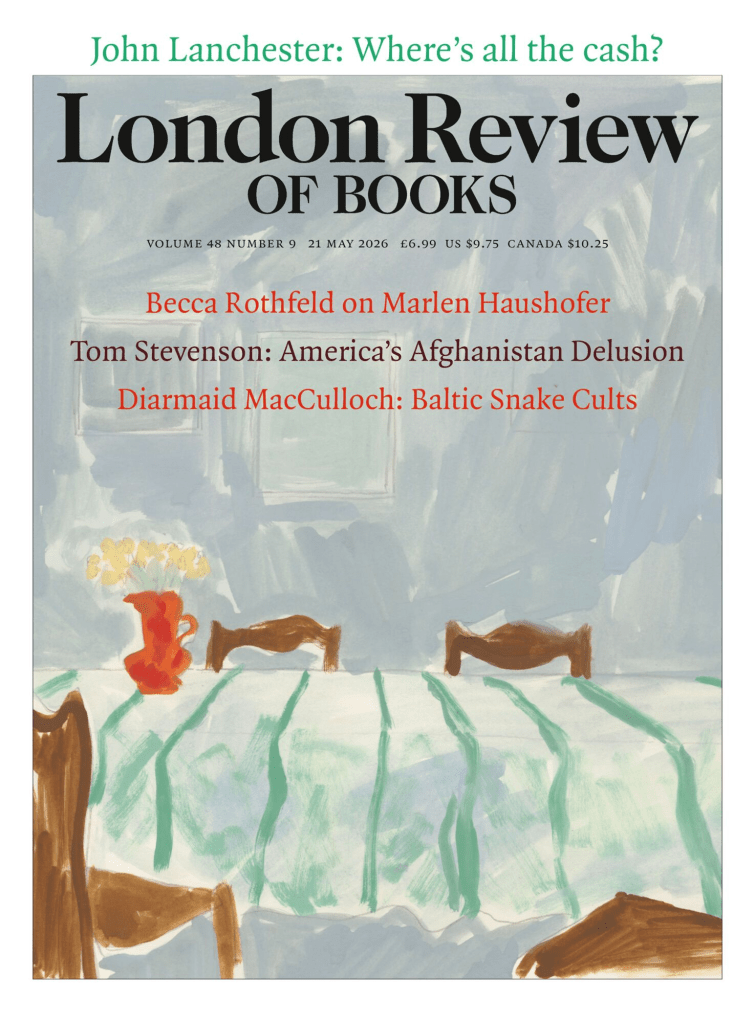
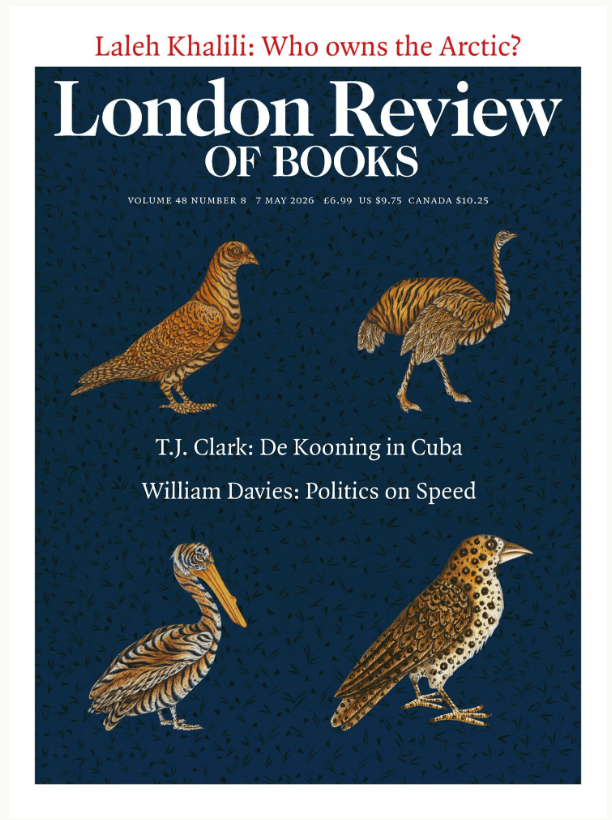
“America’s Afghanistan Delusion” by Tom Stevenson: Stevenson examines the legacy of the War on Terror, arguing that the 2021 withdrawal from Kabul was viewed by the Western establishment as a “mistake” or “cautionary tale” rather than the “crime” he suggests it was. He traces the expansion of American power through “black sites” and military advisers across the globe.
“Short Cuts: Labour’s Failure” by James Butler: Butler analyzes the results of the English local elections (held on May 7). He criticizes Keir Starmer’s leadership style as “all injunction and no argument” and explores why national revulsion toward the Labour Party overshadowed local government issues.
“Where’s All the Cash?” by John Lanchester: A characteristically lucid investigation into modern economics, focusing on the circulation of physical currency and the shifting nature of wealth in a digital-first economy.
Literature & History
“On Marlen Haushofer” by Becca Rothfeld: A deep dive into the work of the Austrian writer, specifically her 1963 masterpiece The Wall. Rothfeld explores Haushofer’s recurring themes of entrapment and isolation, noting the paradoxical “joy” found in her most barricaded characters.
“Baltic Snake Cults” by Diarmaid MacCulloch: The eminent historian reviews the long survival of paganism and “serpent worship” in the Baltic regions, challenging the standard narrative of a monolithic Christian Europe during the Middle Ages.
“Should We Punish?” by Thomas Nagel: The philosopher engages with the ethics of the penal system, weighing the traditional justifications for punishment against contemporary moral and legal theories.
Other Features
“The Clearance of Aoineadh Mòr, 1824” by Tarn MacArthur: A historical account of the Highland Clearances, specifically focusing on the displacement of communities in Scotland.
At the Movies: Michael Wood provides his regular column of film criticism, likely focusing on current European or art-house releases.
Poetry & Correspondence: The issue also contains poems and a robust letters section, which in this period has been heavily occupied by debates over the Arctic (following Laleh Khalili’s piece in the previous issue) and the fallout of the UK local elections.
The US-Israeli war against Iran, far from encouraging a popular uprising, has strengthened the regime’s grip and set back the cause of Iranian freedom indefinitely.
In Everthing Is Now, J. Hoberman chronicles a radical avant-garde’s attempts to jostle New York City out of its postwar complacency and moral retrenchment.
Everything Is Now: The 1960s New York Avant-Garde—Primal Happenings, Underground Movies, Radical Pop by J. Hoberman
Walter Lippmann was the most influential political commentator of his generation, but behind his preternatural confidence was a far more complicated and unsettled character.
Walter Lippmann: An Intellectual Biography by Tom Arnold-Forster
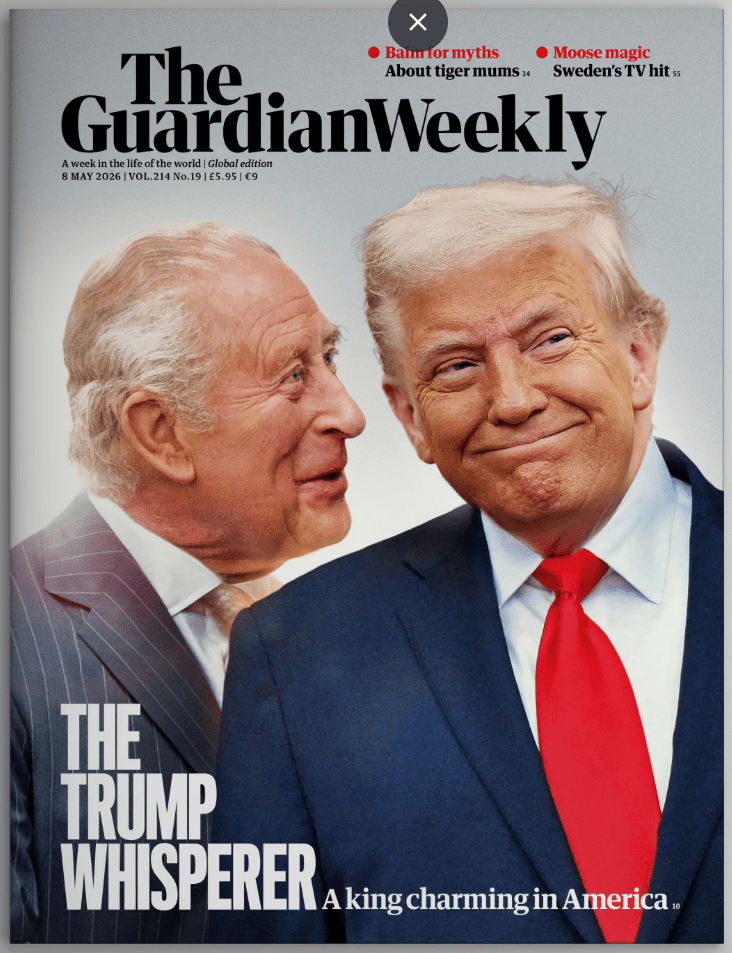
It’s fair to say that the Guardian Weekly does not cover many royal visits, but King Charles III’s US state visit was the most consequential of his reign so far. The king’s ostensible purpose was to celebrate America’s 250 years of independence but last week’s trip was freighted with other agendas, most important of which was to flatter his host, Donald Trump. Washington bureau chief David Smith’s cover story shows how “like a rapier wrapped in ermine, Charles managed to tame Trump while rebuking Trumpism”. Both David and our veteran foreign affairs commentator Simon Tisdall unpick the skill with which Charles spoke truth to this capricious and egotistical president and gave both sides of the heavily divided Congress much to praise. It was a performance of high diplomacy at a time of huge tension in the transatlantic relationship and beyond.
But the charm didn’t wash in New York where, as Adam Gabbatt’s sketch shows, the shadow of Jeffrey Epstein and Andrew Mountbatten-Windsor, Charles’s disgraced brother, lurked while the mayor, Zohran Mamdani, brought up the spectre of colonialism in the shape of the Koh-i-noor diamond, snatched under disputed circumstances.
Spotlight | A small town in Germany Landstuhl, the heart of the largest American military community outside the US, considers its future after Donald Trump’s decision to withdraw 5,000 troops, reports Deborah Cole
Environment | A gift of wings Patrick Barkham takes off for a flight of wonder with The Lost Words duo, who have reunited for a new book on endangered birds
Feature | A balm for tiger mother myths Rebecca Liu explores why a certain image of the tiger mum – strict, cold and demanding – is ubiquitous in popular culture
Opinion | Antiracists need to stand up for us all Another attack on the UK’s Jewish population demands a clear show of solidarity from those who march to protect minorities, argues Jonathan Freedland
Culture | Moose magic on the loose How do cameras capture Sweden’s seasonal TV hit, the Great Moose Migration? Malcolm Jack travels to an uninhabited island in the Ångerman river to ask the show’s makers
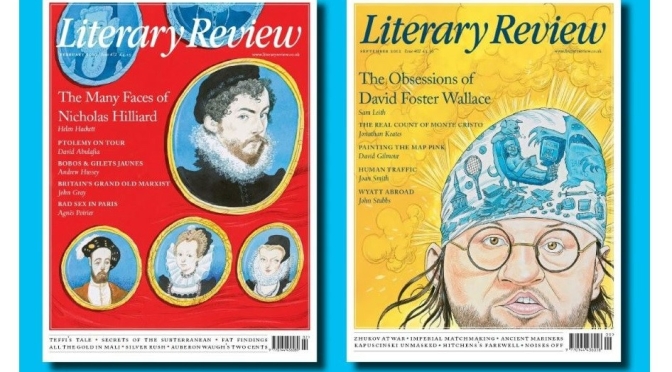
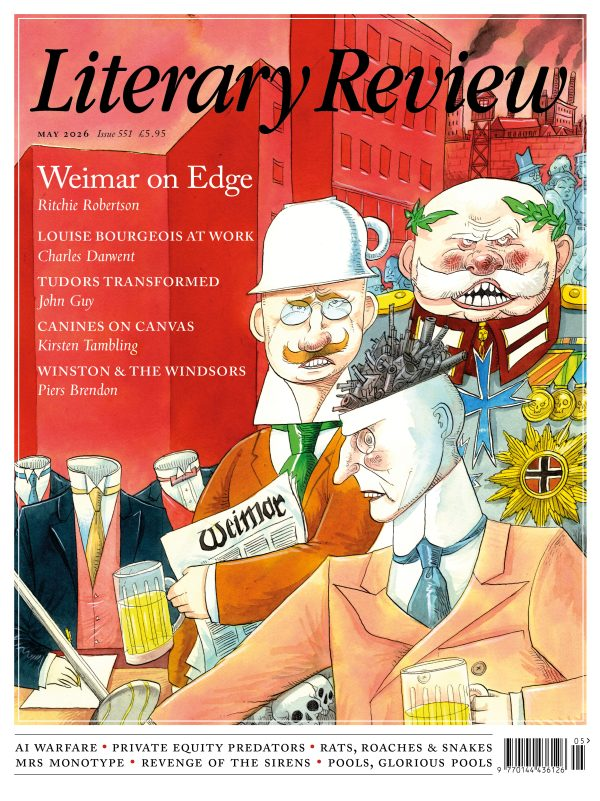
LITERARY REVIEW : The latest issue featuresRitchie Robertson on Weimar * Charles Darwent on Louise Bourgeois * John Guy on the Tudors * Kirsten Tambling on dogs in art * Piers Brendon on Churchill and the crown * Saul David on AI warfare * Simon Nixon on private equity predators * Nigel Andrew on outsider animals * Zoe Guttenplan on Beatrice Warde * Maren Meinhardt on women and music * Lucy Lethbridge on swimming * Diane Purkiss on being published * Anthony Pagden on the West * Michael Reid on Lula * Anthony Teasdale on Tory leaders * Anna Reid on Vera Gedroits * Wendy Holden on Elizabeth II * Harriet Rix on trees * Emma Smith on Shakespeare’s identity * Jane Yager on Herta Müller * Sheena Joughin on Siri Hustvedt * Adam Kucharski on evidence * Keith Miller on Douglas Stuart * Natalie Perman on Jem Calder * and much, much more…
Weimar Germany: Death of a Democracy By Victor Sebestyen
Weimar: Life on the Edge of Catastrophe By Katja Hoyer
The small town of Weimar is overladen with historical associations. Goethe spent more than fifty years there as an employee and friend of Duke (later Grand Duke) Karl August. After the last grand duke abdicated in November 1918, the National Assembly met in Weimar to draw up a new republican constitution for Germany. Other symbolically charged venues considered were Nuremberg (home of Dürer) and Bayreuth (because of Wagner), but it was Weimar that gave its name to the period of German history from …
Having been named for her father, Louis, a mere dealer in antique tapestries, seemed insufficiently romantic to Louise Bourgeois, who was born on Christmas Day in 1911. She preferred the idea that her namesake was Louise Michel, ‘the red virgin of Montmartre’, an anarchist heroine of the Paris Commune. It wasn’t true, of course, but …
A phrase like ‘fortress England’ seems to echo down the centuries, and turns up again in This Little World, Nandini Das’s new study of identity and belonging, cross-border migration, assimilation and estrangement in the period between 1500 and the restoration of Charles II. Das seeks to unmask the period’s most fundamental assumptions about English … read more
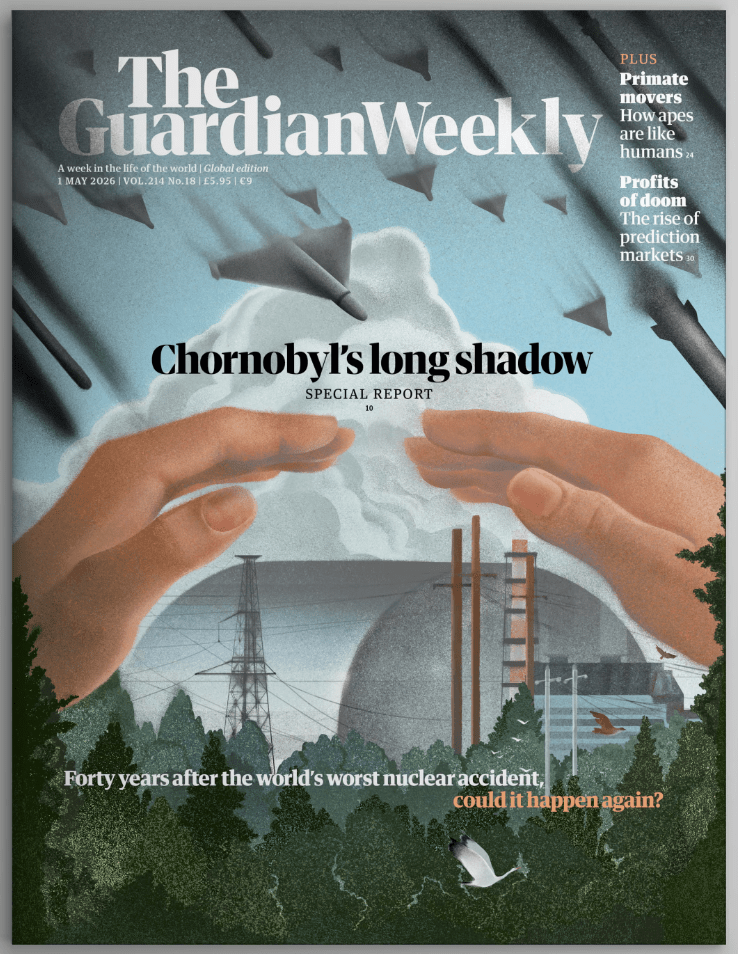
In March 2022, soon after the full-scale Russian invasion of Ukraine began, Kyiv-based illustrator Masha Foya produced what I think is one of the Guardian Weekly’s most powerful covers on the war, concerning the devastation of Mariupol. So it’s a pleasure to feature Masha’s work again for the current edition, this time marking 40 years since the Chornobyl nuclear disaster.
“Since childhood, the story of Chornobyl has always made me feel a strange dissonance – such a tragedy occurring on a beautiful spring day in April,” explains Masha on the thought process behind her design, in which seasonal greens fade away into ominous skies.
It also reflects present-day anxieties. For a special report, Pjotr Sauer visits the site of the world’s worst nuclear accident and sees up close how the giant containment structure around the failed reactor is in urgent need of costly repairs after a Russian drone strike, as fears grow of a possible new catastrophe.
Five essential reads in this week’s edition
Environment | Why apes are more like us than we ever thought Imagination, reason and ability to recognise faces from the past are not the sole preserve of humans, studies show. Gloria Dickie reports
Finance | The wagering of war Once largely siloed to sporting events, betting has now spread to include contracts on news events where insider information could pay handsomely. With over $1bn in perfectly timed bets on the Iran war having recently been seen, Lauren Aratani explores what exactly is going on
Feature | The big game hunters who believe they can save Africa’s wildlife One way to pay for wildlife conservation is to allow the rich to bag a few animals for high prices. But critics see this approach as an exercise in neocolonialism. Cal Flynwent in pursuit of answers
Opinion | Starmer’s listless government shows zombie politics is the new norm Distracted, listless and unambitious – the British PM’s true form has finally emerged. But whatever comes next must end this ruinous cycle for the country, argues Nesrine Malik
Culture | Iron Maiden on 50 years of heavy metal madness As a career-spanning documentary hits cinemas, the legendary rock band revisit their path from pubs to stadiums over half a century of headbanging hits. Harry Sword buckles up
From the 16th century onwards, as European powers feverishly colonised the world, the possibility of a Northern Sea Route connecting the Atlantic to the Pacific, from Scandinavia to the Bering Strait, tantalised the Dutch and the British as an alternative to the southern routes to Asia and the Americas, which were dominated by Portugal and Spain. But the route only became a reality in the Soviet era, after investments in scientific, economic, industrial and military infrastructure in Siberia.
This is what distinguishes hyperpolitics from the mass democracy of the mid-20th century. Symbolic political gestures are now commonplace, but paid membership of organisations and parties has plummeted. The left has failed to find a replacement for trade unions as a basis for collective action in civil society. Political movements are easy to join, and just as easy to leave.
De Kooning’s Suburb in Havana is a counter-revolutionary painting. Well, of course. It is counter-revolutionary because it is counter everything, versus everything, lost in suburbia. It wants to show us how hard it had to work to get precisely nowhere. Why nowhere was where it wished to get to is a question it leaves to the viewer.
Can there be poetic justice in politics? Perhaps once in a lifetime. In 1989, a young Viktor Orbán bravely told the crowds in Budapest’s Heroes’ Square that it was time for the Russians to go home, just as protesters had demanded in 1956; almost four decades later, he was heckled on the campaign trail with the same words.
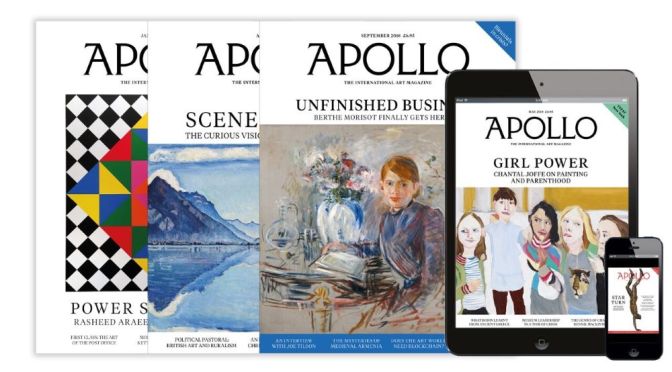
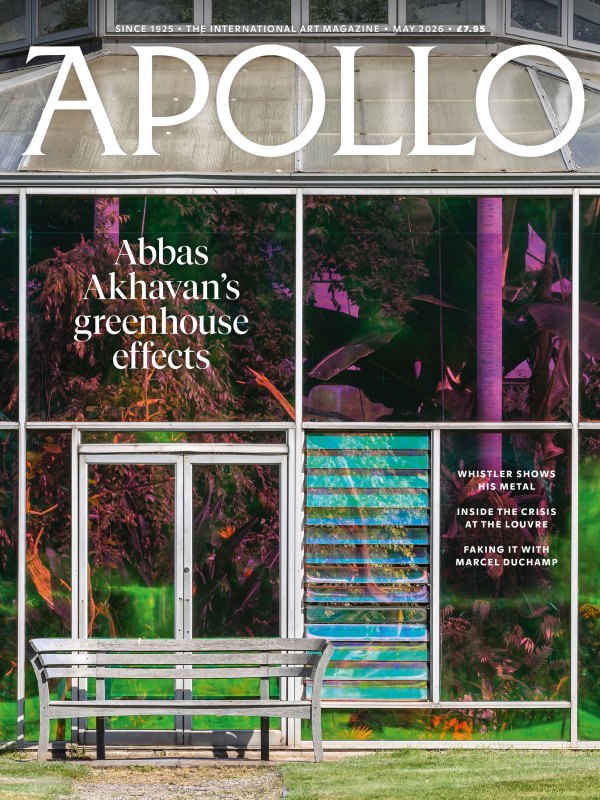
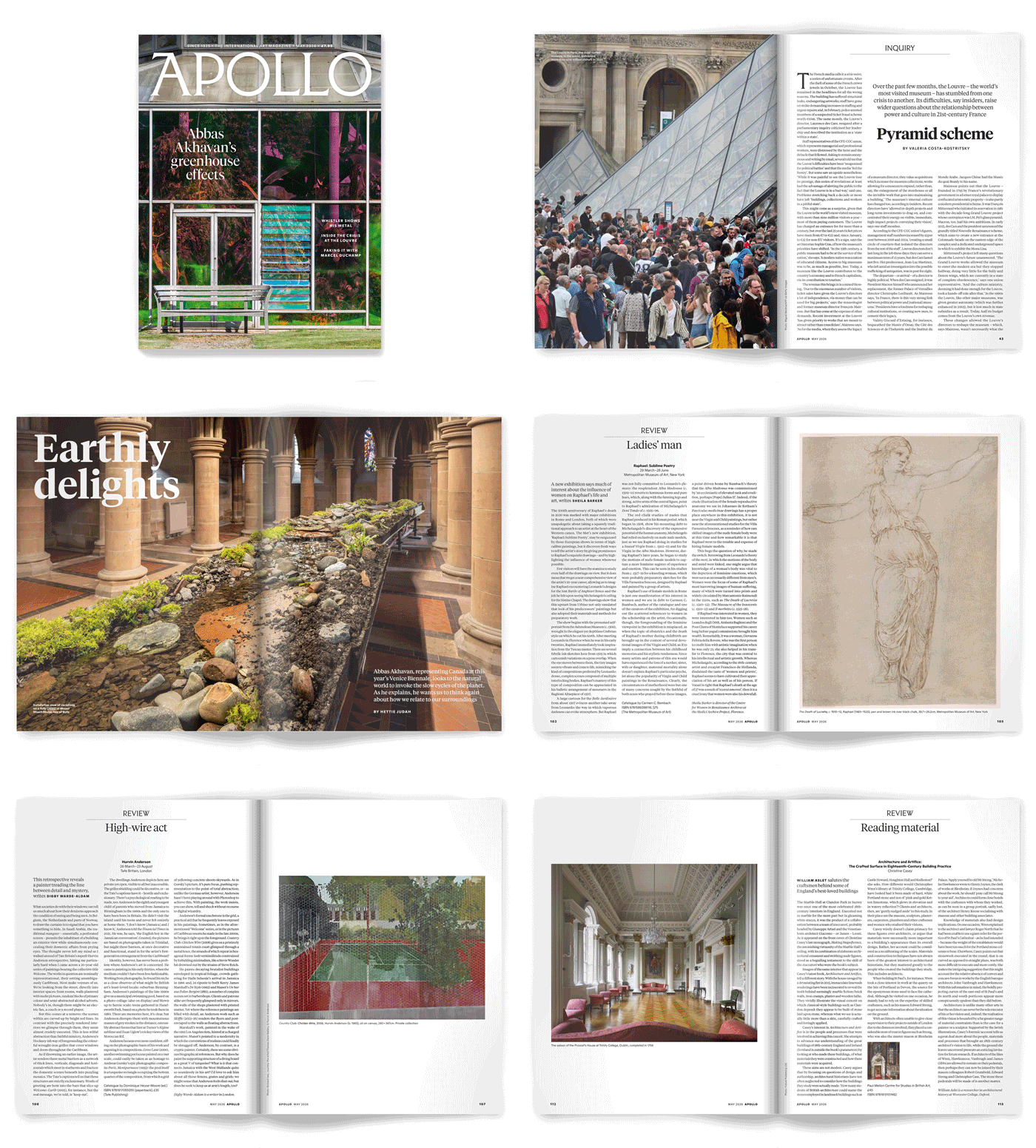
APOLLO MAGAZINE: The latest issue features Inside the crisis at the Louvre | how Marcel Duchamp invented modern art | an interview with Abbas Akhavan | Whistler shows his metal
FEATURES | Valeria Costa-Kostritsky explores the crisis at the Louvre; Hettie Judah talks to Abbas Akhavan before the artist represents Canada at the Venice Biennale; Ana María Bresciani of the Munchmuseet on Edvard Munch and the chocolate factory; Nicole Rudick on how Marcel Duchamp has been misunderstood; and Tara Contractor takes a closer look at Whistler’s love of metallic surfaces
REVIEWS | Sheila Barker on Raphael’s interest in women – and their interest in him; Zachary Ginsberg takes the temperature of contemporary American art at the Whitney Biennial; Digby Warde-Aldam admires Hurvin Anderson’s tricky balancing acts; Robert Hanks on the role of man’s best friend in art history; and William Aslet on the craftsmen behind some of Britain and Ireland’s best buildings
MARKET | Jane Morris on the status of online auctions; Emma Crichton-Miller on the mid-century French designers who married form, function and fun; in New York fair previews: Fatema Ahmed picks highlights from TEFAF; and Arjun Sajip looks ahead to Frieze
PLUS | Charles Darwent salutes the subtleties of Jasper Johns; Samuel Reilly on the threat to one of Glasgow’s most unusual attractions; Will Wiles applauds the witty architectural cartoons of Alan Dunn; Ivan Day on extravagant banquets in the Georgian era; Christina Makris visits the vineyard of Château La Coste; Helena Attlee is fired up by a depiction of Mount Etna; and Edward Behrens on a sale that shines new light on Gerhard Richter
News, Views and Reviews For The Intellectually Curious



 Boomers Daily