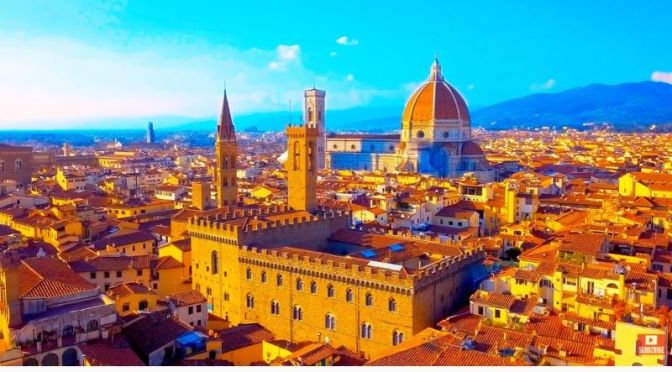
Florence, capital of Italy’s Tuscany region, is home to many masterpieces of Renaissance art and architecture. One of its most iconic sights is the Duomo, a cathedral with a terracotta-tiled dome engineered by Brunelleschi and a bell tower by Giotto. The Galleria dell’Accademia displays Michelangelo’s “David” sculpture. The Uffizi Gallery exhibits Botticelli’s “The Birth of Venus” and da Vinci’s “Annunciation.”
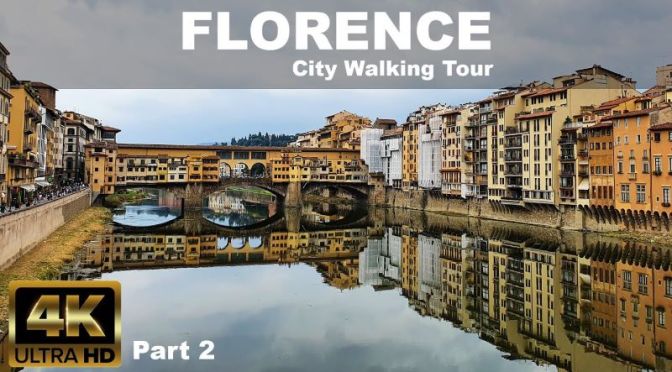
Video Timeline 00:10 Piazza del Duomo – Cattedrale di Santa Maria del Fiore 10:51 Via Roma 12:05 Piazza della Repubblica 13:40 Via dei Calzaiuoli 16:00 Piazza della Signoria – Marzocco 18:00 Loggia dei Lanzi 27:00 Ponte Vecchio
Florence, capital of Italy’s Tuscany region, is home to many masterpieces of Renaissance art and architecture. One of its most iconic sights is the Duomo, a cathedral with a terracotta-tiled dome engineered by Brunelleschi and a bell tower by Giotto. The Galleria dell’Accademia displays Michelangelo’s “David” sculpture. The Uffizi Gallery exhibits Botticelli’s “The Birth of Venus” and da Vinci’s “Annunciation.”
The Palazzo Vecchio “Old Palace” is the town hall of Florence, Italy. It overlooks the Piazza della Signoria, which holds a copy of Michelangelo’s David statue, and the gallery of statues in the adjacent Loggia dei Lanzi. Originally called the Palazzo della Signoria, this building was also known by several other names: Palazzo del Popolo, Palazzo dei Priori, and Palazzo Ducale, in accordance with the varying use of the palace during its long history. This 4K video shows the exterior and interior of this amazing building, focusing on the art present on walls, ceilings and rooms.
Michelangelo, David, 1501–04, marble, 17 feet high (The Galleria dell’Accademia, Florence), a conversation with Dr. Steven Zucker and Dr. Beth Harris.
This astonishing Renaissance sculpture was created between 1501 and 1504. It is a 14.0 ft marble statue depicting the Biblical hero David, represented as a standing male nude. Originally commissioned by the Opera del Duomo for the Cathedral of Florence, it was meant to be one of a series of large statues to be positioned in the niches of the cathedral’s tribunes, way up at about 80mt from the ground. Michelangelo was asked by the consuls of the Board to complete an unfinished project begun in 1464 by Agostino di Duccio and later carried on by Antonio Rossellino in 1475. Both sculptors had in the end rejected an enormous block of marble due to the presence of too many “taroli”, or imperfections, which may have threatened the stability of such a huge statue. This block of marble of exceptional dimensions remained therefore neglected for 25 years, lying within the courtyard of the Opera del Duomo (Vestry Board).
Palazzo Serristori, a historical and prestigious palace currently under restoration is for sale by the river Arno, at a stone’s throw from Florence’s city centre, an internationally-renowned city for its history, art and culture.
The palace dates back to the 16th century and has changed a lot over the years, especially in the 19th century when the Demidoff family gave it its current looks. The property has four floors above ground, a basement and a mezzanine floor. The interiors are embellished with fine finishes and materials, such as walls and ceilings enriched with frescoes and decorations and inlays of great artistic importance. Of the original sixteenth-century palace, only the corner facade where the main entrance opens up is preserved.
In the era of social distancing, Italians in Florence have revived the custom of serving wine through pint-size windows in centuries-old buildings.
Year 2020: The covid-19 pandemic arrives. Italy is under lockdown starting March 8th. Everyone is confined to home for two months and then the government permits a gradual reopening. During this time, some enterprising Florentine Wine Window owners have turned back the clock and are using their Wine Windows to dispense glasses of wine, cups of coffee, drinks, sandwiches and ice cream—all germ-free, contactless!
Year 1634: The Black Death or Plague has passed through the city of Florence, leaving death and havoc in its wake. The Florentine scholar, Francesco Rondinelli, writes a report about disease contagion and describes the use of the abundant Wine Windows in the city for the safe sale of wine, without direct contact between client and seller. Diletta Corsini describes this important document regarding Wine Windows and their uses almost 400 years ago.
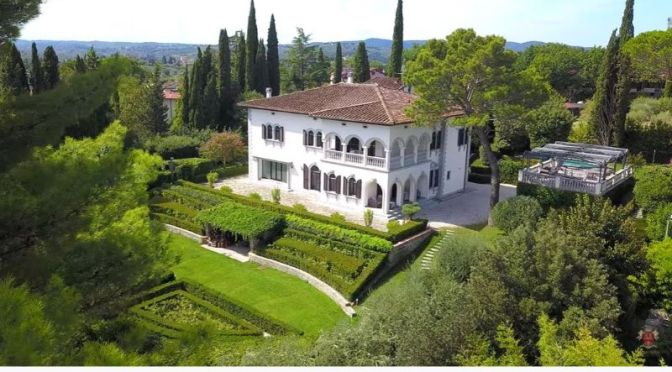
On the hills above Florence, in an extremely panoramic location with direct view over the historiccenter of the city, we find this beautiful luxury villa with Italian garden and swimming pool.
The villa has also easy access to the International School of Florence, which has its headquarters inside Villa Torri di Gattaia (5km; 10’), just above Piazzale Michelangelo.
Easily reached and in one of the most renowned areas of Florence, this property allows easily reaching the historic center of the city on foot (3km; 15’) and at the same time moving throughout the many interesting cities and towns of Tuscany: San Casciano in Val di Pesa (15km; 20’), Greve in Chianti (28km; 35’), Colle di Val d’Elsa (46km; 40’), the imposing towers of San Gimignano (51km; 50’), the unique medieval center of Siena (69km; 55’), Volterra (72km; 1h 10’), Lucca (88km; 1h 10’), Castiglion Fiorentino (98km; 1h 20’), Montalcino, hometown of the superb Brunello wine (107km; 1h 35’), Pisa and its world-famous leaning tower (109km; 1h 20’), Montepulciano with its Nobile wine (112km; 1h 25’) and the Etruscan town of Cortona (120km; 1h 35’).
Producer: Oliver Gallini
Filmmaker: Logan Armstrong, Chris Shepherd
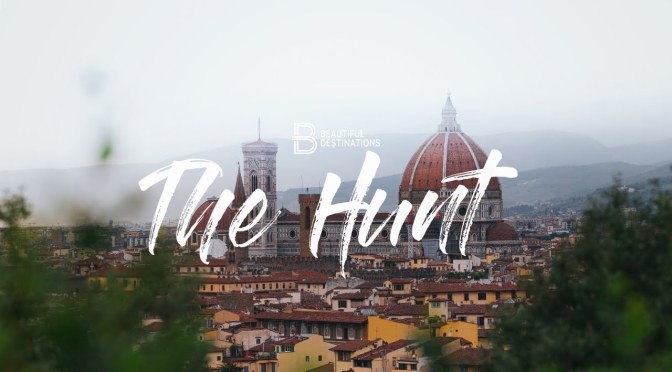
Once a year Firenze turns into a battleground. Four neighborhoods, artisans, craftsmen, bus drivers, butchers and tailors turn into warriors fighting for the “hunt”. Once it’s all over everyone comes back together united as one city.
This is the story of Calcio Storico, a tradition that goes back 500 years.
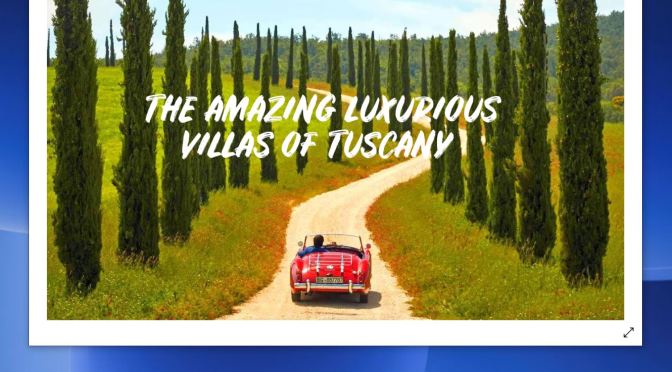
Tuscany, Italy is an Incredible Land With Beautiful Landscapes, Where Striking Historical Villas Dominate the Vineyards, Olive Groves and Sunflowers Fields. A Hilly Region Rich in Agriculture, Tuscany Was the Home of the Etruscan Civilization, and Later the Birthplace of the Renaissance. It’s Known for Charming, Historic Towns Like Siena, Florence, Cortona and Lucca, Tuscany Offers the Best in Culture, Scenery and Serenity. (Part 1 below)
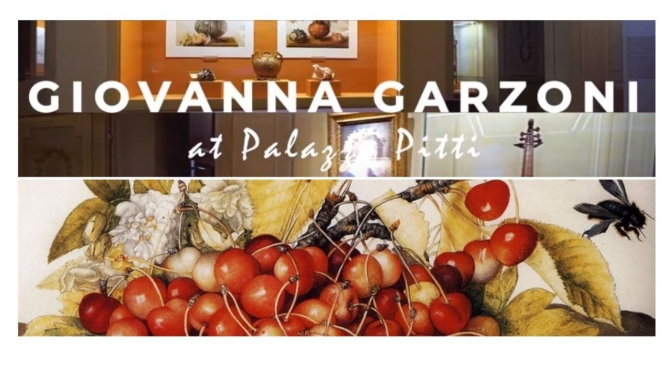
Hosted in the Andito degli Angiolini space at Palazzo Pitti, “The Immensity of the Universe in the Art of Giovanna Garzoni” exhibition encompasses 100 floral compositions, still lives and miniatures by the Baroque, Marche-born painter friend of Artemisia Gentileschi.
The show has been curated by Sheila Barker of The Medici Archive Project and the Advancing Women Artists foundation is running a challenge to inspire the creation of contemporary art based on Garzoni’s oeuvre. While her role in the evolution of scientific illustration is widely acknowledged, Giovanna Garzoni is less familiar as an illustrator of geographical fantasy in the age of the Baroque.
In harmonic and often relatively small compositions, the painter combines exotic objects of extremely varied provenance such as Chinese porcelain, Pacific nautili, Mexican marrows and flowers, South American plants and English lapdogs, in an effort both to astonish and to amuse.
Turning her back on the conventional role reserved for women in her day, Garzoni travelled in Italy, and possibly also in France, gaining access to the most important collections of curios of her era. The exhibition showcases her works collected by the Medici and still owned by the Gallerie degli Uffizi, alongside targeted loans illustrating the artist’s field of action and her prowess as a portraitist.
On the basis of a previously untapped inventory, a section of the exhibition reconstructs Vittoria della Rovere’s Wunderkammer, once hosted in the Sala dell’Aurora in the villa of Poggio Imperiale, thus indirectly shedding light also on a leading member of the grand ducal family.



 The show has been curated by Sheila Barker of The Medici Archive Project and the Advancing Women Artists foundation is running a challenge to inspire the creation of contemporary art based on Garzoni’s oeuvre. While her role in the evolution of scientific illustration is widely acknowledged, Giovanna Garzoni is less familiar as an illustrator of geographical fantasy in the age of the Baroque.
 Boomers Daily