
Tag Archives: Economies

Previews: The Economist Magazine – August 26, 2023

Image

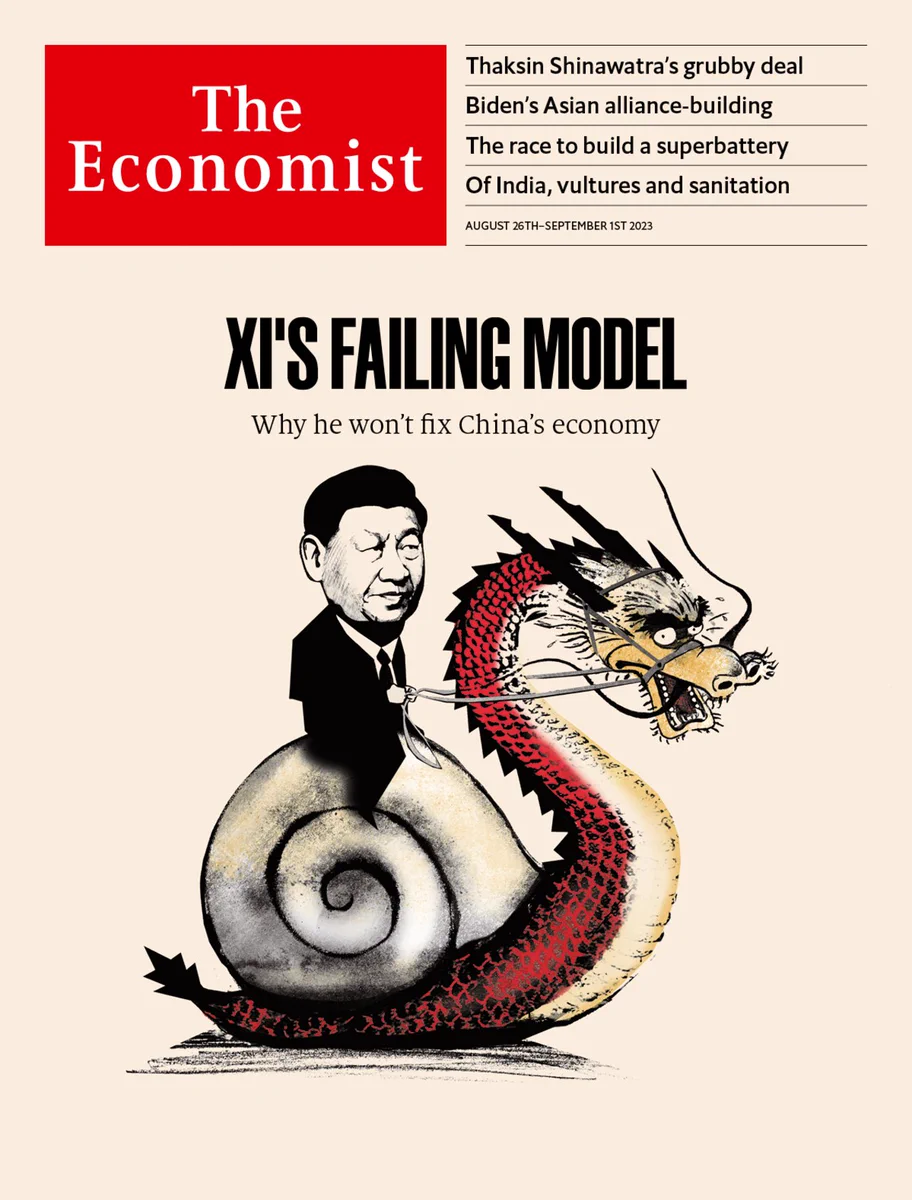
The Economist Magazine (August 26, 2023): This week’s issue features Xi’s failing model: Why he won’t fix China’s economy; Biden’s Asian alliance-building; Prigozhin’s death shows that Russia is a mafia state and more….

Why China’s economy won’t be fixed

An increasingly autocratic government is making bad decisions

Whatever has gone wrong? After China rejoined the world economy in 1978, it became the most spectacular growth story in history. Farm reform, industrialisation and rising incomes lifted nearly 800m people out of extreme poverty. Having produced just a tenth as much as America in 1980, China’s economy is now about three-quarters the size. Yet instead of roaring back after the government abandoned its “zero-covid” policy at the end of 2022, it is lurching from one ditch to the next.

Prigozhin’s death shows that Russia is a mafia state

A healthy country uses justice to restore order. Mr Putin uses violence instead 

Yevgeny Prigozhin gives an address in camouflage and with a weapon in his hands in a desert area

As we published this editorial, it was not certain that Yevgeny Prigozhin’s private jet was shot down by Russian air-defences, or that the mutineer and mercenary boss was on board. But everyone believes that it was and that his death was a punishment of spectacular ruthlessness ordered by Russia’s president, Vladimir Putin. And that is the way Mr Putin likes it.

Previews: The Economist Magazine – August 19, 2023

The Economist Magazine (August 19, 2023): This week’s issue features Why are China’s young people so disillusioned?; China’s defeated youth – When Xi Jinping plays down their individual aspirations in favour of the collective interest, he adds to their gloom.

Why are China’s young people so disillusioned?

Xi Jinping wants them to focus on the party’s goals. Many cannot see why they should

The crowd did not seem excited to see George Michael and Andrew Ridgeley. When Wham! became the first Western pop group to perform in Communist China, the audience was instructed to stay in their seats. It was 1985 and, despite appearances, the young people in attendance were in fact joyous. The country around them was by no means free, but it was starting to reform and open up. Over the next three decades the economy would grow at a rapid pace, producing new opportunities.

China’s defeated youth

Young Chinese have little hope for the future. Xi Jinping wants them to toughen up

A worker tests parts for e-cigarettes on a production line

In the southern city of Huizhou an electronics factory is hiring. The monthly salary on offer is between 4,500 and 6,000 yuan (or $620 and $830), enough to pay for food and essentials, but not much else. The advertisement says new employees are expected to “work hard and endure hardship”. The message might have resonated with Chinese of an older generation, many of whom worked long hours in poor conditions to give their children a brighter future. But many of those children now face similar drudgery—and are unwilling to endure it. “I can’t sit on an assembly line,” says Zhang, a 20-something barista with dyed-red hair at a local tea shop. He scoffs at the idea of making such sacrifices for so little gain. The job at the tea shop pays just 4,000 yuan a month, but he enjoys chatting up customers.

Previews: The Economist Magazine – August 12, 2023

Costly and dangerous: Why Biden’s China strategy isn’t working

The Economist Magazine (August 12, 2023 issue): Why Biden’s China strategy is not working; Saudi Arabia upends sport; The attack on universal values; Twitternomics lives on; How green is your EV and more…

Costly and dangerous: Why Biden’s China strategy isn’t working

Liam Eisenberg

Supply chains are becoming more tangled and opaque

On august 9th President Joe Biden unveiled his latest weapon in America’s economic war with China. New rules will police investments made abroad by the private sector, and those into the most sensitive technologies in China will be banned. The use of such curbs by the world’s strongest champion of capitalism is the latest sign of the profound shift in America’s economic policy as it contends with the rise of an increasingly assertive and threatening rival.

How America is failing to break up with China

The countries’ economic ties are more profound than they appear

A briefcase being handed from one person to another with their hands handcuffed together
image: alberto miranda

When it comes to tracing the geography of global supply chains, few companies provide a better map than Foxconn, the world’s largest contract manufacturer. This year the Taiwanese giant has built or expanded factories in India, Mexico, Thailand and Vietnam. The Chinese production sites once loved by Western companies are firmly out of fashion. Souring relations between the governments in Washington and Beijing have made businesses increasingly fretful about geopolitical risks. As a consequence, in the first half of the year, America traded more with Mexico and Canada than it did with China for the first time in almost two decades. The map of global trade is being redrawn.

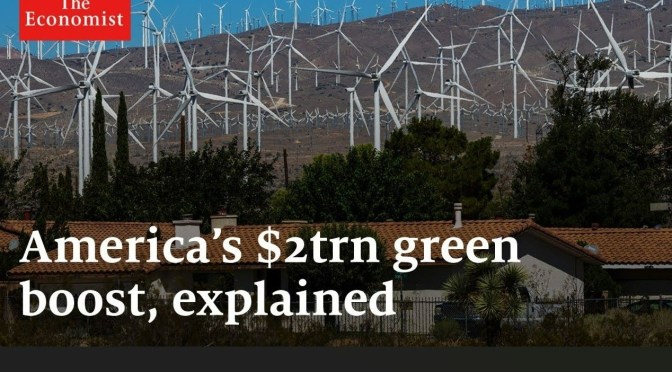
American Economy: The $2 Trillion Green Stimulus

The Economist (March 2, 2023) – America is spending trillions of dollars in an effort to make the country stronger, greener and richer. These are the three key things you need to know about the plan and its chances of success.

Video timeline: 00:00 – A new green America 00:30 – Democrats are being ambitious 01:14 – Manufacturing will move to America 01:53 – Planning could be a stumbling block

To read more about Biden’s plans to remake America’s economy: https://econ.st/3IEGNiP

Analysis: Is New York City At Risk Of Bankruptcy?

Mass unemployment, colossal bankruptcies, and a shattered tourism industry have ravaged New York City during the coronavirus pandemic. In January 2021, Governor Andrew Cuomo proposed raising taxes on the wealthy, while cutting Medicaid and school spending to balance the multi-billion dollar budget deficit. Opponents say tax hikes could lead to a mass exodus of the wealthy New Yorkers who fund a large portion of the city’s revenue. Others say that the crisis has exasperated existing inequalities and cutting social services will only hurt those most affected.

Video Analysis: How Vaccine Passports Can Kick-Start The Economy

Vaccine passports are likely to become a feature of everyday life as lockdowns are lifted across the world. But as “green passes” kick-start economies, what are the potential drawbacks? Read more of our coverage on coronavirus : https://econ.st/397Mkxq

Europe: An Economic History Of Portugal

In the lead up to the Eurozone Crisis, Portugal’s Economy was an outlier. Whilst many economies went on an incredible run, the Portuguese Economy did not have such a good time. Not only underperforming the average eurozone growth rate, but unemployment actually rose from 3.8% to 7.5% between the millennium and 2008. Compare this against the likes of Greece, Spain and Italy, all of which had seen significant declines in unemployment. Raising the question of why? Why had Portugal’s Economy stagnated in what were supposed to be the good times? What was the impact of its long history as a colonial power? And to what extent did a 19th Century letter from Pope Leo the 13th influence its wider economic approach?

Africa: ‘An Economic History Of Egypt’ (Video)

The Egyptian Economy was the only one in the Middle East North Africa region to avoid a recession in 2020. Being a good reflection of the economic rollercoaster Egypt routinely finds itself on. One driven by inflation rates of up to 30% a year, a halving of its currency and a painful IMF bailout in 2016. But how did Egypt’s Economy find itself in this situation? What impacts did Five Year Plans, spending nearly 20% of GDP on the military and widespread nationalisation have on its economy? Why is Egypt the world’s largest importer of wheat? And perhaps most importantly, what has its post 2011 revolution delivered?

Egypt, a country linking northeast Africa with the Middle East, dates to the time of the pharaohs. Millennia-old monuments sit along the fertile Nile River Valley, including Giza’s colossal Pyramids and Great Sphinx as well as Luxor’s hieroglyph-lined Karnak Temple and Valley of the Kings tombs. The capital, Cairo, is home to Ottoman landmarks like Muhammad Ali Mosque and the Egyptian Museum, a trove of antiquities. 

Analysis: ‘Why Big Tech Companies Are Leaving California’ (CNBC Video)

As Oracle, Palantir and Hewlett-Packard Enterprise move their headquarters out of California and Elon Musk moves to Texas, California is considering raising taxes on the wealthy to unprecedented levels. Experts say California needs to find more ways to reverse the trend.