Tag Archives: Covid-19

Travel & The Pandemic: “Lockdown // Edinburgh” In Scotland (April 2020)

Filmed and Directed by: Carsan Choong

The Covid-19 pandemic has affected many people’s lives all over the world. This short film is focusing solely on Edinburgh, showcasing the situation and how the daily lives in the city have been affected. Inclusion of some positivity and optimism too in this short film.

My own old stock footage as well as some aerial footage from third-party suppliers were used. New current footage were shot without flouting the lockdown rules, only done so in conjunction with essential travel.

Music: Nicholas Britell – End Credits Suite (Moonlight – OST)

Edinburgh is Scotland’s compact, hilly capital. It has a medieval Old Town and elegant Georgian New Town with gardens and neoclassical buildings. Looming over the city is Edinburgh Castle, home to Scotland’s crown jewels and the Stone of Destiny, used in the coronation of Scottish rulers. Arthur’s Seat is an imposing peak in Holyrood Park with sweeping views, and Calton Hill is topped with monuments and memorials.


Top New Science Podcasts: Countries’ Coronavirus Comebacks, Managing Water & The Ancient Wari

science-magazine-podcastsContributing Correspondent Kai Kupferschmidt talks with host Sarah Crespi about countries planning a comeback from a coronavirus crisis. What can they do once cases have slowed down to go back to some sort of normal without a second wave of infection?
Contributing Correspondent Lizzie Wade joins Sarah to talk about water management and the downfall of the ancient Wari state. Sometimes called the first South American empire, the Wari culture successfully expanded throughout the Peruvian Andes 1400 years ago.

Also this week, Yon Visell of the University of California, Santa Barbara, talks with Sarah about his Science Advances paper on the biomechanics of human hands. Our skin’s ability to propagate waves along the surface of the hand may help us sense the world around us.

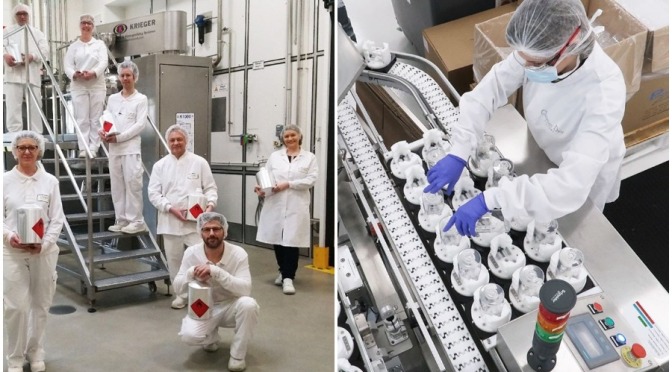
Health: LVMH And Fashion Industry Now Making Hand Sanitizer, Masks And Protective Gear (Podcast)

Monocle 24 On Design LogoJamie Waters explains how the fashion industry emerged as a vital contributor in the fight against the pandemic. Many brands, big and small, have pivoted to make masks and other protective equipment.
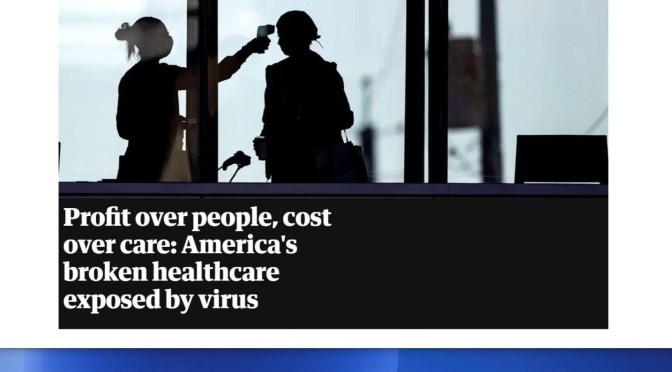
Medical Economics: Virus Exposes America’s “Broken Healthcare System” (2020)

From The Guardian (April 16, 2020):

The Guardian Healthcare“As this epidemic makes clear, at any moment, any of us could become sick, could become hospitalized, could be on a mechanical ventilator,” said Adam Gaffney, an ICU doctor in Boston. “And that, in the United States, could mean potentially ruinous healthcare costs.”
With over 21,000 people dead and more than a 547,000 infected with the coronavirus in the US the last question on a person’s mind should be how they will pay for life-saving treatment.

There were 27.9 million people without health insurance in 2018, and record-high unemployment will increase that figure by millions

But as the death toll mounted, a patient who was about to be put on a ventilator in one of New York City’s stretched to capacity intensive care units had a final question for his nurse: “Who’s going to pay for it?”

Read full article

Health: Testing, Approving And Fairly Distributing A New Coronavirus Vaccine

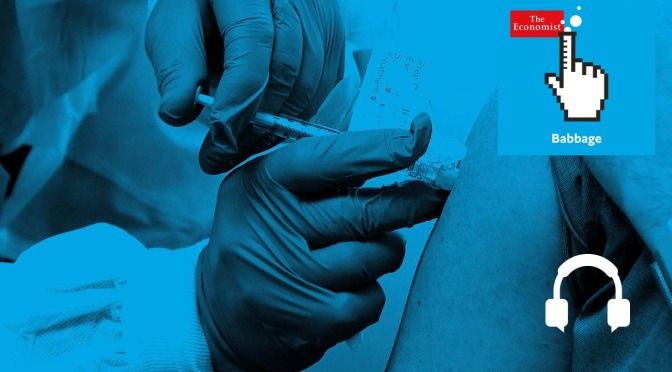
SCIENTISTS ARE working at an unprecedented pace to find a vaccine for SARS-CoV-2, the virus that causes covid-19. The stakes are high. Natasha Loder, The Economist’s health policy editor, explains how an effective vaccine might be developed.

Dr Trevor Drew of the Australian Centre for Disease Preparedness speaks to host Kenneth Cukier about two trials which have reached the animal-testing stage. Plus, once a vaccine is discovered, what can be done to make sure it is distributed fairly? Dr Seth Berkely, chief executive of GAVI, the vaccine alliance, explains the importance of global cooperation. Runtime: 26 min

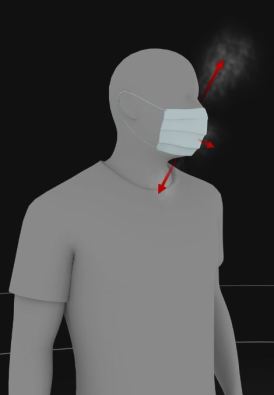
Social Distancing: 3-D Simulation Of How Respiratory Droplets Spread Coronavirus

From The New York Times (April 14, 2020):

Face Mask Disrupts trajectory of cough New York Times April 14 2020

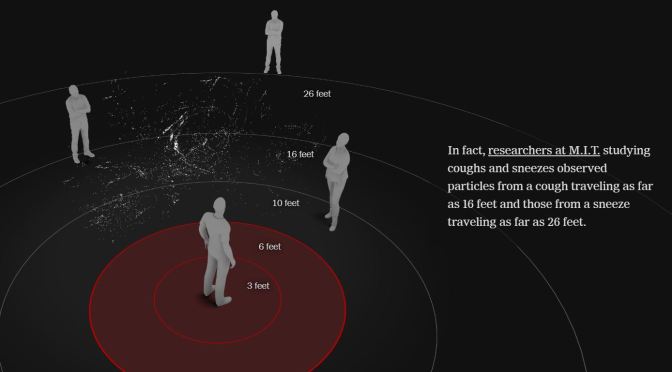
But as this simulation suggests, and scientists have argued, droplets can travel farther than six feet. And small droplets known as aerosols can remain suspended or travel through the air before they eventually settle on surfaces. This is how they could disperse over the next 20 minutes.

The Centers for Disease Control and Prevention encourages people to stay home. If you must venture out, you should stay at least six feet away from others. The World Health Organization recommends a minimum of three feet of separation.

Scientists are learning about the novel coronavirus in real time, and those who study similar respiratory illnesses say that until it is better understood, no guideline is likely to offer perfect safety. Instead, understanding the possible transmission routes for the virus can help us see why keeping our distance is so important.

View 3-D simulation

Travel: Streets Of Paris Under Quarantine – April 2020 (New Yorker Videos)

Scenes from a day of weirdness in quarantine in Paris, France as Parisians socially distance to avoid spreading the coronavirus. The city’s landmarks and streets appear eerily empty while residents have taken shelter at home to curb the outbreak of COVID-19.

Coronavirus/Covid-19: “Face Shields” Are Best In Preventing Transmission Says Epidemiologist

From web post by Michael B. Edmond (April 11, 2020):

Our goal should be to have a face shield for every person in the country. It should be worn anytime a person leaves their home, while in any public place, and even at work. From news reports, it appears that face shields are already being more commonly worn in other nations, particularly in some Asian countries. 

The advantages of face shields are their durability allowing them to be worn an indefinite number of times, the ability to easily clean them after use, their comfort, and they prevent the wearer from touching their face. Importantly, they cover all the portals of entry for this virus–the eyes, the nose, and the mouth. Moreover, the supply chain is significantly more diversified than that of face masks, so availability is much greater.

Some are critical of any strategy that isn’t perfect. But let’s think about the influenza vaccine. Although the effectiveness varies from year to year, on average it’s 40%. We push this vaccine hard in the hospital and in the community. Could we expect that face shields are at least 40% effective in reducing the transmission of COVID-19? I think so. Universal shielding would bend the curve more quickly and accelerate the ability to reduce social distancing and restrictions on movement.
.
Face shields are a simple solution that if implemented universally would have a major impact on public health. Until we have a vaccine, this may be our best intervention for preventing transmission in the community.
.
.
Michael B. Edmond, MD, MPH, MPA, MBA is the Chief Quality Officer and Associate Chief Medical Officer for University of Iowa Health Care and Clinical Professor of Infectious Diseases at the University of Iowa Carver College of Medicine. He previously served as the Richard P. Wenzel Professor of Internal Medicine, Chair of the Division of Infectious Diseases, and Hospital Epidemiologist at Virginia Commonwealth University in Richmond.

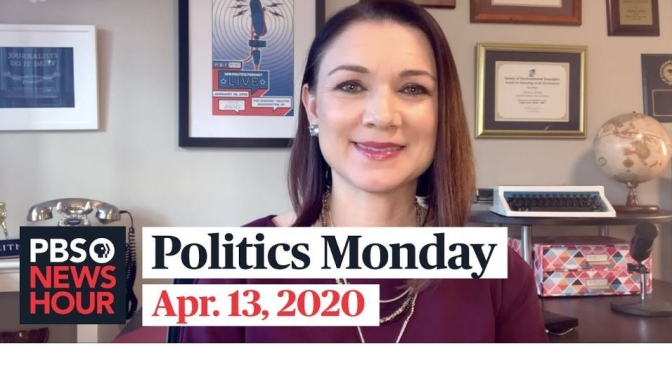
Politics Monday: Tamara Keith And Amy Walter On Joe Biden, Covid-19 (PBS)

NPR’s Tamara Keith and Amy Walter of the Cook Political Report join Judy Woodruff to discuss the latest political news, including Sen. Bernie Sanders’ endorsement of former Vice President Joe Biden for the 2020 Democratic presidential nomination, how Sanders’ politics might influence his former rival and political fallout from the Trump administration’s reaction to COVID-19.