

NPR News Now reports: President Trump and Joe Biden campaigns, Covid-19 vaccine trials, Colorado fires and other top news.

NPR News Now reports: President Trump and Joe Biden campaigns, Covid-19 vaccine trials, Colorado fires and other top news.
Governments will have to deal with the economic fallout from the pandemic for decades to come. If they get their response wrong, countries risk economic stagnation and political division.
Read more here: https://econ.st/3ojORKY

Radio News 24/7 reports: U.S. Presidential Debate, Covid-19 surges in Europe, Nigerian protests against police violence and other top news.

First up, host Sarah Crespi talks with Staff Writer Jon Cohen about some tricky ethical questions that may arise after the first coronavirus vaccine is authorized for use in the United States. Will people continue to participate in clinical trials of other vaccines? Will it still be OK to give participants placebo vaccines?
Next, producer Meagan Cantwell talks with Bert Weckhuysen, a professor at Utrecht University, about a process for taking low-value plastic like polyethylene (often used for packaging and grocery bags) and “upcycling” it into biodegradable materials that can be used for new purposes.

The structure of a beetle’s super-strong exoskeleton could open up new engineering applications, and efforts to address diversity and equality imbalances in academia.
In this episode:
01:17 Insights into an armoured insect
The diabolical ironclad beetle has an exoskeleton so strong, it can survive being run over by a car. Researchers have identified how the structure of the exoskeleton provides this strength, and show that mimicking it may lead to improved aerospace components.
Research Article: Rivera et al.; News and Views: Diabolical ironclad beetles inspire tougher joints for engineering applications
10:42 Coronapod
This week, the UK government announced plans to run a ‘human challenge trial’, where healthy volunteers are deliberately infected with the SARS-CoV-2 virus. We talk about the process, the ethical and procedural hurdles, and whether such an approach will provide any useful data.
News: Dozens to be deliberately infected with coronavirus in UK ‘human challenge’ trials
22:46 Research Highlights
A method to assess the age of RNA, and how southern elephant seals helped to identify supercooled seawater.
Research article: Rodriques et al.; Research article: Haumann et al.
25:20 Efforts to address equity in science
Julie Posselt has been investigating the efforts of academic institutions to assess ingrained imbalances in diversity and equality. We talk to her about these efforts and her new book on the subject.
Book review: How to get more women and people of colour into graduate school — and keep them there
31:43 Briefing Chat
We discuss some highlights from the Nature Briefing. This time, back pay for female professors at Princeton, and a newly uncovered superpower for the tiny tardigrade.
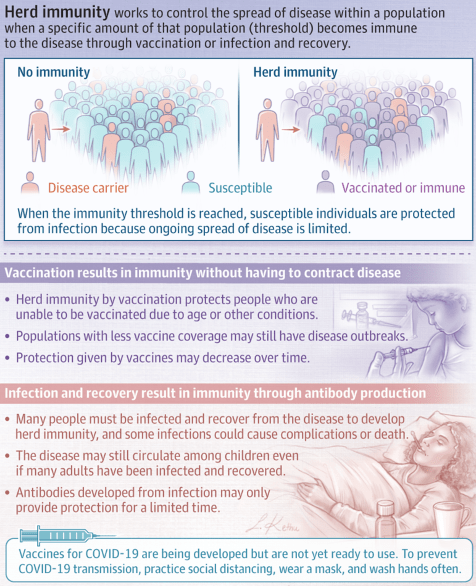

Herd immunity occurs when a significant portion of a population becomes immune to an infectious disease, limiting further disease spread.
Disease spread occurs when some proportion of a population is susceptible to the disease. Herd immunity occurs when a significant portion of a population becomes immune to an infectious disease and the risk of spread from person to person decreases; those who are not immune are indirectly protected because ongoing disease spread is very small.
The proportion of a population who must be immune to achieve herd immunity varies by disease. For example, a disease that is very contagious, such as measles, requires more than 95% of the population to be immune to stop sustained disease transmission and achieve herd immunity.
Herd immunity may be achieved either through infection and recovery or by vaccination. Vaccination creates immunity without having to contract a disease. Herd immunity also protects those who are unable to be vaccinated, such as newborns and immunocompromised people, because the disease spread within the population is very limited. Communities with lower vaccine coverage may have outbreaks of vaccine-preventable diseases because the proportion of people who are vaccinated is below the necessary herd immunity threshold. In addition, the protection offered by vaccines may wane over time, requiring repeat vaccination.
Achieving herd immunity through infection relies on enough people being infected with the disease and recovering from it, during which they develop antibodies against future infection. In some situations, even if a large proportion of adults have developed immunity after prior infection, the disease may still circulate among children. In addition, antibodies from a prior infection may only provide protection for a limited duration.
People who do not have immunity to a disease may still contract an infectious disease and have severe consequences of that disease even when herd immunity is very high. Herd immunity reduces the risk of getting a disease but does not prevent it for nonimmune people.
There is no effective vaccine against coronavirus disease 2019 (COVID-19) yet, although several are currently in development. It is not yet known if having this disease confers immunity to future infection, and if so, for how long. A large proportion of people would likely need to be infected and recover to achieve herd immunity; however, this situation could overwhelm the health care system and lead to many deaths and complications. To prevent disease transmission, keep distance between yourself and others, wash your hands often with soap and water or sanitizer that contains at least 60% alcohol, and wear a face covering in public spaces where it is difficult to avoid close contact with others.
Wuhan, the city at the center of the coronavirus pandemic, had the most tourists of any Chinese city during a public holiday in October. Wuhan is overcoming its pandemic past and benefiting from its hero-city status to become a top travel destination.
Photo: Getty Images

The Los Angeles Lakers took home the NBA championship this week. But the close of the season also marked a big victory for the league itself. The NBA played its finals in a unique environment that came to be known as the bubble.
Players were frequently tested and social distancing was heavily enforced. And, the experiment worked. The NBA did not report a single positive coronavirus case from players or staff. Reporters Emma Court and Brandon Kochkodin describe how the league did it, and whether other organizations can replicate its success.

This Morning With Gordon Deal: Town halls show two distinct styles between President Trump and Joe Biden, dealing with covid stress, and do you really need a new iPhone.
First up, host Meagan Cantwell speaks with Abigail Echo-Hawk, director of the Urban Indian Health Institute and chief research officer for the Seattle Indian Health Board. Echo-Hawk shares what inspired her journey in public health and explains the repercussions of excluding native people from health data.
This story was originally reported by Lizzie Wade, who profiled Echo-Hawk as part of Science’s “voices of the pandemic” series. Next, host Sarah Crespi interviews Danielle Murashige, a Ph.D. student at the University of Pennsylvania, about her Science paper that attempts to quantify how much fuel a healthy heart needs.







 Boomers Daily