
A selection of three essential articles read aloud from the latest issue of The Economist. This week: the shame and the opportunity of Trump’s legacy, how to deal with China (8:50), and why the crazy upward march in stock prices might just continue (15:45).
Tag Archives: China
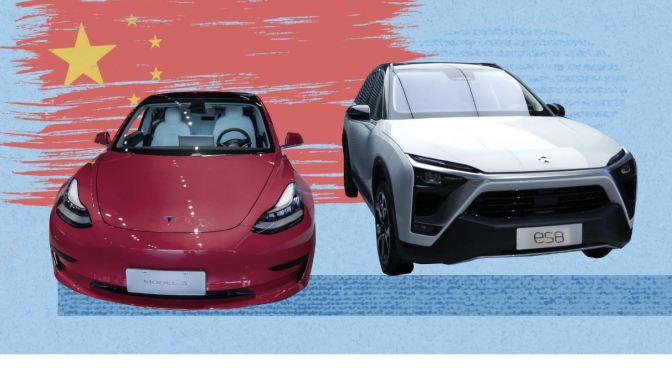
Technology: Tesla Battles Nio In China – Charging Vs Battery Swapping (Video)
Gone are the long waits at charging stations: Chinese electric-vehicle startup NIO is pioneering battery-swap systems, challenging Tesla and other rival car makers. Here’s how NIO and Tesla are racing for the world’s largest EV market in China.
Photo illustration: Sharon Shi

Global News: Britain In The World, E-Commerce & Heating Homes (Podcast)
A selection of three essential articles read aloud from the latest issue of The Economist. This week: Britain’s place in the world, the future of global e-commerce (9:25), and using urine to heat homes (16:30).
Investigations: Chinese Telecomunications Giant Huawei – High Tech or Spy?
Telecommunications giant Huawei is said to be one of the most powerful companies in China. But Huawei has been accused of systematic espionage, and some Western governments doubt whether the company is truly independent of the Chinese government.
This documentary investigates concerns about Huawei and internet security. The company is a major player in the manufacture of smartphones, and enjoys a technological lead in the development of the super-fast 5G broadband network worldwide. But the US and some other Western countries suspect that Huawei works closely with the Chinese government on espionage and sabotage operations.
Has Huawei becomne a pawn in the trade war between the US and China? The arrest of Huawei chief financial officer Meng Wanzhou in Canada in 2018 — at the request of US authorities — marked the climax of the conflict between Huawei and Washington. Some European countries also have concerns about the company.
Does Huawei really have close ties to the Chinese government? And what are the benefits and risks for those foreign clients who choose to work with this 5G giant?
World News Podcast: The Latest Headlines From London, Europe & Asia
Georgina Godwin and guests set the tone for the weekend. News includes veto override of U.S. Defense Bill, China states Covid-19 started in many parts of the world, and other top headlines.
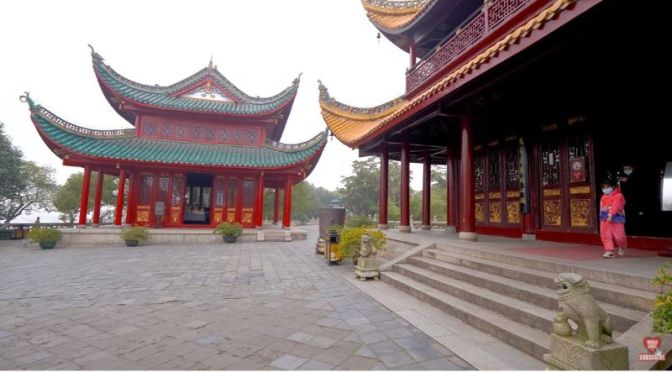
Walks: ‘Yueyang Tower, Hunan, China’ (4K Video)
Yueyang Tower is an ancient Chinese tower in Yueyang, Hunan Province, on the shore of Lake Dongting. Alongside the Pavilion of Prince Teng and Yellow Crane Tower, it is one of the Three Great Towers of Jiangnan.
The famous Yueyang Tower, located at the western city gate of Yueyang in Hunan province, is listed as one of the Three Great Towers in the south of the Yangtze River in China. Yueyang Tower was originally built for military use. The construction of the tower was commissioned by General Lu Su of the Kingdom of Wu during the Three Kingdoms Period(220-280). It was designed as a tower for training, directing marine troops and for military reviews. Standing on the bank of Dongting Lake of Yueyang, Yueyang Tower is magnificent and imposing, overlooking the 400-kilometer waterway scattered with sailing boats. Since the Tang Dynasty(618-907), Yueyang Tower had gradually become a popular tourist destination as well as a favored site for romantic scholars, who would frequent the place for chanting and writing poems.
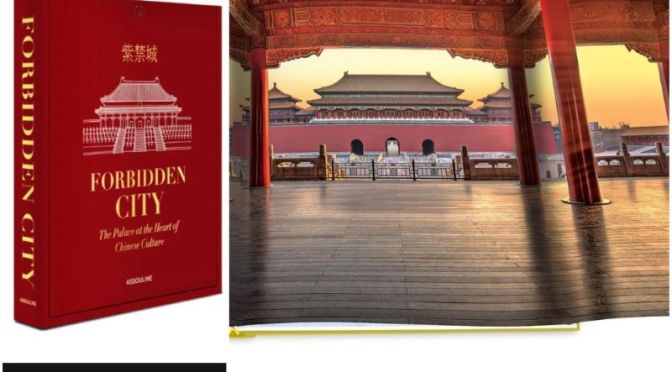
Books: ‘Forbidden City – The Palace at the Heart of Chinese Culture’ (Video)
For more than six centuries, the Forbidden City has awed all those who have travelled from near and far to explore its 900 golden-roofed buildings, set amid moats, gardens, and plazas, where thousands of people lived and worked in service of the world’s largest and most sophisticated pre-modern empire. Marco Polo called it “the greatest Palace that ever was;” Simon Leys praised its architectural genius; and Franz Kafka viewed it as an impressive yet alarming symbol of power.
In this compelling addition to Assouline’s Ultimate Collection, Pulitzer Prize-winning author Ian Johnson guides readers through the magnificent and storied palace built by China’s Yongle Emperor to serve as the seat of the Ming dynasty. Weaving in history and events of the past six centuries and featuring more than 100 photographs, artworks, and historical artifacts, this luxury tome conjures life in this imperial sphere—a small city unto itself, in which soldiers, eunuchs, concubines, and merchants resided alongside the royalty they served. A stunning homage to the grand beauty of one of the most complex structures in all of history, Forbidden City reveals that 600 years after its construction, this royal monument endures as the physical and spiritual heart of Chinese civilization. This volume is presented in a regal, glossy red box reminiscent of traditional Chinese lacquerware, and that features a delicately carved map of the Forbidden City’s grounds.

Walking Tour: Hakka Earth Buildings In Fujian Province, China (Video)
The Fujian Hakka Earth Buildings are a design of building where people belonging to the same clan live together, with the added function of defense. Yongding County and Nanjing County in Fujian Province have the greatest concentration of Fujian Hakka Earth Buildings, which can also be seen in Pinghe, Zhangpu, Yunxiao, Hua’an, Zhao’an and other regions in the Minnan area (the southern part of Fujian province).
Fujian Tulou were built in the Song and Yuan Dynasties and have a history of more than 1,000 years. This style of building was in its heyday in the late Ming Dynasty, the early Qing Dynasty and the era of the Republic of China, and has been preserved until now. The buildings are over two-stories tall, consisting of thick walls constructed of rammed-earth between outer panels.
The main architecture materials were earth, wood, stones and bamboo. It was a mixture of clay and sandy soil in a specific proportion. In 1995, as the representative of China’s southern and northern circular architecture, architectural models of Fujian Hakka Earth Building and Temple of Heaven were displayed in the World Architecture Exhibition of America in Los Angeles. It caused a sensation and was honored as “the Oriental Pearl of Architecture”. In 2008, the Fujian Hakka Earth Building was officially added to the World Heritage List.

Covid-19 Podcast: Latest On Vaccine Rollout, New Mutation & FDA Approvals

Stephen Hahn, U.S. Food and Drug Administration Commissioner, Sigal Atzmon, founder and chief executive officer of Medix Global, and Roche CEO Severin Schwan, on the pandemic, Covid-19 vaccines and the new mutation.

2021: Five Major Stories Shaping The World (Video)
The World in 2021 will start to look beyond covid-19: to the launch of an asteroid-smashing space probe, the next step in the fight against climate change and China’s supremacy at the box office. Here are five stories to watch out for.
Video timeline: 00:00 – Top five stories for 2021 00:39 – Democracy under threat 04:17 – The electric revolution revs up 06:55 – A chance to turn a corner on climate change 10:39 – China v Hollywood: battle of the box offices 14:40 – Defending the planet
 Boomers Daily