Tag Archives: Architecture

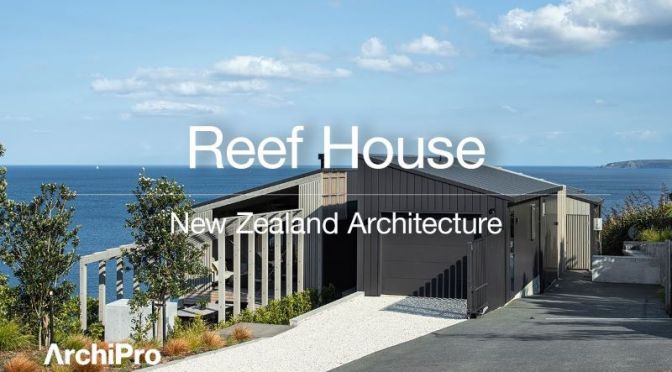
Architecture: ‘Reef House’ – Auckland, New Zealand

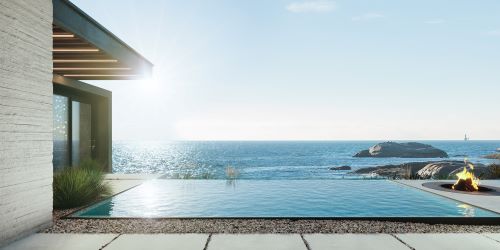
Summer holidays near the coast, any coast, are the right of every New Zealander and loom large in the childhoods of many of us. For some, the reality of a home near the coast is a goal to aspire to; a place where family and friends can build memories that often transcend generations.

For the owner of this house, that was the dream—to provide a holiday home for her three children and their families. One that would ultimately be passed on, becoming, in the process, an indelible embodiment of that dream. In this instance though, the familial link runs deeper, as the owner commissioned her architect cousin—Dave Strachan of Strachan Group Architects (SGA)—to design the home and two of her children, builders starting out on their own, to build it.

“Reef house is very much a family experience,” says Dave. “Not just because of its intended use but because we will all get to look back on it and see where it was touched by each of us in turn.” Situated on an elevated section overlooking the rocky beach break of Daniels Reef, the site enjoys extensive sea views from the northeast through to the south and across to Little Barrier Island. “These views, as well as a fall of seven metres across the site diagonally from west to east, provided the natural context.

A vacant site to the northeast, as well as neighbours overlooking from the north, also needed to be considered in the design process. Dave says that while the site itself was of a good size, council regulations around setbacks and neighbouring sightlines, coupled with topographical considerations, restricted placement of the building site to within a 200m2 building platform.

“From the outset, the goal was to design as complete a council-compliant scheme as possible, including strict adherence to the maximum building footprint. To achieve that, the plan is a split cruciform, providing axial views and cross ventilation in both directions. In section, breaking the form into a twin-roof pavilion allows for ample volumetric shifts across the upper-floor spaces.

“Here, the floorplates are offset and arranged to direct views out to the sea from the entrance and living areas. The kitchen projects through the building envelope and out onto layered and screened outdoor living spaces—helping blur the lines between indoor spaces and outdoor spaces.” Another design element that blurs the lines is the courtyard garden, which works as a climate modifier and is accessed through a bank of hinged doors, cleverly incorporating the space into the interior while maintaining its exterior designation.

Click here to see the full project: https://archipro.co.nz/project/reef-h…
Travel & Architecture: ‘Ziedlejas Resort, Latvia’

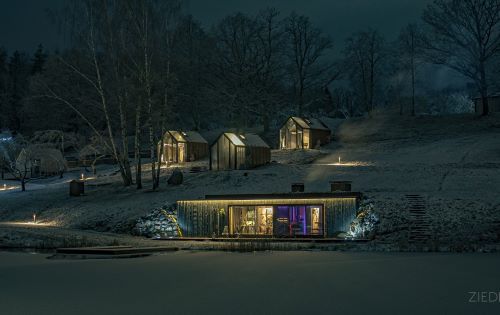
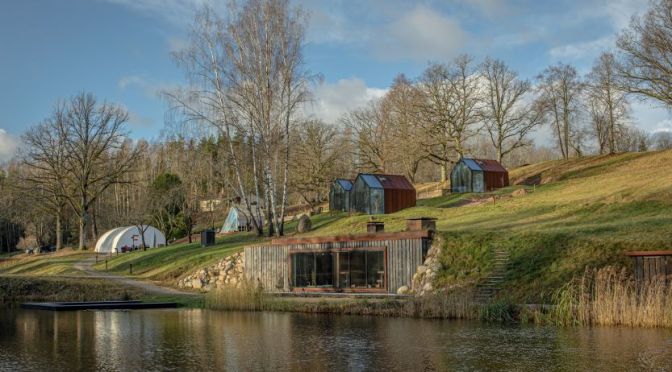
Ziedlejas is a wellness resort rooted in the Latvian sauna tradition. With a secluded location in rural Latvia, it offers natural retreats away from the crowds. Two saunas have already been completed and a third is underway.

Number 1 or the ‘baltā pirts’ (white sauna) is a concrete structure built into the hillside to avoid interfering with the view from the guest cabins. It benefits from natural light and the proximity of the pond for jumping into. We used locally sourced natural materials like wood, herbs and linen to complete the interior.

The more primeval ‘melnā pirts’ (smoke sauna) is built from spruce and fittingly tucked into the woods. While the sauna buildings remain traditional in terms of their purpose, we made sure to enhance functionality and overall aesthetics from a contemporary design perspective.

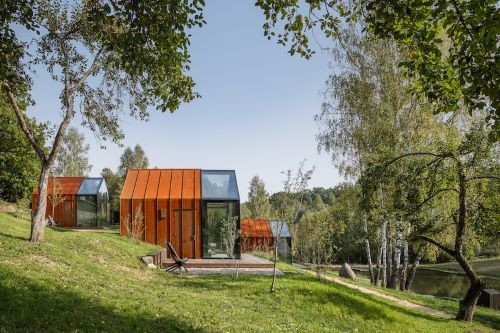
In 2020 four corten steel and glass cabins opened to overnight guests. Tea houses by day and bedrooms by night, they are designed to be multifunctional. The glass front affords unspoilt views of the landscape. Thanks to the neighbouring herb patches, guests can literally pick and mix their own herbal tea blend. 

This is a place to enjoy slowly. Open AD has been involved in the development since day one in partnership with the owners and Landshape landscape architecture firm. 

Read and see more

Views: ‘House On A Cliff’ In Algarve, Portugal By Kerimov Architects

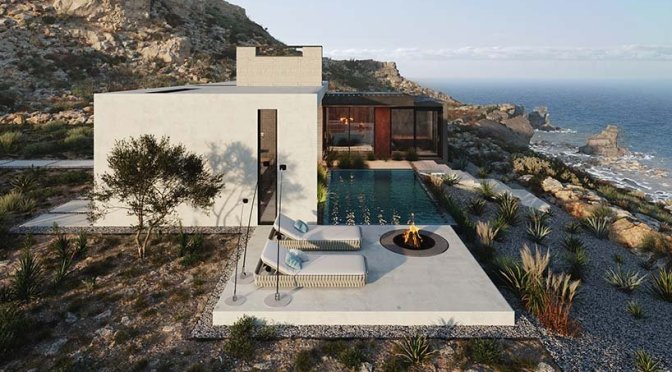
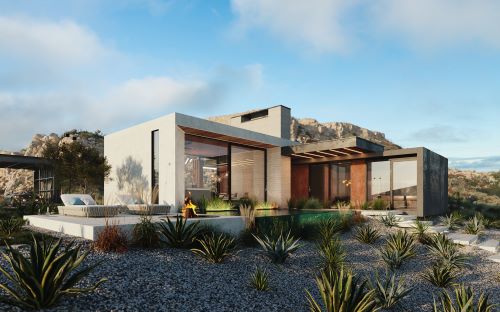
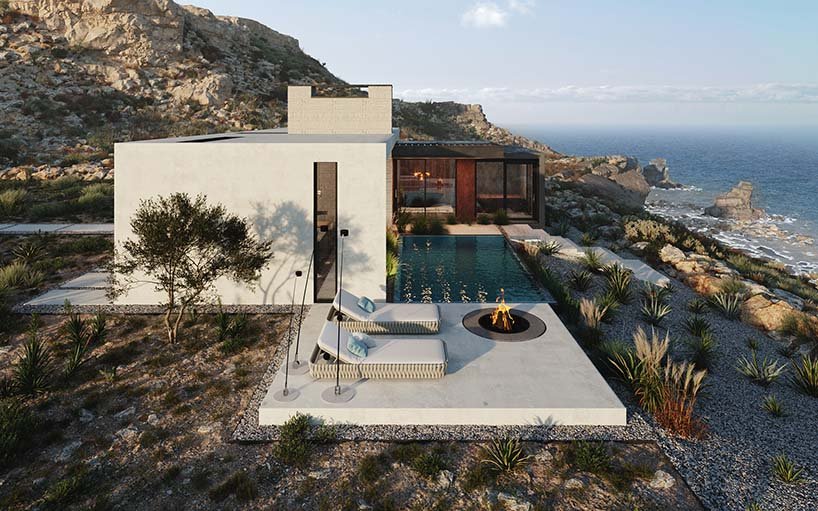
Moscow-based Kerimov Architects have designed a single-story house on a cliff, situated in Algarve, Portugal. The dwelling settles amid the lush natural surroundings and next to the ocean, generating a peaceful refuge away from the bustling city.

the context played a fundamental role in the project, with the volumetry, materiality, and the color palette drawing influence from the rocky landscape. 

Read more

Insider Views: ‘Art And Architecture’ In Beverly Hills, California (Video)

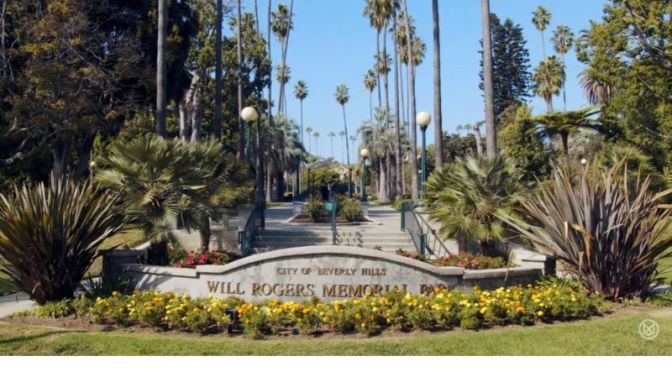
Perched above the buzz of Beverly Hills sits Casa Perfect, a gallery of contemporary design set in a spectacular modernist home. Its founder David Alhadeff shows us the wealth of remarkable art and architecture that is to be found in the varied neighbourhoods of this sunny city. Monocle Films has partnered with Beverly Hills Conference & Visitors Bureau to reveal hidden gems through the eyes of local creatives.

Design: 20 Ft. Wide ‘Pencil Tower Hotel’ In Sydney

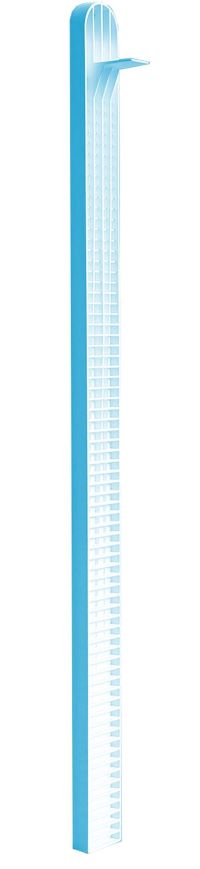
An improbably narrow, six meter wide site is envisaged for a 100m tower in the downtown area of Sydney near its central station. 

Our proposal embraces this extraordinary attenuated quality, proposing a ‘column’ tower on a low scale podium. 

The podium references the delicacy and detail of its heritage neighbours, using the language of grand arching brickwork. A three story urban room houses multiple levels of lobby, cafe & lounge, visible through a large scale keyhole window. A walled courtyard garden for shared use overlooks the street. 

The tower simulates the compression and extension of a column, through a continuous abstraction of the elements of a column: base, shaft and capital.
 

The facade begins with compressed horizontal screening, slowly transforming into exaggerated verticals at the top. Horizontals begin wide and flush with the outside frame, slowly thinning and receding at the height of the tower. Each horizontal is at the height of the slab, handrail and door head height. 

The capital is joyfully expressed as a flying balcony and shell curves of a rooftop sundeck, pool and “hammam” spa. The soffit of the curved ceiling  is brightly tiled, visible from both the street below and the city beyond.
 
Each floor houses compact hotel rooms, gathering light from the street, rear court or internal shapely voids. The voids are tiled to reflect light and colour into the rooms. Key hole windows provide a framed vignette of the seamless tiled surface.

Testing the boundaries of construction and design, the ‘pencil’ tower adds both a generous street room and  a heroic skyline to its neighbourhood.

Read and see more

Buildings: ’98 Front’ In Brooklyn, New York By ODA Architects (Video)

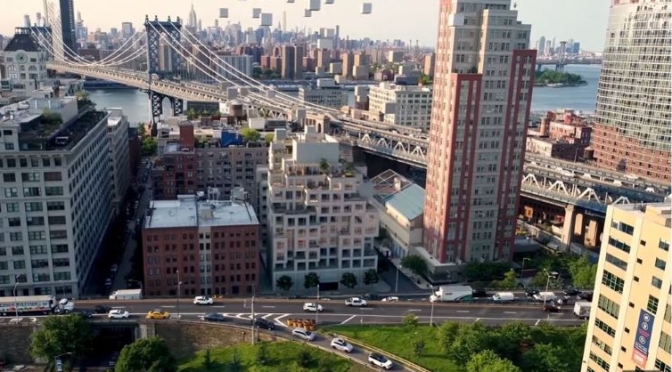
Architecture firm ODA has completed a luxury residential building in Brooklyn that features Jenga-style facades made of concrete and glass.

Called 98 Front, the condominium building occupies a corner lot in Dumbo, a waterfront neighbourhood that has seen a flurry of new development in recent decades. The building is a short walk from Brooklyn Bridge Park, which stretches along the East River.

Designed by New York-based ODA, the project is intended to combine “sophisticated, innovative architecture with superior craftsmanship”. Roughly rectangle in plan, the building rises 10 levels and totals 189,000 square feet (17,559 square metres), Made of concrete and glass, the building’s exterior consists of irregularly placed cubic volumes that recall a game of Jenga. The projecting blocks create numerous overhangs and terraces.

Read more on Dezeen: https://www.dezeen.com/?p=1608959

Architecture: ‘Horizon House’ – Catalonia, Spain

Olot (Catalonia, Spain, population 34,000), an old town in the midst of the Pyrenees’ foothills, is well known for its forested volcanoes, country estates (“masías”) & evergreen pastures, but when Fina Puigdevall talked to her former classmate Carme Pigem about revamping her restaurant Les Cols plus building her new house, neither of them could have imagined that, later on, the former would become a celebrated Michelin-starred chef, and the latter a Pritzker-prize-awarded architect.

Puigdevall grew up in Les Cols, her family’s 15th century masia. In 1990, in an attempt to save it from development, she opened a restaurant in the former stables downstairs. With no formal culinary training, she worked her way to two Michelin stars by 2010 (which she has held since). In 2000, she hired Pigem and RCR architects to open up the space to the outdoors: they designed a light/water cube in the kitchen and a huge glass wall framing the apple orchard and chicken run.

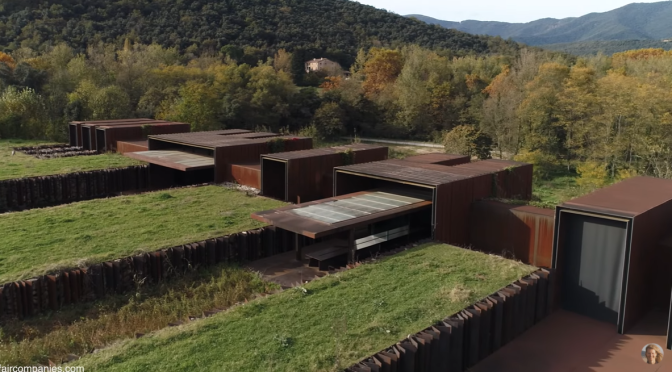
The result is a dining experience that feels immersed in the outdoors. When Puigdevall wanted to expand her own home – a former mill straddling a creek – to accommodate her husband and three daughters, RCR Architects told her they wouldn’t touch the original structure, but proposed something completely new in the middle of the former corn fields. What they dubbed “Horizon House” is a corten steel structure carved into the hill. Large walls of glass can be opened to allow the fields – now planted with native crops like buckwheat- to enter the home.

Green Renovation: ‘1970 Manchester, UK Building’ By TP Bennett Architects

This video produced by Dezeen for TP Bennett reveals how the architecture practice has transformed an old building in Manchester into an “ultra sustainable” mixed-use office building.

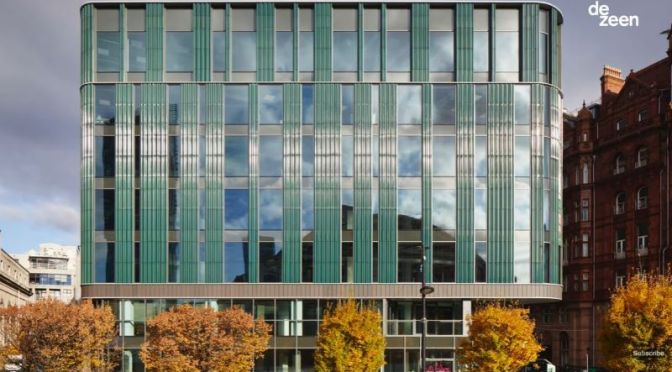
Called Windmill Green, the office building is a conversion of an unused 1970s structure in the heart of the city that was due to be demolished. The site has been transformed into a mixed-use co-working space fitted with several sustainable additions geared towards carbon reduction and biodiversity, such as solar panels, beehives, and “Manchester’s largest living wall”.

“Sustainability was a key driver with this scheme and we transferred a derelict and vacant building into an ultra sustainable and high-spec workplace” said Yvette Hanson, the principal director of TP Bennett, in the video. “At TP Bennett, we bring a deep commitment to carbon reduction to deliver buildings that better reflect the way people live, work and interact, while at the same time fostering a positive social impact,” she added.

Developed in collaboration with real estate investment boutique FORE Partnership, the building features a ground level dedicated to retail and a facade covered with the green terracotta tiles that are typical of buildings in Manchester.

Travel & Architecture: 14th Century Florence Baptistery Restoration

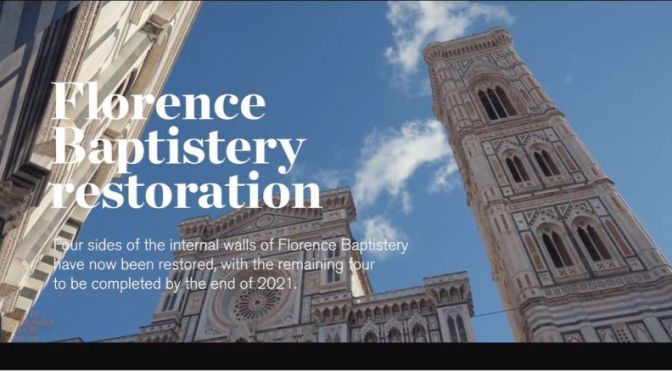
Four sides of the internal walls of Florence Baptistery have been restored, with the remaining four to go by the end of 2021. “Here come all those who wish to see admirable things” is the English translation of the words set in the marble inlay of the floor of Florence’s baptistery, as visitors enter through the Gates of Paradise.

These worthy items include the fourteenth-century mosaics depicting prophets, bishops and cherubs, which are enjoying renewed vigour after the restoration of four of the eight sides of Florence’s oldest monument. The internal walls of the baptistery began to be restored towards the end of 2017 following a restoration campaign on the external walls and roof.

Many discoveries emerged from the diagnostics, the first of their kind to be conducted on the monument, including the original technique used in the parietal mosaics; the presence of a pigmented wax on the green Prato marble, used to cover the white limestone that had formed due to water coming in through the roof, now removed to reveal the stone’s natural hue; and traces of gold leaf on one of the capitals of the matroneum, which could form evidence that the capitals were all originally covered in gold leaf.

In the first couple of decades of the fourteenth century, having completed the colossal feat of the mosaics inside the baptistery’s dome, the decision was made to extend the technique to the parietal sides, something that wasn’t part of the original plans.

It was a solution that allowed the mosaics to be superimposed over the marble covering and solve the issue of the monument’s static nature. Made-to-measure hollow terracotta tiles were used, cut and fixed to the marble on the baptistery’s walls with central iron linchpins driven back and welded in a straight line.

“A hurried sinopia was then conducted on the tiles and later the mosaic with a direct method and over days, which can still be identified and interpreted today,” explained Beatrice Agostini, planner and head of the restoration campaign of Opera di Santa Maria del Fiore. “Even the mixture used to apply the mosaic tiles is absolutely unique. Ordinary mortar wasn’t used. Instead it was more of a glue, and it’s the decline of this compound that has caused the most problems in this restoration.”

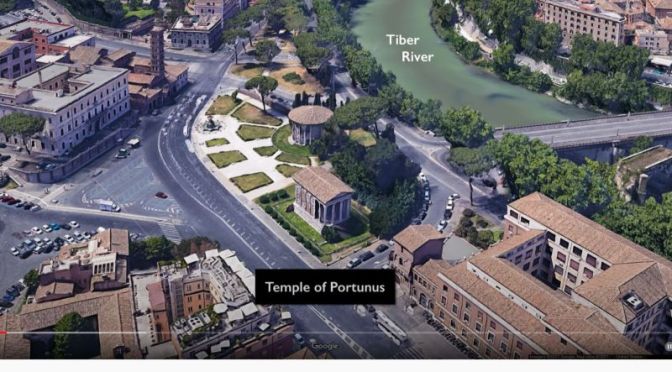
Ancient Architecture: ‘Temple Of Purtunus’ In Rome, Italy (4K Video)

The Temple of Portunus or Temple of Fortuna Virilis is a Roman temple in Rome, Italy, one of the best preserved of all Roman temples. Its dedication remains unclear, as ancient sources mention several temples in this area of Rome, without saying enough to make it clear which this is.