

From a Wall Street Journal online article:

 More schools are building or planning senior-living facilities on or near campus to cater to baby boomers who view college as a stimulating alternative to bingo at an archetypal retirement home. Some savor the pursuit of academic and cultural interests. Others are lured by the promise of interaction with younger students, for whom many hope to act as mentors.
It is the latest way for universities to profit from one of their greatest assets, land. Colleges have already taken advantage of this privilege by developing hotels and high-end student housing. Now, some see sales of upscale senior housing as the next step.
Lasell University, just west of Boston, built one of the first on-campus senior communities two decades ago. It requires members to take 450 hours of coursework or activities each year. Other programs have since sprouted up in places like the University of Michigan and Oberlin College in Ohio. Some communities are on campus; others are situated nearby and may have only a loose affiliation with the school. Many offer assisted living and nursing options.
To read more: https://www.wsj.com/articles/seniors-want-to-go-back-to-class-universities-want-to-sell-them-real-estate-11576751403
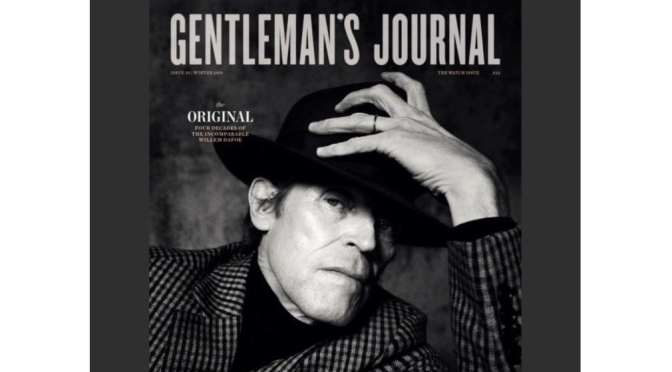
 Thankfully, Willem Dafoe and Willem Dafoe’s face have used this innate recognisability to their joint advantage. To date, the actor has appeared in well over 100 films, and his prolific career can be charted through the cracks and comments — some nice, some not so nice — that those in the industry have made about his looks.
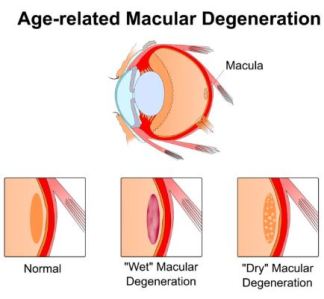 “Our work provides additional evidence that that diet matters,” Millen added. “From a public health standpoint, we can tell people that if you have early AMD, it is likely in your best interest to limit your intake of processed meat, fried food, refined grains, and high-fat dairy to preserve your vision over time.”
 Am I Still a Man?
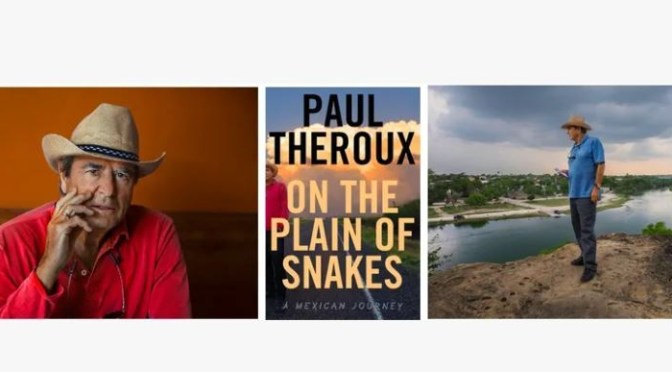
 I think of myself in the Mexican way, not as an old man but as most Mexicans regard a senior, an hombre de juicio, a man of judgment; not ruco, worn out, beneath notice, someone to be patronised, but owed the respect traditionally accorded to an elder, someone (in the Mexican euphemism) of La Tercera Edad, the Third Age, who might be called Don Pablo or tío (uncle) in deference. Mexican youths are required by custom to surrender their seat to anyone older. They know the saying: Más sabe el diablo por viejo, que por diablo – The devil is wise because he’s old, not because he’s the devil.

 Fifty-five years after co-founding the rock band The Who, Pete Townshend is still at it. The lead lyricist and guitarist says he actually doesn’t enjoy performing but views it as an “easy” job necessary to finance his lifestyle and support his family and staff. Economics correspondent Paul Solman sits down with Townshend to discuss aging, surviving child abuse and art’s ability to inspire hope.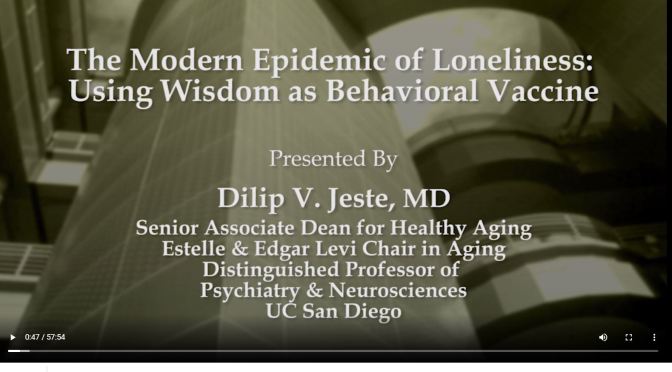
 As societal stresses have increased, loneliness and social isolation have become silent killers. Dilip Jeste, MD, a geriatric neuropsychiatrist who specializes in successful aging, explains how loneliness has become an epidemic, the risk factors, helpful interventions, and how we can harness wisdom for compassion, self regulation, and more.
 Contrary to popular opinion, when it comes to well-being, our lives do not represent an inevitable decline from the sunny uplands of youth to the valley of death. Instead, the opposite is true — we can confidently look forward to old age as the happiest time of our lives.
 So why do people grow happier as they age? Is it an absence of stress, or are they able to focus more on what brings them joy?
 The Grand Challenge Prize is looking for bold, audacious innovations, ideas that can really change aging. We’re looking in science, in technology and engineering, in policy, social sciences, behavioral sciences, economic policy, in traditional medical science and health care, and in work focused on specific diseases. It’s really very broad. We’re looking for innovative thinking that can have global impact. The prizes are going to roll out on three levels. There will be 450 Catalyst Prizes awarded over a three-year period. The first of the three yearly calls will be in January 2020. Once it’s announced, there will be six weeks to submit your idea — just the idea, it doesn’t require any pilot work — and a two-page application. They’ll be reviewed within four months and prizes announced by July. The Catalyst Award is intended as seed funding to get the idea into its earliest stages of development. They’re relatively small in dollar amount, about $50,000 each, but they will give access to an annual meeting bringing together world experts in these fields.
 Boomers Daily