Top Restaurants In Texas: Lucky Robot Japanese Kitchen In Austin Fuses “Nikkei” & Flavors Of Peru

From a Forbes.com online review:

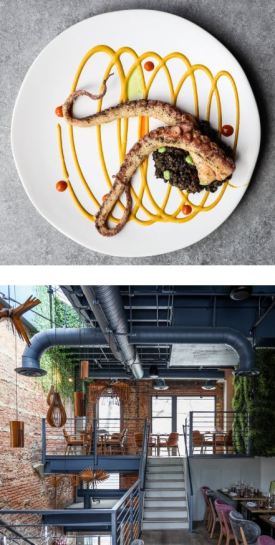
Lucky Robot Japanese Kitchen Austin sustainable SushiChef de cuisine Julio-Cesar Florez, a native of Lima, served as chef de cuisine of the now-defunct Peruvian-themed Isla and has been the sous chef at Lucky Robot since mid-2017, where he began adding subtle Peruvian touches to Huang’s playful Japanese cuisine. Seeing the success of these special menu items, the two decided to take the 6-year old restaurant in this new direction.

Nikkei marries the simplicity and precision of Japanese cooking techniques with the flavor profiles of Peru

Lucky Robot, a casual Japanese restaurant in Austin’s popular South Congress Avenue, switched its menu to focus more intensively on nikkei in the spring. With over 15 years’ experience in Japanese cuisine, training under Master Shibazaki-san of Benihana and Tyson Cole of Uchi, executive chef Jay Huang is a master of Japanese flavors and plating, enhanced by a passion for sustainability and support of local purveyors.

To read more: https://www.forbes.com/sites/claudiaalarcon/2019/09/12/why-you-should-visit-this-austin-restaurant-where-peru-meets-japan/#20490d335ba8

Top Exhibitions: “Félix Vallotton: Painter of Disquiet”, Metropolitan Museum NYC October 29

From the MetMuseum.org website:

Nuit tombante sur la Loire - Félix Vallotton, 1923Witness to the radical aesthetics that gripped Paris in the late nineteenth and early twentieth centuries, Vallotton developed his own singular voice. Today we recognize him as a distinctive artist of his generation. His lampooning wit, subversive satire, and wry humor is apparent everywhere in his artistic production. Vallotton’s trenchant woodcuts of the 1890s solidified his reputation as a printmaker of the first rank while boldly messaging his left-wing politics.

Félix Vallotton: Painter of Disquiet will present pivotal moments in the artist’s career as a painter and printmaker. Painted portraits, luminous landscapes, and interior narratives that pulse with psychological tension join the exhibition from more than two Metropolitan Museum of Artdozen lenders. Swiss-born and Paris-educated, Vallotton (1865–1925) created lasting imagery of fin-de-siècle Paris.

For the first time ever, this exhibition will display Picasso’s legendary portrait of Gertrude Stein, from The Met collection, alongside Vallotton’s rendering of this formidable collector, which was painted a year later. Vallotton finished his portrait in a matter of weeks and gave it to Gertrude Stein.

To read more: https://www.metmuseum.org/exhibitions/listings/2019/felix-vallotton-painter-disquiet

Brain Research: We Make Decisions Based On Memories To Maximize Reward Received

From a Geneva University Neurocenter release:

Geneva University Neurocenter.JPG…the optimal strategy when faced with two propositions is to sum up the values associated with the memories you have of each choice, then calculate the difference between these two sums (do I have more positive memories linked to chocolate eclairs or macaroons?). The decision is made when this difference reaches a threshold value, fixed in advance, which determines the time taken in making the decision. This model leads to rapid decision-making when the values of the two possibilities are very far apart. But when two choices have almost the same value, we need more time, because we need to draw on more memories so that this difference reaches the decision threshold.

Our brains are constantly faced with different choices: Should I have a chocolate éclair or macaroon? Should I take the bus or go by car? What should I wear: a woollen sweater or one made of cashmere? When the difference in quality between two choices is great, the choice is made very quickly. But when this difference is negligible, we can get stuck for minutes at a time – or even longer – before we’re capable of making a decision. Why is it so difficult to make up our mind when faced with two or more choices? Is it because our brains are not optimised for taking decisions? In an attempt to answer these questions, neuroscientists from the University of Geneva (UNIGE), Switzerland, – in partnership with Harvard Medical School – developed a mathematical model of the optimal choice strategy. They demonstrated that optimal decisions must be based not on the true value of the possible choices but on the difference in value between them. The results, which you can read all about in the journal Nature Neuroscience, show that this decision-making strategy maximises the amount of reward received.

To read more: https://neurocenter-unige.ch/news/brain-how-to-optimize-decision-making/


Culinary Arts: Online Wine Courses Are Easy Watching, Still Evolving

From a Wall Street Journal online article by Lettie Teague:

Illustration by Joanna Neborsky for the Wall Street JournalMany self-styled “wine educators” online claim to be certified sommeliers, but that doesn’t mean they have worked in a restaurant. Others are winemakers, adjunct professors or simply oenophiles with a pedagogical bent. Whether via video or podcast, the education they offer tends to fall into two categories: basic (grape names, how to hold a glass) or wonky (the role of tannins, grapevine blights).

LEARNING about wine online seems easy enough—not to mention affordable. Yet after exploring all manner of internet wine education, I’m not ready to declare it the ideal forum—at least not yet.

The educational content actual wine professionals produce mostly falls into the latter camp, and podcasts appear to be the preferred format. The decidedly wonky “Guild of Sommeliers Podcast”(guildpodcast.com) features sommeliers such as Geoff Kruth and Kelli White interviewing top talent. In an episode last fall, Mr. Kruth and Virginia Wilcox, winemaker at Vasse Felix in Western Australia, discussed tannins in a surprisingly lively chat. “I think you can make or break a wine by getting the tannins wrong,” Ms. Wilcox said. She enumerated various categories of tannin, including “astringent,” “squeaky,” “toothy,” “tongue” and “green”—the ones that “push to the back of your throat.” I learned a lot and plan to invoke the term “squeaky tannins” very soon.

To read more click on the following link: https://www.wsj.com/articles/are-online-wine-courses-worth-your-time-11568321079


The Future Of Clothing: “Element Pure” Uses 3D Scanning, AI Technology For Perfect-Fitting Shirts

From a YankoDesign.com online article:

Element Pure AI Body Scanning Tailoring Smartphone TechThe procedure is incredibly simple, and beats having to make an appointment with your tailor for hour-long fitting sessions and getting entangled in measuring tape. Element Pure’s AI tailor needs just two things from you. A front profile and side profile photograph, taken with a standard A4 sheet kept on the floor as reference. Using those two photographs, Element Pure can generate a 99% accurate 3D model of your torso, which the AI Tailor uses to take measurements. The result is a perfectly fitted shirt that’s been designed specifically for you. You can even pick between slim, regular, and relaxed fits, as well as choose your shirt length, depending in whether you wear your shirts tucked or untucked. The AI does the job in minutes that a tailor would take hours or even days to, with no propensity for error. The fitted, tailor-made shirt delivers to your doorstep, giving you the convenience of fast fashion, with the custom-fitting of something your tailor would make for you.

The fabrics used to craft Element Pure’s shirts are woven from eucalyptus pulp rather than cotton, resulting in clothes that keep you cool, resist odors, wrinkles, and are arguably more comfortable and breathable than cotton… even the Huffington Post agrees! The fabric, named TENCEL, is developed in Austria through the ethical farming of organic PEFC certified eucalyptus wood, in a non-toxic, renewable way.

To read more: https://www.yankodesign.com/2019/09/12/this-fashion-brand-uses-a-i-and-3d-scanning-to-tailor-clothes-to-perfectly-fit-your-body/

Destinations: Walk The Streets, Parks And Palaces Of Beethoven’s Vienna

From a Wall Street Journal online article:

Beethoven's Vienna WalkBeethoven moved nearly 70 times while living in Vienna. Two of his former homes are open to the public, and many more are marked with commemorative plaques.

High above Vienna’s historic center, at the edge of the hilly Vienna Woods, the city’s Beethoven Museum, is housed in a onetime bakery complex dating back to the late Middle Ages, with an 18th-century annex containing a small apartment where Beethoven spent the summer of 1802. While living here, he composed his tragic “Tempest” piano sonata and began work on his 3rd Symphony, the “Eroica.”

Where to Binge on Beethoven in Vienna - Wall Street Journal Sept 2019

Theater an der Wien - Beethoven's ViennaLUDWIG VAN BEETHOVEN is as Viennese as apple strudel. Though born in Bonn, Germany in 1770, he moved to the Austrian capital when he was in his early 20s, and then spent the rest of his 56 years changing the course of Western music from the city on the Danube. A quirky, cantankerous celebrity in his own time, he premiered his groundbreaking symphonies and concertos in Vienna’s grand palaces, escaped the summer heat in what are now its sleepy suburbs, and moved around between dozens of supposedly squalid apartments that sprawl across much of the city.

To read more: https://www.wsj.com/articles/where-to-binge-on-beethoven-in-vienna-11568303745

Top Science Podcasts: Modelling Embryonic Development, Baby Sea Turtles, “Nature” News

Nature PodcastListen to the latest from the world of science, with Benjamin Thompson and Shamini Bundell. This week, modelling embryonic development, and an analysis of male dominated conferences.

In this episode:

00:44 Imitating implantation

Researchers have created a system that uses stem cells to model the early stages of pregnancy. Research article: Zheng et al.News and Views: Human embryo implantation modelled in microfluidic channels

08:03 Research Highlights

Traces of baby turtle tracks, and Titan’s explosive past. Research Highlight: A baby sea turtle’s ancient trek is captured in a fossilResearch Highlight: Giant explosions sculpted a moon’s peculiar scenery

09:36 ‘Manferences’

Nature investigates the prevalence of conferences where most of the speakers are male. News Feature: How to banish manels and manferences from scientific meetings

15:41 News Chat

An update on India’s latest moon mission, drugs that may reverse biological age, and this year’s Breakthrough Prize winners. News: India loses contact with its Moon lander minutes before touchdownNews: First hint that body’s ‘biological age’ can be reversedNews: First-ever picture of a black hole scoops US$3-million prize

Long-Term Care: A Highly Contagious, Drug-Resistant “Fatal Fungus” Spreads In Nursing Homes

From a New York Times online article:

Nursing Homes article in New York Times Sept 2019Scientific research on nursing homes and drug resistance is sparse, but some recent studies offer evidence of the problem. A study published in June in the Journal of Clinical Infectious Diseases found that patients and residents in long-term care settings have alarmingly high rates of drug-resistant colonization, which means they carry the germs on their skin or in their bodies, usually without knowing it, and can pass them invisibly to staff members, relatives or other patients. Elderly or severely ill people with weakened immune systems who carry the germ are at high risk of becoming infected. 

Maria Davila lay mute in a nursing home bed, an anguished expression fixed to her face, as her husband stroked her withered hand. Ms. Davila, 65, suffers from a long list of ailments — respiratory failure, kidney disease, high blood pressure, an irregular heartbeat — and is kept alive by a gently beeping ventilator and a feeding tube.

Doctors recently added another diagnosis to her medical chart: Candida auris, a highly contagious, drug-resistant fungus that has infected nearly 800 people since it arrived in the United States four years ago, with half of patients dying within 90 days.

To read more: www.nytimes.com/2019/09/11/health/nursing-homes-fungus.html?action=click&module=News&pgtype=Homepage

New Restaurant Chains: Crack Shack Offers Top “Southern California Fried Chicken & Egg Fare”

From a UpRoxx.com online article:

 The Crack Shack … offer(s) genuinely tasty chicken sandwiches with meat sourced from farms outside of the industrial farming world. They… cost roughly ten times as much as a McChicken and more than double the Popeye’s Chicken Sandwich.

UpRoxx.com online Illustration 2019

“Solid, good cooking and comfort are always on-trend,” says Chef Richard Blais. We reached out to the Top Chef all-star and co-owner of The Crack Shack to talk chicken sandwiches because, well, that’s all people seem to be talking about lately. We figured, if anyone would understand how a sandwich basically turned into a cult obsession at the tail end of summer ’19, he might.

“Chicken is incredibly universal and always a crowd-pleaser,” Blais adds. “As is fried food, so… I think it’s just math.”

The cushy bread, the tangy mayo, the crunch of a salty pickle, and, of course, a beautifully seasoned and deep-fried piece of chicken (hopefully brined thigh meat) is about as complex-yet-simple as a sandwich can be. Add a little heat and it’s bliss in a bun.

https://uproxx.com/life/history-of-the-fried-chicken-sandwich/

Top Events: Open House Chicago 2019 Features Over 350 Sites Oct. 13-14

From the OpenHouseChicago.org website:

Open House Chicago 2019 sitesThe Chicago Architecture Center’s Open House Chicago (OHC) is the city’s annual architecture festival. For one weekend in October you can explore Chicago’s most iconic and unique architectural treasures. From mansions to sacred spaces, theaters to private clubs, hotels to secret rooms—OHC gives visitors a behind-the-scenes look at many of the city’s great spaces that are rarely, if ever, open to the public.

OHC is a citywide event that includes more than 350 sites located in more than 38 neighborhoods. Sites reflect the cultural diversity and history of Chicago, as well as the unique character of each community. Locations include private clubs, residential spaces, offices, hotels, theaters, design/architecture studios, schools and places of worship as well as manufacturing, cultural and government facilities. This diverse selection of sites allows visitors to plan an itinerary according to their own specific interests. Browse the sites that have participated in OHC since 2015.

To read more: https://openhousechicago.org/

News, Views and Reviews For The Intellectually Curious