

Video shows drones taking off and forming various shapes, including a luminous stag seen flying across Scottish skies.
Category Archives: Technology

Futuristic Homes: Solar-Powered Sustainable Mountain Pod (Video)
Designed by: Ehab Alhariri:
A Futuristic Smart Sustainable Mountain pod designed to utilize solar power using a petals mechanism that allows it to open up and close down to charge up the pod using photovoltaic cells mounted on the petals.
Inspired by a flower motion, the petals when open allows for a 360° view of the surrounding, the mechanism could also potentially allow the pod to collect rainwater to be self-sufficient and of the grid hide out.

Sailboat Racing: The Spectacular Technology Behind The ‘America’s Cup AC75 Monohulls’ (Video)
Fusing athleticism, teamwork, and technology, the monohulls competing for the 36th #AmericasCup are the fastest in the world. It was August 2012 when the sailing world was turned upside down by a 72 foot catamaran flying in the Hauraki Gulf. Emirates Team New Zealand had brought the foils to the America’s Cup and changed the face of top-level yacht racing forever. Since then the increase in performance for America’s Cup boats has been greater than at any point in the 170-year history of the event. Six years later, in 2018, the publication of the AC75 Class rule, marked the beginning of a new sailing era. Nowadays foils are commonplace, but the engineering and sailing techniques needed to get the AC75 to fly are completely different from anything seen before.

Medical Technology: The ‘3D-Printed Heart’ (Video)
Imagine having the option to get a 3D-printed organ. Well, a team of biomedical engineers from Carnegie Mellon University has just developed the first flexible, full-size, 3D-print of a human heart, bringing us one step closer to that reality.
Additive manufacturing printers are popular, but are typically known to build hard objects using materials like plastic or metal. But rigid plastic organs aren’t very practical. These printers could be used with softer materials, like biological hydrogels — you know, to make a heart — but those tend to collapse mid-print. But this new method can change the game.
The 3D-printing technique is called Freeform Reversible Embedding of Suspended Hydrogels or FRESH. It can print biological structures with soft squishy materials like alginate, a biomaterial made from seaweed, which feels like human tissue. AND it cleverly solves that collapsing problem during print by suspending flexible materials inside a container of gelatin.
For this team of researchers it all starts with a MRI scan from a real heart. The scan gets “chopped-up” digitally into horizontal slices by a program which then translates them into code that a printer will understand. A needle-like nozzle moves through the gelatin support bath, extruding thin layers of alginate. The layers stack on top of each other to build the shape. When the print is complete, it’s put in an incubator overnight, where the temperature is raised to 37°C to gently melt away the gelatin support structure, leaving only the 3D-printed heart.

Future Of Trucks: Inside The ‘Tesla Electric Semi’
The personal transportation industry has been shaken up over the past decade or so, with the introduction of electric cars proving to be more environmentally friendly, and importantly, cheaper to run, than their petrol or diesel counterparts. Bike manufacturers are also working on the transition in the motorcycle segment. While this change has been taking place, trucking has been continuing unchanged in the background. Our food, household goods, and even electric car parts, have been transported by diesel power just like they have been from the start, while the industry has grown to be worth $700 billion in the US alone, more than many of the world’s countries’ GDPs. With the huge weights involved, electrifying the trucking industry has taken a back seat due to the impracticality, but at the end of 2017, 3 years ago, Tesla announced plans to change this with the Semi, a fully electric truck designed to shake up the shipping industry. Why The Tesla Semi Is The Future of Trucks

2021: Five Major Stories Shaping The World (Video)
The World in 2021 will start to look beyond covid-19: to the launch of an asteroid-smashing space probe, the next step in the fight against climate change and China’s supremacy at the box office. Here are five stories to watch out for.
Video timeline: 00:00 – Top five stories for 2021 00:39 – Democracy under threat 04:17 – The electric revolution revs up 06:55 – A chance to turn a corner on climate change 10:39 – China v Hollywood: battle of the box offices 14:40 – Defending the planet

Future Of Food: The ‘Blue Revolution’ (Video)
Today we face the daunting challenge of feeding nearly 8 billion people, and that number will grow to at least 11 billion by 2100. With already half of all the habitable land on Earth dedicated to agriculture, we’re starting to run out of options. Could the Blue Revolution be our answer?
Learn more here: https://www.nature.org/content/dam/tn…

Future Of Housing: An ‘Autonomous Off-Grid Smart Home Interior’
haus.me Autonomous Off-the-Grid Smart House interior. Luxury hi-tech house delivered fully assembled and furnished. Absolutely self-sustainable smart house. details: http://haus.me

Online Shopping: ‘How Amazon Delivers Your Orders So Quickly’ (Video)
Since the beginning of this century, Amazon has emerged as a pre-eminent giant of retail. How? by creating an expectation among consumers that next day, or even same day, delivery is not only possible but basically routine for a dizzying array of consumer products. Millions of Amazon Prime customers all over the world have now come to expect this astonishingly swift service on countless items as standard, and this has put great swathes of the traditional retail landscape in trouble. So today, we’re going to look at how Amazon delivers packages so fast. Let’s pick a typical Amazon product as an example. Say you need a bicycle pump. How will Amazon get that bike pump delivered to your door, the very next day? How Amazon Delivers Packages So FastSHOW LESS
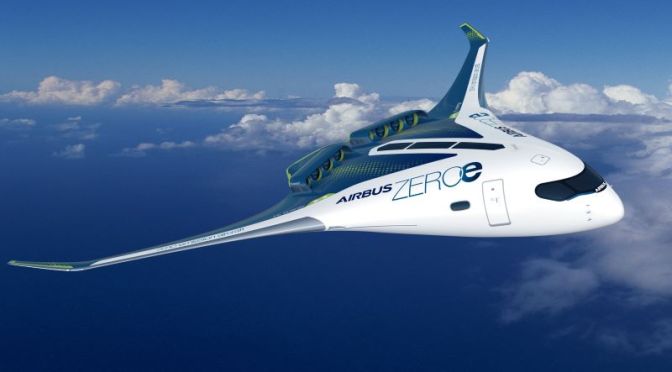
Future Of Air Travel: ‘Airbus ZEROe – Next-Gen Hydrogen Planes’ (Video)
Airbus has revealed three concepts for the world’s first zero-emission commercial aircraft which could enter service by 2035. These concepts each represent a different approach to achieving zero-emission flight, exploring various technology pathways and aerodynamic configurations in order to support the company’s ambition of leading the way in the decarbonisation of the entire aviation industry.
All of these concepts rely on hydrogen as a primary power source – an option which Airbus believes holds exceptional promise as a clean aviation fuel and is likely to be a solution for aerospace and many other industries to meet their climate-neutral targets.
The three concepts – all codenamed “ZEROe” – for a first climate neutral zero-emission commercial aircraft include:
•A turbofan design (120-200 passengers) with a range of 2,000+ nautical miles, capable of operating transcontinentally and powered by a modified gas-turbine engine running on hydrogen, rather than jet fuel, through combustion. The liquid hydrogen will be stored and distributed via tanks located behind the rear pressure bulkhead.
• A turboprop design (up to 100 passengers) using a turboprop engine instead of a turbofan and also powered by hydrogen combustion in modified gas-turbine engines, which would be capable of traveling more than 1,000 nautical miles, making it a perfect option for short-haul trips.
• A “blended-wing body” design (up to 200 passengers) concept in which the wings merge with the main body of the aircraft with a range similar to that of the turbofan concept. The exceptionally wide fuselage opens up multiple options for hydrogen storage and distribution, and for cabin layout.
 Boomers Daily