

Infographic: The ‘3 Types Of Covid-19 Vaccines’

Imagine having the option to get a 3D-printed organ. Well, a team of biomedical engineers from Carnegie Mellon University has just developed the first flexible, full-size, 3D-print of a human heart, bringing us one step closer to that reality.
Additive manufacturing printers are popular, but are typically known to build hard objects using materials like plastic or metal. But rigid plastic organs aren’t very practical. These printers could be used with softer materials, like biological hydrogels — you know, to make a heart — but those tend to collapse mid-print. But this new method can change the game.
The 3D-printing technique is called Freeform Reversible Embedding of Suspended Hydrogels or FRESH. It can print biological structures with soft squishy materials like alginate, a biomaterial made from seaweed, which feels like human tissue. AND it cleverly solves that collapsing problem during print by suspending flexible materials inside a container of gelatin.
For this team of researchers it all starts with a MRI scan from a real heart. The scan gets “chopped-up” digitally into horizontal slices by a program which then translates them into code that a printer will understand. A needle-like nozzle moves through the gelatin support bath, extruding thin layers of alginate. The layers stack on top of each other to build the shape. When the print is complete, it’s put in an incubator overnight, where the temperature is raised to 37°C to gently melt away the gelatin support structure, leaving only the 3D-printed heart.
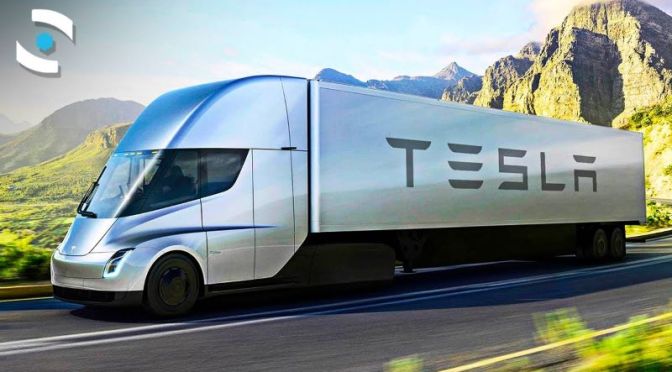
The personal transportation industry has been shaken up over the past decade or so, with the introduction of electric cars proving to be more environmentally friendly, and importantly, cheaper to run, than their petrol or diesel counterparts. Bike manufacturers are also working on the transition in the motorcycle segment. While this change has been taking place, trucking has been continuing unchanged in the background. Our food, household goods, and even electric car parts, have been transported by diesel power just like they have been from the start, while the industry has grown to be worth $700 billion in the US alone, more than many of the world’s countries’ GDPs. With the huge weights involved, electrifying the trucking industry has taken a back seat due to the impracticality, but at the end of 2017, 3 years ago, Tesla announced plans to change this with the Semi, a fully electric truck designed to shake up the shipping industry. Why The Tesla Semi Is The Future of Trucks
For mathematicians and computer scientists, 2020 was full of discipline-spanning discoveries and celebrations of creativity. We’d like to take a moment to recognize some of these achievements.
This year, two teams of physicists made profound progress on ideas that could bring about the next revolution in physics. Another still has identified the source of a long-standing cosmic mystery.
In 2020, the study of the SARS-CoV-2 virus was undoubtedly the most urgent priority. But there were also some major breakthroughs in other areas. We’d like to take a moment to recognize them.
The World in 2021 will start to look beyond covid-19: to the launch of an asteroid-smashing space probe, the next step in the fight against climate change and China’s supremacy at the box office. Here are five stories to watch out for.
Video timeline: 00:00 – Top five stories for 2021 00:39 – Democracy under threat 04:17 – The electric revolution revs up 06:55 – A chance to turn a corner on climate change 10:39 – China v Hollywood: battle of the box offices 14:40 – Defending the planet
Spinario (Boy with Thorn), c. 1st century B.C.E., bronze, 73 cm high (Capitoline Museums, Rome), a conversation with Dr. Steven Zucker and Dr. Beth Harris


While electric cars have become a more common sight on our roads, there is still some way to go before we step away entirely from fossil based fuels. The change to electric power is well underway, but there are still some categories of road transportation that are missing out, including the motor home segment.
That’s until recently. We’ve already seen some electric vans, such as the Nissan e-NV200 and more recently the Mercedes eSprinter, but neither are dedicated camper vans. Various conversions have taken place, and even the one-off electrification of some camper vans, but Germany is home to the world’s first fully electric purpose built RV, the Iridium E-Mobil 70EB.
The original model debuted in early 2019 at a German trade show, a mere hint at what the companies were capable of creating when working together. It’s a shame, then, that its range is just 124 miles. The latest offering doubles this, promising more than 249 miles on a single charge. This comes with the transition from an 86.4 kWh battery pack to a 108 kWh offering. That’s double the range on a 30% battery capacity boost, thanks in part to more efficient technology.








 Boomers Daily