


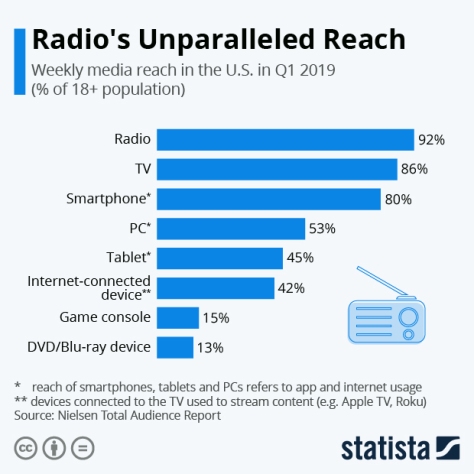
With all the talk about digital media, it’s easy to forget how powerful traditional media such as radio and television still are. Radio in particular rarely gets credited for what it still is: a true mass medium. According to Nielsen, radio even trumps TV in terms of its weekly reach.
According to Nielsen’s measurements, far more than 200 million Americans aged 18 and older listen to the radio at least once a week, equaling a reach of 92 percent of the adult population. Television came in a close second with a weekly reach of 86 percent, while 80 percent of U.S. adults now use apps or browse the web on a smartphone in any given week.
While radio does win in terms of sheer reach, TV remains unparalleled with respect to average daily usage. According to Nielsen’s measurements, U.S. adults spend an average of 4 hours and 27 minutes a day watching TV (live and time-shifted), which is more than 2.5 times the amount of time they listen to the radio (1h 42m).
In this preview of a conversation with correspondent Lee Cowan to be broadcast on “CBS Sunday Morning” on February 16, Harrison Ford, the actor who has played iconic characters in the “Star Wars” and Indiana Jones franchises, talks about returning to familiar roles.
Harrison Ford (born July 13, 1942) is an American actor, aviator, and environmental activist. He gained worldwide fame for his starring role as Han Solo in the original Star Wars Trilogy (1977–1983), eventually reprising the role decades later in the sequel trilogy (2015–2019). Ford is also widely known for his portrayal of Indiana Jones in the Indiana Jones film franchise and as Tom Clancy’s Jack Ryan in the spy thrillers Patriot Games (1992) and Clear and Present Danger (1994).
Film critic Roger Ebert described Ford as “the great modern movie everyman”. His career spans six decades and includes roles in many highly successful Hollywood films. Some of his most popular films include Apocalypse Now (1979), Witness (1985), Presumed Innocent (1990), The Fugitive (1993), Air Force One (1997), What Lies Beneath (2000), and (2013). Seven of his films have been inducted into the National Film Registry: American Graffiti (1973), The Conversation (1974), Star Wars (1977), Apocalypse Now (1979), The Empire Strikes Back (1980), Raiders of the Lost Ark (1981), and Blade Runner (1982).
As of 2019, the U.S. domestic box-office grosses of Ford’s films total over $5.1 billion, with worldwide grosses surpassing $9.3 billion, making him the fourth highest-grossing domestic box-office star of all time.
From Wikipedia
 On this week’s show, senior correspondent Jeffrey Mervis joins host Sarah Crespi to discuss a new National Institutes of Health (NIH) grant program that aims to encourage diversity at the level of university faculty with the long-range goal of increasing the diversity of NIH grant recipients.
Sarah also talks with Pierre Gagnepain, a cognitive neuroscientist at INSERM, the French biomedical research agency, about the role of memory suppression in post-traumatic stress disorder. Could people that are better at suppressing memories be more resilient to the aftermath of trauma?
 Hear the latest from the world of science, brought to you by Nick Howe and Shamini Bundell. This week, uncovering the structure of materials with useful properties, and quantum entanglement over long distances.
In this episode:
Analogues of the paint pigment Prussian blue are used in a variety of chemical processes. Now, researchers have uncovered their atomic structure. Research Article: Simonov et al.; News and Views: Ordered absences observed in porous framework materials
Teenagers’ natural sleep cycles impact on academic performance, and an extinct, giant rodent with a surprisingly tiny brain. Research Highlight: A teenager’s body clock can ring in school success; Research Highlight: Giant extinct rodent was all brawn and little brain
Researchers have demonstrated quantum entanglement between two points separated by 50 km of fibre optic cables. Research Article: Yu et al.
The latest on the coronavirus outbreak, and gene editing gets an upgrade. News: Coronavirus: latest news on spreading infection; News: Super-precise CRISPR tool enhanced by enzyme engineering
From a JAMA Network online study (February 11, 2020):
 In this analysis of commercially insured patients who had undergone elective surgery with an in-network surgeon at an in-network facility, approximately 1 in 5 received an out-of-network bill, with a mean potential balance bill of $2011.
In this retrospective analysis of 347 356 surgical episodes among commercially insured patients who had undergone elective surgery with in-network primary surgeons and facilities, 20% of episodes involved out-of-network charges.
The patterns of out-of-network bills varied with the clinical scenario. Simpler ambulatory procedures that tend to involve 1 surgeon (arthroscopic meniscal repair, breast lumpectomy) had fewer out-of-network bills (13%-15% of cases), whereas inpatient procedures (hysterectomy, knee replacement, colectomy, CABG surgery) had more frequent out-of-network bills (24%-33% of cases). These more complex procedures were also associated with larger potential balance bills, in the range of $2000 to $4000.
 The Badger was designed to handle 0-100 mph launches with minimal loss of performance and to operate on grades up to 40% through advanced software blending of batteries and fuel-cell. With a fully loaded trailer and combined vehicle weight of 18,000 lbs., the Badger will be able to launch from a standstill on a 30% grade without motor stall.
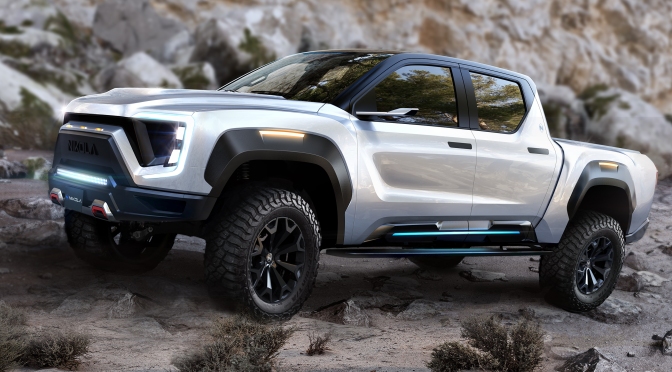
PHOENIX, AZ (February 10, 2020) — Nikola Corporation is excited to announce the product launch of the Nikola Badger electric pickup truck with an estimated range of 600 miles.
Unlike anything on the market, the advanced electric pickup is designed to target and exceed every electric or petrol pickup in its class. The Badger is engineered to deliver 980 ft. lbs. of torque, 906 peak HP and 455 continuous HP. The Badger will be built in conjunction with another OEM utilizing their certified parts and manufacturing facilities.

The electric pickup is designed to handle what a construction company could throw at it and is engineered to outperform all electric pickup trucks on the market in both continuous towing, HP and range. The Badger will be outfitted with a 15-kilowatt power outlet for tools, lights and compressors, which is enough power to assist a construction site for approximately 12 hours without a generator.
“Nikola has billions worth of technology in our semi-truck program, so why not build it into a pickup truck?” said Trevor Milton, CEO, Nikola Corporation. “I have been working on this pickup program for years and believe the market is now ready for something that can handle a full day’s worth of work without running out of energy. This electric truck can be used for work, weekend getaways, towing, off-roading or to hit the ski slopes without performance loss. No other electric pickup can operate in these temperatures and conditions.”

Heavy D, a reality TV star from the “Diesel Brothers,” has partnered with Nikola to design, build and test the Badger in real world environments, which is anticipated to attract millions of viewers and followers through the process. The partnership will follow the Badger build from concept through production.
“My audience, hard-core truck enthusiasts, has expected me to push the limits of truck power and capabilities since my beginnings,” said Heavy D, AKA Dave Sparks. “Being able to pull back the curtain of a production truck build is a rare opportunity where we can include the everyday truck owner to participate in the final outcome of design, exterior choices and performance specs. I wanted to be part of that story and now I have the opportunity with Nikola.”
“The Nikola Badger is a game changer. The program will help drive down the cost of the fuel-cell components on our semi-truck while accelerating the hydrogen station rollout. Giving customers the option to order a fuel-cell or battery electric version will ensure we drive the cost down for everyone across our lineup,” said Mark Russell, president of Nikola Corporation.
The Nikola Badger will make its first appearance at Nikola World 2020 in Phoenix. Prototypes will be available for select customers and media to ride in at Nikola World.
You can see more details at www.nikolamotor.com/badger.
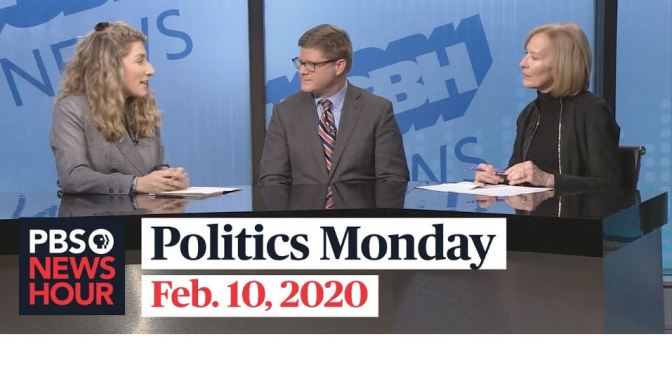
New Hampshire Public Radio’s Lauren Chooljian and James Pindell of the Boston Globe join Judy Woodruff to discuss the latest political news ahead of the New Hampshire Democratic primary, including voters’ levels of excitement and indecision, which candidates have momentum after the confusing Iowa caucuses and President Trump’s objective with rallying in New Hampshire the night before the election.
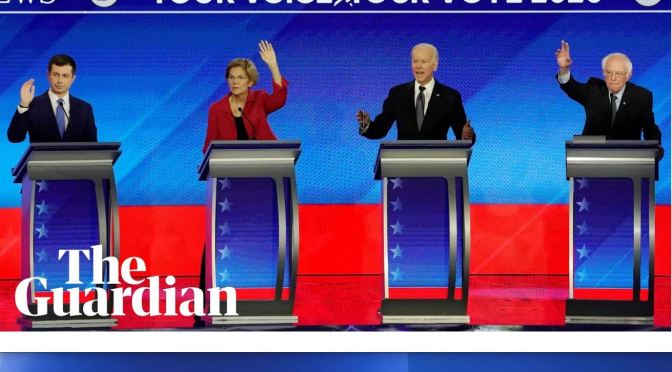
Democratic presidential candidates clashed in a televised debate in New Hampshire on Friday night at the end of a week dominated by the Iowa caucuses chaos and Donald Trump’s acquittal. Attacks were focused against Pete Buttigieg and Bernie Sanders, the two candidates who declared victory in Iowa, as the hottest topics discussed were healthcare and race.
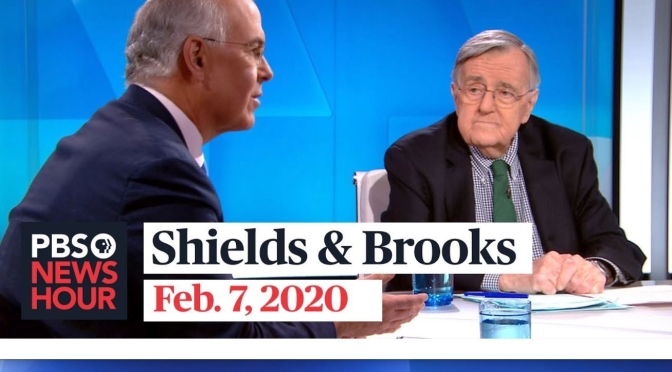
Syndicated columnist Mark Shields and New York Times columnist David Brooks join Judy Woodruff to discuss the week’s political news, including the Senate’s decision to acquit President Trump on both articles of impeachment, Trump’s State of the Union address, the messy Iowa Democratic caucus results and which 2020 Democrats have momentum going into the New Hampshire primary.



 Boomers Daily