An investigation into the U.S. response to COVID-19, from Washington State to Washington, D.C.
How did the U.S. become the country with the worst known coronavirus outbreak in the world? FRONTLINE and veteran science reporter Miles O’Brien investigate the American response to COVID-19, and examine what happens when politics and science collide.
Tension-type headaches can be either episodic or chronic. They are rarely disabling or associated with any significant autonomic phenomena, thus patients do not usually seek medical care and usually successfully self-treat. Unlike migraine, there is no significant nausea, no vomiting, and a lack of aggravation by routine physical activity.
In this podcast Mark Green, Professor of Neurology, Anesthesiology and Rehabilitation Medicine, Director of Headache and Pain Medicine, Icahn School of Medicine at Mount Sinai, New York, gives a clinical overview of the condition.
Cardiovascular consults are way down. Is the threat of COVID-19 infection scaring people away from ED’s?
We caught up with Dr. Comilla Sasson, the American Heart Association’s VP for science and innovation. She’s an emergency physician who teaches at the University of Colorado. She’d traveled to New York City to “help with the response,” and she talked with us from a field hospital that had been set up on a tennis court in Central Park.
She had lots to say about what’s driving patients away from emergency departments these days and what’s likely to happen in medicine (hello, telemedicine!) once the pandemic abates.
Benjamin Thompson, Noah Baker, and Amy Maxmen discuss Trump withholding funds from the WHO, and how COVID-19 kills. We also hear about controlling misinformation while communicating risk.
In this episode:
01:15 Understanding bottlenecks
After listening to last week’s episode of Coronapod, researchers in the USA were inspired to start collecting data about the challenges facing labs carrying out testing. After more than 4,000 responses to their online survey, we discuss their goals.
03:08 A hole in the WHO’s funding
US President Donald Trump has announced plans to withhold funding for the WHO, pending a review of the organization’s handling of the pandemic. We discuss the decision and ask what it means for the global response to COVID-19.
We investigate the role of the immune system in the death of COVID-19 patients and what this could mean for treatments. Could some therapeutics actually be undermining the body’s ability to fight the virus?
Our hosts pick out things that have made them smile in the last 7 days, including seasonal memories from Sierra Leone, a trip to the supermarket, and the 99-year old war veteran who has raised millions for charity.
Clearly communicating risks and evidence is key for governments and other organisations if they are to best inform the public during the pandemic. But what is the best way to do it? We hear the methods that communications experts and behavioural scientists recommend to keep the public informed, and keep misinformation at bay.
“As this epidemic makes clear, at any moment, any of us could become sick, could become hospitalized, could be on a mechanical ventilator,” said Adam Gaffney, an ICU doctor in Boston. “And that, in the United States, could mean potentially ruinous healthcare costs.”
With over 21,000 people dead and more than a 547,000 infected with the coronavirus in the US the last question on a person’s mind should be how they will pay for life-saving treatment.
There were 27.9 million people without health insurance in 2018, and record-high unemployment will increase that figure by millions
But as the death toll mounted, a patient who was about to be put on a ventilator in one of New York City’s stretched to capacity intensive care units had a final question for his nurse: “Who’s going to pay for it?”
SCIENTISTS ARE working at an unprecedented pace to find a vaccine for SARS-CoV-2, the virus that causes covid-19. The stakes are high. Natasha Loder, The Economist’s health policy editor, explains how an effective vaccine might be developed.
Dr Trevor Drew of the Australian Centre for Disease Preparedness speaks to host Kenneth Cukier about two trials which have reached the animal-testing stage. Plus, once a vaccine is discovered, what can be done to make sure it is distributed fairly? Dr Seth Berkely, chief executive of GAVI, the vaccine alliance, explains the importance of global cooperation. Runtime: 26 min
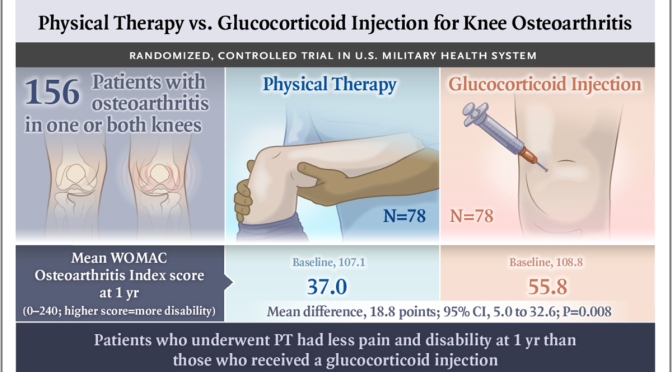
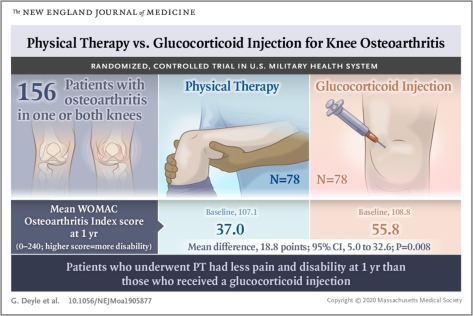
Patients with osteoarthritis of the knee who underwent physical therapy had less pain and functional disability at 1 year than patients who received an intraarticular glucocorticoid injection.
Osteoarthritis of the knee is a leading cause of disability.1 Current management is typically limited to the treatment of symptoms until late stages of arthritis lead to knee replacement.2 Intraarticular glucocorticoid injections are commonly used as a primary treatment for osteoarthritis of the knee,3 but there are conflicting reports regarding the extent and duration of the relief of symptoms with this therapy.4-6 Complications from these injections occur infrequently but include joint infection,7 accelerated degradation of articular cartilage,8 and subchondral insufficiency fractures.9
PHYSICAL THERAPY
The physical therapy intervention, which is described in the protocol,26 included instructions and images for exercises, joint mobilizations, and the clinical reasoning underlying the priorities, dosing, and progression of treatment. During a typical clinical session, the physical therapist would implement hands-on, manual techniques immediately before the patient performed reinforcing exercises to help the patient perform the movements with little or no pain. For example, if a patient could not fully extend or flex the knee, or those movements were painful, the physical therapist would use a hands-on, passive mobilizing technique to repeatedly move the knee to reduce stiffness while altering the mechanics of the technique to avoid pain. The patient would then perform repeated active knee movements in the same direction.
More than 6 million people worldwide have Parkinson disease. Even though it is classically associated with tremors, the disease has many manifestations and is very treatable for most patients.
Michael S. Okun, MD, from the Department of Neurology at the University of Florida, Gainesville, discusses the pathophysiology, clinical presentation, diagnosis, and treatment of Parkinson disease.
News, Views and Reviews For The Intellectually Curious


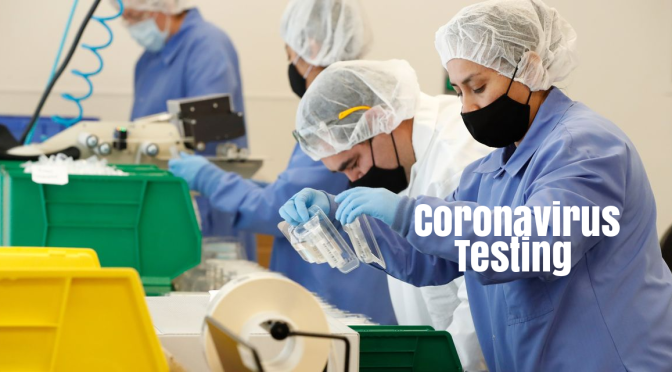
 To reopen the economy safely, experts estimate the U.S. will need to administer millions of tests every month.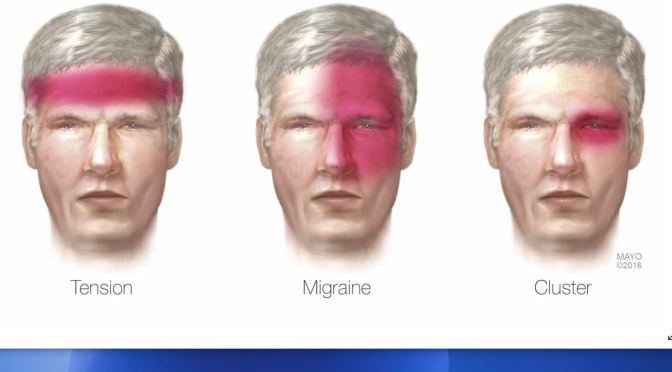
 Tension-type headaches can be either episodic or chronic. They are rarely disabling or associated with any significant autonomic phenomena, thus patients do not usually seek medical care and usually successfully self-treat. Unlike migraine, there is no significant nausea, no vomiting, and a lack of aggravation by routine physical activity.
 Cardiovascular consults are way down. Is the threat of COVID-19 infection scaring people away from ED’s?
 Benjamin Thompson, Noah Baker, and Amy Maxmen discuss Trump withholding funds from the WHO, and how COVID-19 kills. We also hear about controlling misinformation while communicating risk.
 “As this epidemic makes clear, at any moment, any of us could become sick, could become hospitalized, could be on a mechanical ventilator,” said Adam Gaffney, an ICU doctor in Boston. “And that, in the United States, could mean potentially ruinous healthcare costs.”


 More than 6 million people worldwide have Parkinson disease. Even though it is classically associated with tremors, the disease has many manifestations and is very treatable for most patients.
 Boomers Daily