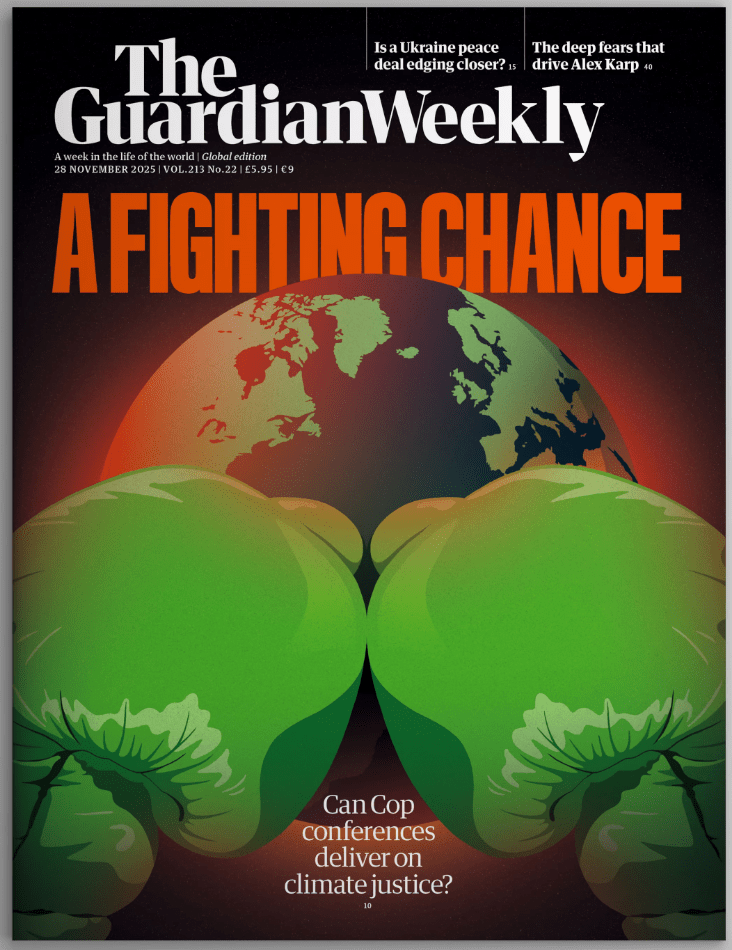
Bitter rows, implacably opposed delegations, threatened walkouts and then, hours after the planned deadline with fear of failure stalking the delegates, a statement towards which recalcitrant countries have been nudged into agreeing is produced. Cop30, which concluded last Saturday in Belém, Brazil, was little different from its recent predecessors, despite the growing urgency of needing to find a solution to our ever hotter planet. For this week’s big story, environment editor Fiona Harvey details how weak consensus was forged between states on the frontline of climate change and the petrostates that sought a rollback from the need to “transition away from fossil” fuels agreed two years ago in Dubai.
Five essential reads in this week’s edition
Spotlight | Is Ukraine edging closer to a peace deal? A whirl of international diplomacy was sparked by a US-Russian authored ‘peace plan’ to end the Ukraine war. Luke Harding and Pjotr Sauer cast a critical eye over the prospects for an agreement.
Spotlight | Trump, Saudi Arabia and shifting Middle Eastern sands Pageantry and trillion-dollar promises reveal how Washington’s regional loyalties may be tilting away from Israel and towards the Gulf, writes Julian Borger
Feature | Is Alex Karp the world’s scariest CEO? His company, Palantir, is potentially creating the ultimate state surveillance tool. Now, Alex Karp’s biographer reveals what makes him tick. BySteve Rose
Opinion | An improbable new adversary for Trump – the Catholic church Inequality, immigration and civil rights are the battlegrounds on which the church – and some other Christian denominations – are fighting the Trump administration, writes Simon Tisdall
Culture | Edmund de Waal’s loose ends The celebrated ceramicist explains to Charlotte Higgins why he turned his decades-long f ixation with Axel Salto – the maker of unsettling stoneware full of tentacle sproutings and knotty growths – into a new show
THE NEW YORKER MAGAZINE: The latest cover features Malika Favre’s and Rea Irvin’s Eustace Tilley – The covers for the fourth and final centenary special issue.
Not only is the department’s behavior not normal; it is also, as is becoming increasingly clear, self-defeating. By Ruth Marcus
Disappeared to a Foreign Prison
The Trump Administration is deporting people to countries they have no ties to, where many are being detained indefinitely or forcibly returned to the places they fled. By Sarah Stillman
The Airport-Lounge Wars
When you’re waiting for a flight, what’s the difference between out there and in here? By Zach Helfand
THE NEW YORK TIMES MAGAZINE:The 11.23.25 Issue features Daniel Bergner on how antidepressants could be disrupting the sexual development of teenagers; Coralie Kraft on three people who fell in love with A.I. chatbots; Jordan Kisner on the power of screaming and the Greek heroine Electra; Tina Brown in conversation with Lulu Garcia-Navarro; and more.
Sixty former staffers describe an environment of suspicion and intimidation within the nation’s most powerful law enforcement agency. By Emily Bazelon and Rachel Poser
Viewers seem baffled by viral videos of homes left to tumble into the ocean. But this is how we approach a growing range of “stranded” assets. By Brooke Jarvis
Research on adults who take S.S.R.I.s shows they tamp down sexual desire. Why aren’t we studying what that could mean for adolescents who take them? By Daniel Bergner
Retirees have less wiggle room to weather volatility than younger investors, and it’s important to make sure your portfolio can withstand the stock market bumps.
In the remote highlands of Uzbekistan, archaeologists are uncovering the remains of a vast metropolis that may rewrite the history of the fabled trading route’s origins By Andrew Lawler | Photographs by Simon Norfolk
After a 1902 train wreck in the heart of Manhattan, one self-taught engineer proposed an improbable urban transformation. His vision reshaped the face of American cities















 Boomers Daily