An investigation into the U.S. response to COVID-19, from Washington State to Washington, D.C.
How did the U.S. become the country with the worst known coronavirus outbreak in the world? FRONTLINE and veteran science reporter Miles O’Brien investigate the American response to COVID-19, and examine what happens when politics and science collide.
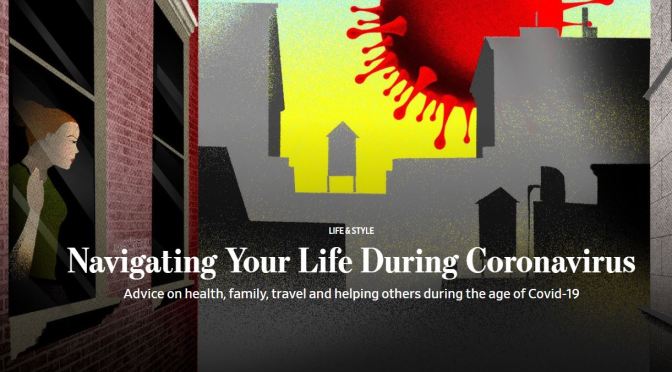
As the coronavirus pandemic upends work, travel and home life, the rules are shifting for what people can and can’t do in their daily lives. The WSJ is continuously updating advice and information on how to stay safe, healthy and connected, and how to help others.
Aid to a Friend Caring for a Coronavirus Patient
“Because I am organized in my job and day-to-day life, I took on my husband’s care thinking I would have it all quickly in hand. But things didn’t turn out that way,” writes Leslie Yazel, whose husband came down with coronavirus-related pneumonia. Here, she offers what she learned about the best ways to help those who are caring for someone with coronavirus.
From an Apollo Magazine online interview (Feb 22, 2020):
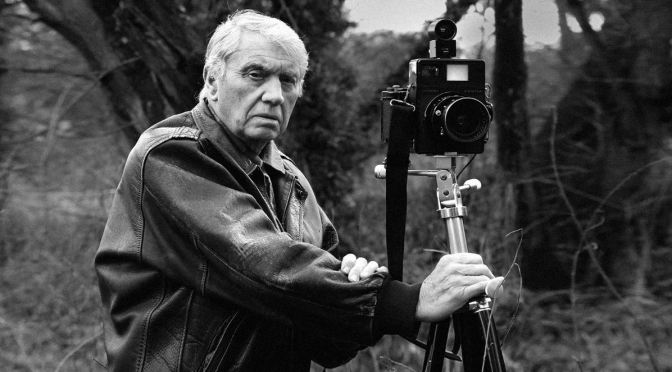
McCullin is reluctant to place himself in the company of artists, partly because he never wants to feel that he’s ‘arrived’ – ‘The moment that happens, I know I’m finished’ – but also because of the nature of his material. ‘There’s a shadow that comes over my life when I think […] that I’ve earned my reputation out of other people’s downfall. I’ve photographed dead people and I’ve photographed dying people, and people looking at me who are about to be murdered in alleyways. So I carry the guilt of survival, the shame of not being able to help dying people.’
On top of a hill a few miles from Don McCullin’s house in Somerset is a dew pond, a perfectly circular artificial pond for watering livestock. Nobody knows how long it has been there; some dew ponds date back to prehistoric times, and it’s tempting to think that this one served the Bronze Age hill-fort that overlooks the site. McCullin is obsessed with the pond. For more than 30 years, whenever he has had the time, he has walked up the hill and stood there with his camera waiting for the right moment to take a photograph. Often, the moment never comes: he can spend hours there, just looking. ‘It’s as if it has a hold over me,’ he tells me when I visit him at home in early January. ‘I can’t leave it alone, I photograph it all the time. And yet I think I’ve done my best picture the first time I ever did it. I can’t tell you how.’
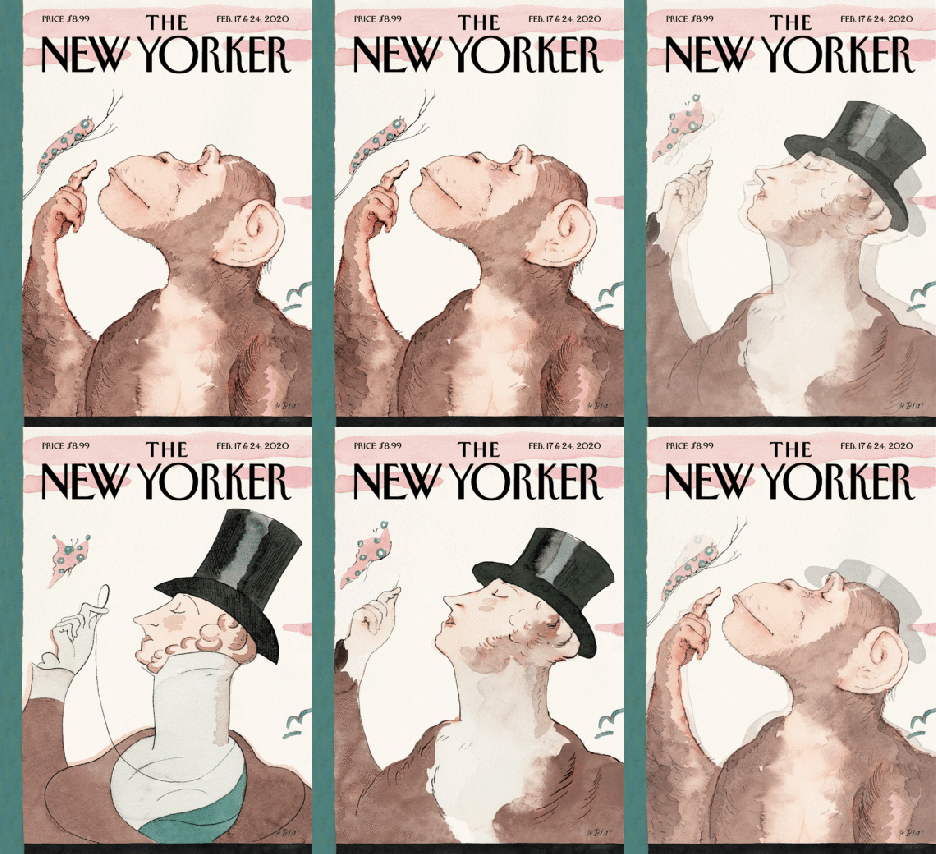
In February, 1925, Rea Irvin, The New Yorker’s first art editor, designed the cover of the magazine’s inaugural issue. That cover’s central character, a dandy peering at a butterfly through a monocle, would come to be known as Eustace Tilley, and he has graced the cover of the magazine nearly every February in the ninety-five years since. This is all a matter of historical record—but Barry Blitt, in this year’s Anniversary Issue, tells a different origin story. We recently talked to Blitt about drawing a familiar face.
You’ve drawn many a Eustace Tilley. Is there something pleasing about revisiting familiar forms?
Well, certain familiar forms are probably traumatic to revisit, but Tilley is a joy to draw repeatedly. All the hard work has been done for you—it’s a beautifully designed image. Hard to make a mess of those shapes and colors, though I give it the old college try.
PBS NewsHour co-founder Jim Lehrer, a giant in journalism known for his tenacity and dedication to simply delivering the news, died peacefully in his sleep at home on Thursday, at the age of 85.
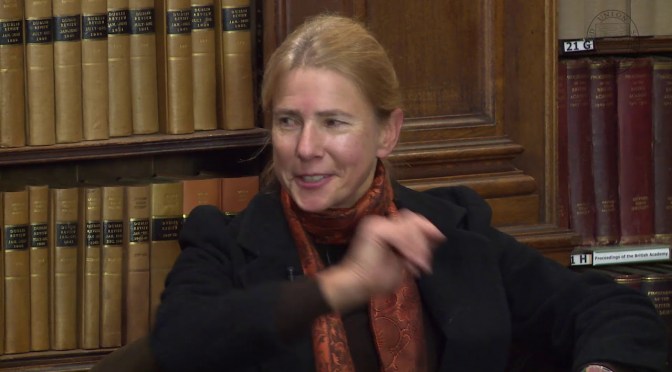
Lionel Shriver (born Margaret Ann Shriver; May 18, 1957) is an American journalist and author who lives in the United Kingdom. She is best known for her novel We Need to Talk About Kevin, which won the Orange Prize for Fiction in 2005 and was adapted into the 2011 film of the same name, starring Tilda Swinton.
Shriver has written for The Wall Street Journal, the Financial Times, The New York Times, The Economist, contributed to the Radio Ulster program Talkback and many other publications. In July 2005, Shriver began writing a column for The Guardian, in which she has shared her opinions on maternal disposition within Western society, the pettiness of British government authorities, and the importance of libraries (she plans to will whatever assets remain at her death to the Belfast Library Board, out of whose libraries she checked many books when she lived in Northern Ireland). She currently writes regularly for The Spectator.
In online articles, she discusses in detail her love of books and plans to leave a legacy to the Belfast Education and Library Board.
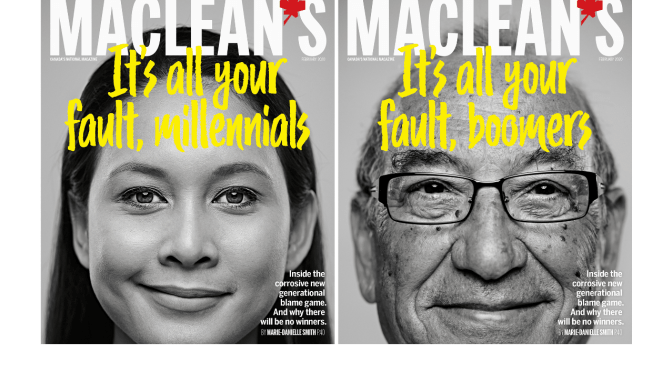
From a Maclean’s Magazine online essay (01/08/20):
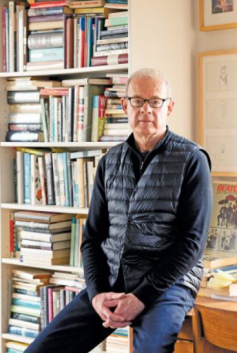
Don Gillmor in his home office (Photograph by May Truong)
Boomers tore down institutions—divorce rates went up, churchgoing went down. We demonized the corporations that previous generations had venerated, though we bought their products in record numbers, our idealism blurring with the search for the perfect pair of jeans. We wanted it all. In place of institutions, we created the cult of the individual, our own particular Frankenstein.
So much of our music comes back to us in unfortunate ways, Dylan’s anthems barely recognizable in sappy orchestral arrangements that fill the hours we spend on hold. And we seem to be permanently on hold these days. We are between 55 and 73 years old now, still defining this as middle age, still a potent economic force because of our numbers, controlling 70 per cent of disposable income, though it feels to many of us that we have already disposed of it. Still, we bought houses when they were vaguely affordable. And politicians still cater to us because we vote en masse. However, we are largely left out of the cultural conversation, as music and social media continues to evolve, always leaving us one app behind the curve.
On 5 October 2017, Twohey and Kantor, already respected investigative journalists, published a story in the New York Times that lit the world ablaze. The article, which detailed decades of sexual harassment and abuse perpetrated by Harvey Weinstein, launched the #MeToo movement into the mainstream and began an ongoing dialogue about the relationship between power and sexual exploitation. The article was the product of months of investigation by Twohey and Kantor, and was awarded the Pulitzer Prize for Public Service in 2018.
News, Views and Reviews For The Intellectually Curious




 comes over my life when I think […] that I’ve earned my reputation out of other people’s downfall. I’ve photographed dead people and I’ve photographed dying people, and people looking at me who are about to be murdered in alleyways. So I carry the guilt of survival, the shame of not being able to help dying people.’
  On top of a hill a few miles from Don McCullin’s house in Somerset is a dew pond, a perfectly circular artificial pond for watering livestock. Nobody knows how long it has been there; some dew ponds date back to prehistoric times, and it’s tempting to think that this one served the Bronze Age hill-fort that overlooks the site. McCullin is obsessed with the pond. For more than 30 years, whenever he has had the time, he has walked up the hill and stood there with his camera waiting for the right moment to take a photograph. Often, the moment never comes: he can spend hours there, just looking. ‘It’s as if it has a hold over me,’ he tells me when I visit him at home in early January. ‘I can’t leave it alone, I photograph it all the time. And yet I think I’ve done my best picture the first time I ever did it. I can’t tell you how.’
 In February, 1925, Rea Irvin, The New Yorker’s first art editor, designed the cover of the magazine’s inaugural issue. That cover’s central character, a dandy peering at a butterfly through a monocle, would come to be known as Eustace Tilley, and he has graced the cover of the magazine nearly every February in the ninety-five years since. This is all a matter of historical record—but Barry Blitt, in this year’s Anniversary Issue, tells a different origin story. We recently talked to Blitt about drawing a familiar face.


 Boomers Daily