In this week’s episode of “Cocktails with a Curator,” journey to sixteenth-century Rome with Deputy Director and Peter Jay Sharp Chief Curator Xavier F. Salomon as he discusses El Greco’s “Vincenzo Anastagi,” one of three important paintings by the Renaissance artist in the Frick’s collection. Born in Crete, El Greco spent a formative seven years in Rome, where he painted this rare, full-length portrait of a minor aristocrat from Perugia then serving as Sergeant Major of Castel Sant’Angelo. Look closely at this unusual painting while sipping an Ouzo Lemonade, which gets its kick from the anise-flavored spirit popular in the artist’s birthplace.
The Spanish economy is one of extremes. At one point a focus of the eurozone crisis, at another the largest contributor of growth, and more recently, suffering the greatest economic hit of any Advanced Economy in 2020. Spain’s economic problems are often confused. In the years leading up to the Great Recession it posted consistent budget surpluses. However, a huge real estate bubble was lying in wait. The question… is why? Why did Spain go from a seemingly safe level of debt to one larger than it’s economy? How was the housing bubble encouraged? And since then, has Spain’s economy ever truly recovered? Or in what ways?
n this week’s episode of “Cocktails with a Curator,” Curator Aimee Ng explores the turbulent history behind Édouard Manet’s “Bullfight,” once part of a larger work that the artist exhibited at the Salon of 1864. The original canvas was derided and caricatured by critics, prompting Manet to cut it into pieces. The two surviving fragments were brought together for the first and only time during a 1999 exhibition at the Frick. This week’s complementary cocktail is, fittingly enough, the Toreador.
In this episode, Getty curator Davide Gasparotto discusses early accounts of Leonardo’s life and how they shaped our understanding of the artist. Passages from these biographies were recently collected in the Getty Publications book Lives of Leonardo da Vinci.
“He was a great artistic personality, crucial for the development, in some way, of what we think as the modern science. But he was not alone.”
Leonardo da Vinci died more than 500 years ago, but he is still revered as a genius polymath who painted beguiling compositions like the Mona Lisa, avidly studied the natural sciences, and created designs and inventions in thousands of journal pages. Even during Leonardo’s lifetime, contemporaries marveled at the artist’s great skill and wide-ranging pursuits, but many also noted his perfectionism and difficulty completing projects. Since his death, the legends surrounding his life and personality have continued to grow. Today Leonardo’s story inspires novels and his work brings record-breaking prices, demonstrating his enduring relevance and mystique.
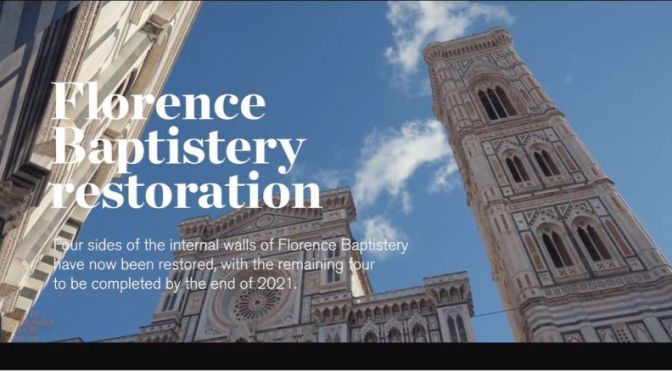
Four sides of the internal walls of Florence Baptistery have been restored, with the remaining four to go by the end of 2021. “Here come all those who wish to see admirable things” is the English translation of the words set in the marble inlay of the floor of Florence’s baptistery, as visitors enter through the Gates of Paradise.
These worthy items include the fourteenth-century mosaics depicting prophets, bishops and cherubs, which are enjoying renewed vigour after the restoration of four of the eight sides of Florence’s oldest monument. The internal walls of the baptistery began to be restored towards the end of 2017 following a restoration campaign on the external walls and roof.
Many discoveries emerged from the diagnostics, the first of their kind to be conducted on the monument, including the original technique used in the parietal mosaics; the presence of a pigmented wax on the green Prato marble, used to cover the white limestone that had formed due to water coming in through the roof, now removed to reveal the stone’s natural hue; and traces of gold leaf on one of the capitals of the matroneum, which could form evidence that the capitals were all originally covered in gold leaf.
In the first couple of decades of the fourteenth century, having completed the colossal feat of the mosaics inside the baptistery’s dome, the decision was made to extend the technique to the parietal sides, something that wasn’t part of the original plans.
It was a solution that allowed the mosaics to be superimposed over the marble covering and solve the issue of the monument’s static nature. Made-to-measure hollow terracotta tiles were used, cut and fixed to the marble on the baptistery’s walls with central iron linchpins driven back and welded in a straight line.
“A hurried sinopia was then conducted on the tiles and later the mosaic with a direct method and over days, which can still be identified and interpreted today,” explained Beatrice Agostini, planner and head of the restoration campaign of Opera di Santa Maria del Fiore. “Even the mixture used to apply the mosaic tiles is absolutely unique. Ordinary mortar wasn’t used. Instead it was more of a glue, and it’s the decline of this compound that has caused the most problems in this restoration.”
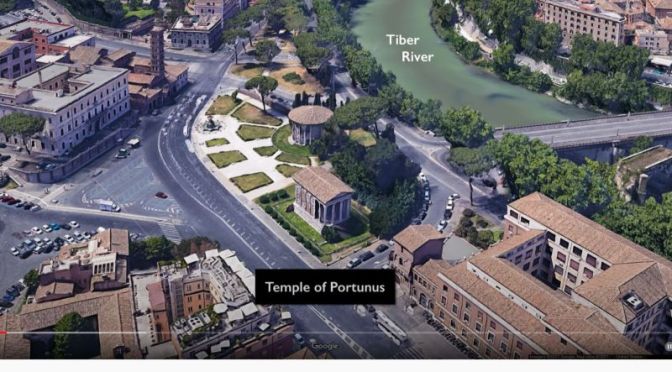
The Temple of Portunus or Temple of Fortuna Virilis is a Roman temple in Rome, Italy, one of the best preserved of all Roman temples. Its dedication remains unclear, as ancient sources mention several temples in this area of Rome, without saying enough to make it clear which this is.
Kyushu is said to be the wellspring of Japanese civilization. Yet few tourists visit the southernmost of Japan’s main islands. This documentary contrasts modern Japanese cities with traditional customs in the countryside.
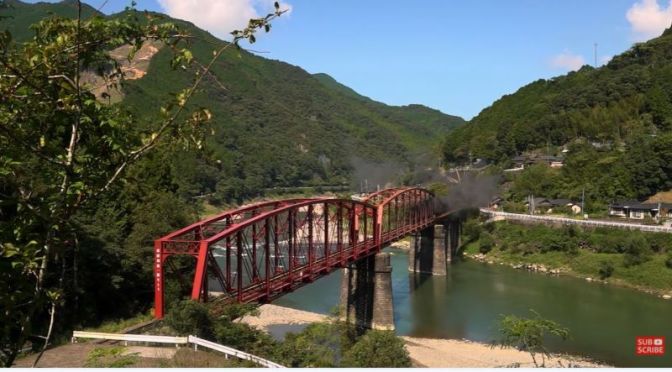
The rail journey begins in Fukuoka – a city with a metro population of 2.5 million – and ends at the southern tip of the island, in the city of Ibusuki. As the train rolls along, it travels through time – and reveals the amazing diversity and contrasts of the most southerly of Japan’s four main islands. The trip provides spectacular landscape views, as well as deep insight into a foreign culture, and its ancient traditions and modern lifestyles. In the West, Kyushu is one of the lesser-known regions in the “Land of the Rising Sun.”
Even for the Japanese, the green, mountainous island is seen mostly as a holiday spot. Europeans rarely visit this part of the country – but there are plenty of restaurants and cafes that have names like “Wolfgang,” “Bavaria,” or “Côte d’Azur.” Travel guides say that these words sound “European” to Japanese.
The family of the emperor, or Tenno, comes from Kyushu as well. This is also where the dynasties of the proud warrior class, the samurai, have their roots. And there are a number of active volcanoes on Kyushu. One of the most famous is Mount Aso. Its caldera – the cauldron-like hollow at the top — has a circumference of about 120 kilometers.
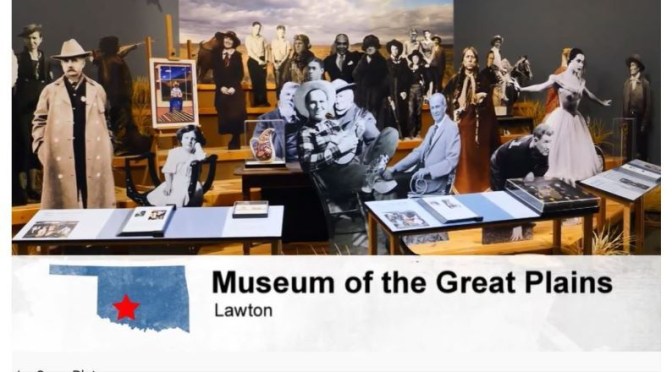
Experience a visual history of the life and people of the Great Plains on display at the Museum of the Great Plains in Lawton. From 11,000 years ago to a strong focus on Lawton and southwest Oklahoma and the southern plains in particular. Through all the interactive exhibits, one can not only learn about the fascinating history but also have fun. From life on the cattle trail to Native American artifacts and exhibits, you can immerse yourself in the culture of this special area in the state.
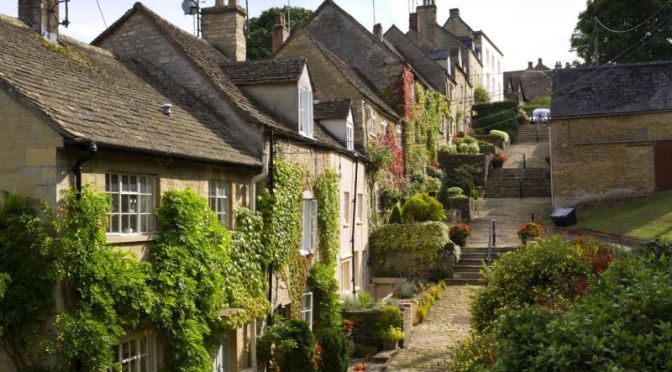
Tetbury is another historic wool town in the Cotswolds, England. It sits on the site of an ancient hill fort, where an Anglo-Saxon monastery was built. It has various royal connections and is well worth a visit to any Cotswold traveller.
New York City LIVE: Downtown Manhattan in the American Revolution with Karen Q’s Patriot Tours.
Karen Q is a Revolutionary War and Founding Era historian. She is the author of Theodosia Burr: Teen Witness to the Founding of a New Nation, 21st Century Imprints, Lerner Books. She also appears in area Revolutionary War reenactments as “Mrs. Q”. Karen is a regular cast member of the Travel Channel’s *Mysteries at the Museum* and has appeared on more than twenty episodes. You can see a full list of episodes here.
News, Views and Reviews For The Intellectually Curious





 Boomers Daily