
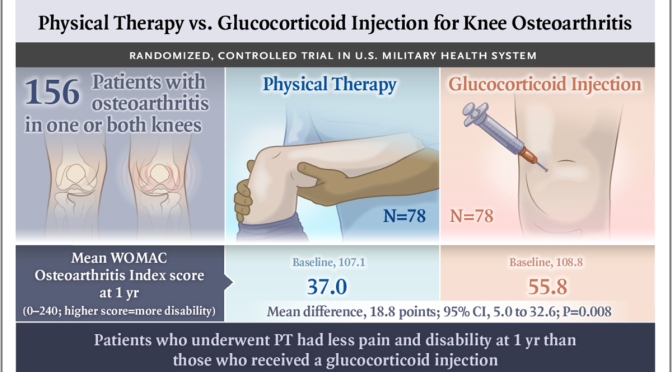

Patients with osteoarthritis of the knee who underwent physical therapy had less pain and functional disability at 1 year than patients who received an intraarticular glucocorticoid injection.
Osteoarthritis of the knee is a leading cause of disability.1 Current management is typically limited to the treatment of symptoms until late stages of arthritis lead to knee replacement.2 Intraarticular glucocorticoid injections are commonly used as a primary treatment for osteoarthritis of the knee,3 but there are conflicting reports regarding the extent and duration of the relief of symptoms with this therapy.4-6 Complications from these injections occur infrequently but include joint infection,7 accelerated degradation of articular cartilage,8 and subchondral insufficiency fractures.9
PHYSICAL THERAPY
The physical therapy intervention, which is described in the protocol,26 included instructions and images for exercises, joint mobilizations, and the clinical reasoning underlying the priorities, dosing, and progression of treatment. During a typical clinical session, the physical therapist would implement hands-on, manual techniques immediately before the patient performed reinforcing exercises to help the patient perform the movements with little or no pain. For example, if a patient could not fully extend or flex the knee, or those movements were painful, the physical therapist would use a hands-on, passive mobilizing technique to repeatedly move the knee to reduce stiffness while altering the mechanics of the technique to avoid pain. The patient would then perform repeated active knee movements in the same direction.

 More than 6 million people worldwide have Parkinson disease. Even though it is classically associated with tremors, the disease has many manifestations and is very treatable for most patients.

 Historically, the U.S. Centers for Disease control and Prevention has been the agency in charge of predicting, and containing outbreaks of disease. But as Covid 19 ravaged the country, the agency took a backseat to the White House.
 What might that mean for the bathrooms of the post-coronavirus world? Americans have already demonstrated a keen fixation with this household feature: In the last 50 years, the number of home bathrooms per person has doubled. One could easily see the lavatory-building boom accelerate further as future homeowners keep the needs of the self-quarantined in mind. And many have speculated that sales of bidet attachments will surge as toilet-paper shortages encourage Americans to embrace this more sustainable alternative.
 The sleep industry caters to a working consumer’s wish to sleep less, yet sleep more productively, and accommodates transnational industry which has joined the state as a custodian of biopolitics. Jonathan Crary’s 24/7 spells out in detail how the state and a capitalist economy are encroaching stupendously on the private sphere, in which sleep was one of the last vestiges of unfettered time.


 A hundred days after a Chinese government website announced the discovery of a “pneumonia of unknown cause”, it has become clearer that the dynamics behind the virus’s rapid expansion across the globe has relied heavily on such “cluster effects”.

 An interview with Dr. Anthony Fauci about what it will take to open America back up after the coronavirus pandemic: “It isn’t like a light switch, on and off.”
 Boomers Daily