



Ampia Rooftop (Ampia meaning “Space” in Italian) is a sprawling 4,500 Sq. foot outdoor rooftop terrace featuring individual greenhouses for a social distance dining experience, opulent clusters of colorful flower gardens, and Italian-themed art and décor dispersed throughout. Chef Michele Iuliano offers up an authentic Italian menu of lite casual fare, along with a selection of inventive seafood paninis.
Restaurant Business (August 1, 2020) – The first step was a name change. When New York City announced that restaurants could open for outdoor dining during Phase 2, the Iulianos changed the name from Gnoccheria Rooftop to Ampia—a move that gave it a distinct identity. Then they set about redesigning the space to satisfy all the restrictions.
The entire space was sprayed with an electrostatic sanitary coating, including the tables, chairs, bar and every touchable surface. The process sanitizes for up to three months. The pair also purchased a facial recognition thermometer and all the essential PPE specified in New York Gov. Andrew Cuomo’s Phase 2 guidelines.
Next, the space was reconcepted from the original 250-seat restaurant to an outdoor dining venue with a limited bar and food menu. The beer garden in the original plan had to be scrapped; it’s impossible to enforce social distancing in that kind of setting. Instead, tables were spread out and seating areas set far apart, accommodating 60 to 65 guests.
The regulations around social distancing state that if tables cannot be arranged six feet apart, a restaurant can use plexiglass dividers between them. But the Iulianos wanted to infuse Ampia with the same stylish elements that differentiate their other restaurants.
Plexiglass dividers and floor decals might not be permanent, but the pandemic will bring lasting change to offices. Experts from the architecture and real-estate industries share how they are getting back to work and what offices will look like in the future.
Photo: Cesare Salerno for The Wall Street Journal
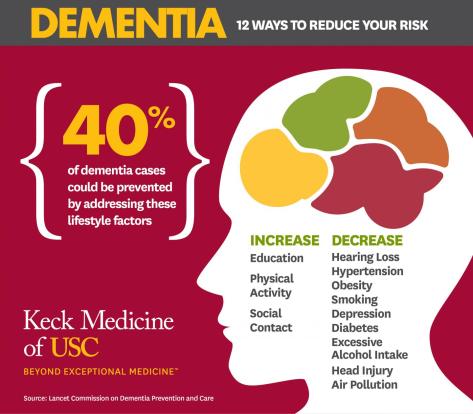
“We are learning that tactics to avoid dementia begin early and continue throughout life, so it’s never too early or too late to take action,” says commission member and AAIC presenter Lon Schneider, MD, co-director of the USC Alzheimer Disease Research Center‘s clinical core and professor of psychiatry and the behavioral sciences and neurology at the Keck School of Medicine of USC.
LOS ANGELES — Modifying 12 risk factors over a lifetime could delay or prevent 40% of dementia cases, according to an updated report by the Lancet Commission on dementia prevention, intervention and care presented at the Alzheimer’s Association International Conference (AAIC 2020).
Twenty-eight world-leading dementia experts added three new risk factors in the new report — excessive alcohol intake and head injury in mid-life and air pollution in later life. These are in addition to nine factors previously identified by the commission in 2017: less education early in life; mid-life hearing loss, hypertension and obesity; and smoking, depression, social isolation, physical inactivity and diabetes later in life (65 and up).
Schneider and commission members recommend that policymakers and individuals adopt the following interventions:
 NPR News Now reports on tracking hospital data on Covid-19, continuing protests in Portland, and other top news stories.
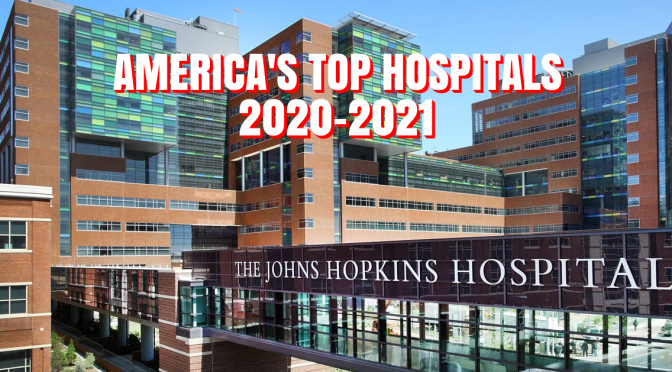
 The Best Hospitals Honor Roll highlights 20 hospitals that excel across most or all types of care evaluated by U.S. News. Hospitals received points if they were nationally ranked in the 16 specialties – the more specialties and the higher their rank, the more points they got – and if they were rated high performing in any of the 10 procedures and conditions. The top point-scorers made the Honor Roll.

 The Republicans have reached a deal on coronavirus relief, but it could mean much less unemployment money for Americans. Can they convince Democrats? Major League Baseball is already postponing games due to COVID-19 infections. And do we need another lockdown to beat COVID-19?
NEW ENGLAND JOURNAL OF MEDICINE (JULY 23, 2020): A large body of evidence suggests that consumption of caffeinated coffee, the main source of caffeine intake in adults in the United States, does not increase the risk of cardiovascular diseases and cancers. In fact, consumption of 3 to 5 standard cups of coffee daily has been consistently associated with a reduced risk of several chronic diseases.
 Coffee and tea have been consumed for hundreds of years and have become an important part of cultural traditions and social life.5 In addition, people use coffee beverages to increase wakefulness and work productivity. The caffeine content of commonly used sources of caffeine is shown in Table 1. For a typical serving, the caffeine content is highest in coffee, energy drinks, and caffeine tablets; intermediate in tea; and lowest in soft drinks. In the United States, 85% of adults consume caffeine daily,6 and average caffeine intake is 135 mg per day, which is equivalent to about 1.5 standard cups of coffee (with a standard cup defined as 8 fluid oz [235 ml]).7 Coffee is the predominant source of caffeine ingested by adults, whereas soft drinks and tea are more important sources of caffeine ingested by adolescents,
 This week, lawmakers in Capitol Hill are trying to piece together the next stimulus package as many benefits like unemployment insurance and forgiving evictions expire. Democrats and Republicans both agree that a new bill is necessary but there’s been a lot of back and forth about the specifics. And they’re running out of time.
Guests: Axios’ Alayna Treene, Sam Baker, and Sara Fischer.







 Boomers Daily