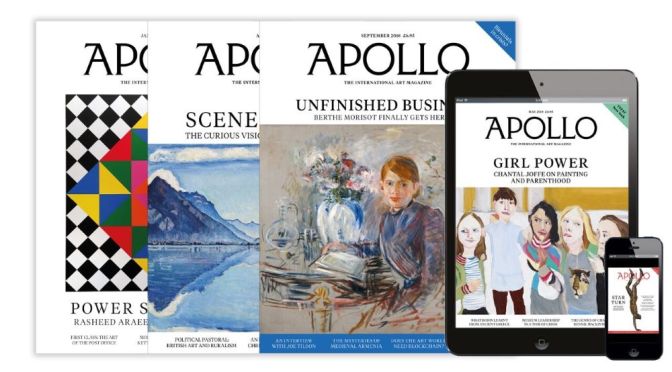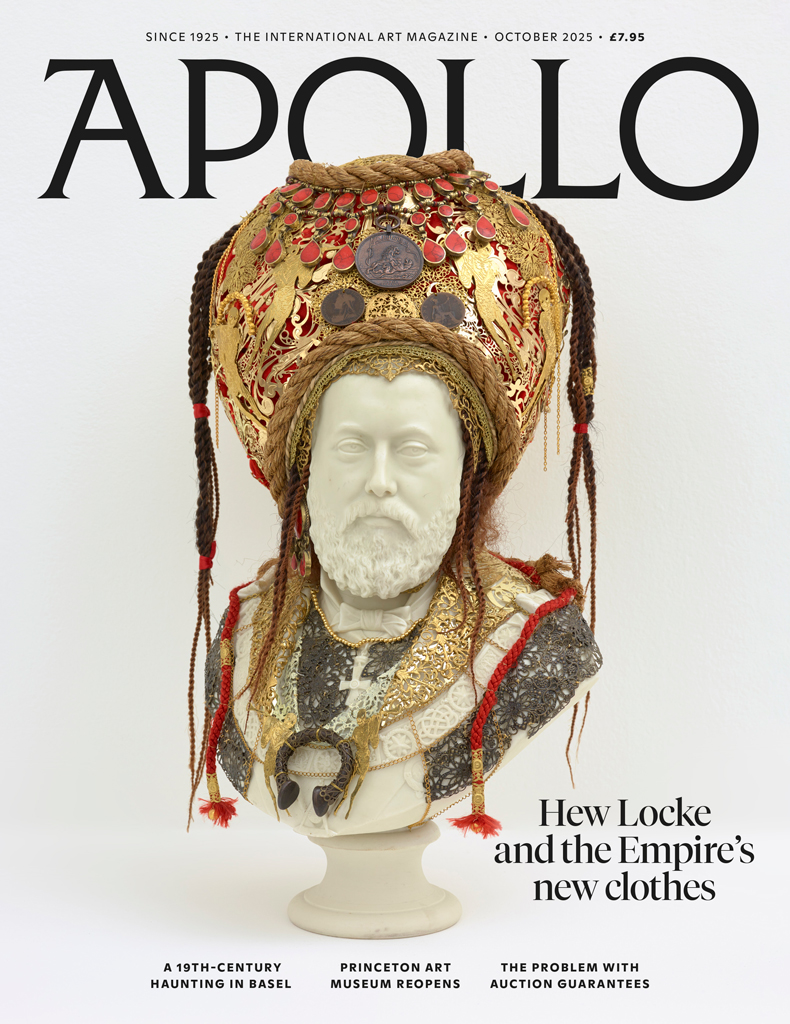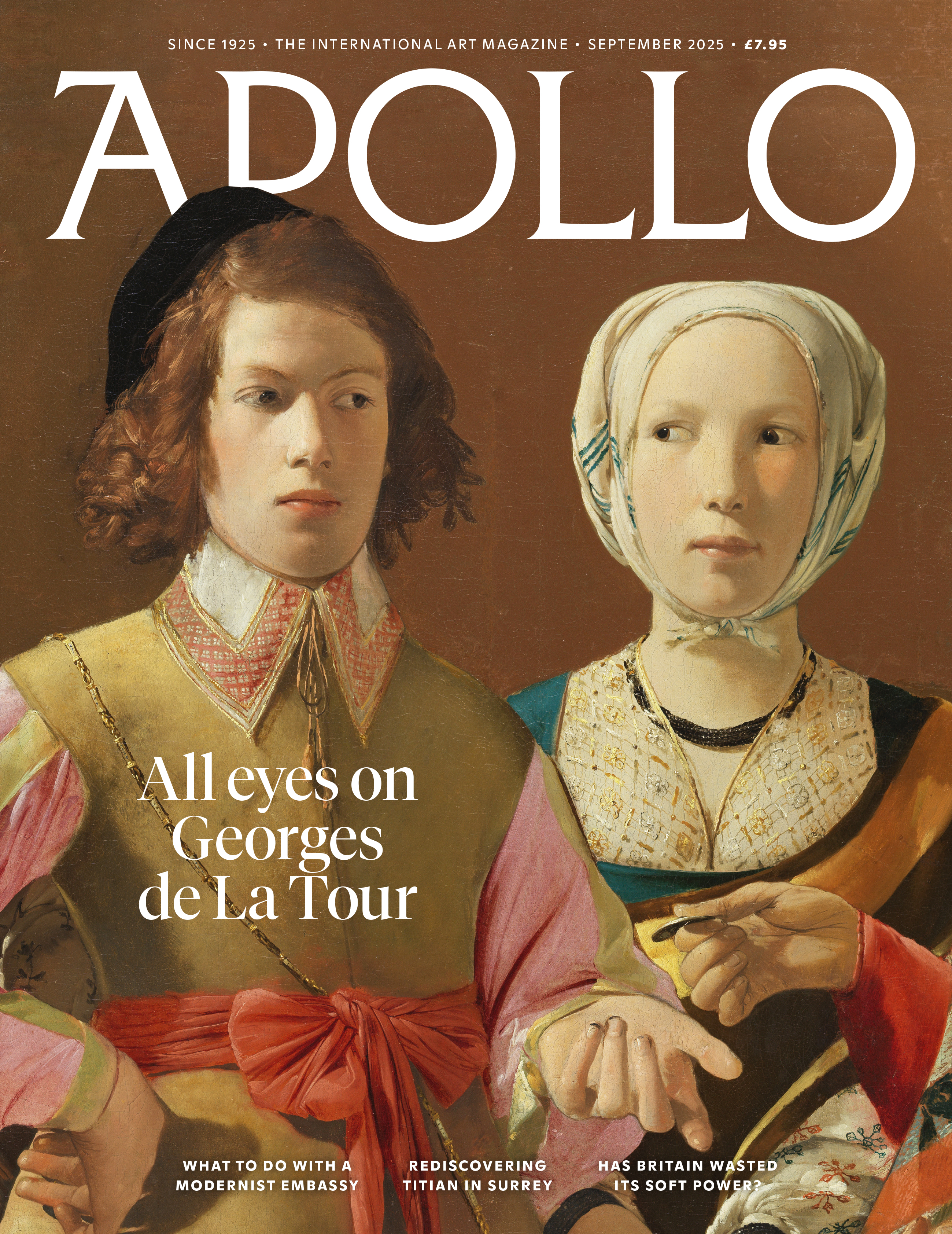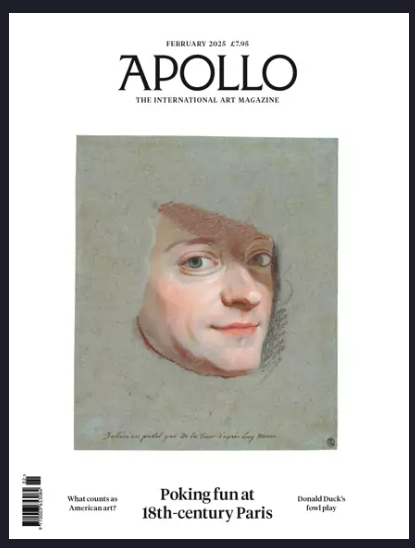
APOLLO MAGAZINE: The latest issue features Hew Locke and the Empire’s new clothes | Princeton University Art Museum reopens | William Hogarth’s bedside manner | the many faces of Nigerian modernism
Plus: Cinecittà in focus, Wangechi Mutu at the Galleria Borghese, the light touch of Antoine Watteau, Egypt’s new home for antiquities, how polenta caused a stir in Venice, the Aspen art scene continues to snowball, and the revival of London’s art market; in reviews: Amy Sherald’s portraits, King James VI and I’s cultural legacy, and what is a Jewish country house?
Plus: the artists who have bared all, the Michael C. Rockefeller Wing at the Met, Gertrude Stein’s museum of modern art, Elizabeth I’s favourite kitchen utensil, how Jenny Saville turns paint into flesh, and a preview of Treasure House Fair; in reviews: Hiroshige in London, Frida Kahlo and Mary Reynolds in Chicago, and art versus AI
THE WEEK IN ART (March 14, 2025): After a challenging year in which international galleries, auction houses and museums have been forced to scale back their operations and make redundancies on an alarming scale, a slower, more considered approach to business seems to be emerging.
So are we into an era of longer, more in-depth exhibitions and bespoke events concerned more with authentic connection than flashy spectacle? Ben Luke talks to Anny Shaw, a contributing editor at The Art Newspaper. In the Netherlands, just as in the US, cuts by far-right politicians to international development seem likely to have a huge impact on arts projects. As Tefaf, the major international art fair opens in the Dutch city of Maastricht, we talk to Senay Boztas, our correspondent based in Amsterdam, about fears of a funding crisis. And this episode’s Work of the Week is one of the greatest paintings ever made: The Hunters in the Snow (1565) by Pieter Bruegel the Elder. It is part of an exhibition called Arcimboldo – Bassano – Bruegel: Nature’s Time, which opened this week at the Kunsthistorisches Museum in Vienna. The museum’s director, Jonathan Fine, tells us more.
Arcimboldo–Bassano–Bruegel: Nature’s Time, Kunsthistorisches Museum, Vienna, until 29 June
Inside, cultural experts including Antony Gormley RA and Cameron Mackintosh reveal the visionary art of the author of Les Misérables. Plus: how Brazilian artists evolved a sense of place through art, from tropical modern fantasies to contemporary responses to colonial legacies; a visit to the Balearic Islands to see prize-winning social-housing built from locally quarried stone; an interview with artist-couple Michael Landy RA and Gillian Wearing RA; and ‘Inside the mind’ of maverick artist Helen Chadwick.
Including a new golden age at Versailles, Cycladic art over the centuries, the dangers of living in Los Angeles, Tracey Emin’s passion for painting, what new EU import laws will do to the art market, and a preview of TEFAF Maastricht; plus reviews of modernism in Brazil, the drawings of Henri Michaux, and the essays of Svetlana Alpers. And: Tessa Hadley on Bellini’s shocking depiction of the making of a martyr
The author of ‘A Chance Meeting’ talks to Apollo about the reissue of her dazzlingly original account of more than a century of artistic endeavour in the United States
The designer’s wallpaper patterns are so familiar that they’re in danger of being taken for granted – but there’s still plenty to discover if we look more closely
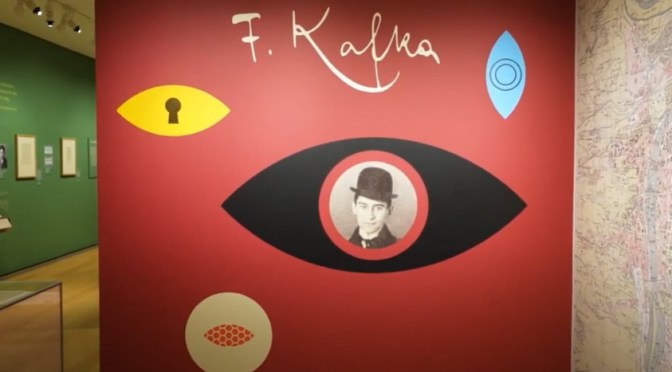
This exhibition will present, for the first time in the United States, the Bodleian Library’s extraordinary holdings of literary manuscripts, correspondence, diaries, and photographs related to Kafka, including the original manuscript of his novella The Metamorphosis.
Other highlights include the manuscripts of his novels Amerika and The Castle; letters and postcards addressed to his favorite sister, Ottla; his personal diaries, in which he also composed fiction, including his literary breakthrough, the 1912 story “The Judgment”; and unique items such as his drawings, the notebooks he used when studying Hebrew, and family photographs. In addition to presenting unique literary and biographical material, the exhibition examines Kafka’s afterlife, from the complex journeys of his manuscripts, to the posthumous creation of a literary icon whose very name has become an adjective, to his immense influence on the worlds of literature, theater, dance, film, and the visual arts.
Drawing on institutional holdings and private collections in the United States and Europe, the Morgan will show a selection of key works, among them Andy Warhol’s portrait of Kafka, part of his 1980 series Ten Portraits of Jews of the Twentieth Century.
“Franz Kafka” is open to the public November 22, 2024 through April 13, 2025.