

Category Archives: Classics

Classical Music: “Overture To William Tell” By Giaochino Rossini (LJS&C)
 Rossini’s 1829 opera “William Tell” is rarely performed today, but its Overture lives on as one of the most popular works in the classical repertoire. The Overture is essentially an instrumental suite written in four parts and performed without pause. The best-known section is the last, the allegro vivace, famously used as the rousing theme music for “The Lone Ranger” radio and TV series (and notoriously so in “A Clockwork Orange).
Recorded on 11/03/2019.
More from: La Jolla Symphony & Chorus (https://www.uctv.tv/lj-symphony-chorus)
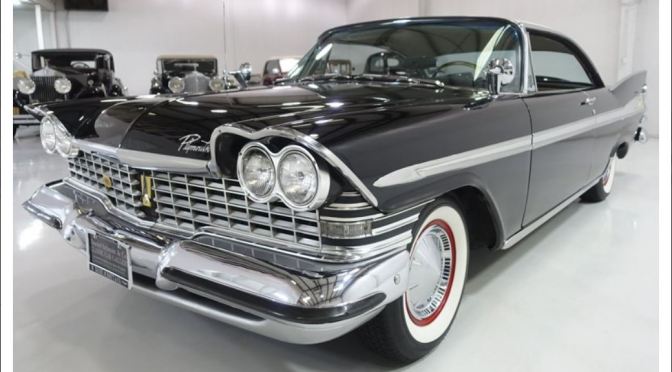
American Cars: “1959 Plymouth Sport Fury Coupe” (Classic Driver)
From Wikipedia:
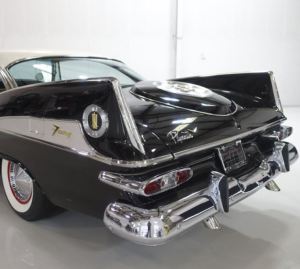 In 1959, Plymouth introduced the Sport Fury as its top model, and the Fury as its second from the top model to replace the Plymouth Belvedere at the top of the Plymouth line-up. The Fury range was now available as a four-door sedan and station wagon, as well as a two-door hardtop and sedan. The Sport Fury series had only a two-door hardtop and convertible. The Sport Fury was dropped at the end of 1959, but was reintroduced in mid-1962 and discontinued in 1971.
 The Plymouth Fury is a model of automobile which was produced by Plymouth from 1955 to 1989. It was introduced for the 1956 model year as a sub-series of the Plymouth Belvedere, becoming a separate series one level above the contemporary Belvedere for 1959. The Fury was a full-size car from 1959 to 1961, then a mid-size car from 1962 to 1964, again a full-size car from 1965 to 1974, and again a mid-size car from 1975 to 1978. From 1975 to 1977 the Fury was sold alongside the full-size Plymouth Gran Fury.
More photos from Classic Driver
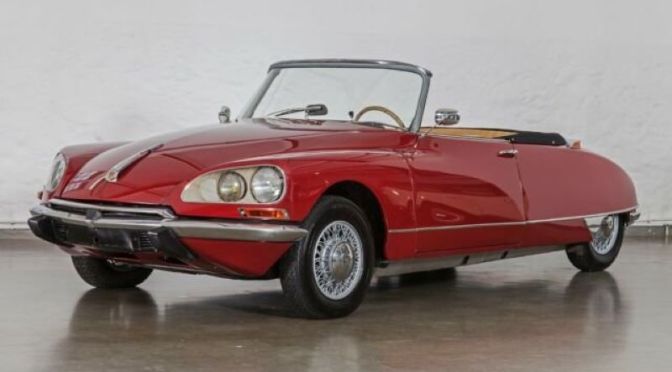
1960’s Classic Cars: 1966 Citroën DS 21 Convertible
From Wikipedia:
 The Citroën DS is a front-engine, front-wheel-drive executive car that was manufactured and marketed by the French company Citroën from 1955 to 1975 in sedan, wagon/estate and convertible body configurations across three series/generations.
Noted for its aerodynamic, futuristic body design and innovative technology, the DS set new standards in ride quality, handling, and braking — the latter as the first mass production car equipped with disc brakes.
Italian sculptor and industrial designer Flaminio Bertoni and the French aeronautical engineer André Lefèbvre styled and engineered the car, and Paul Magès developed  the hydropneumatic self-levelling suspension. Citroën sold 1,455,746 examples, including 1,330,755 manufactured at the manufacturer’s Paris Quai André-Citroën production plant.
The DS placed third in the 1999 Car of the Century poll recognizing the world’s most influential auto designs and was named the most beautiful car of all time by Classic & Sports Car magazine.
1930’S Racing Cars: Amazing “Bugatti Type 59” Reunion (Classic Driver)
From a Classic Driver Magazine online article:
 During this year’s Monterey Car Week, all four of Bugatti’s hallowed Type 59s were reunited for the first time since 1935. We spoke to the man who pulled off arguably the most historically significant automotive rendezvous of the decade…
In the fabled legend of Bugatti’s racing cars, there is one model that is so beautiful and so elusive that is stands at the top of every enthusiast of the great French marque’s wish list: the Type 59. Along with the input of Jean Bugatti, who had been one of the  driving forces behind the introduction of the twin-cam engine, Ettore Bugatti created the ultimate expression of his jewel-like Grand Prix car.
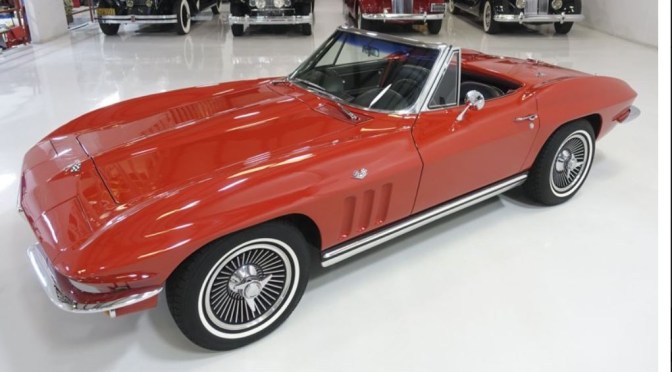
Classic Cars: “1965 Corvette L76 Stingray”
From Wikipedia:
 For its third season, the 1965 Corvette Sting Ray further cleaned up style-wise and was muscled up with the addition of an all-new braking system and larger powerplants. 1965 styling alterations were subtle, confined to a smoothed-out hood now devoid of scoop indentations, a trio of working vertical exhaust vents in the front fenders that replaced the previous nonfunctional horizontal “speedlines,” restyled wheel covers and rocker-panel moldings, and minor interior trim revisions. The 1965 Corvette Sting Ray became ferocious with the mid-year debut of the “Big-Block” 396 cu in (6,490 cc) engine producing 425 hp (317 kW).
Ultimately, this spelled the end for the Rochester fuel injection system, as the carbureted 396ci/425hp option cost $292.70 to the fuel injected 327ci/375hp’s $538.00. Few buyers could justify $245 more for 50 hp (37 kW) less, even if the FI cars offered optional bigger brakes not available on carbureted models.[18] After only 771 fuel injected cars were built in 1965, Chevrolet discontinued the option. It would be 18 years until it returned.
 1965 also added another 350 hp small block engine (Option L79) which used hydraulic rather than solid lifters, a milder camshaft and a modestly redesigned smaller oil pan.[19] Otherwise, the 350 hp engine was cosmetically and mechanically identical to the 365 hp engine (Option L76) solid lifter engine. The smaller oil pan allowed this high output small block 350hp engine to be ordered with optional Power Steering for the first time amongst the optional stable of higher output small block engines. Power steering was previously only available with the lower 250 hp and 300 hp engines.

Classic Car Nostalgia: “1963 Plymouth Valiant”
From Wikipedia:
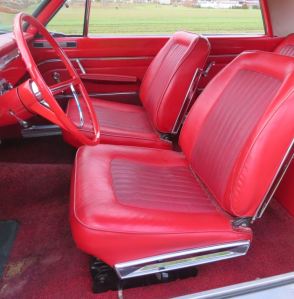 The Plymouth Valiant (first appearing in 1959 as simply the Valiant) is an automobile which was manufactured by the Plymouth division of the Chrysler Corporation in the United States from the model years of 1960 through 1976. It was created to give the company an entry in the compact car market emerging in the late 1950s. The Valiant was also built and marketed, without the Plymouth name, worldwide in countries including Argentina, Australia, Brazil, Canada, Finland, Mexico, New Zealand, South Africa, Sweden and Switzerland, as well as other countries in South America and Western Europe. It became well known for its excellent durability and reliability, and was one of Chrysler’s best-selling automobiles during the 1960s and 1970s, essentially keeping the company afloat during its hard economic times.
 The Valiant was totally reskinned for 1963 with a 0.5 in (13 mm) shorter wheelbase; it had a wide, flat hood and a flat square rear deck. The upper belt feature line ran from the rear body, in a gentle sweep, to the front fender tip. Here it was ‘veed’ back and down to the trailing edge of the front fender. The roofline was flatter and sharpened in profile. The grille was a variation of the inverted trapezoid shape that characterized contemporary Chryslers, with a fine mesh insert. Advances in body structure, many accessories and a new spring-staged choke were promotional highlights. The Valiant was offered as a 2-door hardtop and convertible, a 2- or 4-door sedan, and a 4-door station wagon. The hardtop and the convertible, with manual- or optional power-operated top, were offered only in the high V200 and premium Signet trim levels.

Podcast: Top Christmas Songs In France, England, Germany, Japan & U.S.
Top Christmas songs from the world’s top 5 music markets as selected by Monocle Magazine.
5. France – Johnny Hallyday (“Mon Plus Beau Noël”)

4. England – Pet Shop Boys (“Always On My Mind”)

3. Germany – Helene Fischer (“Stille Nacht”)

2. Japan – Yamashita Tatsuro (“Christmas Eve”)

1. United States – Mariah Carey (“All I Want For Christmas Is You”)

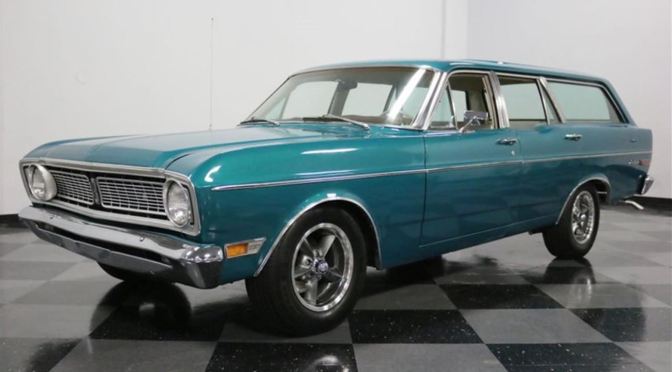
Classic Cars: “1968 Ford Falcon Futura Wagon”
From Wikipedia:
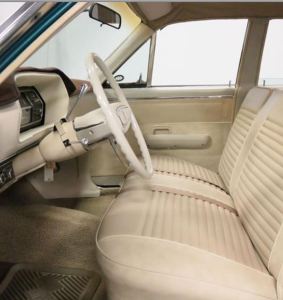 In late 1965, Ford launched the third generation Falcon, based on a shortened Fairlane platform with revised styling. At the top of the line was the highly-trimmed Futura Sports Coupe, which featured chrome side window frames, giving this two-door sedan the look of a hardtop. It also featured a premium all-vinyl interior. Large “Sports Coupe” script on the “C” pillar was borrowed from the 1964–1965 Fairlane Sports Coupe.
 The heater-defroster became standard.[22] Brakes were 9-in for six-cylinder Falcons, and 10-in for V8s.[23] The two-door hardtop and convertible were dropped, while the station wagon and Ranchero were moved to a larger platform shared with the contemporary Fairlane. The Ranchero left the Falcon line and adopted the Fairlane’s front sheet metal for 1967. The 1966 Falcon was used in the Trans-Am series. The 1967 models were mostly the same as the 1966 models, but more Federally-mandated safety equipment was added, including a dual-circuit brake system, energy-absorbing steering wheel with a large, padded center hub, 4-way flashers, soft interior panels, and mountings for front shoulder belts (which were available as an option). A reminder light was added for the seatbelts;[24] 1968 was the first model year for the square tail lights.[25]
1968 and 1969 Falcons got new side marker lights or reflectors, front outboard shoulder belts, and headrests for cars built after January 1, 1969. The basic body and mechanical specifications remained the same as 1966–1967 models.

Classic Car Books: “Healey – The Men & The Machines”
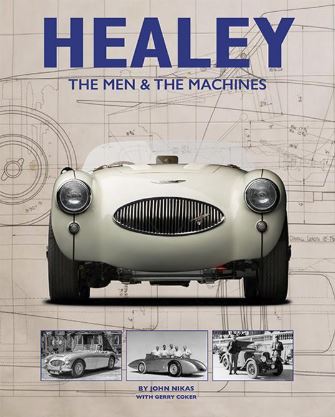 “Nikas combines extensive research into a previously unavailable and highly detailed archive of Donald Healey’s personal records with the author’s masterful ability to weave together an amazing level of detail while making it an eminently readable story. The result is a book that both seasoned automotive historians and anyone with an interest in the story of a life well lived will enjoy. Until you’ve read this book, you don’t know the true story of Donald Healey and his cars”
(Reid Trummel, Editor in Chief, Healey Marque)
Written in collaboration with Gerry Coker, the designer responsible for the iconic Austin-Healey 100 and Sprite, this volume represents the most complete account ever of the sports cars built at Warwick, Longbridge, Abingdon and West Bromwich. With unprecedented access to Donald and Geoffrey Healey’s private papers, diaries, scrapbooks and photo albums, corporate and financial records from BMC, Donald Healey Motor Company and Healey Automobile Consultants, the files of Jensen Motors and Nash-Kelvinator, dozens of personal interviews and exhaustive research into previously unavailable primary source material, this book provides a thorough account of the true story behind these automobiles and the individuals who created them.
 Boomers Daily