After the 2016 election, progressives blamed white women for Hillary Clinton’s loss. This year, Black men have come under special scrutiny. By Jelani Cobb
Voices of Music (October 12, 2024): Mozart’s motet Exsultate Jubilate, performed on original instruments by the award winning Early Music ensemble Voices of Music. Nola Richardson, soprano. The complete is work presented here for the first time in 8K video on period instruments.
Video timeline: 0:00 I. Exsultate Jubilate 5:00 II. Recit: Fulget amica dies 6:04 III. Aria: Tu Virginum Corona 13:11 IV. Alleluia 16:05 Credits
Reconstruction of the recitative: directors Hanneke van Proosdij and David Tayler reconstructed the recitativo accompagnato string parts from Mozart’s continuo part, and this receives its world premiere here. Months after completing the Divertimento in D Major,
Leopold and Wolfgang Mozart left for their third tour of Italy, with a first stop in Milan. There they met the soprano castrato, composer, and harpsichordist Venanzio Rauzzini, who was cast as one of the leads in Wolfgang Mozart’s new opera Lucio Silla opposite the prima donna Anna Lucia de Amicis.
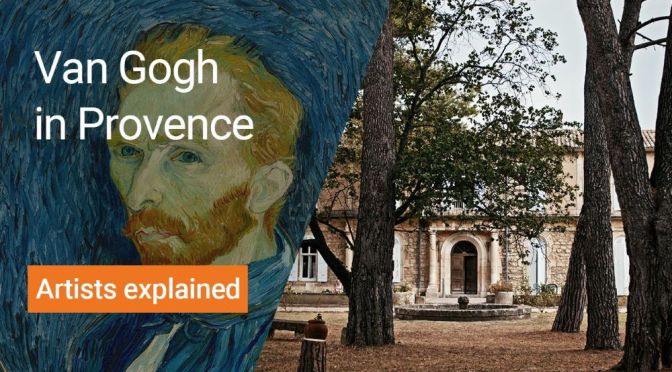
The National Gallery (October 11, 2024): Journey to the south of France and witness the landscapes that so inspired Vincent van Gogh and the painting techniques that have made him famous today. Travel through Arles and Saint-Rémy – from the banks of the Rhône to the hospital where he stayed.
See for yourself the locations that made their way onto Van Gogh’s canvases. ‘Van Gogh: Poets and Lovers’ is a once-in-a-century exhibition that brings together paintings from across the globe, some rarely seen in public. Track Vincent’s work through 1888 and 1889, the two most artistically fruitful years in his life.
Van Gogh: Poets and Lovers 14 September 2024 – 19 January 2025
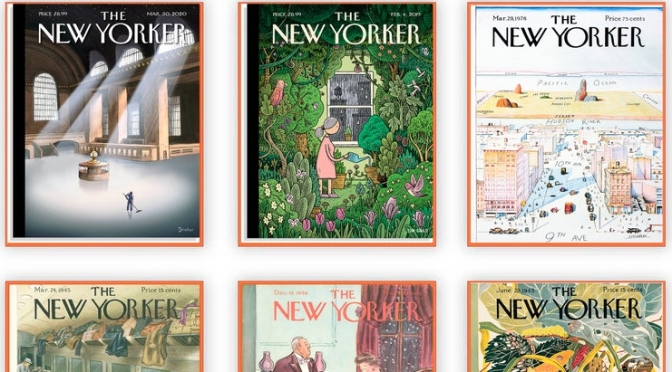
The New Yorker (October 7, 2024): The latest issue featuresVictoria Tentler-Krylov’s “New Heights” – Sunlight flickering on the hustle and bustle of the streets.
Trump’s Dangerous Immigration Obsession
The daily stream of racism and mendacity has had a numbing effect. But the question of what Trump might actually do is a prospect that voters cannot afford to ignore. By Jonathan Blitzer
Silicon Valley, the New Lobbying Monster
From crypto to A.I., the tech sector is pouring millions into super PACS that intimidate politicians into supporting its agenda. By Charles Duhigg
Sleep Essential for Health
Donald Trump is lying next to you in the bed, wearing snug cotton pajamas printed to look like his signature blue suit. You want to tell him a few things you think he ought to know, but his fake snoring drowns you out. By Ian Frazier
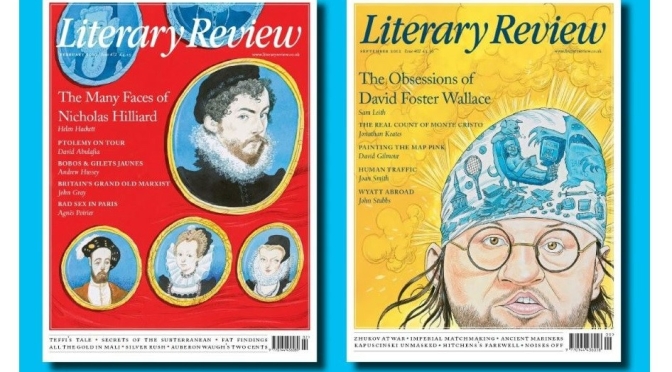
Literary Review – October 2, 2024: The latest issue featuresRichard Vinen on Churchill; @wendymoore99 on Marie Curie; Ritchie Robertson on Augustus the Strong; @robinsimonbaj on British art and @tomlamont on James Salter
‘It’s not a bad life for the leaders of the British bourgeoisie! There’s plenty for them to protect in their capitalist system!’ So wrote Ivan Maisky, the Soviet ambassador in London, after his first visit to Winston Churchill’s country house at Chartwell in Kent. He described the house thus: ‘A wonderful place! Eighty-four acres of land … all clothed in a truly English dark-blue haze.’
Frederick Augustus (1670–1733), elector of Saxony and king of Poland, owed his sobriquet ‘the Strong’ to such feats as crushing a tin plate in his hand (mentioned by Rilke in the ‘Fifth Duino Elegy’) and to his vigorous sex life. Contemporaries credited him with fathering 354 illegitimate children; Tim Blanning soberly reduces the number to eight. This biography is concerned not with court gossip, however, but with Augustus’s political career and cultural achievements. Blanning celebrates Augustus as the virtual creator of the once-magnificent city of Dresden, where the kings of Saxony resided, and hence, surprisingly, as ‘a great artist, arguably the greatest of his age’.
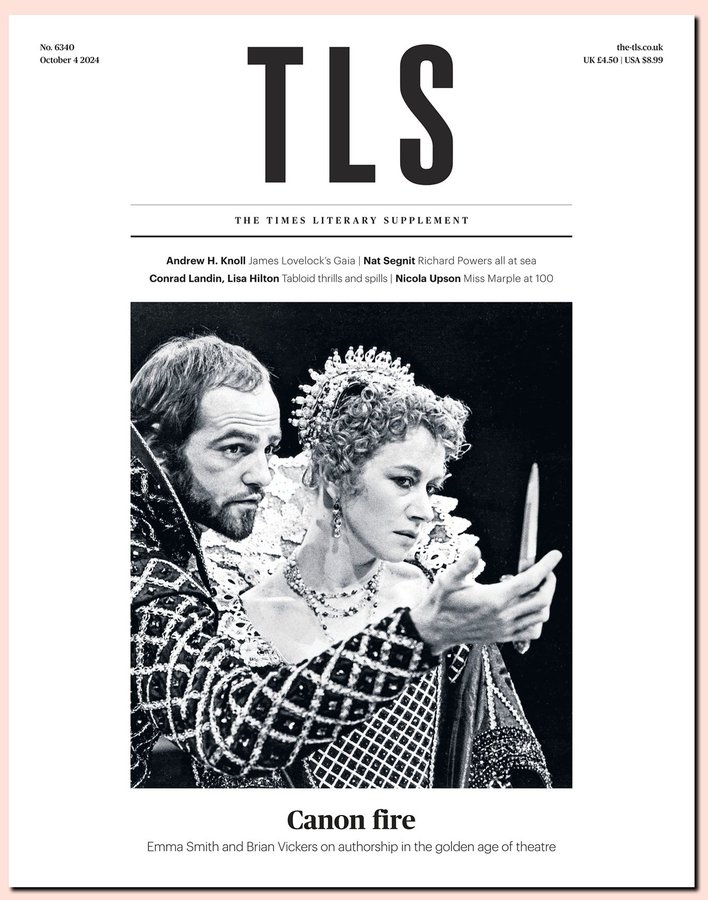
Times Literary Supplement (October 2, 2024): The latest issue features‘Canon Fire’ – Emma Smith and Brian Vickers on authorship in the golden age of theatre…



















 Boomers Daily