

Sir Cedric Lockwood Morris, 9th Baronet was a British artist, art teacher and plantsman. He was born in Swansea in South Wales, but worked mainly in East Anglia. As an artist he is best known for his portraits, flower paintings and landscapes
Category Archives: Art
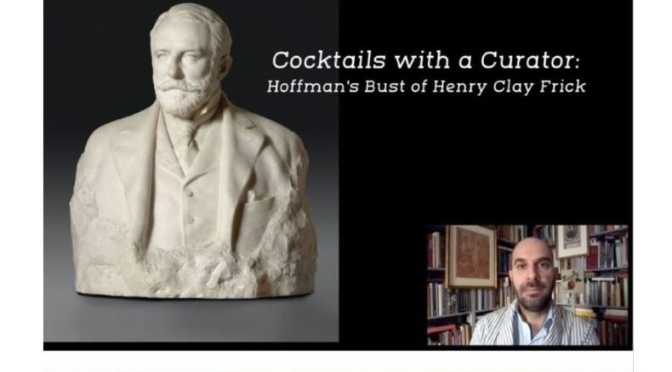
Cocktails With A Curator: ‘Hoffman’s Bust of Henry Clay Frick’ (Frick Video)
In this week’s episode of “Cocktails with a Curator,” Deputy Director and Peter Jay Sharp Chief Curator Xavier F. Salomon takes a closer look at Malvina Cornell Hoffman’s marble bust of Henry Clay Frick, the museum’s founder, and considers the complicated legacy of the Pennsylvania-born industrialist. This month marks several important milestones for the Frick, including the eighty-fifth anniversary of the opening of a museum for, in Frick’s words, “all persons whomsoever.” This oft-overlooked bust was commissioned by his daughter, Helen Clay Frick, and for many years welcomed guests in the Entrance Hall at 1 East 70th Street. This week’s complementary cocktail is the Old Fashioned, a nod to Frick’s first job as an accountant for the family whiskey distillery.
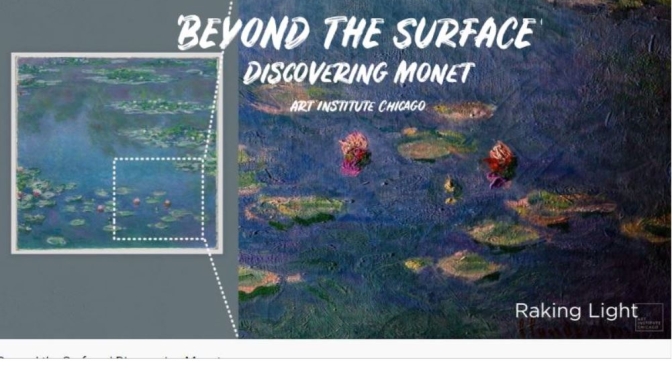
Art: ‘Beyond The Surface’ – Monet’s “Changing Light”
This video takes an in-depth look at Monet’s approach to painting in series, an approach that consumed his later years. From stacks of wheat in the French countryside to sites of foggy London to water lilies at his home garden in Giverny, Monet painted beloved subjects again and again, depicting changing light and atmospheric conditions in works that captivate us still today. New scientific discoveries, however, reveal that Monet’s genius goes well beyond what we see on the surface.
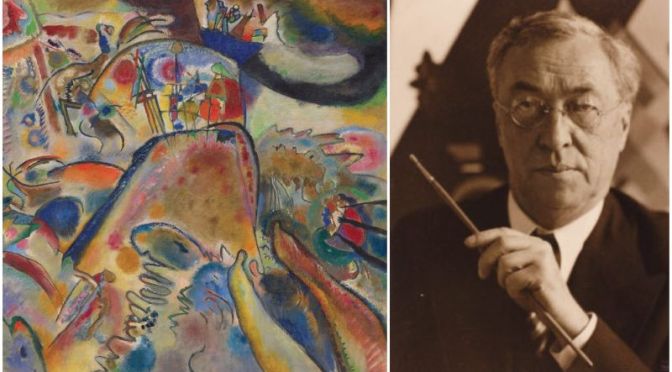
Exhibitions: ‘Kandinsky’ At The Guggenheim Bilbao In Spain (Nov ’20 To May ’21)
As a pioneer of abstraction and a renowned aesthetic theorist, Vasily Kandinsky (b. 1866, Moscow; d. 1944, Neuilly-sur-Seine, France) is among the foremost artistic innovators of the early twentieth century.
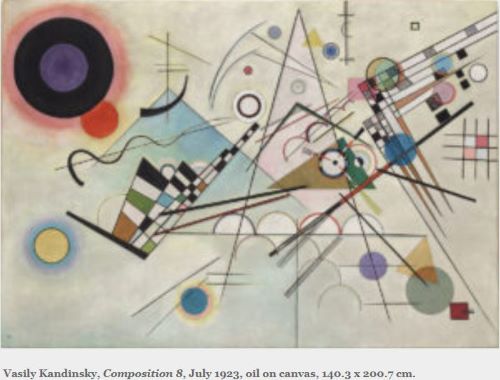
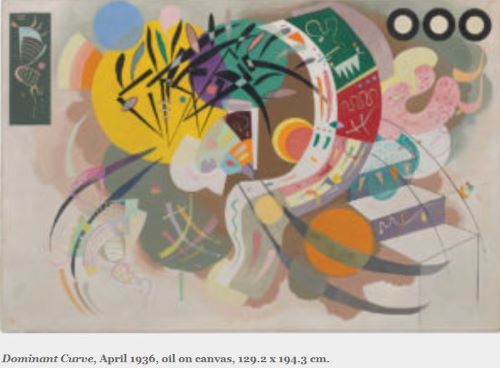
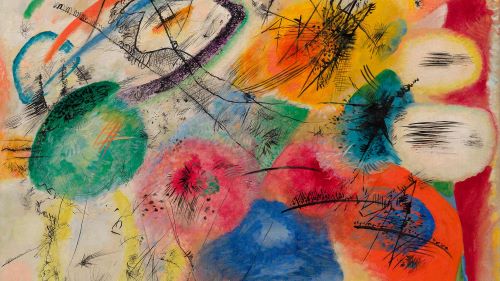

In his endeavor to free painting from its ties to the natural world, Kandinsky discovered a new subject matter based solely on the artist’s “inner necessity” that would remain his lifelong concern.
In Munich in the 1900s and early 1910s, Kandinsky began exploring the expressive possibilities of color and composition, but he was abruptly forced to leave Germany with the outbreak of World War I, in 1914. The artist eventually returned to his native Moscow, and there his pictorial vocabulary started to reflect the utopian experiments of the Russian avant-garde, who emphasized geometric shapes in an effort to establish a universal aesthetic language. Kandinsky subsequently joined the faculty of the Bauhaus, a German school of art and applied design that shared his belief in art’s ability to transform self and society. Compelled to abandon Germany again when the Bauhaus closed under Nazi pressure in 1933, he settled outside Paris, where Surrealism and the natural sciences influenced Kandinsky’s biomorphic imagery.
More so than any other artist, Kandinsky is intertwined with the history of the Solomon R. Guggenheim Foundation, established in New York in 1937. Industrialist and museum founder Solomon R. Guggenheim began collecting Kandinsky’s work in 1929 and met him at the Dessau Bauhaus the following year. This exhibition draws from the foundation’s extensive holdings to illustrate the full arc of Kandinsky’s seminal career.
Curator: Megan Fontanella
Organized by The Solomon R. Guggenheim Foundation, New York
Wassily Wassilyevich Kandinsky was a Russian painter and art theorist. Kandinsky is generally credited as the pioneer of abstract art. Born in Moscow, Kandinsky spent his childhood in Odessa, where he graduated at Grekov Odessa Art school. He enrolled at the University of Moscow, studying law and economics.
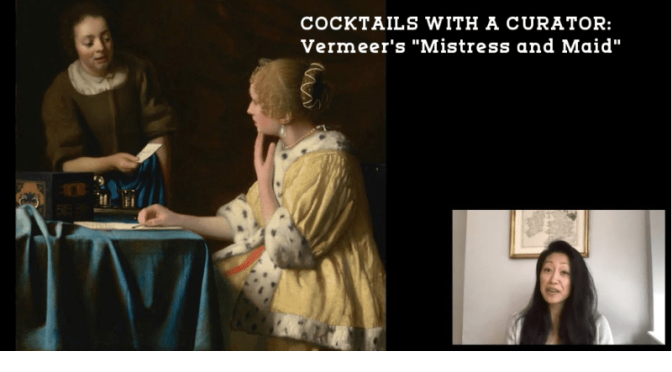
Cocktails With A Curator: Vermeer’s “Mistress And Maid” (The Frick Video)
In this week’s episode of “Cocktails with a Curator,” Curator Aimee Ng pulls back the curtain on hidden details in “Mistress and Maid,” the largest of the Frick’s three Vermeer paintings and Henry Clay Frick’s final acquisition for his collection. Take a closer look at the rumpled tablecloth, the lady’s wispy curls, and the dark background to understand how this mysterious work has changed since Vermeer applied paint to canvas in the mid-17th century. For this week’s complementary cocktail, the Genever Brûlée, Aimee has dipped into the bottle of genever she featured in her summer episode on Vermeer’s “Officer and Laughing Girl.”
To view this painting in detail, please visit our website: https://www.frick.org/mistressmaid

Art History: Jacqueline Roque – “Picasso’s Great Love, Wife & Muse” (Video)
In this episode of Expert Voices, Brooke Lampley describes Pablo Picasso’s remarkable love affair with Jacqueline Roque. A classically beautiful portrayal, Picasso married Rocque in 1961 – leading her to be an omnipresent constant in his life.
Painting: Buste de femme assise
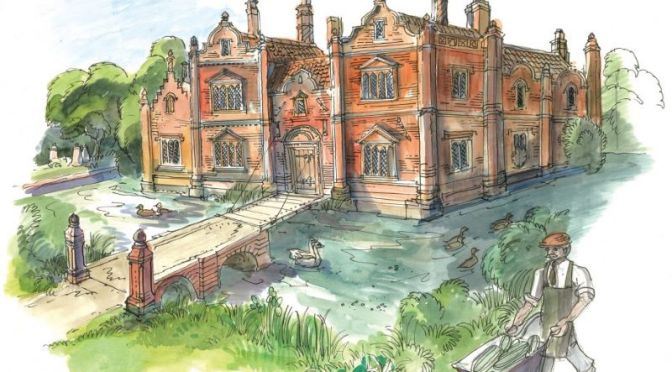
Literary Illustrators: ‘The Houses Of Sherlock Holmes’ By Matthew Rice

Dartmoor’s Baskerville Hall is one of the most famous country houses in English fiction. The arrival at its doors of Dr Watson, in the company of Sir Henry Baskerville, is a vivid piece of cinematic direction, artfully combining the Gothic horror tale with the more modern taste for detective thrillers.

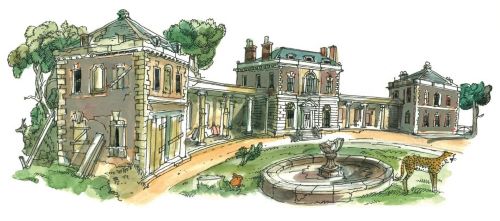


Passing a ruined black-granite lodge, Watson and Baskerville go through the gates that are ‘a maze of fantastic tracery in wrought iron’ before reaching an avenue where ‘old trees shot their branches in a sombre tunnel’. The hall is a ‘heavy block’, with a projecting porch, its façade ‘draped in ivy’ within which the odd window or heraldic display can be seen.

Art: Michelangelo’s Sculpture ‘David’ & The Republic Of Florence
Michelangelo, David, 1501–04, marble, 17 feet high (The Galleria dell’Accademia, Florence), a conversation with Dr. Steven Zucker and Dr. Beth Harris.
This astonishing Renaissance sculpture was created between 1501 and 1504. It is a 14.0 ft marble statue depicting the Biblical hero David, represented as a standing male nude. Originally commissioned by the Opera del Duomo for the Cathedral of Florence, it was meant to be one of a series of large statues to be positioned in the niches of the cathedral’s tribunes, way up at about 80mt from the ground. Michelangelo was asked by the consuls of the Board to complete an unfinished project begun in 1464 by Agostino di Duccio and later carried on by Antonio Rossellino in 1475. Both sculptors had in the end rejected an enormous block of marble due to the presence of too many “taroli”, or imperfections, which may have threatened the stability of such a huge statue. This block of marble of exceptional dimensions remained therefore neglected for 25 years, lying within the courtyard of the Opera del Duomo (Vestry Board).
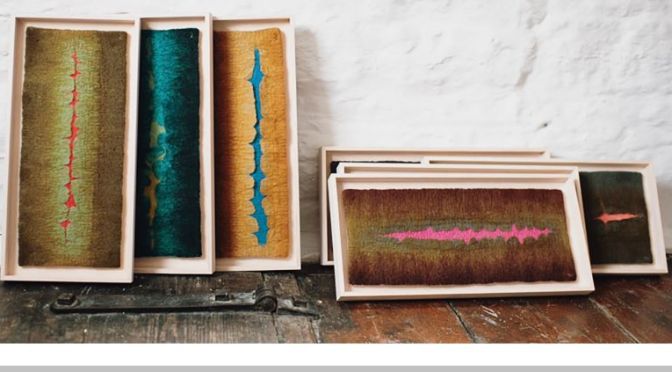
Profile Video: French-English Textile Artist ‘Valerie Wartelle’
My main fascination lies within the manipulation of fibres and textiles as an expressive art form. Taking the rural environment as my inspiration,I explore long-term interests of texture, colour, layering and process to create contemplative and ethereal artworks.
My primary technique is wet felting; a traditional craft technique using wool tops, hot water, soapsuds and friction to interlock the fibres together. The making is muscular and rhythmic as I lay, pour, roll and squeeze again and again. It seems repetition nudges me into a semi-meditative space – it invites me to trust myself, and let the haptic connections sinuously paint a new space for the viewer to contemplate.
The compositions are built in layers, hinting at what may lie beneath, and use translucency and light to create absorbing moods. These are highly textured felt pieces in which cloth is embedded, prints disguised, and threads unravelled as a painter with her brush. The analogy with painting is significant throughout, making the viewing inquisitive, and challenging people’s perception.
Brought up in France and French Polynesia, I originally came to the UK to study textile design and am now a widely exhibited artist working and living in West Yorkshire. In 2015, I was awarded the Embroidery Magazine’s Best Emerging Textile Artist at SIT Select Showcase, as well as Best Picture in Show at theGreat North Art Show.
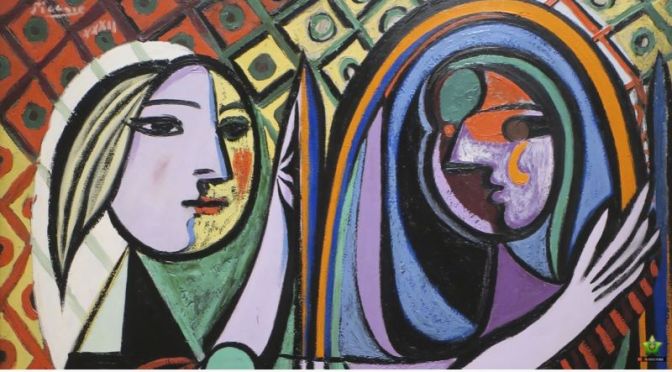
Art: Pablo Picasso’s ‘Girl Before A Mirror’ (Video)
This image of a young woman and her mirror reflection is riotous in color and chockablock with pattern. It is one of the last in a major series of canvases that Picasso created between 1931 and 1932. According to The Museum of Modern Art’s founding director, Alfred H. Barr, Jr., Picasso said he “preferred this painting to any of the others,” which speaks to the painting’s dazzling visual and thematic complexity. Its primary subject is the time-honored artistic theme of a woman before her mirror, reinvented in strikingly modern terms. The girl’s smoothly painted profile, in a delicately blushing pink-lavender, abuts a heavily built-up and garishly colored frontal view in yellow and red. Allusions to youth and old age, sun and moon, light and shadow are compressed into a single multivalent face.
 Boomers Daily