
A selection of three essential articles read aloud from the latest issue of The Economist. This week, the new fault lines in the world economy, the catastrophic consequences of America abandoning Afghanistan (10:28) and how Mills & Boon, a famed publisher of romantic novels, wants to diversify its hero base (17:30)
Category Archives: Analysis
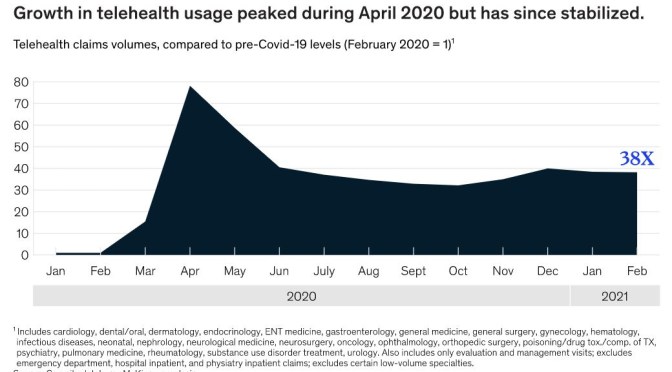
Telemedicine: Growth Rate Peaked In April 2020, Stabilized During 2021
A year ago, we estimated that up to $250 billion of US healthcare spend could potentially be shifted to virtual or virtually enabled care. Approaching this potential level of virtual health is not a foregone conclusion. It would likely require sustained consumer and clinician adoption and accelerated redesign of care pathways to incorporate virtual modalities.
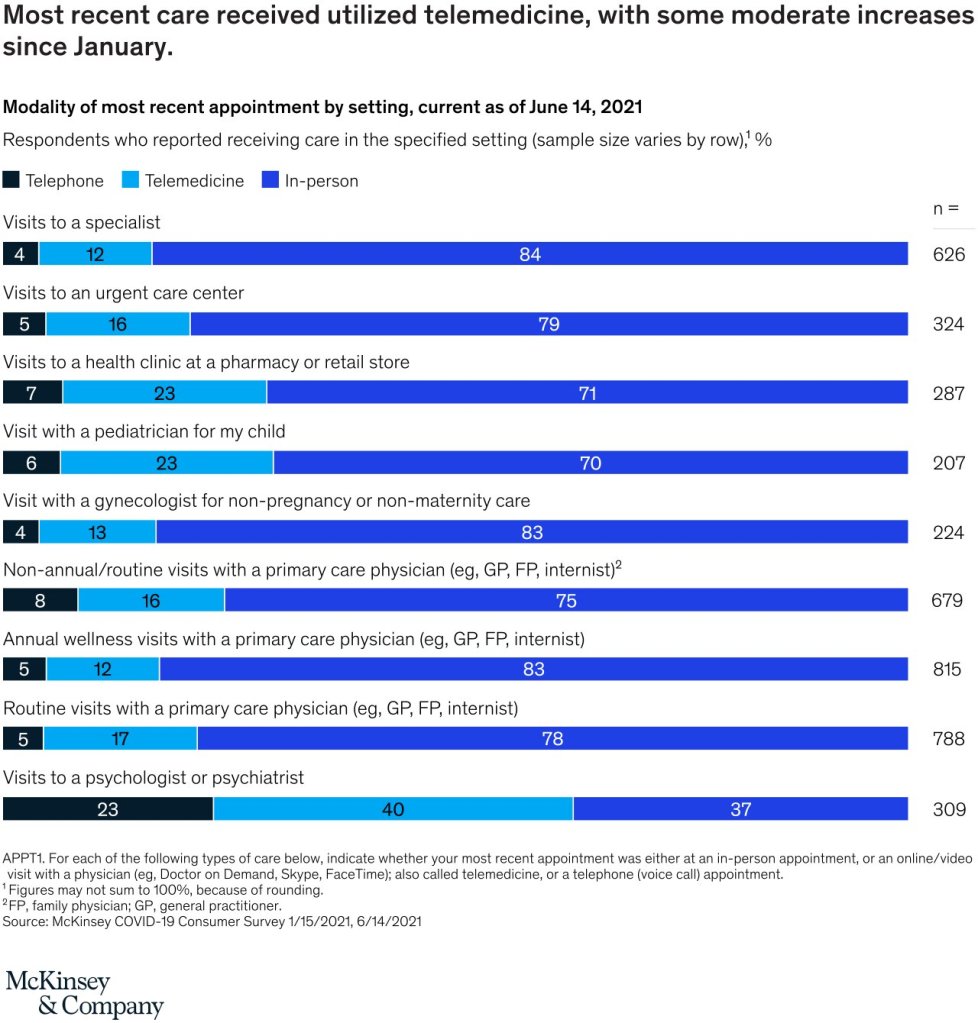
- Telehealth utilization has stabilized at levels 38X higher than before the pandemic. After an initial spike to more than 32 percent of office and outpatient visits occurring via telehealth in April 2020, utilization levels have largely stabilized, ranging from 13 to 17 percent across all specialties.2 This utilization reflects more than two-thirds of what we anticipated as visits that could be virtualized.3
- Similarly, consumer and provider attitudes toward telehealth have improved since the pre-COVID-19 era. Perceptions and usage have dropped slightly since the peak in spring 2020. Some barriers—such as perceptions of technology security—remain to be addressed to sustain consumer and provider virtual health adoption, and models are likely to evolve to optimize hybrid virtual and in-person care delivery.
- Some regulatory changes that facilitated expanded use of telehealth have been made permanent, for example, the Centers for Medicare & Medicaid Services’ expansion of reimbursable telehealth codes for the 2021 physician fee schedule. But uncertainty still exists as to the fate of other services that may lose their waiver status when the public health emergency ends.
- Investment in virtual care and digital health more broadly has skyrocketed, fueling further innovation, with 3X the level of venture capitalist digital health investment in 2020 than it had in 2017.4
- Virtual healthcare models and business models are evolving and proliferating, moving from purely “virtual urgent care” to a range of services enabling longitudinal virtual care, integration of telehealth with other virtual health solutions, and hybrid virtual/in-person care models, with the potential to improve consumer experience/convenience, access, outcomes, and affordability.

Political Analysis: Brooks & Tumulty On Congress’ Earmarks, Afghanistan
New York Times columnist David Brooks and deputy opinion editor for The Washington Post, Karen Tumulty, join Judy Woodruff to discuss the week in politics, including the return of congressional earmarks, withdrawal of U.S. troops from Afghanistan, the latest on the New York City mayor’s race and what it means about the Democratic Party.

Online Shopping: Alibaba Challenges Amazon (WSJ)
Inside the company’s automated warehouse in China Chinese e-commerce giant Alibaba is challenging Amazon by promising fast deliveries from China to anywhere in the world. WSJ visits Alibaba’s largest automated warehouse to see how robots and a vast logistics network are helping it expand globally. Composite: Clément Bürge
Analysis: Fixing The EV Charging Bottleneck
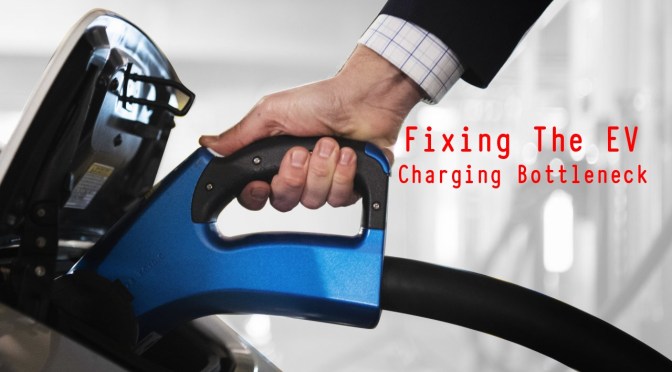
Electric-vehicle entrepreneurs are working on the industry’s biggest bottleneck: charging infrastructure. Companies are building more chargers, but it may not be enough to make EVs work for people who can’t plug in at home. Photo illustration: Carlos Waters/WSJ

Covid-19: The Economist ‘Global Normalcy Index’
Across much of the world, covid-19 restrictions are starting to ease. The Economist has crunched the data to calculate how close countries are to pre-pandemic levels of normality—but will life ever be the same again? Read more here: https://econ.st/3AG9siz

Drought: Desalination Plant Opens In California
San Diego is set to soon start supplying itself with millions of gallons a day of fresh, drinkable water, using saltwater from the Pacific Ocean, converted by a brand new desalination plant. As California’s historic drought continues, the plant will likely intensify the debate over the role of desalination may play in the state’s water supply. Special Correspondent Mike Taibbi reports.
View the Full Story/Transcript: http://www.pbs.org/newshour/bb/desali…

News: China’s Communist Party At 100 – What’s Next?
At the Chinese Communist Party’s centennial celebration, President Xi Jinping called for defiance against foreign pressure. As China challenges the U.S.’s leadership – from AI to defense – WSJ’s Jonathan Cheng looks at what’s next for the country. Photo: Wang Zhao/AFP
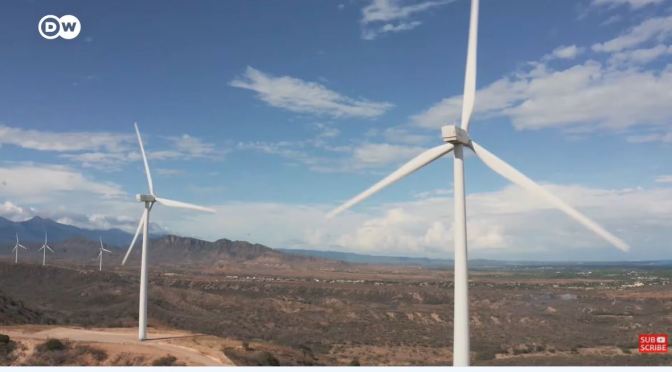
Views: Dominican Republic Shifts Into Green Energy
Small solar panels are to be installed on the roofs of houses in the village of Sabana Real, Dominican Republic. The local project is part of a major plan: By 2025, the country hopes to generate a quarter of its energy from renewable sources.

Finance: Why The Fed Will Create A Digital Dollar
The Federal Reserve is trying to figure out how to keep cash relevant in a cashless world. It’s considering digitizing the U.S. dollar, giving people money they can access on their phone and bypassing electronic payments that can be slow and costly for businesses. Illustration: Jacob Reynolds/WSJ
 Boomers Daily