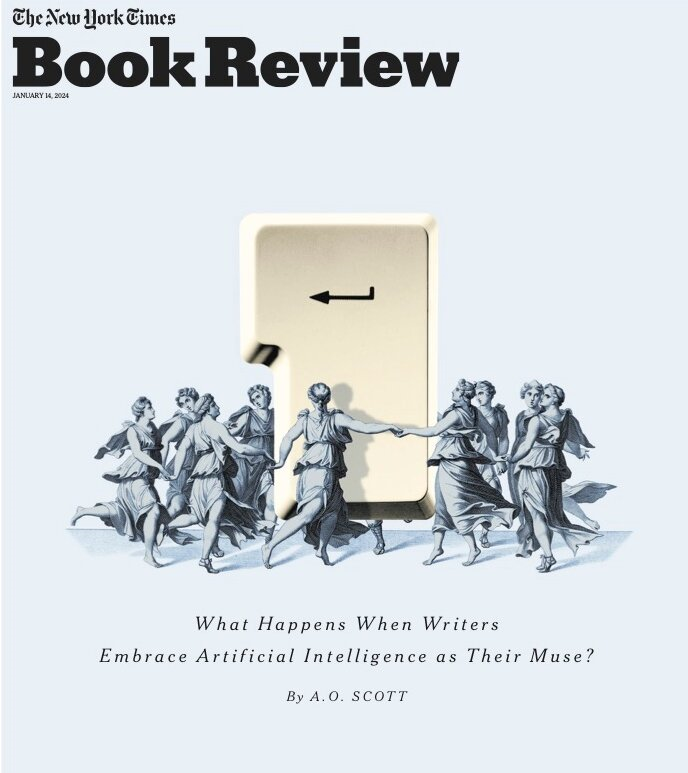
THE NEW YORK TIMES BOOK REVIEW (January 12, 2024): The latest issue features ‘What Happens When Writers Embrace Artificial Intelligence as Their Muse? by A.O. Scott…
The robots of literature and movies usually present either an existential danger or an erotic frisson. Those who don’t follow in the melancholy footsteps of Frankenstein’s misunderstood monster march in line with the murderous HAL 9000 from “2001: A Space Odyssey,” unless they echo the siren songs of sexualized androids like the ones played by Sean Young in “Blade Runner” and Alicia Vikander in “Ex Machina.”
We fantasize that A.I. programs will seduce us or wipe us out, enslave us or make us feel unsure of our own humanity. Trained by such narratives, whether we find them in “Terminator” movies or in novels by Nobel laureates, we brace ourselves for a future populated by all kinds of smart, possibly sentient machines that will disrupt our most cherished notions of what it means to be human.
For Álvaro Enrigue, a novelist fascinated with historical detail, the first meeting of the Aztecs and Spanish conquistadors is the obsession of a lifetime. He brings it to life in “You Dreamed of Empires.”
By Benjamin P. Russell
The Aug. 13, 2021 edition of The New York Times failed to mention the 500th anniversary of the fall of Tenochtitlan, the erstwhile Aztec capital out of which Mexico City was born. Álvaro Enrigue noticed. Of course.
The 54-year-old Enrigue, who grew up in Mexico City, believes that early meeting between Europe and the Americas changed the trajectory of global commerce, urbanism, industry and much else besides. Modernity itself, he argues, was born in the moment the Aztec emperor Moctezuma and Hernan Cortés, the Spanish conquistador, first looked each other in the eye in 1519, a clash of empires that set in motion the city’s capture two years later.
The Economist Magazine (January 12, 2024): The latest issue features ‘China’s EV Onslaught’ – An influx of Chinese cars is terrifying the West; Europe’s Silicon Valley; ‘America Fights Back’ – The new contest for sea power; Why Olaf Scholz is no Angela Merkel – Germany is unable and unwilling to lead Europe; What science says about old leaders…
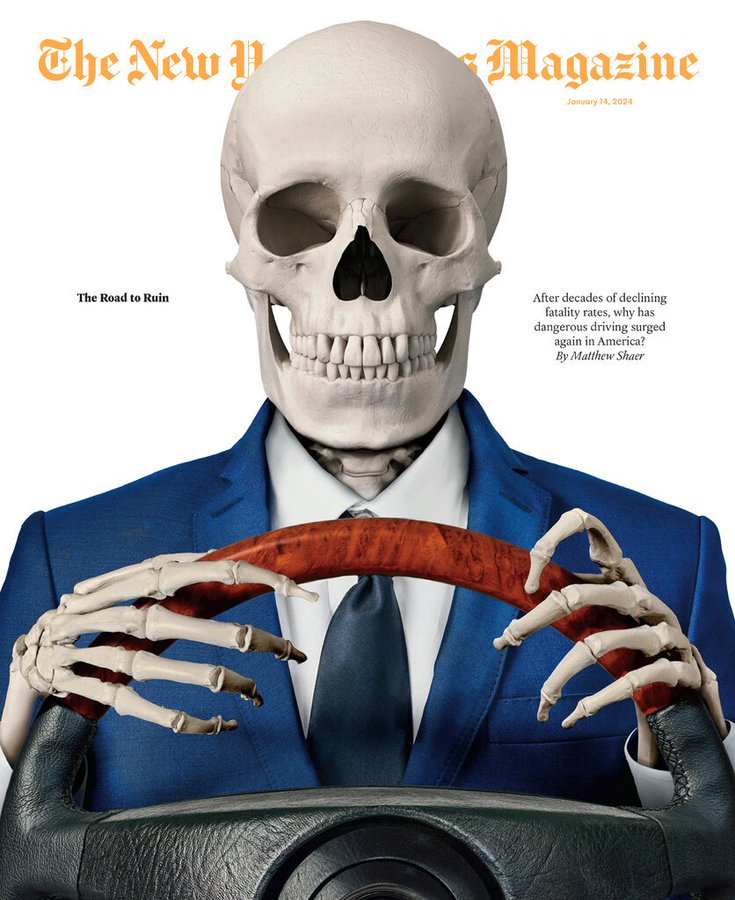
THE NEW YORK TIMES MAGAZINE (January 12, 2024): The new issue features ‘Why Are American Drivers So Deadly’ –After decades of declining fatality, dangerous driving has surged again….
After decades of declining fatality rates, dangerous driving has surged again.
By Matthew Shaer
In the summer of 1999, a few years after graduating from medical school, Deborah Kuhls moved from New York to Maryland, where she had been accepted as a surgical fellow at the R Adams Cowley Shock Trauma Center in Baltimore. Founded by a pioneer in emergency medicine, Shock Trauma is one of the busiest critical-care facilities in the country — in an average year, doctors there see approximately 8,000 patients, many of them close to death.
Andy Reid’s diligence and sense of mischief have made him one of the game’s best-ever coaches. Can he get his struggling Chiefs back to the Super Bowl?
By Michael Sokolove
Andy Reid, the coach of the Kansas City Chiefs, has won more than 250 games in his career, fourth all-time, which puts him high on any list of the N.F.L.’s greatest coaches. Most of the others in that pantheon are men who personify the sport’s militaristic soul — Vince Lombardi, for example, the fabled coach of the 1960s-era Green Bay Packers, or Reid’s contemporary, the grim Bill Belichick of the New England Patriots. But Reid is no Lombardi or Belichick; he’s Steve Jobs. He’s a designer, a tinkerer, a product engineer who imbues his football with creativity and even an occasional touch of whimsy.
Warner Classics (January 12, 2024) – An aria powerfully reminiscent of Maria Callas’s own story, Tosca’s tragic manifesto, “Vissi d’arte” (“I lived for art”), unfolds in this illustrated retelling by Matteo Cozzo.
The story is told through the designer’s unique style, using the collage technique to create unique textures, expressions, and effects.
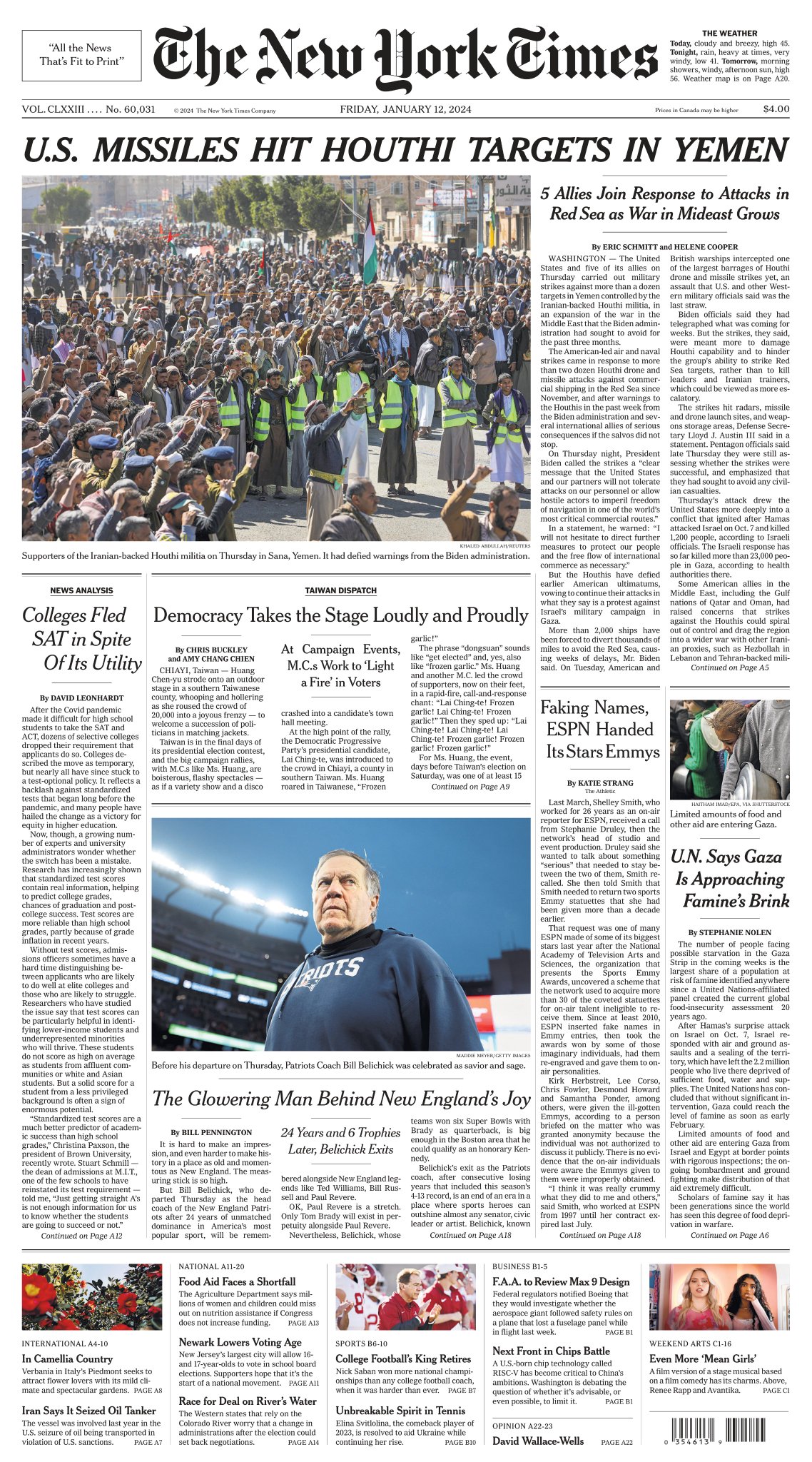
The Globalist Podcast (January 12, 2024) –US and UK forces have carried out air strikes against the Houthis in Yemen with mission support from the Netherlands, Australia, Canada and Bahrain.
Targets reportedly include sites in the capital city, Sana’a, the Red Sea port of Al-Hudaydah, Dhamar and the northwestern Houthi stronghold of Sa’ada. We discuss the political consequences of South Africa’s case against Israel at the International Court of Justice.
Also, an eventful week in US politics ahead of this year’s presidential election, Greece plans an initial public offering of Athens International Airport and the latest theatre news.
The American-led strikes came in response to more than two dozen Houthi drone and missile attacks against commercial shipping in the Red Sea since the Israel-Hamas war began.
A U.N.-affiliated panel said the territory could tip into famine very soon. International laws to protect people from human-made famines offer little help.
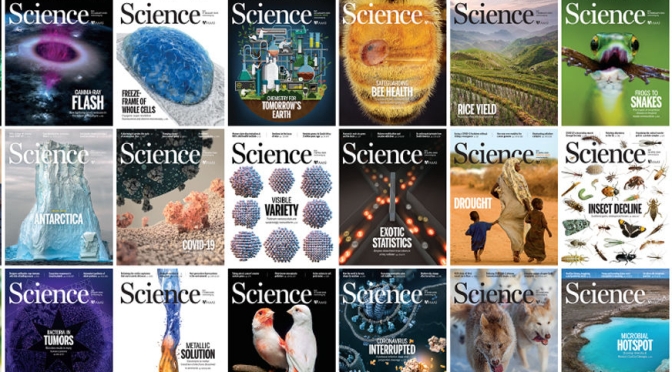
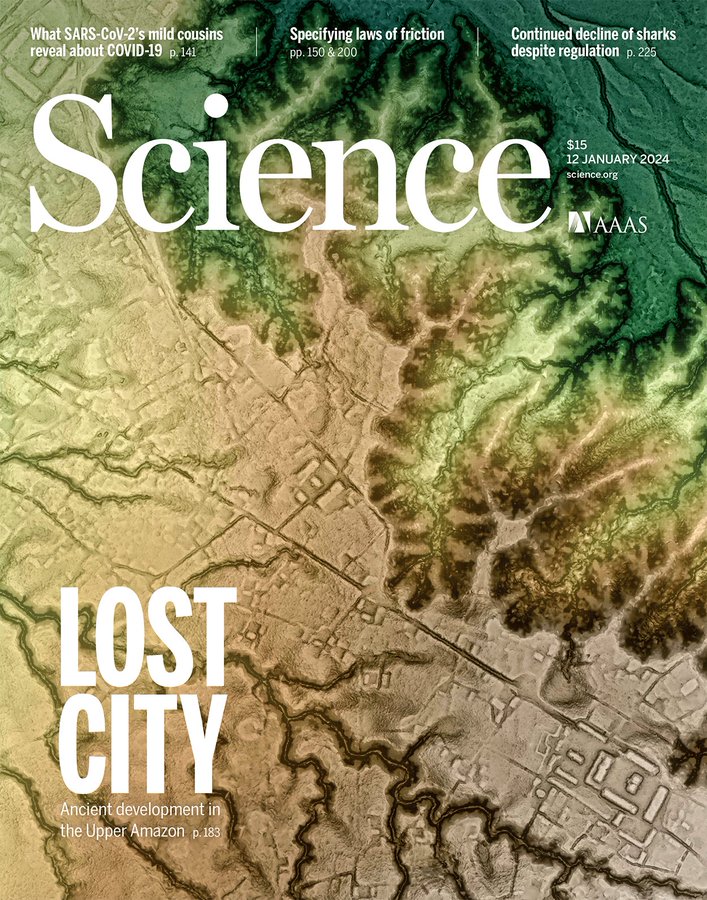
Science Magazine – January 11, 2024: The new issue features‘Lost City’ – Ancient development in the Upper Amazon; What SARS-CoV-2’s mild cousins reveal about Covid-19; Specifying laws of friction and a Continued decline in sharks despite regulation…
The Economist (January 11, 2024) – Guam, an island in the northern Pacific, is just 48km long and has a population of about 170,000. So why is it so important to America’s strategy to defend Taiwan from a potential Chinese invasion?
Video timeline: 00:00 – Where is Guam? 00:13 – Why is it so important? 01:00 – What makes it vulnerable?
News, Views and Reviews For The Intellectually Curious























 T
T Boomers Daily