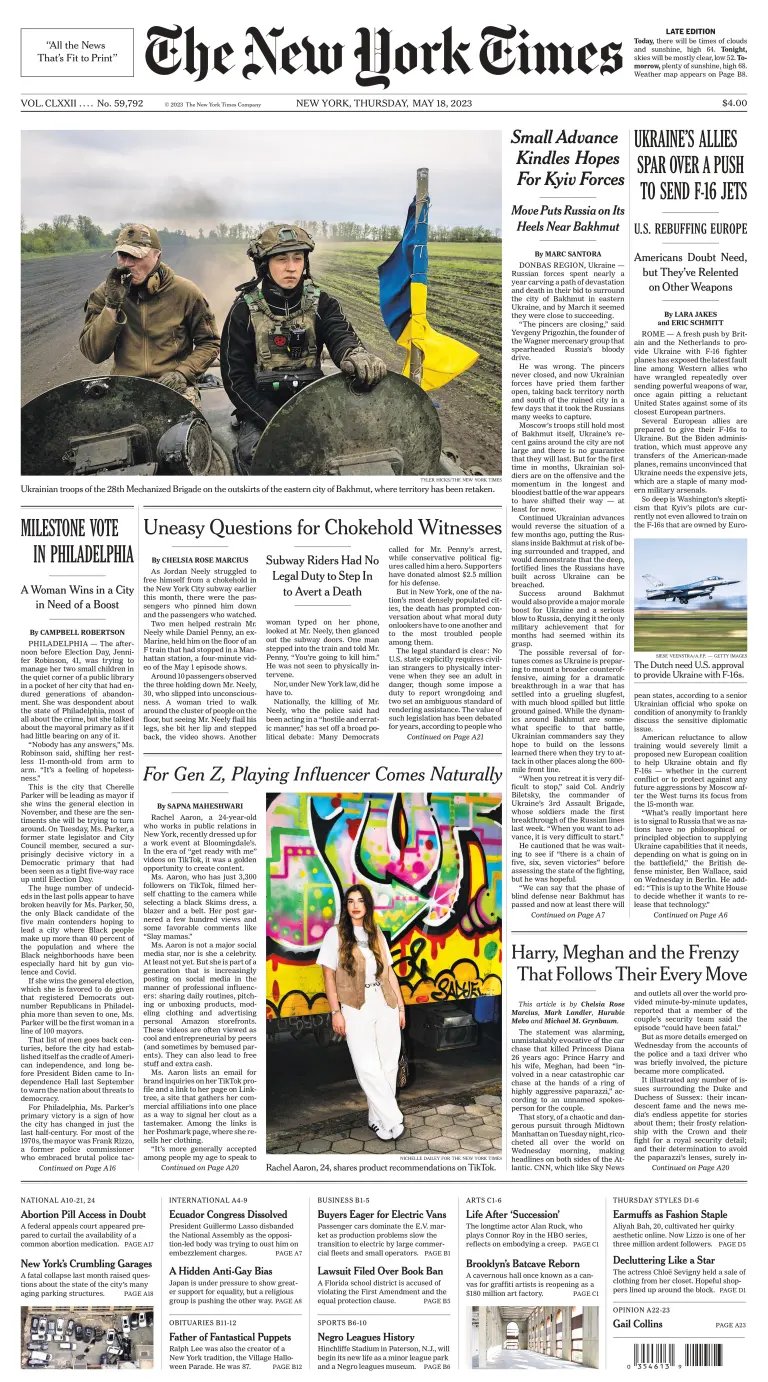
Front Page: The New York Times —- May 18, 2023

Image

The Latest Rift Among Ukraine’s Allies Is Whether to Send F-16s

A Dutch F-16 jet fighter landing at Volkel air base in the Netherlands. Britain and the Netherlands are leading a European push to send the jets to Ukraine.

The United States is resisting a European push for the powerful fighters. But will it relent, as it did before with tanks, rocket launchers and air defense missiles?

Gains Near Bakhmut Raise Ukraine’s Hopes of a Turning Tide

The 28th Mechanized Brigade of the Ukrainian Army in a BMP armored vehicle during an operation to fire on a Russian target in the direction of Bakhmut, in eastern Ukraine, in May.

The advances have been small, and Russians still hold most of the city, but Ukrainians say they see a meaningful shift in momentum.

After Historic Primary in Philadelphia, a New Mayor Will Face Old Problems

Cherelle Parker’s win in the Democratic primary is a sign of how the city has changed. But Philadelphia’s challenges remain deep and daunting.

They Watched Jordan Neely Die. Did They Have a Duty to Intervene?

New York does not require bystanders to act when someone is in danger, but the killing on the F train has residents debating when they should step in.
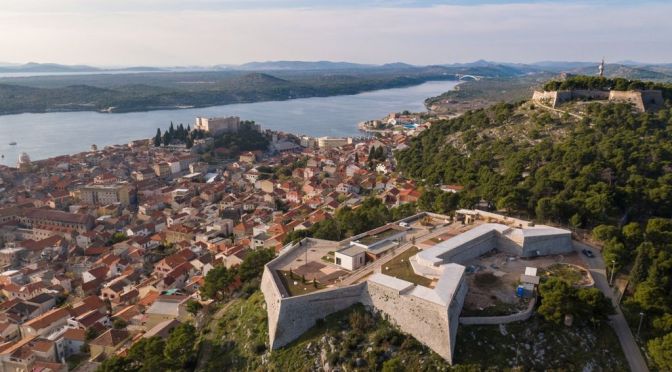

Travel Tour: Šibenik In Western Croatia (4K)

Massimo Nalli (May 18, 2023) – Šibenik, historically known as Sebenico, is a historic city in Croatia and is also the third-largest city in the Dalmatian region. Unlike other cities along the Adriatic coast, which were established by Greeks, Illyrians and Romans,

Šibenik was founded by Croats.Between the 11th and 12th centuries, Šibenik was tossed back and forth among Venice, Byzantium, and Hungary. The city, like the rest of Dalmatia, initially resisted the Venetian Republic, but it was taken over after a three-year war in 1412. The fall of the Republic of Venice in 1797 brought Sebenico under the authority of the Habsburg monarchy. The Italian name Sebenico only was used until around 1871. After the WW1 Šibenik was occupied by the Kingdom of Italy until 12 June 1921. As a result of the Treaty of Rapallo, the Italians gave up their claim to the city and it became a part of the Kingdom of Serbs, Croats and Slovenes.

During World War II, Šibenik was annexed by Italy and was part of the Italian Governorate of Dalmatia from 1941 to 1943 being part of the province of Zara. Communist partisans liberated Šibenik on 3 November 1944. After World War II it became a part of the SFR Yugoslavia until Croatia declared independence in 1991. The central church in Šibenik, the Šibenik Cathedral of St James, is on the UNESCO World Heritage list. In the city of Šibenik there are four fortresses, each of which has views of the city, sea and nearby islands. The fortresses are now tourist sightseeing destinations.

Travel & Nature: National Geographic — June 2023

Image

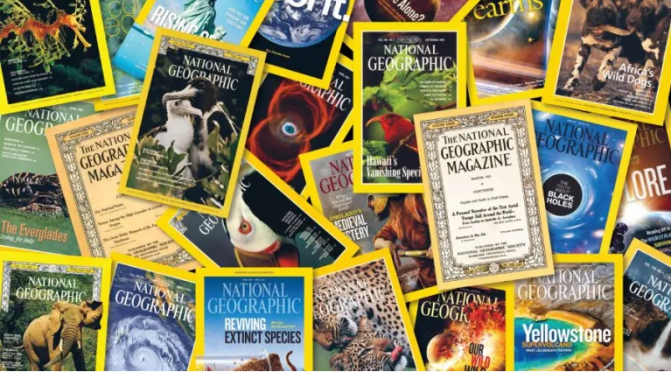
National Geographic Magazine (June 2023): Into The Wild – Life and Death in one of America’s last great places; Underwater volcanoes in Italy; Ancient iron from Space.

These violent undersea volcanoes harbor a secret: life

Off the coast of Italy, the Mediterranean’s most active volcano system is extremely volatile—yet our photographer found that marine life clings on all the same.

How did ancient cultures first discover iron? It fell from the sky.

Early cultures used meteorites to craft weapons and jewelry long before anyone knew how to extract iron from ore.

Arts: Meissen Porcelain – ‘A Fox with a Chicken’

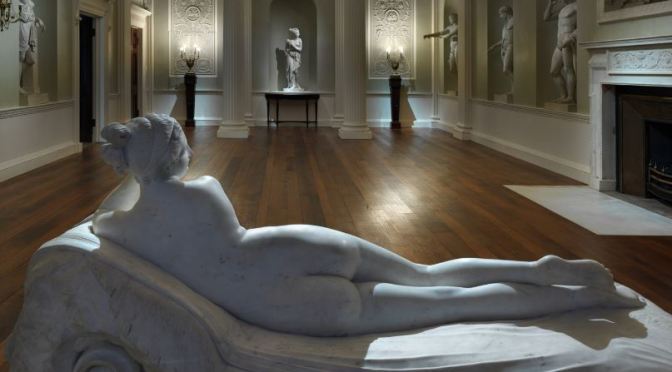
Getty Museum (May 17, 2023) – Imagine a menagerie of over 500 life-sized porcelain animals long gallery in a palace in Dresden. A Fox with a Chicken was a part of this new creation commissioned by Augustus II “The Strong” in the 18th century to share his love for Japanese porcelain with others.

A Fox with a Chicken

Meissen Porcelain Manufactory (German, active 1710 – present), Model by Johann Gottlieb Kirchner (German, 1706 – 1768)

Johann Gottlieb Kirchner produced the model for this life-size porcelain sculpture of a fox-looking a little guiltily around the chicken it is about to devour-as part of an extraordinary commission from Augustus the Strong, elector of Saxony and king of Poland, who envisioned a life-size porcelain menagerie for his Japanese Palace in Dresden. The Meissen Porcelain Manufactory had been operating for only twenty years when Augustus commissioned this series of porcelain animals to be rendered “in their natural sizes and colors.” The production of porcelain models of this size had never been attempted before in Europe.

Research Preview: Nature Magazine – May 18, 2023

Volume 617 Issue 7961

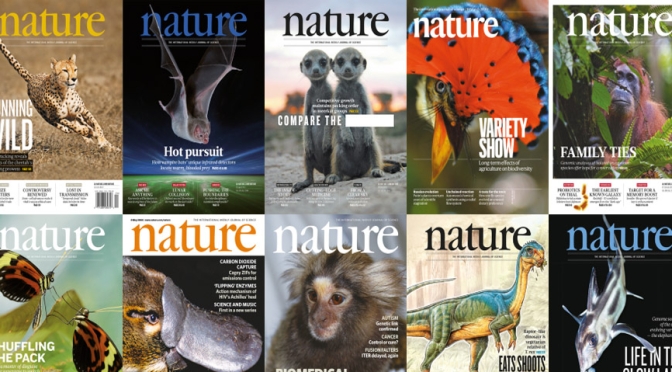
nature Magazine – May 18, 2023 issue: The cover shows an artist’s impression of two male mammoths fighting. During episodes of musth, adult male elephants undergo periods of elevated testosterone levels associated with aggression and competition for mating. In this week’s issue, Michael Cherney and his colleagues show that male woolly mammoths (Mammuthus primigenius) experienced similar episodes of musth. 

The ocean is hotter than ever: what happens next?

Record temperature combined with an anticipated El Niño could devastate marine life and increase the chances of extreme weather.

Split level of shallow bleaching corals and island, New Ireland, Papua New Guinea, June 2010

The global ocean hit a new record temperature of 21.1 ºC in early April, 0.1 ºC higher than the last record in March 2016. Although striking, the figure (see ‘How the ocean is warming’) is in line with the ocean warming anticipated from climate change. What is remarkable is its occurrence ahead of — rather than during — the El Niño climate event that is expected to bring warmer, wetter weather to the eastern Pacific region later this year.

For chemists, the AI revolution has yet to happen

Machine-learning systems in chemistry need accurate and accessible training data. Until they get it, they won’t achieve their potential.

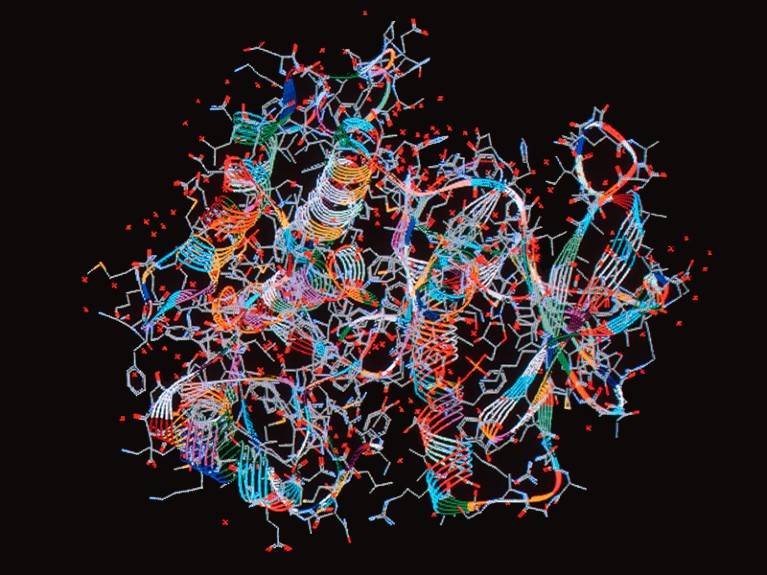
Cancer protein. Computer model of the enzyme protein tyrosine kinase, which is involved in cancer cell formation.

Many people are expressing fears that artificial intelligence (AI) has gone too far — or risks doing so. Take Geoffrey Hinton, a prominent figure in AI, who recently resigned from his position at Google, citing the desire to speak out about the technology’s potential risks to society and human well-being.

Village Walks: Grimaud In The South Of France (4K)

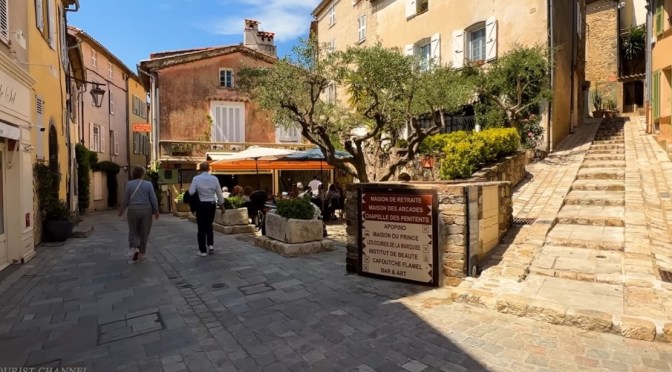
Tourist Channel (May 17, 2023) – Nestling between the Gulf of Saint-Tropez and the Maures Massif, Grimaud is a charming village whose medieval character is still very much in evidence. Perched on a hill, the first thing you see when you arrive is its castle. Built in the 11th century, this feudal structure (of which some imposing ruins remain) offers a stunning view of the coast and the wooded hills of the Maures Massif.

Boasting some well-preserved heritage, Grimaud contains a plethora of pretty little cobbled streets in bloom, village squares, archways and restored period homes. In the old village, you can also see the beautiful Church of St. Michael, built in the late 12th century in the Provençal Romanesque style. It houses a fresco from 1850 depicting St. Michael, St. Peter and St. Bartholomew, as well as contemporary stained glass windows made in 1975 by the jeweller Jacques Gautier.

Travel In France: Secrets Of Mont-Saint-Michel

DW Travel (May 17, 2023) – Mont-Saint-Michel is steeped in mystery: Its construction alone is perplexing – a monastery built atop a steep crag in the middle of a bay.

Video timeline: Intro 01:01 How to get there and when is the best time? 01:34 How they built it 02:21 Dangerous surrounding 03:08 The architecture of Mont-Saint-Michel 04:39 Inhabitants: monks and nuns 05:19 The darkest secret of the abbey 06:07 A deeply mysterious place

Surrounded by water at high tide, at low tide you can walk across the tidal flats to visit it. Mont-Saint-Michel is one of France’s most visited locations, and is a UNESCO World Heritage Site. Have you ever been there?

Arts/Books: Times Literary Supplement – May 19, 2023

Image

Times Literary Supplement (May 19, 2023) – Portrait of a Marriage: The Mandelas; The Return of Inflation; Doing Justice to John Rawls; The Greatest Italian Novel and Heaney’s translations.

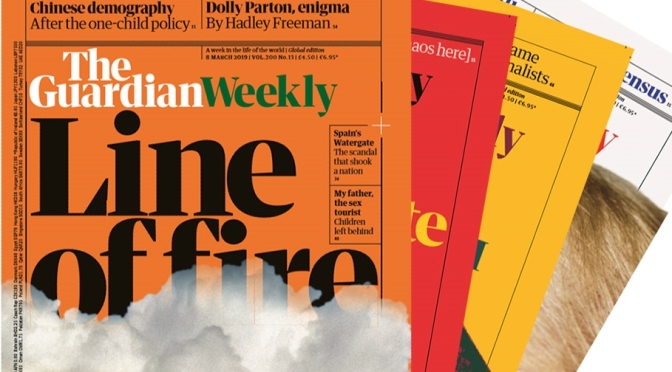
Politics: The Guardian Weekly – May 19, 2023

Image

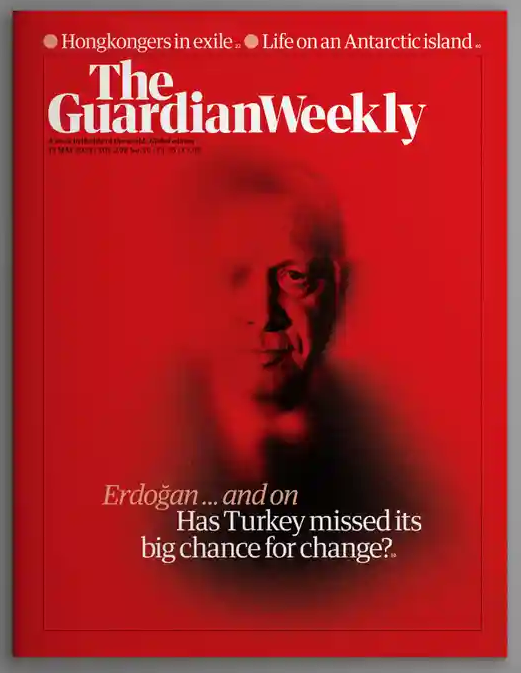
The Guardian Weekly (May 19, 2023) – This week’s issue considered the end of Recep Tayyip Erdoğan’s long political career. But it soon became clear that predictions of the Turkish president’s demise had been greatly misjudged. A first-round victory over his secular opponent, Kemal Kılıçdaroğlu, did not come by a wide enough margin to prevent a runoff vote on 28 May. But, barring a remarkable swing back to Kılıçdaroğlu, the indications are that Erdoğan will further extend his 20-year authoritarian brand of rule over Turkey.

As Ukraine’s president, Volodymyr Zelenskiy, toured European capitals to drum up support this week, speculation continued over when and where Ukraine’s long-anticipated counteroffensive against Russian forces would begin – or if indeed it had already done so. From Kherson, Luke Harding hears from a frontline commander why Kyiv is happy to bide its time, while defence editor Dan Sabbagh outlines four possible scenarios in which a Ukrainian counterattack might develop.

Two environmentally slanted features bring fascinating insights into very different parts of the world. From Kenya there’s the uplifting story of the waste picker who is lobbying for his colleagues’ working rights to be enshrined in a UN treaty. Then, John Bartlett reports from Antarctica on how the climate crisis, geopolitical tensions and booming tourism are straining relations at a remote scientific research station.

Sustainable Design: ‘Rapid Assembly Housing’ (2023)

Dezeen Films (May 17, 2023) – In this video produced by Dezeen for Holcim, Norman Foster introduces a housing prototype for displaced people that the Norman Foster Foundation developed with the building materials company and unveiled in Venice during the launch of the Architecture Biennale.

The Essential Homes Research Project is a housing concept designed to sustainably provide rapidly assembled housing for people displaced by natural and manmade disasters. The prototype was designed by the Norman Foster Foundation and realised by Holcim using its materials. The homes have been designed to offer a durable alternative to tent shelters in order to withstand the elements.

They can be built on-site in order to expedite construction during emergencies. The project responds to the fact that displaced people often end up living in temporary accommodation for more than a decade, and require homes that offer safety and dignity. “Disasters lead to the need for instant accommodation and camps – mostly tented – offering scant protection from the elements,” Foster said in an exclusive video interview with Dezeen.

“What if there would be something that would be more permanent, more durable, offering greater protection from the elements, but which could be realised very quickly?”

Read more on Dezeen: https://www.dezeen.com/tag/holcim/