Design: Seymour House In Melbourne, Australia

An Architect’s own home, Seymour House is inserted as a respectful addition to its neighbourhood, openly embracing the streetscape lined with heritage-listed properties and modernist gems. In crafting the dwelling, Lani Fixler of Lani Fixler Studio has created a place that is private and personal whilst also engaging in an open conversation with the surrounds.

Timeline: 00:00 – The Local Project Print Publication 00:10 – Creating a Family Home 00:40 – Introduction to the Home 01:25 – Entering the Modernist Home 02:04 – Walking through the Home 02:47 – The Bedrooms and Bathrooms 03:19 – Landscaping 03:40 – Courtyard Sculpture 03:54 – Artwork Throughout the Home 04:29 – What the Architect is Most Proud Of 05:00 – Subscribe to The Local Project Print Publication

Located in a south-eastern suburb of Melbourne, Seymour House is an architect’s own home that draws from Lani Fixler Studio’s long-standing familiarity with the built environment. The project is one that expertly merges personal responses with the contextual. In the construction of Seymour House, a connection to the street was important, as well as embracing the constricted site instead of challenging it. Sitting adjacent to Harleston Park, Seymour House is an architect’s own home crafted to be a continuation of its natural setting, with only two concrete plinths defining the barrier between the public and the private. Throughout the building, modernism is championed through a natural and restrained materiality with the use of concrete, terrazzo, timber and slate. The consistency with which the palette is applied – with blockwork featuring as both an internal and external architectural element – celebrates the environment surrounding an architect’s own home. Expressing considered detail and the characteristics of an architect’s own home, Seymour House is imbued with a sense of personality that uplifts its understated aesthetic. Crafted to complement the history and culture of the surrounding neighbourhood, Lani Fixler Studio graciously allows past narratives to continue as new chapters unfold.


Previews: Times Literary Supplement – June 3, 2022


June 3, 2022

In this week’s TLS

Things don’t usually fall apart completely in Britain and the centre holds. In the mid-seventeenth century, however, civil war raged across the islands. Military rule in England was followed by the conquest of Ireland and Scotland, paving the way for the Union. Michael Braddick, reviewing Ian Gentles’s The New Model Army, thinks there are lessons here for our “dysfunctional” democracy. This week the TLS features several meditations on times of civil war.

By Martin Ivens

Reviews: ‘The Week In Art’

This week, Picasso and the Old Masters: as shows pairing the Spaniard with Ingres and El Greco open in London and Basel respectively.

Ben Luke talks to Christopher Riopelle (curator of Picasso Ingres: Face to Face at the National Gallery) and Carmen Giménez (curator of Picasso-El Greco at the Kunstmuseum in Basel) about the profound influence of historic artists on Picasso’s rupturing of tradition. In this episode’s Work of the Week, The Art Newspaper’s contemporary art correspondent, Louisa Buck, talks to Chris Levine, the creator of Lightness of Being, one of the best known recent portraits of Queen Elizabeth II, as the British monarch celebrates 70 years on the throne. And as the Polish government replaces yet another museum director, what can be done about political interference in museum governance? Ben talks to Goranka Horjan, director of Intercom, the International Committee for Museum Management, and Bart De Baere, chair of the Museum Watch programme at the International Committee for Museums and Collections of Modern Art (Cimam).

Picasso Ingres: Face to Face, National Gallery, London, until 9 October. Picasso-El Greco, Kunstmuseum, Basel, 11 June-25 September.

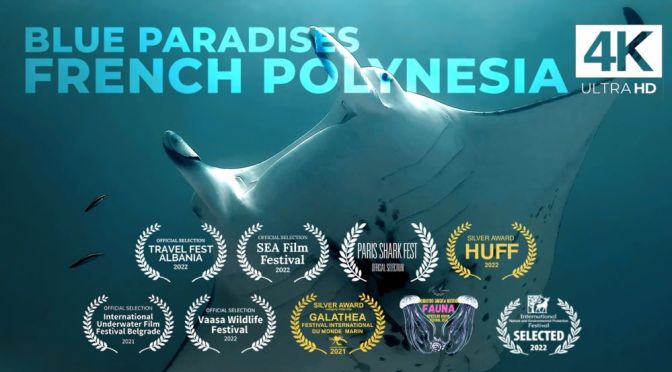
Views: The ‘Blue Paradises Of French Polynesia’ (4K)

Bora Bora, Fakarava, Ranguiroa, Tahiti, Tikehau, Moorea, Maupiti…

Our Odyssey through these islands and atolls is one of the most spectacular diving expeditions we have had the chance to do.
A crystal clear water (visbility can reach 45 meters), hundreds of different reef fish species, corals and pelagic, to sum up : an exceptional beauty both in terms of flora and fauna.

French Polynesia is known as the largest shark santuary in the world,
probably the only place in the world where you can see 6 species of sharks in a single dive : Grey reef sharks, Tiger sharks, Black-tip sharks, White-tip sharks, Nurse sharks and Lemon sharks. Yes! In a single dive.
The dives are mainly drifting because of the underwater topography of its passes, this is where the show begins, life is teeming: Hammerhead sharks, dolphins, school of barracuda, eagle rays, turtles, manta rays, marbled groupers, tuna, napoleons… We are not going to give you an exhaustive list, because there are around 800 species, I’ll let you imagine.
We dived into the main passes:Tiputa, Tumakohua, Garuae, Avatoru,… But the one that offered us the most beautiful spectacle is undoubtedly Tetamanu, the southern pass of Fakarava. Imagine yourself in front of a wall of 700 sharks (We were there the third week of June).
If you do not yet practice scuba diving, no worries, you can fully enjoy the beauties that French Polynesia has to offer by practicing snorkeling.
In the stunning lagoon of Moorea, you can snorkel with stingrays, black tip sharks and colorful fishes.

If French Polynesia benefits from a unique underwater environment, magnificent coral reefs and amazing lagoons, it is also an earthly paradise, not only for its majestic scenery or its dream beaches but above all for the kindness of the Polynesians (Tahitians).
So far we have mainly traveled to the Society Islands and the Tuamotus but we are planning to go in the Austral archipelago to swim with the
Humpback whales. Exploring Polynesia is the adventure of a lifetime, because it is the size of Europe.

Cover Preview: Science Magazine – June 3, 2022

Science Magazine – June 3, 2022: A 10th-century Maya structure at Chichen Itza, Mexico, is often called the Observatory for its expansive view of the sky and a design seemingly guided by key positions of the Sun, Moon, and planets. The historic Maya anchored their calendars and rituals to celestial events, and their astronomical knowledge is now coming into sharper focus thanks to new analyses of archaeological relics and insights from today’s Maya.

COVERS: FRANCE-AMÉRIQUE MAGAZINE – JUNE 2022 ISSUE

France-AmériqueJune 2022

French Lands Adrift in the Ocean

Some 3 million people live in French overseas territories – islands like Guadeloupe, Martinique, Polynesia, New Caledonia, Réunion, and Saint Pierre and Miquelon, remnants of France’s colonial empire. We explore these distant lands that are regularly pushing for independence. Also in this issue, meet the French community of Hawaii, read about Alma de Bretteville Spreckels – the “great-grandmother of San Francisco” and a friend of Rodin – and discover our interview with U.S. historian Stephen Bourque on the “the Allied war against France” during the Normandy landings. Lastly, we bring you the story of Disneyland Paris, which revived fears of Americanization in France when it opened 30 years ago.

Preview: New Scientist Magazine – June 4, 2022

New Scientist Default Image

New Scientist Magazine – 4 June 2022

COVER STORIES

  • CULTURE Doctor Who: Worlds of Wonder review: The science behind the show
  • FEATURES Fast fashion is ruining the planet – here’s how to make it sustainable
  • FEATURES Can you take the trip out of psychedelics and still treat depression?

Front Page: Wall Street Journal – June 2, 2022

Gunman Kills at Least Four People in Shooting at Tulsa Medical Clinic

Mass shooting in Oklahoma follows recent massacres in Buffalo, N.Y., and Uvalde, Texas