
Edinburgh is Scotland’s compact, hilly capital. It has a medieval Old Town and elegant Georgian New Town with gardens and neoclassical buildings. Looming over the city is Edinburgh Castle, home to Scotland’s crown jewels and the Stone of Destiny, used in the coronation of Scottish rulers. Arthur’s Seat is an imposing peak in Holyrood Park with sweeping views, and Calton Hill is topped with monuments and memorials.
Monthly Archives: October 2021

Previews: The New Yorker Magazine – OCT 25, 2021

Covid-19: Molnupiravir – Merck’s Antiviral Drug
Molnupiravir (MK-4482, EIDD-2801) is an investigational oral antiviral medicine that significantly reduced the risk of hospitalization or death at a planned interim analysis of the Phase 3 MOVe-OUT trial in at risk, non-hospitalized adult patients with mild-to-moderate COVID-19. At the interim analysis, molnupiravir reduced the risk of hospitalization or death by approximately 50%; 7.3% of patients who received molnupiravir were either hospitalized or died through Day 29 following randomization (28/385), compared with 14.1% of placebo-treated patients (53/377); p=0.0012. Through Day 29, no deaths were reported in patients who received molnupiravir, as compared to 8 deaths in patients who received placebo.

Aerial Views: Dhaka – Capital Of Bangladesh (4K)
Dhaka is the capital city of Bangladesh, in southern Asia. Set beside the Buriganga River, it’s at the center of national government, trade and culture. The 17th-century old city was the Mughal capital of Bengal, and many palaces and mosques remain. American architect Louis Khan’s National Parliament House complex typifies the huge, fast-growing modern metropolis.

Views: Green River Drift Cattle Drive In Wyoming
Hitch a ride with 60 Minutes correspondent Bill Whitaker along the Green River Drift, the longest running cattle drive in the U.S.
Upper Green River Valley, Wyoming
Predating most federal land management agencies, the Green River Drift cattle trail has been continuously used since the 1890s by the Upper Green River Cattle Association ranchers to get cattle from spring pasture on the desert to summer pasture in the forest. Chilly fall weather causes the cattle to “drift” back out of the forest to return to their home ranches. The trail, 58 miles long with 41 miles of spurs, crosses BLM, State of Wyoming, National Forest, and private properties.

Front Page Views: Wall Street Journal – OCT 18
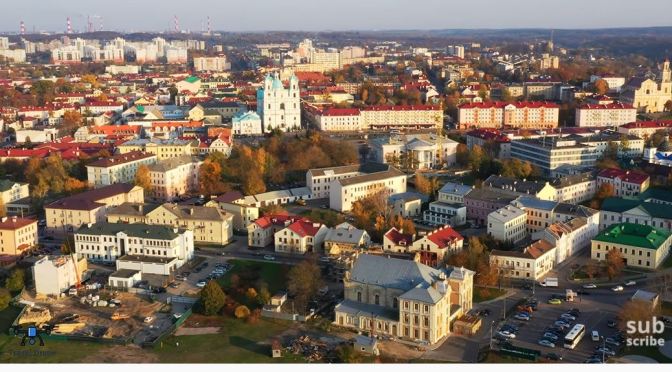
Aerial Views: Grodno In Western Belarus (4K)
Grodno is a city in western Belarus, near the Polish and Lithuanian borders. By the Neman River, the Old Castle is a Renaissance palace on the site of an 11th-century fort. Nearby, the New Castle was built in the 18th century as a royal residence. The 12th-century Kalozha Church of Sts. Boris and Gleb is adorned with polished stones and majolica tiles. The St. Francis Xavier Cathedral features an ornate carved altar.

Analysis: Green Era Energy Shock, From Pandemic To Endemic, Poland’s ‘Polexit’
A selection of three essential articles read aloud from the latest issue of The Economist. This week, the first big energy shock of the green era, how covid-19 will move from pandemic to endemic (11:29) and our Charlemagne columnist assesses the odds of “Polexit” versus a “dirty remain” (17:21).

Politics & Technology: China’s Surveillance State
China is building a huge digital surveillance system. The state collects massive amounts of data from willing citizens: the benefits are practical, and people who play by the rules are rewarded. Critics call it “the most ambitious Orwellian project in human history.”
China’s digital surveillance system involves massive amounts of data being gathered by the state. In the so-called “brain” of Shanghai, for example, authorities have an eye on everything. On huge screens, they can switch to any of the approximately one million cameras, to find out who’s falling asleep behind the wheel, or littering, or not following Coronavirus regulations. “We want people to feel good here, to feel that the city is very safe,” says Sheng Dandan, who helped design the “brain.” Surveys suggest that most Chinese are inclined to see benefits as opposed to risks: if algorithms can identify every citizen by their face, speech and even the way they walk, those breaking the law or behaving badly will have no chance. It’s incredibly convenient: a smartphone can be used to accomplish just about any task, and playing by the rules leads to online discounts thanks to a social rating system. That’s what makes Big Data so attractive, and not just in China. But where does the required data come from? Who owns it, and who is allowed to use it? The choice facing the Western world is whether to engage with such technology at the expense of social values, or ignore it, allowing others around the world to set the rules.
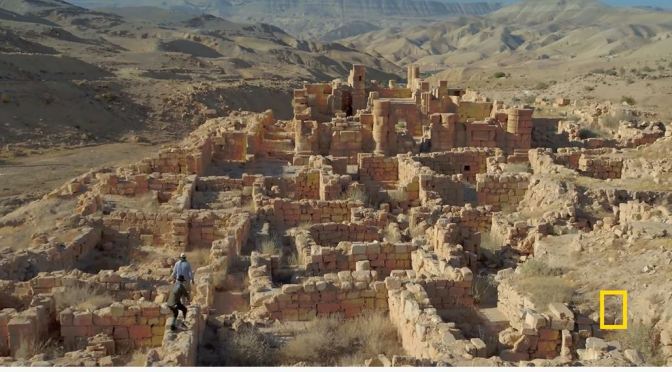
Archaeology: Lost Cities Of The Nabateans, Jordan (National Geographic)
Dr. Albert Lin is exploring the ancient architecture of the Nabateans, and recreates one of their lost cities using lidar.
The Nabataeans, also Nabateans, were an ancient Arab people who inhabited northern Arabia and the southern Levant. Their settlements—most prominently the assumed capital city of Raqmu —gave the name Nabatene to the Arabian borderland that stretched from the Euphrates to the Red Sea.
 Boomers Daily