

Wildfires rage in California, stoked by extreme heat, President Trump and Joe Biden go on the offensive, and renegotiating your bills.

Wildfires rage in California, stoked by extreme heat, President Trump and Joe Biden go on the offensive, and renegotiating your bills.
Filmed and Edited by: Richard Steinberger
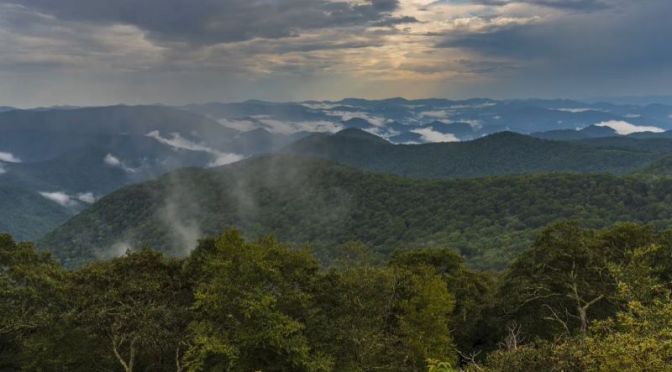
A timelapse film of the Great Smoky Mountains National Park and the Blue Ridge Parkway in North Carolina. Photographed over a five-day period in August 2020. Shot in 6 & 8 k on Sony a7riii and Sony a7iii cameras. Motion timelapse equipment by Edelkrone.
Music score “Waiting for the Day” by Evocativ.
The Great Smoky Mountains are a mountain range rising along the Tennessee–North Carolina border in the southeastern United States. They are a subrange of the Appalachian Mountains, and form part of the Blue Ridge Physiographic Province.

NPR’s Tamara Keith and Amy Walter of the Cook Political Report join Amna Nawaz to discuss the latest political news, including campaign messaging from President Trump and Democratic presidential nominee Joe Biden around the pandemic and the economy, whether Black voters could make the difference in key Midwestern states and the significance of voters casting ballots early by mail.
In the era of social distancing, Italians in Florence have revived the custom of serving wine through pint-size windows in centuries-old buildings.
Year 2020: The covid-19 pandemic arrives. Italy is under lockdown starting March 8th. Everyone is confined to home for two months and then the government permits a gradual reopening. During this time, some enterprising Florentine Wine Window owners have turned back the clock and are using their Wine Windows to dispense glasses of wine, cups of coffee, drinks, sandwiches and ice cream—all germ-free, contactless!
Year 1634: The Black Death or Plague has passed through the city of Florence, leaving death and havoc in its wake. The Florentine scholar, Francesco Rondinelli, writes a report about disease contagion and describes the use of the abundant Wine Windows in the city for the safe sale of wine, without direct contact between client and seller. Diletta Corsini describes this important document regarding Wine Windows and their uses almost 400 years ago.

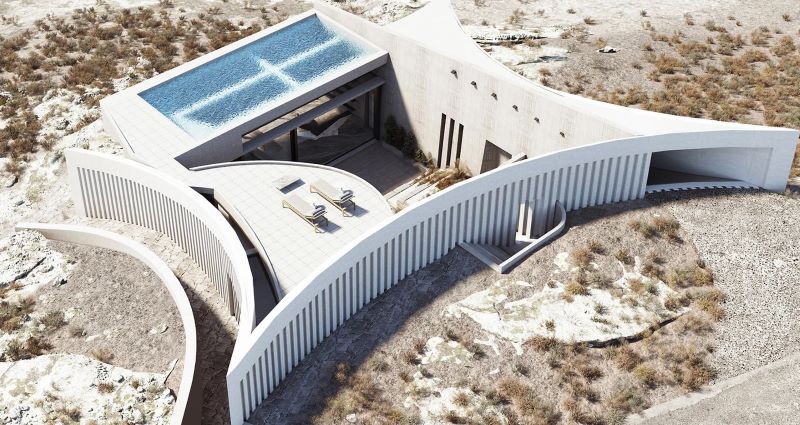
The holiday home located in the area of Agioi Apostoloi in Aegina is organized around a central patio. The dialogue with the natural terrain of the plot as well as the unobstructed visual views of the land were elements crucial to the design.
The visitor enters from the highest point of the patio from where the movements are distributed around the three living areas of the house – the master bedroom, the guest rooms and the lounge area – and the swimming pool. The morphology of the patio follows the outer sloping terrain and as it gradually descends through a path of terraces and outdoor seating areas leads the visitor to the view.
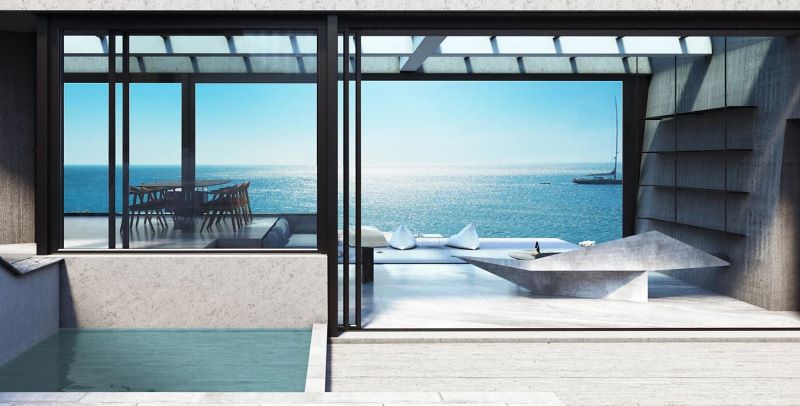
Its final level, in combination with the airy living room, constitutes an expanded covered balcony to the sea. Its transparent roof bears the pool-observatory. The patio functions as a vital living space of the residence and so does the rooftop swimming pool.
The bedrooms maintain their privacy while at the same time referring to the heart of the whole – the patio and the sea view. The section of the house levels creates an internal microcosm of spaces and movements, constituting a path that can bypass the enclosed spaces and end up outside the plot around the side of the daily activities volume.
The morphology of the complex expresses the function of each individual space housed under it while the selected rough materials set up a direct dialogue with the island’s topos. The individual volumes are embraced by a dynamic curved, unifying outer skin that holds the whole together and forms a characteristically acute, yet silent gesture of a human intervention on the natural landscape.


Health experts are warning that with Labor Day celebrations in full swing, the US could see another COVID-19 spike. Also, rescue operations continue after a record heat wave in California intensifies wildfires trapping campers in the Sierra National Forest this weekend. And, Beirut’s search for survivors ends as the country continues to recover one month after a massive blast tore through the city.
A selection of three essential articles read aloud from the latest issue of The Economist. This week, America’s ugly election: How bad could it get? How Abe Shinzo changed Japan (8:35) and why Britons walk their dogs so much (16:00).
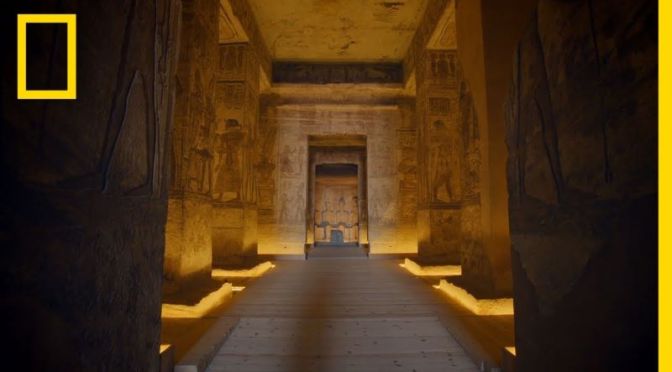
Through ancient propaganda and by immortalizing some of his greatest achievements, Ramses the Great became revered as one of the most powerful rulers of Ancient Egypt. Even to do this day he credited for making Egypt one of the most powerful nations of the ancient world.
Filmed and Edited by: Kirsten Dirksen
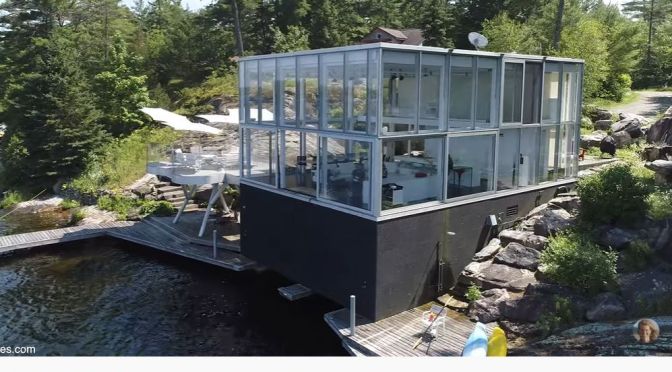
To create a photography studio with maximum daylight, Larry Williams built a glasshouse. Doubling as a boat garage (the lower floor), it hugs the lake’s edge. Viewed from the inside, the outside world tumbles in: the wake of a powerboat ripples up to the window, kayakers wave as they pass, a child jumps from the dock. Toward the back of the house, granite invades the view: the home is built on top of the Canadian Shield- a swath of ancient rock stretching across half of Canada.
Williams speaks proudly of the 300 million-year-old limestone and 3 billion-year-old granite outside his door. To heat and cool the home, architect Pat Hanson relied on a geothermal system: tubes of water snake into the lake to benefit from the lake floor’s nearly constant year-round temperature. In summer, the water in the closed-loop system is cooled by the lake and in winter it is warmed. The granite floor acts as a heat sink to slowly radiate the sun’s energy through the house during the evening. The white roof reflects light and heat to keep the place cool during summer.
To create a home inside four walls of glass, Hanson placed the domestic functions inside a floating cube supported by steel beams so as not to touch the walls. Downstairs, it houses the kitchen and guest bath and upstairs, an open bedroom. The stairway is bathed in Corian which continues upstairs with a Corian bathtub and bed structure doubling as sculpture. Large sliding fritted glass doors close to provide privacy for the mezzanine bedroom, though are typically left open to allow for natural ventilation.








 Boomers Daily