
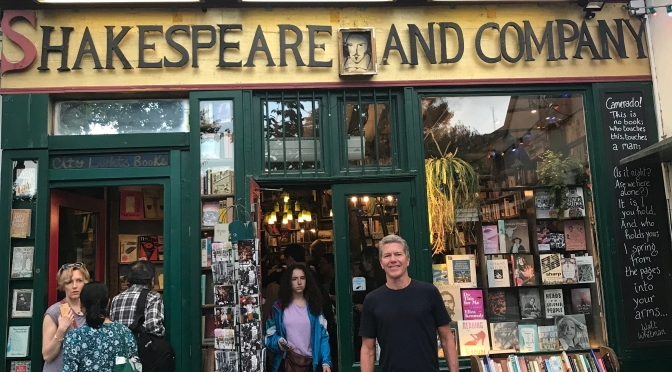
From a Shakespeare and Company email:
Dear Sylvia Beach,
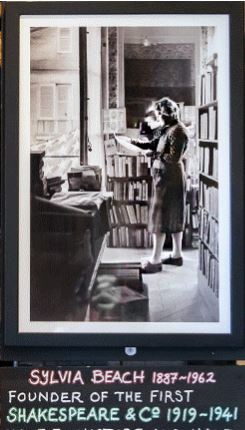 One hundred years ago this month, you opened the shutters of a small bookshop on rue Dupuytren. Its name was Shakespeare and Company. I often wonder if, on that first morning, you could ever have imagined how important your story would be.
You were only 32 but had already lived quite a life. Soulful and fearless, witty and energetic, you’d been active in the women’s suffrage movement, studied French poetry in Paris, and served with the Red Cross in Serbia during the First World War. You had also met Adrienne Monnier, one of the first women in France to found her own bookshop. Adrienne would be your companion for decades to come.
Your bookshop—first on rue Dupuytren, then around the corner on rue de l’Odéon—became a sanctuary for Anglophone and Francophone writers. T.S. Eliot, Gertrude Stein, Ezra Pound, James Joyce, Ernest Hemingway, Djuna Barnes, and F. Scott Fitzgerald, as well as André Gide, Paul Valéry, and Louis Aragon, among many others, all bought and borrowed books from you, and attended readings and parties at Shakespeare and Company. As André Chamson wrote about you: “Sylvia Beach carried pollen like a bee. She cross-fertilised these writers. She did more to link England, the United States, Ireland, and France than four great ambassadors combined.” I think of this whenever I ponder the role booksellers and bookshops can play during this age of political and ecological turbulence. When James Joyce couldn’t find anyone to publish Ulysses—his modernist masterpiece that had been condemned for obscenity—you stepped up. Even when you closed your bookshop in 1941, it was not an act of defeat but of defiance—you would rather see your life’s work shuttered forever than sell Finnegans Wake to a high-ranking Nazi officer.

When my father, George Whitman, opened this bookshop in 1951, you were not just a regular visitor but an inspiration. You had shown how a true bookseller must also be prepared to be a librarian, a publisher, a PO box, a banker, a hotelier, and—most importantly—a friend to writers and readers. For your belief that a love of reading is more important than the quest for profit, you have been called the patron saint of independent bookstores. We’re sure that your extraordinary memoir and your beautiful letters continue to embolden booksellers the world over, just as they embolden us. Particularly during hard times, your story stands like a beacon when we need direction, comfort, or inspiration.
Thank you, Sylvia, for everything you did and everything you stood for.
In loving homage,
Sylvia Whitman
Proprietor
Shakespeare And Company
https://shakespeareandcompany.com/


 Dalí poses as the Magician, his wife Gala becomes the Empress, and the death of Julius Caesar is reinterpreted as the Ten of Swords in the artist’s extraordinary custom tarot deck. First published in a 1984 limited edition that has since long sold out, this lush box set brings back all 78 cards, each dazzling in color, along with a companion book on the making-of and practical instructions.
 We conclude that Pollock avoided the appearance of the hydrodynamic instabilities, contrary to what was argued by previous studies. Pollock selected the physical properties of the paint to prevent filament fragmentation before deposition, and applied it while moving his hand sufficiently fast and at certain heights to avoid fluid filaments from coiling into themselves. An understanding of the physical conditions at which these patterns were created is important to further art research and it can be used as a tool in the authentication of paintings.
 Considered one of the most prominent American painters of the 20th century, the life and work of Jackson Pollock have been the subject of books, movies, and documentaries [
 “This is the fourth time in the last two years we’ve had to activate our hospital’s emergency operations plan for a major drug shortage,” Dr. Biddinger told NBC News. “It’s almost unfathomable in modern medicine. I never thought we would get to a point in the U.S. healthcare system where we wouldn’t have essential medicines to be able to treat patients.”


 In its heyday, dynamite was a transformative tool; it could blast rock quarries, excavate tunnels, and demolish buildings with power and reliability never before seen. But it also proved to be useful in some surprising ways. In this special episode of Sidedoor, we team up with the history podcast Backstory to explore two less-typical applications of the explosive: the artistic blasting at Mount Rushmore, and how anarchists used dynamite to advance their political agenda in 1886.
 “The results we saw were stunning and suggest that holistically addressing aging via gene therapy could be more effective than the piecemeal approach that currently exists,” said first author Noah Davidsohn, a former research scientist at the Wyss Institute and HMS who is now chief technology officer of Rejuvenate Bio. “Everyone wants to stay as healthy as possible for as long as possible, and this study is a first step toward reducing the suffering caused by debilitating diseases.”
 As digital payments become the norm, will there be a need for cash? The Economist’s Finance editor Helen Joyce takes a look behind the scenes of the future, from Sweden to Shanghai. She explores how digital payments will transform the economy, and how they risk leaving some people behind.
 “Another behavior change is physical exercise,” Pillemer said. “A paradox of pain is that exercise helps reduce it, but it’s difficult for people in pain to think about exercising. So they don’t exercise, they get more sedentary and the pain increases; it’s a vicious circle. So how do you get people to actually change their behavior?”
 Boomers Daily