

From Louise Aronson’s website:
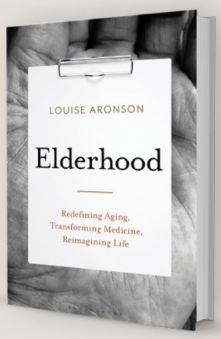 Noted Harvard-trained geriatrician Louise Aronson uses stories from her quarter century of caring for patients and draws from history, science, literature, popular culture, and her own life to weave a vision of old age that’s neither nightmare nor utopian fantasy—a vision full of joy, wonder, frustration, outrage, and hope about aging, medicine, and life itself.
For more than 5,000 years, “old” has been defined as beginning between the ages of 60 and 70. Now that humans are living longer than ever before, many people alive today will be elders for 30 years or more. Yet at the very moment that most of us will spend more years in elderhood than in childhood, we’ve made old age into a disease, a condition to be dreaded, disparaged, neglected, and denied.
To read more: https://louisearonson.com/books/elderhood/

 Kaia’s iOS and Android apps were developed with the help of physiotherapists, pain management physicians, orthopedic surgeons, and clinical psychologists, the company claims, and are registered as Class 1 medical devices with the Food and Drug Administration. They serve up video clips covering basic back and COPD pain information and step-by-step physiotherapy exercises, in addition to psychological strategies, such as mindfulness and muscle relaxation.
 Revere’s place in history was cemented by
  The exhibition was organized by the
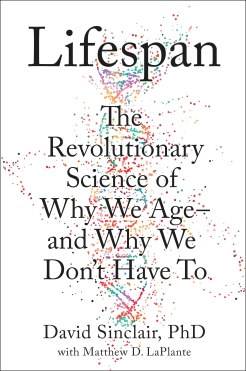 Lifespan, by geneticist David Sinclair and journalist Matthew LaPlante, provides a vision of a not-too-distant future in which living beyond 120 will be commonplace. For Sinclair and LaPlante, the answer lies in understanding and leveraging why we age…
 The presence of the inn itself demands this kind of myth-making. Its hulking imperfections, hidden staircases and infinite doorways, narrow pathways and intricate stonework, call to mind an honest, handmade world, where times were slower and things made to last. Rumors of its past are worn proudly on its proverbial sleeve — stripped wood where there once was a second floor balcony, prominently displayed plaques of historic register, mismatched sediments of historic photos, the speckled outline of a dart board and creaking floorboards. The front door was originally the back door because most guests arrived by boat.



 “As a result, today’s epidemic of physical inactivity in conjunction with highly processed, high-sodium diets contributes to thicker, stiffer hearts that compromise the heart’s ability to cope with endurance physical activity, and importantly this may start to occur prior to increases in resting blood pressure,” explains Shave.
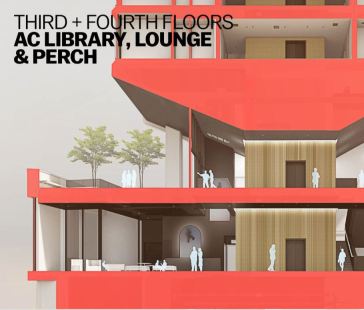 This Volumetric High-Rise Modular Hotel will be the world’s tallest modular hotel and one of the most stylish, combining modular efficiency with architectural flair. AC by Marriott at 842 6th Avenue, New York City, will be the tallest modular hotel in the world when it opens in early 2020. But it won’t just be a step up for modular design, it will be a step forward. The building leverages the advantages of modular construction, uses cutting-edge proprietary technology to address potential drawbacks, and, most importantly, put to rest the idea that a modular building can only be the sum of its factory-made parts.
 Rigorously unsentimental in his attitude to the world around him, Mr. Frank deviated from form in 1950, taking what was arguably his most romantic picture. He had his reasons. He was in love. The year before he had met artist Mary Lockspeiser, who became his first wife. In “Tulip/Paris,” he photographed a young man who is holding behind his back a tulip — presumably intended for the woman standing in the background. An old man, at the other end of life’s arc, approaches the viewer. It is a classic romantic Paris street photograph.
 Boomers Daily