
From a New England Journal of Medicine online study release:
The findings from our approach suggest with high predictive accuracy that by 2030 nearly 1 in 2 adults will have obesity (48.9%; 95% confidence interval [CI], 47.7 to 50.1), and the prevalence will be higher than 50% in 29 states and not below 35% in any state.

Nearly 1 in 4 adults is projected to have severe obesity by 2030 (24.2%; 95% CI, 22.9 to 25.5), and the prevalence will be higher than 25% in 25 states. We predict that, nationally, severe obesity is likely to become the most common BMI category among women (27.6%; 95% CI, 26.1 to 29.2), non-Hispanic black adults (31.7%; 95% CI, 29.9 to 33.4), and low-income adults (31.7%; 95% CI, 30.2 to 33.2).
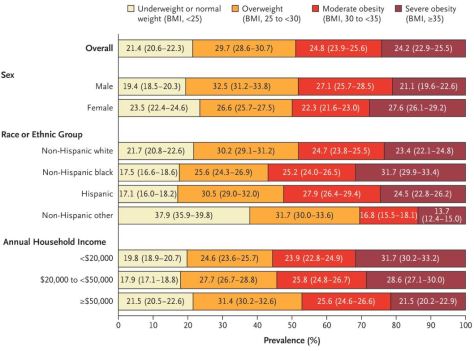
Although severe obesity was once a rare condition, our findings suggest that it will soon be the most common BMI category in the patient populations of many health care providers. Given that health professionals are often poorly prepared to treat obesity,27 this impending burden of severe obesity and associated medical complications has implications for medical practice and education.
In addition to the profound health effects, such as increased rates of chronic disease and negative consequences on life expectancy,25,28 the effect of weight stigma29 may have far-reaching implications for socioeconomic disparities as severe obesity becomes the most common BMI category among low-income adults in nearly every state.
To read more: https://www.nejm.org/doi/full/10.1056/NEJMsa1909301?query=featured_home
 In our own study of more than 7,000 middle-aged to older adults in the U.K., published in 2019 in Brain Imaging and Behavior, we demonstrated that people who spent more time engaged in moderate to vigorous physical activity had larger hippocampal volumes. Although it is not yet possible to say whether these effects in humans are related to neurogenesis or other forms of brain plasticity, such as increasing connections among existing neurons, together the results clearly indicate that exercise can benefit the brain’s hippocampus and its cognitive functions.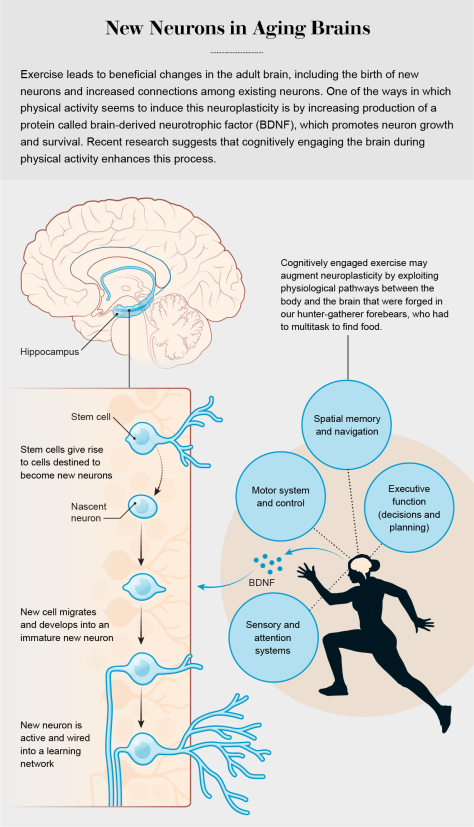

 …primary care providers (general practice, paediatrics, and internal medicine) performed the best, giving a considerably lower percentage of antibiotic prescriptions without a documented indication (12%) than other specialists such as gynaecologists and urologists, who commonly prescribed antibiotics (24%), as well as those in all other specialties (29%).
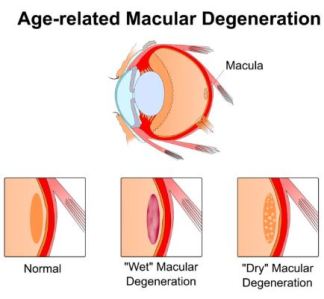 “Our work provides additional evidence that that diet matters,” Millen added. “From a public health standpoint, we can tell people that if you have early AMD, it is likely in your best interest to limit your intake of processed meat, fried food, refined grains, and high-fat dairy to preserve your vision over time.”
 This cohort study included 146 152 individuals from the Prostate, Lung, Colorectal, and Ovarian Cancer Screening Trial and found that aspirin use 3 or more times per week was associated with reduced risk of all-cause, cancer, gastrointestinal cancer, and colorectal cancer mortality.
 This systematic review and meta-analysis of 11 studies involving 21 517 physicians demonstrated an association between physician depressive symptoms and an increased risk for perceived medical errors (RR, 1.95; 95% CI, 1.63-2.33). We also found that the magnitude of the associations of physician depressive symptoms and perceived medical errors were relatively consistent across studies that assessed training and practicing physicians, providing additional evidence that physician depression has implications for the quality of care delivered by physicians at different career stages.
 Thus, while aging led to a pro-inflammatory profile within blood and muscle, lifelong exercise partially prevented this and generally preserved the acute inflammatory response to exercise seen in young exercising men. Lifelong exercise may positively impact muscle health throughout aging by promoting anti-inflammation in skeletal muscle.

 “This proof of concept study demonstrates a new paradigm that measurement of blood proteins can accurately deliver health information that spans across numerous medical specialties and that should be actionable for patients and their healthcare providers,” said Peter Ganz, MD, co-leader of this study and the Maurice Eliaser distinguished professor of medicine at UCSF and director of the Center of Excellence in Vascular Research at Zuckerberg San Francisco General Hospital and Trauma Center.
  Boomers Daily