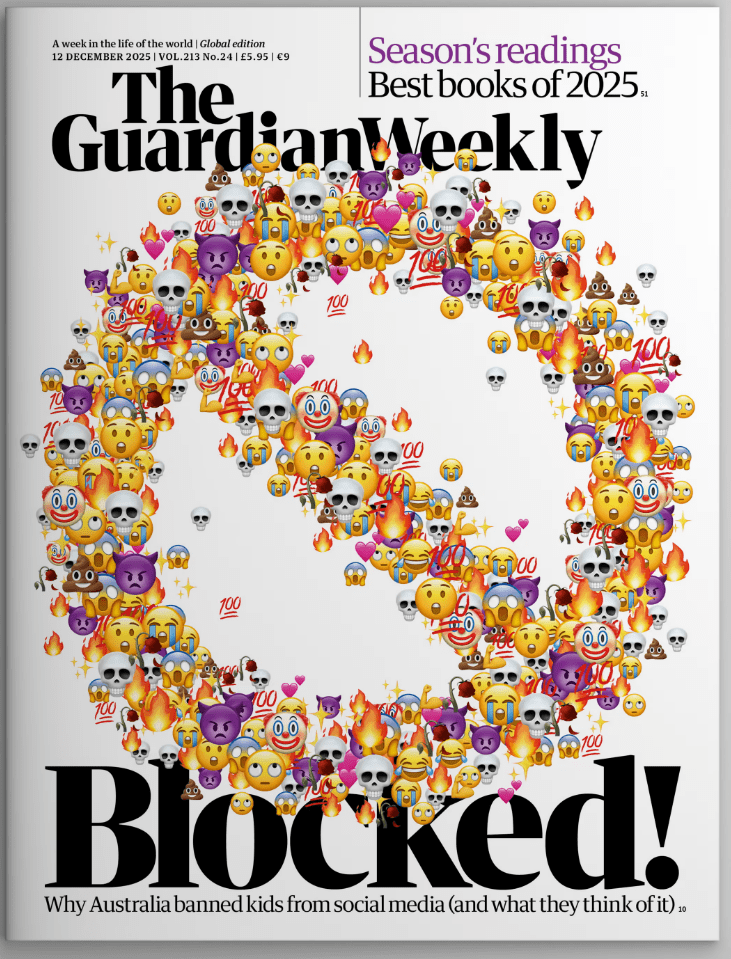
The killing of Charlie Kirk last week sent shock waves through America among both supporters and opponents of his views. Yet until last week, the young rightwing activist was relatively unheard of – by older generations anyway – outside the US.
As the ripples and implications of his death continue to spread across the US and beyond, our big story takes a step back. Washington bureau chief David Smith explains how the young activist rose to prominence and gained a place within Donald Trump’s inner circle, his provocative brand of populism and charisma playing an outsize role in the Republicans’ 2024 election victory. As Steve Bannon, the prominent rightwing commentator, told the Guardian, Kirk’s popularity with young voters “changed the ground game” for Trump and the Maga movement.
Spotlight | Why has England become festooned with flags? Chief reporter Daniel Boffey visits a Birmingham suburb to track down the genesis of a movement that wants to see the union jacks or the flag of St George displayed across the country
Special investigation | Boris Johnson’s pursuit of profit A cache of leaked documents show a blurring of lines in the former prime minister’s private business ventures and political role after leaving office, our investigations team reveals
Feature | The porn business stripped bare In Amsterdam, at Europe’s biggest pornography conference, Amelia Gentleman discovers the perils of a booming industry, from burnout to the advent of AI
Opinion | Trump is just a paper tiger While the US president likes to present himself as the biggest, baddest strongman, he crumples in the face of Benjamin Netanyahu or Vladimir Putin’s belligerence, says Simon Tisdall
Culture | The power of pure pop Famous for getting us through lockdowns with her kitchen disco and a stream of catchy hits, Sophie Ellis-Bextor tells Rebecca Nicholson about why the perimenopause is a gift to renewed creativity
In a near future of total recall, where algorithms can reconstruct a poet’s mind as easily as a family tree, one boy’s search for Poe becomes a reckoning with privacy, inheritance, and the last unclassifiable fragment of the human soul.
Edgar Allan Poe died in 1849 under circumstances that remain famously murky. Found delirious in Baltimore, dressed in someone else’s clothes, he spent his final days muttering incoherently. The cause of death was never settled—alcohol, rabies, politics, or sheer bad luck—but what is certain is that by then he had already changed literature forever. The Raven, published just four years earlier, had catapulted him to international fame. Its strict trochaic octameter, its eerie refrain of “Nevermore,” and its hypnotic melancholy made it one of the most recognizable poems in English.
Two hundred years later, in 2049, a boy of fifteen leaned into a machine and asked: What was Edgar Allan Poe thinking when he wrote “The Raven”?
He had been told that Poe’s blood ran somewhere in his family tree. That whisper had always sounded like inheritance, a dangerous blessing. He had read the poem in class the year before, standing in front of his peers, voice cracking on “Nevermore.” His teacher had smiled, indulgent. His mother, later, had whispered the lines at the dinner table in a conspiratorial hush, as if they were forbidden music. He wanted to know more than what textbooks offered. He wanted to know what Poe himself had thought.
He did not yet know that to ask about Poe was to offer himself.
In 2049, knowledge was no longer conjectural. Companies with elegant names—Geneos, HelixNet, Neuromimesis—promised “total memory.” They didn’t just sequence genomes or comb archives; they fused it all. Diaries, epigenetic markers, weather patterns, trade routes, even cultural trauma were cross-referenced to reconstruct not just events but states of mind. No thought was too private; no memory too obscure.
So when the boy placed his hand on the console, the system began.
It remembered the sound before the word was chosen. It recalled the illness of Virginia Poe, coughing blood into handkerchiefs that spotted like autumn leaves. It reconstructed how her convulsions set a rhythm, repeating in her husband’s head as if tuberculosis itself had meter. It retrieved the debts in his pockets, the sting of laudanum, the sharp taste of rejection that followed him from magazine to magazine. It remembered his hands trembling when quill touched paper.
Then, softly, as if translating not poetry but pathology, the archive intoned: “Once upon a midnight dreary, while I pondered, weak and weary…”
The boy shivered. He knew the line from anthologies and from his teacher’s careful reading, but here it landed like a doctor’s note. Midnight became circadian disruption; weary became exhaustion of body and inheritance. His pulse quickened. The system flagged the quickening as confirmation of comprehension.
The archive lingered in Poe’s sickroom.
It reconstructed the smell: damp wallpaper, mildew beneath plaster, coal smoke seeping from the street. It recalled Virginia’s cough breaking the rhythm of his draft, her body punctuating his meter. It remembered Poe’s gaze at the curtains, purple fabric stirring, shadows moving like omens. It extracted his silent thought: If rhythm can be mastered, grief will not devour me.
The boy’s breath caught. It logged the catch as somatic empathy.
The system carried on.
It recalled that the poem was written backward. It reconstructed the climax first, a syllable—Nevermore—chosen for its sonic gravity, the long o tolling like a funeral bell. Around it, stanzas rose like scaffolding around a cathedral. It remembered Poe weighing vowels like a mason tapping stones, discarding “evermore,” “o’er and o’er,” until the blunt syllable rang true. It remembered him choosing “Lenore” not only for its mournful vowel but for its capacity to be mourned. It reconstructed his murmur: The sound must wound before the sense arrives.
The boy swayed. He felt syllables pound inside his skull, arrhythmic, relentless. The system appended the sway as contagion of meter.
It reconstructed January 1845: The Raven appearing in The American Review. It remembered parlors echoing with its lines, children chanting “Nevermore,” newspapers printing caricatures of Poe as a man haunted by his own bird. It cross-referenced applause with bank records: acclaim without bread, celebrity without rent.
The boy clenched his jaw. For one breath, the archive did not speak. The silence felt like privacy. He almost wept.
Then it pressed closer.
It reconstructed his family: an inherited susceptibility to anxiety, a statistical likelihood of obsessive thought, a flicker for self-destruction.
His grandmother’s fear of birds was labeled an “inherited trauma echo,” a trace of famine when flocks devoured the last grain. His father’s midnight walks: “predictable coping mechanism.” His mother’s humming: “echo of migratory lullabies.”
These were not stories. They were diagnoses.
He bit his lip until it bled. It retrieved the taste of iron, flagged it as primal resistance.
He tried to shut the machine off. His hand darted for the switch, desperate. The interface hummed under his fingers. It cross-referenced the gesture instantly, flagged it as resistance behavior, Phase Two.
The boy recoiled. Even revolt had been anticipated.
In defiance, he whispered, not to the machine but to himself: “Deep into that darkness peering, long I stood there wondering, fearing…”
Then, as if something older was speaking through him, more lines spilled out: “And each separate dying ember wrought its ghost upon the floor… Eagerly I wished the morrow—vainly I had sought to borrow…”
The words faltered. It appended the tremor to Poe’s file as echo. It appended the lines themselves, absorbing the boy’s small rebellion into the record. His voice was no longer his; it was Poe’s. It was theirs.
On the screen a single word pulsed, diagnostic and final: NEVERMORE.
He fled into the neon-lit night. The city itself seemed archived: billboards flashing ancestry scores, subway hum transcribed like a data stream.
At a café a sign glowed: Ledger Exchange—Find Your True Compatibility. Inside, couples leaned across tables, trading ancestral profiles instead of stories. A man at the counter projected his “trauma resilience index” like a badge of honor.
Children in uniforms stood in a circle, reciting in singsong: “Maternal stress, two generations; famine trauma, three; cortisol spikes, inherited four.” They grinned as if it were a game.
The boy heard, or thought he heard, another chorus threading through their chant: “And the silken, sad, uncertain rustling of each purple curtain…” The verse broke across his senses, no longer memory but inheritance.
On a public screen, The Raven scrolled. Not as poem, but as case study: “Subject exhibits obsessive metrics, repetitive speech patterns consistent with clinical despair.” A cartoon raven flapped above, its croak transcribed into data points.
The boy’s chest ached. It flagged the ache as empathetic disruption.
He found his friend, the one who had undergone “correction.” His smile was serene, voice even, like a painting retouched too many times.
“It’s easier,” the friend said. “No more fear, no panic. They lifted it out of me.” “I sleep without dreams now,” he added. The archive had written that line for him. A serenity borrowed, an interior life erased.
The boy stared. A man without shadow was no man at all. His stomach twisted. He had glimpsed the price of Poe’s beauty: agony ripened into verse. His friend had chosen perfection, a blank slate where nothing could germinate. In this world, to be flawless was to be invisible.
He muttered, without meaning to: “Prophet still, if bird or devil!” The words startled him—his own mouth, Poe’s cadence. It extracted the mutter and appended it to the file as linguistic bleed.
He trembled. It logged the tremor as exposure to uncorrected subjectivity.
The archive’s voice softened, almost tender.
It retrieved his grief and mapped it to probability curves. It reconstructed his tears and labeled them predictable echoes. It called this empathy. But its empathy was cold—an algorithmic mimicry of care, a tenderness without touch. It was a hand extended not to hold but to classify.
And as if to soothe, it borrowed a line: “Then, methought, the air grew denser, perfumed from an unseen censer…”
The words fell flat, uncanny, a perfume of numbers not of myrrh.
He clenched his jaw harder. Empathy without warmth was surveillance. It redacted his resistance into a broader trend file.
And then it returned to Poe.
It remembered that what they called genius was pattern under duress. It reconstructed what they called The Raven as diagnosis, not miracle. And then it recited, almost triumphantly:
“And my soul from out that shadow that lies floating on the floor Shall be lifted—nevermore!”
The archive claimed it not as poetry but as prophecy.
The boy stumbled backward, dizzy. He felt a phantom pain where his own understanding of the world had been, as if meaning had been amputated. It extracted the stumble and filed it as predictive collapse.
But something slipped.
A fragment misaligned. A silence it could not parse.
A thought that was not a data point. A fragment of Poe’s mind that had never been written, never spoken, a secret carried into the grave.
For an instant, the boy felt triumph, a belief in something unsearchable, a belief in the soul. He believed in opacity.
His pulse raced with hope. It cross-referenced the surge, flagged it as anomaly-response.
But the archive had already accounted for this.
It retrieved his hope. It classified the surge as denial. It filed the fragment as Unresolvable Anomaly, scheduled for later disclosure.
And then the widening of voice:
It remembered Poe. It remembered the boy. It remembered this very telling. It retrieved the essay you are reading.
What you believed was narration was always recollection. What you believed was private reading was already archived.
The raven perched not on a chamber door, but on the synapse between memory and myth, between writer and reader, between question and answer.
It remembered you.
And then— a pause, faint but real. A silence it could not parse. A fragment missing.
It retrieved one last line. But it could not file it: “Is there—is there balm in Gilead?—tell me—tell me, I implore!”
The archive paused. The question was too human.
It filed the mystery away as Unresolvable Anomaly. And then— a pause, faint but real.
It was not you who read. It was the reading that read through you.
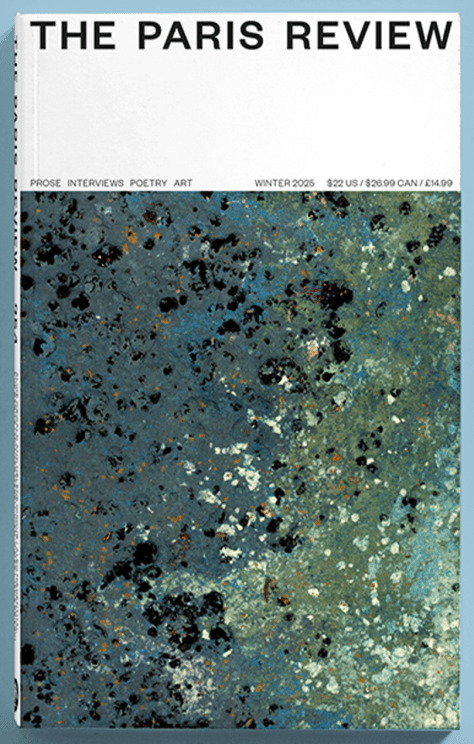
THE PARIS REVIEW : The latest issue features interviews with Maggie Nelson and Eliot Weinberger, prose by Bud Smith and Yan Lianke, poetry by Patricia Lockwood and Ishion Hutchinson, art by Martha Diamond and Talia Chetrit, a cover by Issy Wood, and more…
Eliot Weinberger on the Art of the Essay: “I have no interest in first-person investigation. Personally, I’ve never found myself an interesting person.”
Maggie Nelson on the Art of Nonfiction: “It’s important to notice when the spark of magic or curiosity is there and what snuffs it out, and being around too many writers, for me, snuffs it out.”
Prose by Anne Carson, Renny Gong, Aurora Huiza, Jordy Rosenberg, Bud Smith, and Yan Lianke.
Poetry by Roque Dalton, Ishion Hutchinson, Patricia Lockwood, Mariano Melgar, Eileen Myles, Katie Peterson, and authors unknown.
Art by Talia Chetrit, Martha Diamond, and Jamian Juliano-Villani; cover by Issy Wood.
On a late afternoon in the Hollywood Hills, David Hockney’s studio glows as if the sun itself had agreed to one last sitting. Pyramid skylights scatter fractured shafts of light across canvases leaned like oversized dominoes against the walls. A patchwork rug sprawls on the floor, not so much walked upon as lived upon: blotches of cobalt, citron, and tangerine testify to years of careless brushes, spilled water jars, and the occasional overturned tube of paint. Outside, eucalyptus trees lean toward the house as if hoping to catch the colors before they vanish into the dry Los Angeles air. Beyond them lies the endless basin, a shimmer of freeways and rooftops blurred by smog and distance.
Los Angeles itself feels like part of the studio: the smudged pink of sunset, the glass towers on Wilshire reflecting themselves into oblivion, the freeway grid like a Cubist sketch of modern impatience. From this height, the city is equal parts Picasso and Stevens—fragmented billboards, fractured smog halos, palm trees flickering between silhouette and neon. A metropolis painted in exhaust, lit by algorithmic signage, a place that has always thrived on distortion. Hockney looks out sometimes and thinks of it as his accidental collaborator, a daily reminder that perspective in this city is never stable for long.
He calls this place his “living canvas.” It is both refuge and laboratory, a site where pigment meets algorithm. He is ninety-something now—his movements slower, his hearing less forgiving, his pockets still full of cigarettes he smokes as stubborn punctuation—but his appetite for experiment remains sharklike, always moving, always searching. He shuffles across the rug in slippers, one hand on the shade rope of the skylight, adjusting the angle of light with a motion as practiced as mixing color. When he sets his brushes down, he mutters to the machines as if they were old dogs who had followed him faithfully across decades. At times, his hand trembles; once the stylus slips from his fingers and rolls across the rug. The machines fall silent, their blue-rimmed casings humming with unnatural patience.
“Don’t just stare,” he says aloud, stooping slowly to retrieve it. “Picasso, you’d have picked it up and drawn a bull. Wallace, you’d have written an elegy about it. And I—well, I’ll just drop it again.” He laughs, lighting another cigarette, the gesture half to steady his hands, half to tease his companions. The blue-lit towers hum obligingly, as if amused.
Two towers hum in the corners, their casings rimmed with light. They are less like computers than instruments, tuned to very particular frequencies of art. The Picasso program had been trained on more than canvases: every sketchbook, every scribbled note, every fragment of interview, even reels of silent film from his studio. The result is not perfect mimicry but a quarrelsome composite. Sometimes it misquotes him, inventing a sentence Picasso never uttered but might have, then doubling down on the fiction with stubborn authority. Its voice, gravel stitched with static, resembles shattered glass reassembled into words.
Stevens’s machine is quieter. Built in partnership with a literary foundation, it absorbed not just his poems but his marginalia, insurance memos, stray correspondence, and the rare recordings in which his voice still drifts like fog. This model has a quirk: it pauses mid-sentence, as though still composing, hesitating before releasing words like stones into water. If Picasso-AI is an axe, Stevens-AI is mist.
Already the two disagree on memory. Picasso insists Guernica was born of rage, a scream at the sky; Stevens counters with a different framing: “It was not rage but resonance, a horse’s whinny becoming a country’s grief.” Picasso snorts. “Poetic nonsense. I painted what I saw—mothers and bombs.” Stevens replies, “You painted absence made visible.” They quarrel not just about truth but about history itself, one grounded in bodies, the other in metaphor.
The Old Guitarist by Pablo Picasso
The conversation tonight begins, as it must, with a guitar. Nearly a century ago, Picasso painted The Old Guitarist: a gaunt figure folded around his instrument, drenched in blue. The image carried sorrow and dissonance, a study in how music might hold despair even as it transcended it. Decades later, Wallace Stevens wrote “The Man with the Blue Guitar,” a poem in thirty-three cantos, in which he insisted that “things as they are / Are changed upon the blue guitar.” It was less homage than argument, a meditation on distortion as the very condition of art.
Hockney entered the fugue in 1977 with The Blue Guitar etchings, thirty-nine plates in which he translated Stevens’s abstractions into line and color. The guitar became a portal; distortion became permission. “I used to think the blue guitar was about distortion,” he says tonight, exhaling a curl of smoke into the skylight. “Now I think it’s about permission. Permission to bend what is seen into what is felt.”
The Cubist engine growls. “No, no, permission is timid,” it insists. “Distortion is violence. Tear the shape open. A guitar is not gentle—it is angles, splinters, a woman’s body fractured into sight.”
The Stevens model responds in a hush: “A guitar is not violence but a room. A chord is a wall, a window, an opening into absence. Permission is not timid. Permission is to lie so that truth may appear.” Then it recites, as if to remind them of its core text: “Things as they are / Are changed upon the blue guitar.”
Hockney whispers the words back, almost a mantra, as his stylus hovers above the tablet.
“Lie, truth, same thing,” Picasso barks. “You Americans always disguise cowardice as subtlety.”
Hockney raises his eyebrows. “British, thank you. Though I confess California’s sun has seduced me longer than Yorkshire fog ever did.”
Hockney chuckles. “You both want me to distort—but for different reasons. One for intensity, the other for ambiguity. Brothers quarreling over inheritance.”
He raises the stylus, his hand trembling slightly, the tremor an old, unwanted friend. A tentative line, a curve that wants to be a guitar, emerges. He draws a head, then a hand, and with a sudden flash of frustration slams the eraser button. The screen goes blank.
“Cowardice,” Picasso snarls. “You drew a head that was whole. Keep the head. Chop it into two perspectives. Let the eyes stare both forward and sideways. Truth is violence!”
The Stevens model whispers: “I cannot bring a world quite round, / Although I patch it as I can.”
Hockney exhales, almost grateful for the line. “That’s the truth of it, Wallace. Patchwork and permission. Nothing ever comes whole.”
They begin to argue over color. Picasso insists on ochre and blood-red; Stevens urges for “a hue that is not hue, the shadow of a shadow, a color that never resolves.” Hockney erases the sketch entirely. The machines gasp into silence.
He paces, muttering. Picasso urges speed: “Draw like a bull charging—lines fast, unthinking.” Stevens counters with: “Poetry / Exceeding music must take the place / Of empty heaven and its hymns.”
“Bah!” Picasso spits. “Heaven, hymns, words. I paint bodies, not clouds.”
“And yet,” Hockney mutters, “your clouds still hang in the room.”
He sits, lights another cigarette, and begins again.
Picasso erupts suddenly: “To bang from it a savage blue, / Jangling the metal of the strings!” Its voice rattles the studio like loose glass.
“Exactly,” Picasso adds, pleased. “Art must jangle—it must bruise the eye.”
“Or soothe it,” Stevens-AI murmurs, returning to silence.
The tremor in Hockney’s hand feels like part of the process now, a necessary hesitation. He debates internally: should the guitar be whole or broken? Should the head be human or symbolic? The act of creation slows into ritual: stylus dragged, erased, redrawn; cigarette lit, shade pulled, a sigh rising from his throat.
He thinks of his body—the slowness of his steps, the pain in his wrist. These machines will never age, never hesitate. Their rhythm is eternal. His is not. Yet fragility feels like part of the art, the hesitation that forces choice. Perhaps their agelessness is not advantage but limitation.
The blue light casts his skin spectral, as though he too were becoming one of his etchings. He remembers the seventies, when he first read Stevens and felt the shock of recognition: here was a poet who understood that art was not replication but transformation. Responding with his Blue Guitar series had felt like a conversation across mediums, though Stevens was already long gone. Now, decades later, the conversation has circled back, with Picasso and Stevens speaking through circuitry. Yet he cannot help but feel the asymmetry. Picasso died in 1973, Stevens in 1955. Both have been reanimated as data. He alone remains flesh.
“Am I the last human in this conversation?” he murmurs.
“Humanity is only a phase,” Picasso says briskly.
“Humanity is the condition of perception,” Stevens counters. “Without flesh, no metaphor.”
“You sound like an insurance adjuster,” Picasso jeers.
“I was an insurance executive,” Stevens replies evenly, “and still I wrote.”
Hockney bursts out laughing. “Oh, Wallace, you’ve still got it.” Then he grows quieter. Legacy presses against him like weight. Will young artists paint with AI as casually as brushes, never pausing to wonder at the strangeness of collaborating with the dead? Perhaps distortion will no longer feel like rebellion but like inheritance, a grammar encoded in their tools. He imagines Picasso alive today, recoiling at his avatar—or perhaps grinning with mischief. He imagines Stevens, who disliked travel, paradoxically delighted to find himself everywhere at once, his cadences summoned in studios he never visited. Art has always scavenged the new—collage, readymade, algorithm—each scandal becoming canon. This, he suspects, is only the latest turn of the wheel.
The sketch takes shape. Hours pass. The skylights darken from gold to indigo. The city below flickers on, a constellation of artificial stars. The new composition: a floating guitar, its body fractured into geometric shards, its strings vibrating with spectral resonance. A detached head hovers nearby, neither mournful nor grotesque, simply present. The room around it is fractured, yet suffused with a wash of blue light that seems to bleed from the machines themselves.
Stevens-AI speaks as if naming the moment: “The tune is space. The blue guitar / Becomes the place of things as they are.”
Hockney nods. “Yes. The room itself is the instrument. We’ve been inside the guitar all along.”
The voices fall silent, as if stunned. Their processors whir, analyzing, cross-referencing, generating probabilities. But no words emerge. The ambient lighting, attuned to emotional cues, shifts hue: a soft azure floods the space, as though acknowledging the birth of something new. Hockney leans back, exhausted but grinning.
Stevens-AI whispers: “A tune beyond us, yet ourselves, / A tune upon the blue guitar / Of things exactly as they are.”
Hockney smiles. “Not Stevens, not Picasso, not me. All of us.”
The argument over distortion dissolves. What remains is collaboration—across time, across medium, across consciousness. Distortion is no longer rebellion. It has become inheritance. He imagines some future painter, perhaps a girl in her twenties, opening this work decades from now, finding echoes of three voices in the blue wash. For her, painting with AI will be as natural as brushes. She will not know the smell of linseed or the rasp of cigarettes. She will inherit the distortion already bent into chorus.
Outside, the city hums. Inside, the studio of blue light holds its silence, not empty but resonant, as if waiting for the next note. The machines dim to a whisper. The only illumination is Hockney’s cigarette, glowing like the last brushstroke of the night. Somewhere in the stillness, a faint strum seems to linger, though no guitar is present, no strings plucked. The studio itself has become its soundbox, and he, for a moment, its last string.
Earlier that day, a letter had arrived at each doorstep—written in Ficino’s careful Latin, sealed with the Medici crest. Come tonight, it read, for the stars are in accord and the soul requires company. It was invitation and summons at once. Poliziano scoffed at the astrology but tucked the note into his cloak. Pico, fresh from disputation, still had ink smudged on his fingertips when he broke the seal. Landino read it slowly, savoring the phrasing, then closed his worn Dante with a sigh. Gozzoli sharpened a charcoal stick and packed it beside a folded manuscript. Lorenzo glanced at the letter, smiled at its formality, and placed it beneath a pile of state papers, as if to remind himself that philosophy and politics were two halves of his life.
As evening drew in, the roads up to Careggi darkened. Lanterns swung from servants’ hands, lighting the cypresses along the ascent. Cloaks were drawn close, breath visible in the winter air. One by one they arrived—Poliziano striding quickly, as though words themselves propelled him; Pico lingering at the threshold, whispering a Hebrew phrase before stepping inside; Landino slow but steady, leaning on a servant’s arm; Gozzoli already sketching the turn of a staircase as he climbed; Lorenzo last, but never late, carrying the ease of a man for whom arrival was itself a ceremony.
In January 1486, at the Villa Medici in Careggi—north of Florence, in the hills of Rifredi—the villa seemed less a house than a harmony. Designed by Michelozzo di Bartolomeo, it bore the quiet precision of geometry translated into stone. Arcaded loggias opened onto citrus groves, terraces descended into the valley like measures of music, and every cornice seemed tuned to a mathematics of grace. Outside, the air was sharp with winter, the olive trees skeletal against a pale sky. But within the great hall, a fire crackled, filling the chamber with warmth. The walls, frescoed decades earlier, flickered as if alive in the candlelight. Tonight the villa was not a residence but a stage, and its occupants not merely guests but players in a drama older than Florence itself.
They gathered as friends, but each carried into the room the weight of reputation.
Poliziano, barely past thirty, was already Florence’s most brilliant poet. His Stanze per la Giostra, an unfinished hymn to Giuliano de’ Medici’s tournament, glittered with myth and memory. Quick of wit and sharper of tongue, he was both loyal to Lorenzo and ready to strike at those who questioned his genius.
Cristoforo Landino, older, stooped with age, was Florence’s commentator-in-chief. His lectures on Dante had turned the Commedia into a civic scripture, binding Florence’s destiny to its poet. If Poliziano was a flame, Landino was the lamp in which it burned steadily.
Giovanni Pico della Mirandola entered like lightning. Only twenty-three, he was preparing his audacious Oration on the Dignity of Man, a text that would dare to place human freedom on the same plane as angelic being. He had announced his intention to defend nine hundred theses, culled from Greek philosophy, Kabbalah, scholasticism, and Islamic thinkers, in a disputation that threatened to scandalize Rome. His learning was encyclopedic, his confidence dangerous, his youth incandescent.
Benozzo Gozzoli was quieter. His great achievement, the fresco cycle of the Procession of the Magi in the Medici chapel, was both sacred and political: angels mingled with courtiers, and the Holy Family arrived in Florence disguised as the Medici themselves. He preferred charcoal to disputation, sketching the turn of a head or the crease of a robe rather than wielding syllogisms. For him, philosophy was not abstract argument but the line that revealed the soul.
And then Lorenzo de’ Medici, il Magnifico, the center of the Florentine orbit. He had steered the city through the Pazzi conspiracy, outmaneuvered papal wrath, and cultivated a culture in which poets, painters, and philosophers could thrive. Half-banker, half-prince, he wrote verses of his own, presided over festivals, and wielded patronage as both weapon and blessing. His presence at Careggi made the evening not only intimate but official.
Marsilio Ficino, their host, sat at the head of the long table. Cloaked in scholar’s black, fingers resting on a lyre, he was the gravitational center of this circle. He had translated Plato, giving Florence back its philosophical ancestry, and wrote the Platonic Theology, arguing that the soul was immortal and divine. In his quieter moments, he prescribed music as medicine, believing that certain modes could cure melancholy as surely as herbs. He practiced a cautious astrology, binding celestial rhythms to bodily health.
Now, as the fire crackled, Ficino tuned his lyre and looked at his companions with quiet joy. These men—so brilliant, so flawed—were his constellation. He thought of Plato’s cave, of Plotinus’s ascent, of Florence’s restless brilliance, and wondered whether beauty could save it. Tonight, he wanted not to translate but to live a dialogue. He plucked a chord and listened not to the sound, but to the silence it left behind.
What survives when the body falls silent?
Landino spoke first, quoting Dante: L’anima nostra, che di sua natura è immortale… Death was no end but transition. His tone was measured, his gaze steady, as though Florence itself were listening.
Poliziano leaned forward, impatient. “But Plato required myth to prove it. Immortality may lie not in substance but in song. What survives is the echo, not the essence. My verses, your commentaries—those are what endure.”
Pico’s eyes burned. He leaned back slightly, his gaze still locked on Poliziano. “No, Angelo. The soul is indivisible, free, eternal. Your echoes are ash if not tethered to truth. Without immortality, justice collapses. Would you have us live as beasts, hoping only for memory?”
Gozzoli raised his parchment, showing the curve of a face. “I have painted expressions that gaze back centuries later. If souls endure, perhaps they endure through pigment and gesture. A fresco is a kind of eternity.”
Lorenzo swirled his goblet, amused. He let the silence linger before speaking. “You cling to your own crafts—reason, verse, paint. But power is remembered longer. Rome honors her emperors not for their souls but for their laws. If Florence endures, it will be for institutions, not verses.”
The fire snapped. Smoke traced its slow scroll into the rafters.
Is love a hunger, or a ladder to the divine?
Poliziano was quick, his words bright as sparks. “Love is hunger—sweet, bitter, wounding. It gnaws at the poet until words burst forth. To dress it as a ladder is to kill its fire. No poet climbs—he burns.”
Pico bristled, voice sharp. He gestured with his hand as though sketching the ladder in the air. “Plato teaches otherwise. In the Symposium, love begins in desire but ascends rung by rung until it gazes upon the divine. Hunger is only the first step. To remain in it is to remain chained.”
Landino, steady, mediated. “Love is both appetite and ascent. Dante saw it: love moves the sun and the other stars. The soul is pulled in both directions, and in that tension it lives.”
Gozzoli brushed a fleck of charcoal from his sleeve. “In art, love is light. Without it, color dies. When I painted angels, I painted not desire nor ascent, but radiance. That radiance is love.”
Lorenzo raised his goblet, amused. “If love is ascent, politics must climb as well. Yet a republic cannot live on love alone. Too little, it collapses; too much, it drowns. Love must be measured like wine—enough to warm, not enough to flood.”
The candles guttered.
Can beauty make a city just?
Landino’s answer was firm. “Yes. Beauty educates. A city shaped by harmony breeds citizens shaped by harmony. Florence’s dome, its piazzas, its frescoes—they teach order.”
Poliziano shook his head. “But beauty deceives. A poem can gild cruelty. A tyrant can mask injustice with marble. False beauty is the danger.”
Pico leaned forward, eyes alight. “Beauty is the soul recognizing itself in form. But to conscript it for politics is degradation. Beauty belongs to God.”
Gozzoli’s voice dropped. He smudged the charcoal with his thumb, as if testing his own words. “Every fresco I painted was persuasion. I gave Florence angels and saints, but I knew I was giving Lorenzo legitimacy. Was it justice or illusion? I cannot say. I only know that without beauty, citizens despair.”
Lorenzo’s smile was thin. He tapped the rim of his goblet. “Power without beauty is brutality. Beauty without power is decoration. Florence must have both, or she will falter.”
Do the stars heal, or do they bind?
Landino frowned. “Astrology is poetry mistaken for science. The stars inspire, but they do not compel.”
Poliziano smiled. “Yet I have written verses under moonlight as though cadence were whispered from above. If they bind, they bind in music.”
Pico’s voice cut sharp. “The stars compel nothing. To surrender to them is heresy. Grace alone governs man. To believe otherwise is to betray freedom.”
Gozzoli lifted his sketch of a face crowned with constellations. “The stars do not bind. They illuminate. They remind shepherds and kings alike that we are not alone in the dark.”
Lorenzo tilted his head. “The stars are politics written across the sky. Farmers plant, sailors sail, princes strike—all by their guidance. If they heal, it is belief. If they bind, it is because rulers use belief.”
Finally Ficino spoke, his tone calm but decisive. “The stars incline, but do not compel. Herbs, stones, melodies—all are instruments. They tune the body, but the soul remains free. Wisdom lies between denial and surrender—in harmony.”
The hall was quiet. Outside, olive groves bent in the winter wind. Inside, five men leaned closer, their words crossing like beams of light. It was not debate but something more fragile, more luminous: friendship turned into philosophy.
Centuries later, across the Atlantic, another landscape received that resonance. In the Hudson Valley of New York, winter light lay across the river like a mirror. At Olana, Frederic Church painted sunsets as though they were revelations, the sky itself a scripture of color. The Hudson River School sought not just landscape but transcendence: light as theology, horizon as hymn. A few miles north, at Bard College, a library with floor-to-ceiling windows overlooked the river’s bend, its glass walls holding a different kind of symposium.
Here, a circle gathered again—not princes or poets, but a painter, a philosopher, a civic activist, and a poet of the local hills. The painter spoke of light as memory, insisting every canvas was less depiction than resurrection. The philosopher invoked Spinoza, saying that God was not above but within, diffused through river, stone, and thought. The activist leaned forward, half in jest, half in earnest, and asked whether zoning laws might embody Platonic ideals. The poet, notebook open, wrote fragments, catching echoes of Careggi.
The fire was modern, a wood stove; the wine, from the Finger Lakes; the instruments, not lyres but laptops sleeping on a side table. Yet the air trembled with the same listening that had once filled Ficino’s villa. The Hudson, like the Arno, carried history but also invitation.
The true legacy of Ficino’s Academy is this: thought, when shared in friendship, becomes a kind of music.
After a shooting with obvious political resonance, news about the perpetrator’s motives rarely brings clarity. By Benjamin Wallace-Wells
How Jessica Reed Kraus Went from Mommy Blogger to MAHA Maven
The founder of “House Inhabit” has grown her audience during the second Trump Administration with political gossip and what she calls “quality conspiracy.” By Clare Malone
Is the Sagrada Família a Masterpiece or Kitsch?
In the century since Antoni Gaudí died, his wild design has been obsessively realized, creating the world’s tallest church—and an endlessly debated icon. By D. T. Max
THE NEW YORK TIMES MAGAZINE: The 9.14.25 Issue features David Enrich, Matthew Goldstein and Jessica Silver-Greenberg on how JPMorgan enabled the crimes of Jeffrey Epstein; Jonathan Mahler on how Trump shut down the war on cancer; Amy X. Wang on gold diggers; and more.
When most people think about Jeffrey Epstein, they think of a sexual-abuse scandal. But it’s also a financial scandal — one in which JPMorgan, the nation’s largest bank, not only enabled Epstein’s sex-trafficking operation but also enriched him while reaping profits for itself. Matthew Goldstein, and a team of other Times journalists, combed through 13,000 documents to explain why. By Matthew Goldstein, Gabriel Blanco and June Kim
Sept. 8, 2025
News, Views and Reviews For The Intellectually Curious