Coral reefs face many serious threats from human activity.
Experiments in sea anemone and mushroom coral now show that the sunscreen component oxybenzone can be converted to a powerful phototoxin in their cells. Read that study and more in Science: https://t.co/U2kCVGhyitpic.twitter.com/7xIpQXyn2q
On this week’s show: How physicists are using quantum sensors to suss out dark matter, how rabies thwarts canine vaccination campaigns, and a kickoff for our new series with authors of books on food, land management, and nutrition science
Dark matter hunters have turned to quantum sensors to find elusive subatomic particles that may exist outside physicists’ standard model. Adrian Cho, a staff writer for Science, joins host Sarah Crespi to give a tour of the latest dark matter particle candidates—and the traps that physicists are setting for them.
Next, we hear from Katie Hampson, a professor in the Institute of Biodiversity, Animal Health & Comparative Medicine at the University of Glasgow, about her work contact tracing rabies in Tanzania. Her group was able to track rabies in a population of 50,000 dogs over 14 years. The massive study gives new insight into how to stop a virus that circulates at superlow levels but keeps popping up, despite vaccine campaigns.
Finally, we launch our 2022 books series on food and agriculture. In six interviews, which will be released monthly for the rest of the year, host and science journalist Angela Saini will speak to authors of recent books on topics from Indigenous land management to foods that are going extinct. This month, Angela talks with Lenore Newman, director of the Food and Agriculture Institute at the University of the Fraser Valley, who helped select the books for the series.
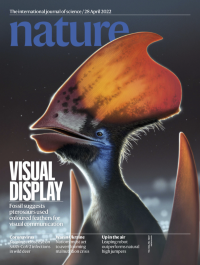
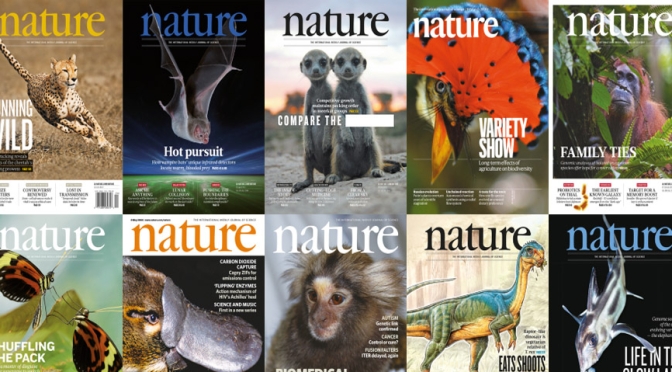
The cover shows an artist’s impression of the pterosaur Tupandactylus imperator. Although feathered pterosaurs have been reported, these claims have been controversial and it has not been clear whether these leathery-winged flying reptiles had feathers of different colours like modern-day birds.
In this week’s issue, Aude Cincotta and her colleagues present evidence that not only did pterosaurs have feathers but that the feathers probably had varied coloration. The researchers analysed a partial skull of Tupandactylus, found in Brazil and dated to around 113 million years ago. They identified two types of feather along the base of the crest, one of which featured branched structures very similar to modern feathers. They also found pigment-producing organelles in both types of feather and the skin on the head crest. The team suggests that these coloured feathers would have been used in visual communication and that their presence in Tupandactylus indicates the ability to manipulate feather colour stretches back farther than was previously realized.
A whole-genome analysis of more than 12,000 cancers, investigating the impacts of traffic safety messages, and revealing new insights into how tumor cells escape death.
At COP26 countries made a host of promises and commitments to tackle global warming. Now, a new analysis suggests these pledges could limit warming to below 2˚C — if countries stick to them.
03:48 Efficiency boost for energy storage solution
Storing excess energy is a key obstacle preventing wider adoption of renewable power. One potential solution has been to store this energy as heat before converting it back into electricity, but to date this process has been inefficient. Last week, a team reported the development of a new type of ‘photothermovoltaic’ that increases the efficiency of converting stored heat back into electricity, potentially making the process economically viable.
07:56 Leeches’ lunches help ecologists count wildlife
Blood ingested by leeches may be a way to track wildlife, suggests new research. Using DNA from the blood, researchers were able to detect 86 different species in China’s Ailaoshan Nature Reserve. Their results also suggest that biodiversity was highest in the high-altitude interior of the reserve, suggesting that human activity had pushed wildlife away from other areas.
11:05 How communication evolved in underground cave fish
Research has revealed that Mexican tetra fish are very chatty, and capable of making six distinct sounds. They also showed that fish populations living in underground caves in north-eastern Mexico have distinct accents.
14:36 Declassified data hints at interstellar meteorite strike
In 2014 a meteorite hit the Earth’s atmosphere that may have come from far outside the solar system, making it the first interstellar object to be detected. However, as some of the data needed to confirm this was classified by the US Government, the study wasn never published. Now the United States Space Command have confirmed the researchers’ findings, although the work has yet to be peer reviewed.
The strong inverse correlation between lifespan and mutation rate: we accrue mutations at a slower pace than many mammals but have roughly the same number of mutations by the end of our respective lifespans https://t.co/MBgFMkEeUn@Naturepic.twitter.com/H9kXAXXwjs
Cells acquire mutations throughout life, a process that is known to give rise to cancer and has been proposed to contribute to ageing. There is little knowledge, however, about the rate at which mutations accumulate in species other than humans, and whether this rate is influenced by biological traits such as lifespan or body size. In this week’s issue, Alex Cagan, Adrian Baez-Ortega and colleagues address these questions. The researchers studied the speed at which mutations accumulate during life in 16 mammalian species and found that the number of mutations increases by a roughly constant amount each year. They also observed that the molecular processes causing mutations are broadly similar across species. Crucially, the team identified a strong anticorrelation between lifespan and mutation rate: longer-lived species accrue mutations at a slower pace than shorter-lived ones, such that different species have roughly the same number of mutations by the end of their respective lifespans.
A new study used a light-based tomographic #3Dprinting approach to synthesize fine glass parts. The method should be flexible enough to provide a variety of high-quality glass parts for various applications.
COVER – A glass structure about 4.5 mm tall with features as small as 0.25 mm is 3D printed with microscale computed axial lithography followed by high-temperature sintering. The process enables the synthesis of highly transparent and inert glass parts with fine details, which are useful for a variety of applications.
A new, very-high-precision measurement of the W boson mass suggests that improvements to calculations or extensions to the standard model of particle physics might be needed.





 Boomers Daily