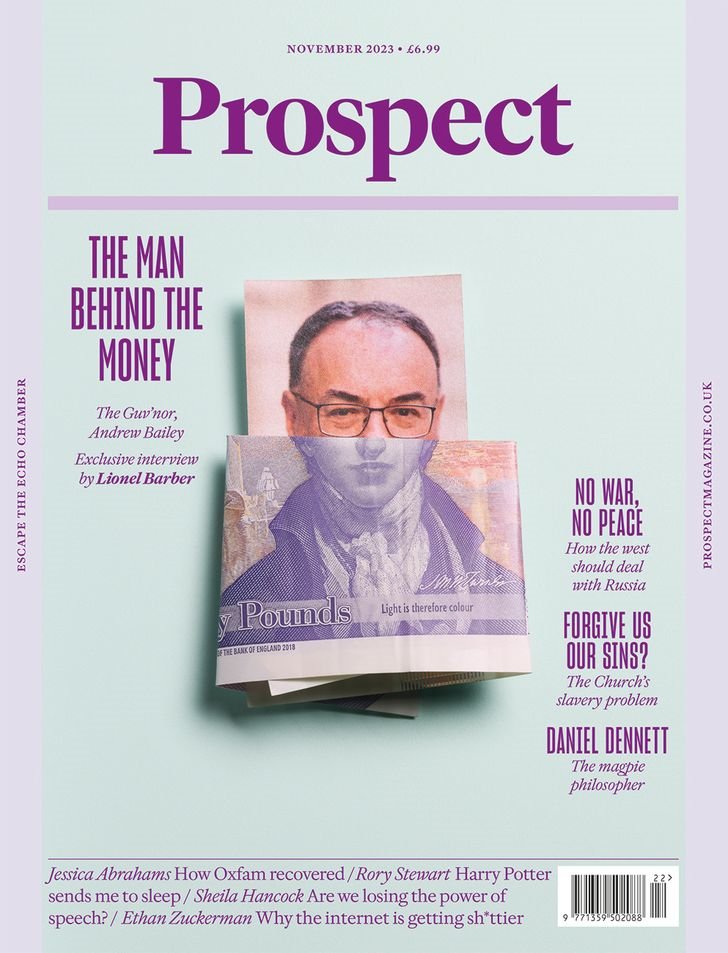
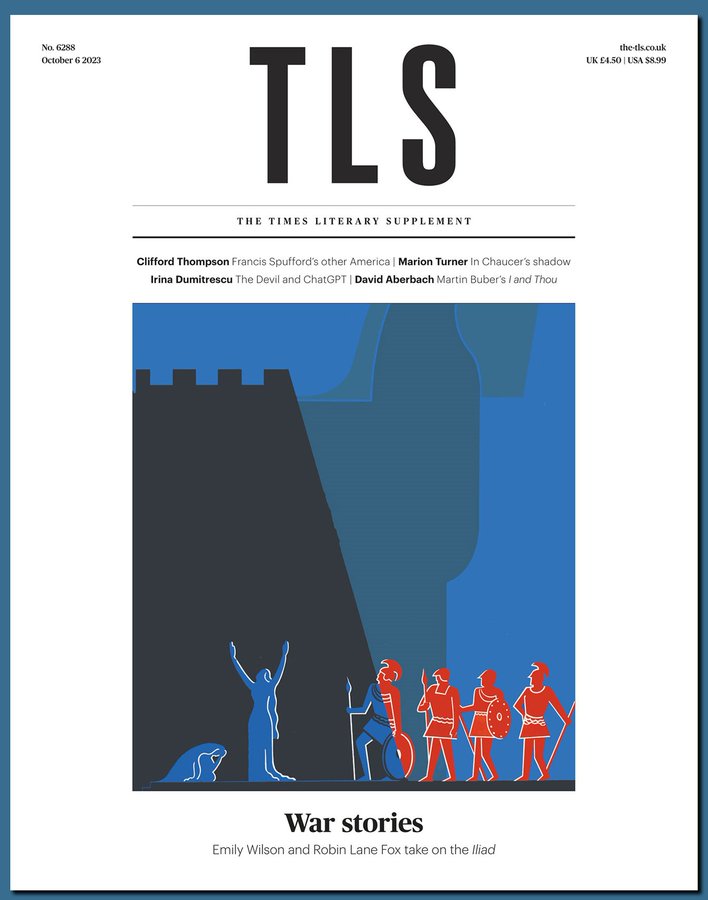
Times Literary Supplement (July 28, 2023): War diaries – Marci Shore on Ukrainian accounts from the front line; Richard Russo reconstructed; Boris and other bounders; Family secrets and lies; and more…

Times Literary Supplement (July 28, 2023): War diaries – Marci Shore on Ukrainian accounts from the front line; Richard Russo reconstructed; Boris and other bounders; Family secrets and lies; and more…
The New York Review of Books (August 17, 2023) – American Carnage – Jeffrey Toobin’s book about Timothy McVeigh and the Oklahoma City Bombing; The Sadistic Brats of ‘Succession’; Rats in Paris!; Colin Grant’s Unsparing Family Portrait; Resurrecting the Porter Sisters; The True Fables of Agota Kristof, and more…

Jeffrey Toobin’s book about Timothy McVeigh and the Oklahoma City bombing traces the path from Ronald Reagan’s antigovernment ideology to today’s radicalized right.
By Sean Wilentz
Ronald Reagan’s pronouncement, in his first inaugural address in 1981, that “government is not the solution to our problem, government is the problem” marked a signal moment in what has become the most successful political counterrevolution in modern American history.
LA Review of Books (Summer 2023) – In this elemental issue of LARB Quarterly, no. 38: Earth, we found new ways of looking at the planet. Writers were free to take up the theme casually or catastrophically, studying the earth beneath their fingernails or the planet from hundreds of thousands of miles away. We imagined being sealed outside, dreaming of coming home.
/https%3A%2F%2Fdev.lareviewofbooks.org%2Fwp-content%2Fuploads%2F2023%2F07%2FQJ_LARB.jpg)
ON AN UNUSUALLY rainy evening in Los Angeles this March, at the Thomas Mann House in Pacific Palisades, two investigative reporters from Germany gave a talk about a financial scandal known as “cum-ex.” Against the backdrop of a mid-century modern terrace, its polished cement looking dull and gray in the storm, the pair flashed through a series of slides about international tax embezzlement.
A relatively small drip of funds from the German cultural ministry sometimes supports talks like these in the name of Mann’s legacy. When the capital of German literary life was exiled to Los Angeles around the Second World War, the author built a home that now still hosts salons in the name of democratic cultural exchange.
/https%3A%2F%2Fdev.lareviewofbooks.org%2Fwp-content%2Fuploads%2F2023%2F07%2FGhetto-Fights.jpg)
THE YEAR WAS 1971, the place Łódź. Journalist Hanna Krall was interviewing a pioneering heart surgeon named Jan Moll. The good doctor, apparently unhappy with the outcome of previous interviews, told Krall that everything journalists ever wrote about medicine was nonsense. So, if she wanted to avoid doing the same, he strongly suggested she have her article vetted by a certain cardiologist, a Dr. Edelman, who, said Moll, would correct her mistakes. Krall agreed and arranged a meeting. She sat down with Marek Edelman in the Grand Hotel café, where it took 15 minutes for him to read through her article.

The New Yorker – July 31, 2023 issue: The ‘rich and famous’ above the law, a small-town newspaper lands ‘Big Stories’, how Larry Gagosian reshaped the art world, and more…

With a common touch that appeals to juries and a client list that includes Elon Musk, Jay-Z, and Megan Thee Stallion, he’s on a winning streak that makes his rivals seethe.
From the issue of July 31, 2023
In the summer of 2018, four years before he bought Twitter, the entrepreneur Elon Musk was facing legal consequences for two of his more reckless forays on the social-media platform. A boys’ soccer team in Thailand had been trapped in a flooded cave for more than two weeks, and a caver involved in the rescue said on CNN that a bespoke submarine Musk had sent to save the children was a “PR stunt.” Infuriated, Musk told his twenty-two million Twitter followers, without basis in fact, that the caver, Vernon Unsworth, was a “pedo guy.” The tweet went viral, and Unsworth’s attorney threatened to sue Musk for defamation.

The dealer has been so successful selling art to masters of the universe that he has become one of them.
It was the Friday afternoon of Memorial Day weekend on Further Lane, the best street in Amagansett, the best town in the Hamptons, and the art dealer Larry Gagosian was bumming around his eleven-thousand-square-foot modernist beach mansion, looking pretty relaxed for a man who, the next day, would host a party for a hundred and forty people. A pair of French bulldogs, Baby and Humphrey, waddled about, and Gagosian’s butler, Eddie, a slim man with a ponytail and an air of informal professionalism, handed him a sparkling water.

THE NEW YORK TIMES MAGAZINE (July 23, 2023) – In this issue, Robert Kolker on a family’s struggle with a genetic mutation that leads to dementia in middle age; Caity Weaver tries to track down Tom Cruise; Jon Gertner on the future of Wikipedia as A.I. feeds off its human input; and more.

They all have a 50-50 chance of inheriting a cruel genetic mutation — which means disappearing into dementia in middle age. This is the story of what it’s like to live with those odds.
By Robert Kolker
Barb was the youngest in her large Irish Catholic family — a surprise baby, the ninth child, born 10 years after the eighth. Living in the suburbs of Pittsburgh, her family followed the football schedule: high school games on Friday night, college games on Saturday, the Steelers on Sunday. Dad was an engineer, mom was a homemaker and Barb was the family mascot, blond and adorable, watching her brothers and sisters finish school and go on to their careers.

Can the online encyclopedia help teach A.I. chatbots to get their facts right — without destroying itself in the process?
By JON GERTNER
In early 2021, a Wikipedia editor peered into the future and saw what looked like a funnel cloud on the horizon: the rise of GPT-3, a precursor to the new chatbots from OpenAI. When this editor — a prolific Wikipedian who goes by the handle Barkeep49 on the site — gave the new technology a try, he could see that it was untrustworthy. The bot would readily mix fictional elements (a false name, a false academic citation) into otherwise factual and coherent answers.

The action star has gone to great lengths to avoid the press for more than a decade. But maybe our writer could track him down anyway?
By CAITY WEAVER
In an interview with Playboy in 2012, Tom Cruise described Katie Holmes as “an extraordinary person” with a “wonderful” clothing line, and someone for whom he was fond of “doing things like creating romantic dinners” — behavior that, he confided, “she enjoys.” It would prove to be his last major interview with a reporter to date. Despite what may be recalled through the penumbra of memory, this sudden silence was not directly preceded by either of Cruise’s infamous appearances on television: not by his NBC’s “Today” show interview (in which he labeled host Matt Lauer both “glib” and “Matt — MattMattMattMatt”), nor even by his appearance on “The Oprah Winfrey Show” (in which he reverse-catapulted himself onto Winfrey’s fawn-colored couch multiple times in a demonstration of his enthusiasm for Holmes).
Science Magazine – July 21, 2023 issue: The cover depicts an x-ray of a human skeleton walking. Researchers extracted 23 skeletal proportions from 30,000 individuals using deep learning. Coupled with genetic and biobank data, more than 100 genetic variants associated with these proportions were identified. These analyses shed light on the evolution of the skeletal form, which facilitates bipedalism, and reveal connections to musculoskeletal disorders.
A-bomb architect “was no Einstein,” historian says, but he did Nobel-level work on black holes
The Economist Magazine- July 22, 2023 issue: Making babymaking better – A special report on the future of fertility; How Cities can respond to Extreme Heat; The World Economy is still in danger, and more…
Fertility is still poorly understood

After louise brown was born in Manchester in July 1978, her parents’ neighbours were surprised to see that the world’s first “test-tube baby” was “normal”: two eyes, ten fingers, ten toes. In the 45 years since, in vitro fertilisation has become the main treatment for infertility around the world. At least 12m people have been conceived in glassware. An ivf baby takes its first gulp of air roughly every 45 seconds. ivf babies are just as healthy and unremarkable as any others. Yet to their parents, most of whom struggle with infertility for months or years, they are nothing short of miraculous.
Officials from Beijing to Phoenix are grappling with unbearable temperatures

The best thing that has happened in Phoenix, Arizona, since the beginning of July is that the electricity grid has kept functioning.
This has meant that during a record-breaking run of daily maximum temperatures above 43°C (110°F), still in progress as The Economist went to press, the houses, indoor workplaces and publicly accessible “cooling stations” in the city have been air-conditioned. There have been deaths from heat stroke and there will be more; there has been a lot of suffering; and there will have been real economic losses. But if Arizona’s grid had gone out, according to an academic quoted in “The Heat Will Kill You First”, a new book, America would have seen “the Hurricane Katrina of extreme heat”.

Times Literary Supplement (July 21, 2023) – Moral catastrophe – The great inflation in Germany in 1923 and the Hitler putsch; Pioneer’s in Women’s Sport; Colson Whitehead’s Harlem; Dangerous children; Dating The Tempest and Shakespreare’s tutor….

The Guardian Weekly (July 21, 2023) – Hollywood on strike; extreme heat is here. Plus the Women’s World Cup kicks off.
When the result of the Hollywood actors’ strike ballot was announced last Thursday, the big-name stars of Oppenheimer left the film’s London premiere.
This show of solidarity by Matt Damon, Emily Blunt, Cillian Murphy and Florence Pugh was a demonstration of the far-reaching effects of creatives taking to the picket lines. For our big story, arts reporter Vanessa Thorpe looks at what the historic joint walkout by writers and actors means for all of us as movie-goers and TV viewers as well as the stars, lesser-known actors and technicians struggling to make a living.
And we look at what lies behind the dispute with our film editors Catherine Shoard and Andrew Pulver while Los Angeles reporter Lois Beckett hears from actors finding it ever harder to make a living in the age of streaming and the use of AI in the entertainment industry.
TECHNOLOGY QUARTERLY (JULY 22ND 2023) – The most personal technology. Demand for, and expectations of, in vitro fertilisation are growing. The technology is struggling to keep up, write Catherine Brahic and Sacha Nauta.

Developing the technology to change that is proving a difficult task
With the possible exception of Adam and Eve, all human beings born before 1978 were conceived inside a woman’s body. Today the world contains at least 12m people who started off in laboratory glassware. On average, four more are born every three minutes. That is a worldwide rate of roughly one newborn in 175.

And plenty of clinics are taking advantage: the second of seven articles on the technology of fertility
Most healthy young couples seeking to get pregnant will try for a few months before they are successful. Those who are not will try for months more, or years, before concluding they need help and stepping into the waiting room of an ivf clinic. They often arrive in a state of acute emotional vulnerability, clutching at the hope that doctors will help.