

Tag Archives: Healthy Diet
New Study: “Five Healthy Habits” For Diet, Exercise, BMI, Smoking & Alcohol” Lower Chronic Disease, Raise Lifespan (Harvard)
From a BMJ online article:
We derived a healthy lifestyle score based on information on five lifestyle factors—diet, smoking, physical activity, alcohol consumption, and body mass index (BMI).
 Our findings suggest that promotion of a healthy lifestyle would help to reduce the healthcare burdens through lowering the risk of developing multiple chronic diseases, including cancer, cardiovascular disease, and diabetes, and extending disease-free life expectancy. Public policies for improving food and the physical environment conducive to adopting a healthy diet and lifestyle, as well as relevant policies and regulations (for example, smoking ban in public places or trans-fat restrictions), are critical to improving life expectancy, especially life expectancy free of major chronic diseases.
The average life expectancy in the world has increased substantially in the past few decades. The aging of the population has led to a high prevalence of chronic diseases such as diabetes, cardiovascular disease, and cancer. Although people live longer, older individuals often live with disabilities and chronic diseases. People with chronic diseases including cancer, cardiovascular disease, and diabetes have a shorter life expectancy than do their peers without these chronic conditions. Estimates of the loss in life years due to these chronic conditions range from 7.5 to 20 years, depending on the methods used and the characteristics of the study population.
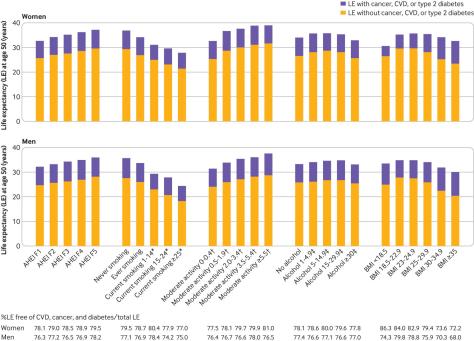
Modifiable lifestyle factors including smoking, physical activity, alcohol intake, body weight, and diet quality affect both total life expectancy and incidence of chronic diseases. Studies have shown that smoking, inactivity, poor diet quality, and heavy alcohol consumption contribute up to 60% of premature deaths and 7.4-17.9 years’ loss in life expectancy. Nevertheless, little research has looked at how a combination of multiple lifestyle factors may relate to life expectancy free from the major diseases of diabetes, cardiovascular disease, and cancer.

Aging: “Okinawa’s Secrets To Longevity” (Telegraph)
 Hundreds of miles south of Japan’s main islands, in the East China Sea, is a Jurassic Park of longevity, with a higher percentage of centenarians (people who live to 100 years old) than anywhere else on Earth.
Greg Dickinson visits the Japanese archipelago of Okinawa to discover the secret to long life.
Read the full article at: https://telegraph.co.uk/travel/destin…
New Studies: Beneficial Effects Of “18-Hour Intermittent Fasting” On Health And Aging (NEJM)
From a New England Journal of Medicine online release:
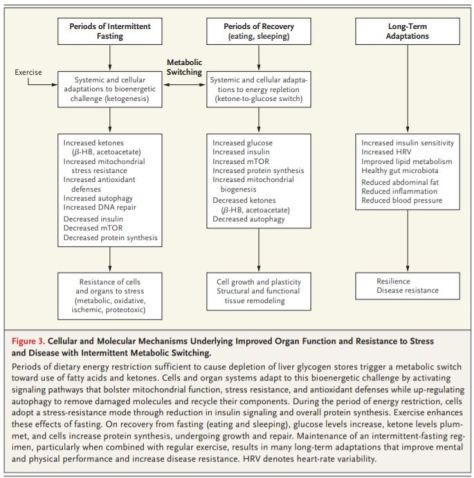
In humans, intermittent-fasting interventions ameliorate obesity, insulin resistance, dyslipidemia, hypertension, and inflammation. Intermittent fasting seems to confer health benefits to a greater extent than can be attributed just to a reduction in caloric intake.
Evidence is accumulating that eating in a 6-hour period and fasting for 18 hours can trigger a metabolic switch from glucose-based to ketone-based energy, with increased stress resistance, increased longevity, and a decreased incidence of diseases, including cancer and obesity.

Preclinical studies and clinical trials have shown that intermittent fasting has broad-spectrum benefits for many health conditions, such as obesity, diabetes mellitus, cardiovascular disease, cancers, and neurologic disorders. Animal models show that intermittent fasting improves health throughout the life span, whereas clinical studies have mainly involved relatively short-term interventions, over a period of months.
BOOMERS-DAILY.COM “18-HOUR INTERMITTENT FASTING DIET” STUDY
How much of the benefit of intermittent fasting is due to metabolic switching and how much is due to weight loss? Many studies have indicated that several of the benefits of intermittent fasting are dissociated from its effects on weight loss. These benefits include improvements in glucose regulation, blood pressure, and heart rate; the efficacy of endurance training; and abdominal fat loss.
Research: Omega-3 Fatty Acids In Diet Promotes Health By Limiting Large Fat Cell Accumulation
From a Stanford Medicine online news release:
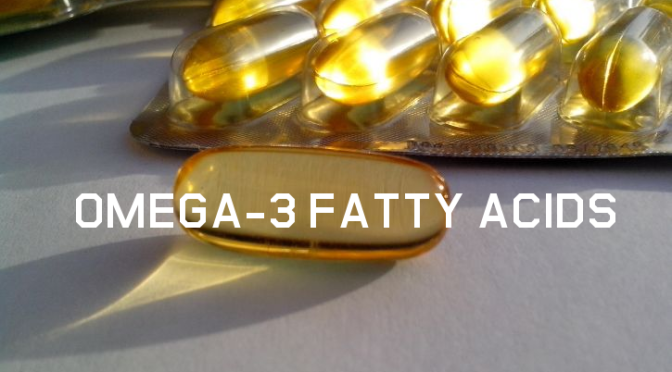
 “What you want is more, small fat cells rather than fewer, large fat cells,” Jackson said. “A large fat cell is not a healthy fat cell. The center is farther away from an oxygen supply, it sends out bad signals and it can burst and release toxic contents.” Large fat cells are associated with insulin resistance, diabetes and inflammation, he added.
Jackson and his colleagues found that when omega-3 fatty acids bind to a receptor called FFAR4 on the cilia of fat stem cells, it prompts the fat stem cells to divide, leading to the creation of more fat cells. This provides the body with more fat cells with which to store energy, something that is healthier than storing too much fat in existing fat cells.
For years, researchers have known that defects in an ancient cellular antenna called the primary cilium are linked with obesity and insulin resistance. Now, researchers at the Stanford University School of Medicine have discovered that the strange little cellular appendage is sensing omega-3 fatty acids in the diet, and that this signal is directly affecting how stem cells in fat tissue divide and turn into fat cells.
To read more: http://med.stanford.edu/news/all-news/2019/11/omega-3-fatty-acids-health-benefit-linked-to-stem-cell-control.html

Brain Health: “Package Of Lifestyle Changes” (Brisk Exercise, Healthy Diet & Sleep, Cognitive Training) Helps Prevent Dementia
From a Wall Street Journal online article:
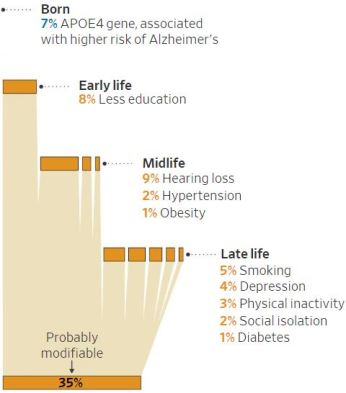
Dementia is a complicated disease that has multiple causes and risk factors, some of which remain unknown. Nevertheless, there is increasing evidence that people—even those who inherit genes that put them at greater risk of developing Alzheimer’s in later life—can improve their chances by adopting lifestyle changes.
“It’s not just about running three times a week,” says Sarah Lenz Lock, executive director of AARP’s Global Council on Brain Health. “Instead, it’s about a package of behaviors, including aerobic exercise, strength training, a healthy diet, sleep and cognitive training.”
When it comes to battling dementia, the unfortunate news is this: Medications have proven ineffective at curing or stopping the disease and its most common form, Alzheimer’s disease. But that isn’t the end of the story. According to a recent wave of scientific studies, we have more control over our cognitive health than is commonly known. We just have to take certain steps—ideally, early and often—to live a healthier lifestyle.
In fact, according to a recent report commissioned by the Lancet, a medical journal, around 35% of dementia cases might be prevented if people do things including exercising and engaging in cognitively stimulating activities. “When people ask me how to prevent dementia, they often want a simple answer, such as vitamins, dietary supplements or the latest hyped idea,” says Eric Larson, a physician at Kaiser Permanente in Seattle and one of a group of scientists who helped prepare the report. “I tell them they can take many common-sense actions that promote health throughout life.”
To read more: https://www.wsj.com/articles/what-science-tells-us-about-preventing-dementia-11574004600

Health Studies: Better Diets Reduce Side Effects Of Sleep Deprivation
From a Stanford Medicine online release:
 In a study published online Sept. 10 in the American Journal of Lifestyle Medicine, Hamidi, along with other Stanford researchers, examined survey results on sleep and nutrition from 245 Stanford physicians and found that a better diet is associated with reduced side effects of sleep deprivation.
Physicians face significant barriers to eating well at work due to long hours, a heavy workload and limited access to healthy meals, snacks and drinks. The findings of this study suggest that by providing healthy options at work, employers could help reduce the brain fogginess, difficulty concentrating and irritability caused by poor sleep among health care providers. And, as a result, help improve patient care.
“Potential mechanisms for the effect of diet on cognitive performance include regulation of hormones, neurotransmitters, and blood flow as well as reduction of oxidative stress and inflammation. The effects of diet on sleep quality have been attributed to the role of dietary factors in regulation of peripheral circadian clocks and to the synthesis of hormones and neurotransmitters that are involved in sleep regulation.”
To read more: http://med.stanford.edu/news/all-news/2019/10/to-fight-effects-of-sleep-deprivation–reach-for-healthy-snacks-.html
Diet Studies: “Dietary Fructose” In Soft Drinks, Foods Impairs The Body’s Ability To Burn Fat
From a Cell Metabolism online release:
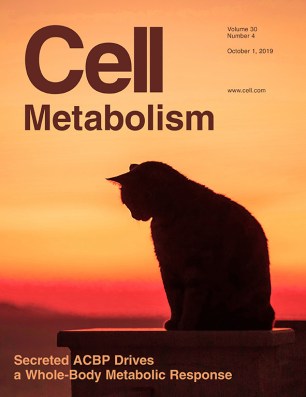 In summary, dietary fructose, but not glucose, supplementation of HFD impairs mitochondrial size, function, and protein acetylation, resulting in decreased fatty acid oxidation and development of metabolic dysregulation.
Dietary sugars, fructose and glucose, promote hepatic de novo lipogenesis and modify the effects of a high-fat diet (HFD) on the development of insulin resistance. Here, we show that fructose and glucose supplementation of an HFD exert divergent effects on hepatic mitochondrial function and fatty acid oxidation. This is mediated via three different nodes of regulation, including differential effects on malonyl-CoA levels, effects on mitochondrial size/protein abundance, and acetylation of mitochondrial proteins. HFD- and HFD plus fructose-fed mice have decreased CTP1a activity, the rate-limiting enzyme of fatty acid oxidation, whereas knockdown of fructose metabolism increases CPT1a and its acylcarnitine products. Furthermore, fructose-supplemented HFD leads to increased acetylation of ACADL and CPT1a, which is associated with decreased fat metabolism.
Nutrional Health Studies: Mediterranean Diet Improves Cognitive Function In Older People
From a Nutritional Neuroscience online release:
 Our findings suggest that higher adherence to a Mediterranean diet is associated with better cognitive performance, and therefore less cognitive decline, in older but not middle-aged individuals.
Over a period of five years, higher adherence to a Mediterranean diet was associated with improvements in Global Cognitive Function, Visual-Spatial Organisation and Memory and scanning and tracking in participants ≥70 years.
Adherence to a Mediterranean diet is associated with higher cognitive function and reduced risk of dementia in Mediterranean populations. However, few studies have investigated the association between Mediterranean diet adherence and cognition in populations outside of the Mediterranean basin.
To read more: https://www.tandfonline.com/doi/full/10.1080/1028415X.2019.1655201

Diet Studies: 2-Year Calorie Restriction Diets Lower LDL/Total Cholesterol, C-Reactive Protein & Blood Pressure
From The Lancet Diabetes & Endocrinology:
 2 years of moderate calorie restriction significantly reduced multiple cardiometabolic risk factors in young, non-obese adults. These findings suggest the potential for a substantial advantage for cardiovascular health of practicing moderate calorie restriction in young and middle-aged healthy individuals, and they offer promise for pronounced long-term population health benefits.
Calorie restriction caused a persistent and significant reduction from baseline to 2 years of all measured conventional cardiometabolic risk factors, including change scores for LDL-cholesterol (p<0·0001), total cholesterol to HDL-cholesterol ratio (p<0·0001), and systolic (p<0·0011) and diastolic (p<0·0001) blood pressure. In addition, calorie restriction resulted in a significant improvement at 2 years in C-reactive protein (p=0·012), insulin sensitivity index (p<0·0001), and metabolic syndrome score (p<0·0001) relative to control. A sensitivity analysis revealed the responses to be robust after controlling for relative weight loss changes.
To read more click on following link: https://www.thelancet.com/journals/landia/article/PIIS2213-8587(19)30151-2/fulltext?dgcid=raven_jbs_etoc_email
 Boomers Daily