Tag Archives: Genetics

NATURE MAGAZINE – JULY 24, 2025 – RESEARCH PREVIEW

Volume 643 Issue 8073

NATURE MAGAZINE: The latest issue features ‘Microbes Mapped’ – Spread of human pathogens across Eurasia plotted from ancient DNA.

Asia’s haze affects ice and weather on the Frozen Continent

Pollution emitted by fossil-fuel usage in Asia influences sea-ice coverage in Antarctica.

The mysterious missing ingredient in the highest-energy cosmic rays

Data from a South Pole observatory show that the fraction of protons in ultrahigh-energy cosmic rays is lower than expected.

How the world’s biggest bats got their enormous wingspans

Genetic analysis helps to reveal why flying foxes can measure almost 2 metres from wingtip to wingtip.

How sugar overload in early life affects the brain later

A study in mice finds that a high-sucrose diet during youth has long-term implications for learning and brain connectivity.

Research Preview: Science Magazine – July 21, 2023

Image

Science Magazine – July 21, 2023 issue: The cover depicts an x-ray of a human skeleton walking. Researchers extracted 23 skeletal proportions from 30,000 individuals using deep learning. Coupled with genetic and biobank data, more than 100 genetic variants associated with these proportions were identified. These analyses shed light on the evolution of the skeletal form, which facilitates bipedalism, and reveal connections to musculoskeletal disorders.

Hollywood movie aside, just how good a physicist was Oppenheimer?

A-bomb architect “was no Einstein,” historian says, but he did Nobel-level work on black holes

Deglaciation of northwestern Greenland during Marine Isotope Stage 11

Cover Preview: Nature Magazine – March 17, 2022

Volume 603 Issue 7901, 17 March 2022

Volume 603 Issue 7901

For more than 50 years, scientists have been trying to understand the relationship between DNA sequence, gene-expression phenotype and fitness to decipher principles of gene regulatory evolution. In this week’s issue, Eeshit Dhaval Vaishnav, Carl de Boer, Aviv Regev and their colleagues present a framework for understanding and engineering regulatory DNA sequences that takes a step towards this goal. The researchers built this framework around an ‘oracle’ they developed using a deep neural network model that predicts gene expression given a promoter DNA sequence. The neural network was trained using the expression measurements for tens of millions of promoter sequences. The result was an AI oracle that predicts expression from sequence well enough to study the evolutionary history and future evolvability of regulatory DNA sequences, as well as to design regulatory DNA sequences for synthetic biology applications. The cover offers a visual representation of the evolutionary properties of sequences at the extremes of the evolvability spectrum. 

FOOD & AGRICULTURE: “The Robot Producing Crops Of The Future” (WSJ Video)

Arizona has what researchers call “the climate of tomorrow, today.” Scientists are using a 30-ton robotic field scanner in the state to study plant genetics and hopefully develop stress-resilient crops.

Photo: Jesse Rieser for The Wall Street Journal

More from the Wall Street Journal: Visit WSJ.com: http://www.wsj.com

Science Podcasts: Low-Cost Cryo-Electron Microscopes & Genetic Roots Of Schizophrenia

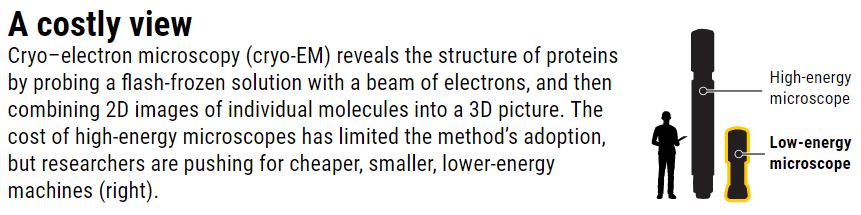
Science Magazine PodcastsStructural biologists rejoiced when cryo–electron microscopy, a technique to generate highly detailed models of biomolecules, emerged. But years after its release, researchers still face long queues to access these machines. Science’s European News Editor Eric Hand walks host Meagan Cantwell through the journey of a group of researchers to create a cheaper, more accessible alternative.

Cryo-Electron Microscopes

Also this week, host Joel Goldberg speaks with psychiatrist and researcher Goodman Sibeko, who worked with the Xhosa people of South Africa to help illuminate genetic details of schizophrenia. Though scientists have examined this subject among Western populations, much less is known about the underlying genetics of people native to Africa.

Website

Genetic Engineering: Harvard Scientist George Church Seeks To “Reverse Aging” (60 Minutes Video)

Our lives have been transformed by the information age. But what’s coming next is likely to be more profound, call it the genetic information age. We have mapped the human genome and in just the last few years we have learned to read and write DNA like software. And you’re about to see a few breakthroughs-in-waiting that would transform human health. For a preview of this revolution in evolution we met George Church, a world leading geneticist, whose own DNA harbors many eccentricities and a few genes for genius.

Website: https://www.cbsnews.com/news/harvard-geneticist-george-church-goal-to-protect-humans-from-viruses-genetic-diseases-and-aging-60-minutes-2019-12-08/


Health Studies: People With Depression (Genetic) Reduce Depressive Episodes With Exercise

From a MD Magazine online release:

Benefits of ExerciseThe investigators discovered that patients with a higher genetic risk for depression were more likely to be diagnosed with depression over the next 2 years. However, more physically active patients at baseline were less likely to depression, even after they accounted for genetic risks.

Increasing physical activity could pay dividends for people with a high risk of developing depression.

A team from Massachusetts General Hospital (MGH) recently discovered that several hours of weekly exercise result in a decreased chance to be diagnosed with a new episode of depression, even in patients with a higher genetic risk of developing Major Depressive Disorder (MDD).

The team examined the genomic and electronic health record (EHR) data of approximately 8000 patients in the Partners Healthcare Biobank, which represents the first study to show how physical activity influences depression despite genetic risk.

To read more: https://www.mdmag.com/medical-news/physical-activity-epressive-episode?eKey=bWljaGFlbDkyNjUxQHlhaG9vLmNvbQ==&utm_medium=email&utm_campaign=MDMagSS%20Daily%20Clinical%20eNews%20Sponsored%20Article%2011-5-19%20copy&utm_content=MDMagSS%20Daily%20Clinical%20eNews%20Sponsored%20Article%2011-5-19%20copy+CID_7326ad4f0f2426afa568130acb5dabae&utm_source=CM%20MDMag&utm_term=Physical%20Activity%20Reduces%20Odds%20of%20Depressive%20Episode