Tag Archives: Fitness

Passion Unleashed Or Reason Restrained: The Tale Of Two Theaters

By Michael Cummins, Editor, August 6, 2025

The theatrical landscapes of England and France, while both flourishing in the early modern period, developed along distinct trajectories, reflecting their unique cultural, philosophical, and political climates. The English Renaissance stage, exemplified by the towering figures of Christopher Marlowe and William Shakespeare, embraced a sprawling, often chaotic, exploration of human experience, driven by individual ambition and psychological depth. In contrast, the French Neoclassical theatre, championed by masters like Molière and Jean Racine, championed order, reason, and a more focused examination of societal manners and tragic passions within a stricter dramatic framework.

This essay will compare and contrast these two powerful traditions by examining how Marlowe and Shakespeare’s expansive and character-driven dramas differ from Molière’s incisive social comedies and Racine’s intense psychological tragedies. Through this comparison, we can illuminate the divergent artistic philosophies and societal preoccupations that shaped the dramatic arts in these two influential European nations.

English Renaissance Drama: The Expansive Human Spirit and Societal Flux

The English Renaissance theatre was characterized by its boundless energy, its disregard for classical unities, and its profound interest in the multifaceted human psyche. Playwrights like Christopher Marlowe and William Shakespeare captured the era’s spirit of exploration and individualism, often placing ambitious, flawed, and deeply introspective characters at the heart of their narratives. These plays, performed in bustling public theaters, offered a mirror to an English society grappling with rapid change, shifting hierarchies, and the exhilarating—and terrifying—potential of the individual.

Christopher Marlowe (1564–1593), a contemporary and rival of Shakespeare, pioneered the use of blank verse and brought a new intensity to the English stage. His plays often feature protagonists driven by overwhelming, almost superhuman, desires—for power, knowledge, or wealth—who challenge societal and divine limits. In Tamburlaine the Great, the Scythian shepherd rises to conquer empires through sheer force of will, embodying a ruthless individualism that defied traditional hierarchies. Marlowe’s characters are often defined by their singular, often transgressive, ambition.

“I hold the Fates bound fast in iron chains, / And with my hand turn Fortune’s wheel about.” — Christopher Marlowe, Tamburlaine the Great

Similarly, Doctor Faustus explores the dangerous pursuit of forbidden knowledge, with its protagonist selling his soul for intellectual mastery and worldly pleasure. Marlowe’s drama is characterized by its grand scale, its focus on the exceptional individual, and its willingness to delve into morally ambiguous territory, reflecting a society grappling with new ideas about human potential and the limits of authority. His plays were often spectacles of ambition and downfall, designed to provoke and awe, suggesting an English fascination with the raw, unbridled power of the individual, even when it leads to destruction. They spoke to a society where social mobility, though limited, was a potent fantasy, and where traditional religious and political certainties were increasingly open to radical questioning.

William Shakespeare (1564–1616) built upon Marlowe’s innovations, expanding the scope of English drama to encompass an unparalleled range of human experience. While his historical plays and comedies are diverse, his tragedies, in particular, showcase a profound psychological realism. Characters like Hamlet, Othello, and King Lear are not merely driven by singular ambitions but are complex individuals wrestling with internal conflicts, moral dilemmas, and the unpredictable nature of fate. Shakespeare’s plays often embrace multiple plots, shifts in tone, and a blend of prose and verse, reflecting the messy, unconstrained reality of life.

“All the world’s a stage, / And all the men and women merely players; / They have their exits and their entrances; / And one man in his time plays many parts…” — William Shakespeare, As You Like It

Hamlet’s introspection and indecision, Lear’s descent into madness, and Othello’s tragic jealousy reveal a deep fascination with the inner workings of the human mind and the devastating consequences of human fallibility. Unlike the French emphasis on decorum, Shakespeare’s stage could accommodate violence, madness, and the full spectrum of human emotion, often without strict adherence to classical unities of time, place, or action. This freedom allowed for a rich, multifaceted exploration of the human condition, making his plays enduring studies of the soul. These plays vividly portray an English society grappling with the breakdown of traditional order, the anxieties of political succession, and the moral ambiguities of power. They suggest a national character more comfortable with contradiction and chaos, finding truth in the raw, unfiltered experience of human suffering and triumph rather than in neat, rational resolutions.

French Neoclassical Drama: Order, Reason, and Social Control

The French Neoclassical theatre, emerging in the 17th century, was a reaction against the perceived excesses of earlier drama, favoring instead a strict adherence to classical rules derived from Aristotle and Horace. Emphasizing reason, decorum, and moral instruction, playwrights like Molière and Jean Racine crafted works that were elegant, concentrated, and deeply analytical of human behavior within a structured society. These plays offered a reflection of French society under the centralized power of the monarchy, particularly the court of Louis XIV, where order, hierarchy, and the maintenance of social appearances were paramount.

Molière (Jean-Baptiste Poquelin, 1622–1673), the master of French comedy, used wit and satire to expose the follies, hypocrisies, and social pretensions of his contemporary Parisian society. His plays, such as Tartuffe, The Misanthrope, and The Miser, feature characters consumed by a single dominant passion or vice (e.g., religious hypocrisy, misanthropy, avarice). Molière’s genius lay in his ability to create universal types, using laughter to critique societal norms and encourage moral rectitude. His comedies often end with the restoration of social order and the triumph of common sense over absurdity.

“To live without loving is not really to live.” — Molière, The Misanthrope

Unlike the English focus on individual transformation, Molière’s characters often remain stubbornly fixed in their vices, serving as satirical mirrors for the audience. The plots are tightly constructed, adhering to the classical unities, and the language is precise, elegant, and witty, reflecting the French emphasis on clarity and rational thought. His plays were designed not just to entertain, but to instruct and reform, making them crucial vehicles for social commentary. Molière’s comedies reveal a French society deeply concerned with social decorum, the perils of pretense, and the importance of maintaining a rational, harmonious social fabric. They highlight the anxieties of social climbing and the rigid expectations placed upon individuals within a highly stratified and centralized court culture.

Jean Racine (1639–1699), the preeminent tragedian of the French Neoclassical period, explored the destructive power of human passions within a highly constrained and formal dramatic structure. His tragedies, including Phèdre, Andromaque, and Britannicus, focus intensely on a single, overwhelming emotion—often forbidden love, jealousy, or ambition—that inexorably leads to the protagonist’s downfall. Racine’s plays are characterized by their psychological intensity, their elegant and precise Alexandrine verse, and their strict adherence to the three unities (time, place, and action).

“There is no greater torment than to be consumed by a secret.” — Jean Racine, Phèdre

Unlike Shakespeare’s expansive historical sweep, Racine’s tragedies unfold in a single location over a short period, concentrating the emotional and moral conflict. His characters are often members of the aristocracy or historical figures, whose internal struggles are presented with a stark, almost clinical, precision. The tragic outcome is often a result of an internal moral failing or an uncontrollable passion, rather than external forces or a complex web of events. Racine’s work reflects a society that valued order, reason, and a clear understanding of human nature, even when depicting its most destructive aspects. Racine’s tragedies speak to a French society that, despite its pursuit of order, recognized the terrifying, almost inevitable, power of human passion to disrupt that order. They explore the moral and psychological consequences of defying strict social and religious codes, often within the confines of aristocratic life, where reputation and controlled emotion were paramount.

Divergent Stages, Shared Human Concerns: A Compelling Contrast

The comparison of these two dramatic traditions reveals fundamental differences in their artistic philosophies and their reflections of national character. English Renaissance drama, as seen in Marlowe and Shakespeare, was expansive, embracing complexity, psychological depth, and a vibrant, often chaotic, theatricality. It reveled in the individual’s boundless potential and tragic flaws, often breaking classical rules to achieve greater emotional impact and narrative freedom. The English stage was a mirror to a society undergoing rapid change, where human ambition and internal conflict were paramount, and where the individual’s journey, however tumultuous, was often the central focus.

French Neoclassical drama, in contrast, prioritized order, reason, and decorum. Molière’s comedies satirized social behaviors to uphold moral norms, while Racine’s tragedies meticulously dissected destructive passions within a tightly controlled framework. Their adherence to classical unities and their emphasis on elegant language reflected a desire for clarity, balance, and a more didactic approach to theatre. The French stage was a laboratory for examining universal human traits and societal structures, often through the lens of a single, dominant characteristic or emotion, emphasizing the importance of social harmony and rational control.

The most compelling statement arising from this comparison is that while English drama celebrated the unleashing of the individual, often leading to magnificent chaos, French drama sought to contain and analyze the individual within the strictures of reason and social order. The English stage, with its public accessibility and fewer formal constraints, became a crucible for exploring the raw, unvarnished human condition, reflecting a society more comfortable with its own contradictions and less centralized in its cultural authority. The French stage, often patronized by the monarchy and adhering to strict classical principles, became a refined instrument for social critique and the dissection of universal passions, reflecting a society that valued intellectual control, social hierarchy, and the triumph of reason over disruptive emotion.

Despite these significant stylistic and philosophical divergences, both traditions ultimately grappled with universal human concerns: ambition, love, betrayal, morality, and the search for meaning. Whether through the grand, sprawling narratives of Shakespeare and Marlowe, or the concentrated, analytical dramas of Molière and Racine, the theatre in both nations served as a vital arena for exploring the human condition, shaping national identities, and laying groundwork for future intellectual movements. The “stages of the soul” in the Renaissance and Neoclassical periods, though built on different principles, each offered profound insights into the timeless complexities of human nature.

THIS ESSAY WAS WRITTEN AND EDITED UTILIZING AI

HEALTHY AGING: WHY LEAN MUSCLE MASS IS ESSENTIAL

By Michael Cummins, Editor, August 5, 2025

When we envision the journey of aging, we often focus on the more visible signs—the lines on our faces, the graying hair, or the occasional ache in our joints. But the most profound changes occur beneath the surface, particularly within our muscular system. The gradual loss of muscle mass, a condition known as sarcopenia, is often accepted as an inevitable part of getting older. Yet, this decline is far from a cosmetic concern. It represents a fundamental shift in our body’s operating system, compromising our resilience and making us more vulnerable to chronic disease.

Modern science has revolutionized our understanding of skeletal muscle. It is not merely a tool for movement but a dynamic, multifaceted endocrine organ—a bustling chemical factory that profoundly influences every aspect of our health. By actively engaging and maintaining this “factory,” we can effectively fight back against the aging process at a cellular and systemic level. This essay will explore the critical importance of preserving lean muscle mass, detailing its key functions in regulating metabolism, combating chronic inflammation, bolstering our immune system, and acting as a protective shield for the entire body. Ultimately, it will argue that building and maintaining muscle should be a foundational and non-negotiable pillar of any strategy for promoting a long, healthy, and vibrant life.

The Unseen Architects: A Deeper Look at Mitochondria

To truly appreciate the power of muscle, we must first look inside the cell at the microscopic architects that make it all possible: the mitochondria. While famously known as the “powerhouses” of the cell, their story is far more fascinating. As scientist Lena Pernas from the Max Planck Institute for Biology of Ageing explains in her TEDxPadova talk, their ancestors were ancient bacteria that, over 1.5 billion years ago, forged a symbiotic relationship with our early eukaryotic ancestors by finding their way into a larger cell and staying. This remarkable evolutionary event is why mitochondria still retain some bacterial traits, including their own unique circular DNA, known as mtDNA. Interestingly, all of our mitochondrial DNA is passed down exclusively from our mothers.

“To truly appreciate the power of muscle, we must first look inside the cell at the microscopic architects that make it all possible: the mitochondria.”

These tiny organelles are responsible for converting the oxygen we breathe and the nutrients we consume into adenosine triphosphate (ATP), the chemical energy that powers our every thought, movement, and biological process. Mitochondria are not scattered randomly in our bodies; they are strategically placed in the greatest numbers and size within the tissues that have the highest energy demands. This makes our lean muscle tissue a prime location for these cellular power plants. A healthy, active muscle is packed with a dense network of mitochondria, ready to produce the vast amounts of energy needed for physical activity. The strength and efficiency of this mitochondrial network are directly linked to the health and vitality of your muscles, making the connection between muscle mass and healthy aging all the more profound.

The Metabolic Engine Room: Regulating Your Body’s Energy

Skeletal muscle is the single largest organ in the human body, constituting nearly 50% of total body weight in a lean individual. Its sheer size and constant activity make it a metabolic powerhouse. One of its most vital roles is as the body’s primary glucose regulator. After a meal, muscle tissue acts as a massive storage container, efficiently taking up glucose from the bloodstream in response to insulin’s signal. This action is crucial for keeping blood sugar levels balanced and preventing the dangerous spikes and crashes associated with metabolic dysfunction.

“By maintaining a robust amount of muscle mass, you effectively protect this system, keeping your metabolic ‘engine room’ running smoothly.”

However, as we age and lose muscle mass, this storage container shrinks. The remaining cells have to work harder to manage blood sugar, which often leads to a condition called insulin resistance. In this state, your body’s cells become less responsive to insulin’s message, causing glucose to accumulate in the bloodstream—a key precursor to Type 2 diabetes. Insulin resistance triggers a dangerous cascade of events. The excess glucose in the blood can bind to proteins, forming pro-inflammatory molecules known as Advanced Glycation End-products (AGEs).

Additionally, impaired insulin action leads to a rise in circulating free fatty acids, which directly activate inflammatory pathways within cells. This vicious cycle, where metabolic dysfunction drives inflammation and vice versa, is a cornerstone of numerous age-related diseases. By maintaining a robust amount of muscle mass, you effectively protect this system, keeping your metabolic “engine room” running smoothly and providing a high-leverage strategy for preventing chronic conditions.

Fighting Inflammation: Your Body’s Internal Anti-Inflammatory Factory

Chronic, low-grade systemic inflammation is a major driver of age-related decline. Known as inflammaging, this slow-burning inflammatory state contributes to everything from heart disease and arthritis to neurodegenerative disorders. The genius of skeletal muscle lies in its ability to actively combat this process.

When muscles contract during physical activity, they release a complex cocktail of signaling molecules called myokines. These myokines act as powerful, natural anti-inflammatory agents. They are the chemical messengers of your muscle’s “pharmacy,” traveling throughout the body to modulate inflammatory and immune responses. Without enough muscle and physical activity, you lose this natural defense, allowing the chronic inflammatory “fire” to burn hotter.

One of the most well-studied myokines, Interleukin-6 (IL-6), beautifully illustrates this concept. While often associated with inflammation in its chronic state, when it is secreted acutely by working muscles, it acts as a powerful anti-inflammatory signal. Muscle-derived IL-6 can inhibit the production of other pro-inflammatory cytokines, creating a more balanced and healthy systemic environment.

Brown Fat: Your Body’s Calorie-Burning Furnace

A particularly exciting and potent anti-inflammatory function of myokines is their ability to influence your body’s fat tissue. Not all fat is created equal. While white fat stores energy, brown fat is a specialized tissue packed with mitochondria that burns calories to produce heat. People with higher levels of brown fat are often at a lower risk for conditions like type 2 diabetes and heart disease, even if they are overweight.

“By keeping your muscles active, you are sending out potent signals that actively work to counteract the systemic inflammation and metabolic dysfunction that drives the aging process.”

Skeletal muscle plays a vital, direct role in the production and activation of this beneficial brown fat. Exercise-induced myokines, notably Irisin and Fibroblast Growth Factor 21 (FGF21), are key players in a process called “browning.” This is a remarkable biological feat where white fat cells, particularly in certain areas of the body, are signaled to transform into brown-like fat cells (often called “beige” adipocytes).

These new beige fat cells become metabolic furnaces, increasing your overall energy expenditure and helping to improve blood sugar control and cholesterol levels. By keeping your muscles active, you are not just building strength; you are sending out these potent signals that actively work to counteract the systemic inflammation and metabolic dysfunction that drives the aging process.

The Vicious Cycle: How Inactivity and Obesity Degrade Muscle

While lean muscle can act as a powerful protective agent, a sedentary lifestyle and obesity create a detrimental environment that actively degrades both mitochondrial and muscle health.

“In essence, inactivity and obesity create a vicious cycle…a dangerous cycle that accelerates the decline of overall health.”

This is a complex interplay of chronic inflammation, insulin resistance, and altered metabolic processes that forms a dangerous cycle.

Impact on Mitochondria: Inactivity and obesity are a direct assault on the cell’s powerhouses.

They impair their function by:

Reduced Mitochondrial Biogenesis: Without the stimulus of physical activity, the body suppresses the process of creating new mitochondria. This leads to a decrease in the overall number and density of these crucial power plants in your muscle cells.

Impaired Function: The existing mitochondria become less efficient at producing ATP, reducing your muscles’ capacity to generate energy.

Increased Oxidative Stress: A sedentary lifestyle and excess metabolic load lead to a significant increase in reactive oxygen species (ROS). This oxidative stress damages mitochondria and reduces your body’s natural antioxidant defenses, leading to an accumulation of cellular damage.

Compromised Quality Control: Your body has a clean-up process called mitophagy that removes damaged mitochondria. Inactivity and obesity make this process sluggish, allowing unhealthy mitochondria to build up and further compromise energy production.

Impact on Lean Muscle:
Beyond the cellular level, inactivity and obesity degrade muscle tissue through a state of chronic low-grade inflammation. This silent inflammation is a hallmark of obesity and is characterized by the infiltration of immune cells and the release of harmful molecules.

Pro-inflammatory Molecules: Immune cells and fat cells in obese individuals secrete inflammatory molecules like TNF-α and MCP-1. These molecules cause inflammation within muscle cells and interfere with their metabolism, leading to insulin resistance.

Insulin Resistance and Protein Degradation: The insulin resistance that is common with obesity directly accelerates muscle breakdown. It does this by suppressing a crucial signaling pathway responsible for building muscle protein, while simultaneously activating pathways that break down protein.

Ectopic Lipid Deposition: This is the accumulation of fat within the muscle itself, a condition known as myosteatosis. This fatty infiltration is directly linked to decreased muscle strength and a reduced ability for muscle regeneration.

In essence, inactivity and obesity create a vicious cycle. They promote chronic inflammation and insulin resistance, which in turn damages mitochondria and leads to the breakdown of muscle protein. This loss of muscle then further worsens metabolic function, fueling the cycle and accelerating the decline of overall health.

The Immune System’s Secret Fuel Tank and Guardian

Beyond their metabolic and anti-inflammatory functions, muscles are a critical support system for your immune health. The human body is a constant battlefield, and your immune cells are your first line of defense. But these cells are metabolically demanding, requiring a constant supply of energy and building blocks to function effectively. This is where lean muscle mass becomes an unsung hero.

“Think of your muscles as a vast ‘fuel tank’ for your immune system.”

Skeletal muscle is your body’s largest reservoir of protein and amino acids. This vast store is not just for building brawn; it actively provides essential amino acids for vital functions, including the rapid proliferation and activation of immune cells. A prime example is glutamine, an amino acid that is abundantly produced by skeletal muscle. Glutamine is the primary energy source for rapidly dividing immune cells like lymphocytes and monocytes. Think of your muscles as a vast “fuel tank” for your immune system.

If this tank is full, your immune cells have the fuel they need to mount a robust defense against pathogens. However, if you lose muscle mass or your body is under severe stress (such as during a serious illness), this glutamine tank can run low. When this happens, immune cells are deprived of their primary fuel source, which can compromise their function, proliferative capacity, and ability to effectively fight off infections. This direct metabolic link explains why individuals with sarcopenia or significant muscle wasting are often more susceptible to infections and have poorer outcomes when they get sick.

Beyond Strength: A Whole-Body Protective Shield

The benefits of maintaining muscle mass extend far and wide, touching virtually every system in the body. A higher lean body mass is a powerful indicator of overall health and resilience.

Bone Health: The act of resistance training creates tension on your muscles, which in turn puts a positive, mechanical stress on your bones. This stimulus signals to the bones to get stronger and denser, making resistance training one of the most effective defenses against osteoporosis.

Heart Health: A higher ratio of muscle to fat mass is associated with a healthier lipid profile, lower blood pressure, and a reduced risk of heart disease. The myokines released during exercise also play a role in protecting the cardiovascular system.

Brain Power: Research shows a fascinating link between muscle and brain health. Myokines released during exercise can have neuroprotective effects, enhancing cognitive function and potentially reducing the risk of neurodegenerative diseases. They can influence the production of brain-derived neurotrophic factor (BDNF), a molecule essential for neuronal growth and survival.

“A higher lean body mass is a powerful indicator of overall health and resilience.”

The sheer volume and metabolic activity of muscle mean that even subtle changes in its health can have widespread systemic effects, offering a powerful, protective shield for the entire body.

The Action Plan: What You Can Do

The good news is that sarcopenia is not an irreversible fate. You can actively fight muscle loss at any age, and the most effective strategy is a powerful combination of resistance training and a strategic approach to nutrition.

Resistance Training: This is the most crucial signal you can give your body to keep and build muscle. This doesn’t mean you have to become a bodybuilder; it means making your muscles work against a force. This can include:

Lifting weights: Using dumbbells, barbells, or machines.

Resistance bands: An excellent, low-impact option.

Bodyweight exercises: Squats, lunges, push-ups, and planks are highly effective.
The key is progressive overload, which means gradually increasing the intensity over time to challenge your muscles and force them to adapt and grow.

Eating Enough Protein: Protein is the essential building block of muscle tissue. As we get older, our bodies become less efficient at using protein, a phenomenon called “anabolic resistance.” This means older adults need a higher intake of protein per meal than younger individuals to achieve the same muscle-building response. Aim for a consistent intake of high-quality protein with every meal, especially around your resistance training sessions, to maximize muscle protein synthesis and counteract sarcopenia.

Crucially, the research shows that combining these two strategies—exercise and nutrition—creates a synergistic effect. The benefits are amplified when you support your muscles with both the mechanical stimulus to grow and the nutritional building blocks they need.

Conclusion

The journey of healthy aging is not about avoiding the passage of time but about building a body that can withstand its effects. At the heart of this process lies our skeletal muscle. By moving beyond the old paradigm of muscle as a simple locomotive tool, we can appreciate its central and multifaceted role as a metabolic regulator, an anti-inflammatory agent, and a vital supporter of our immune system. The progressive loss of this powerful organ is a primary driver of age-related decline and chronic disease.

“The secret to a long, healthy life isn’t hidden in a mythical fountain of youth—it’s waiting for you to build it, one muscle fiber at a time.”

However, this new understanding also provides a clear and empowering path forward. By prioritizing regular resistance training and a thoughtful approach to nutrition, we can actively build and maintain our lean muscle mass. This is not just an investment in a stronger body; it is an investment in a more resilient metabolism, a calmer inflammatory system, and a more robust immune defense. The secret to a long, healthy life isn’t hidden in a mythical fountain of youth—it’s waiting for you to build it, one muscle fiber at a time.

THIS ESSAY WAS WRITTEN AND EDITED UTILIZING AI

Traveller Magazine — March 2025 Preview

NATIONAL GEOGRAPHIC TRAVELLER MAGAZINE (February 6, 2025): The latest issue features ‘The World’s Best Train Trips’….

Also inside this issue:

Greenland: Meet the communities working to preserve Inuit culture for future generations
Portugal: Roman relics and pagan festivities on a road trip through the untamed north
Kerala: A photographer’s journey among the tranquil backwaters and perfumed spice farms of Kochi
Southern Mexico: A guide to the region’s immense jungles, ancient settlements and distinct cuisine
Hong Kong: Beyond the urban sprawl, adventures abound in the form of kayaking and intrepid hikes
Glasgow: Warm yourself in the Scottish city’s art galleries and era-defining music venues
Essaouira: Myriad cultures have made this Moroccan port city a hub for art and music
Cognac: A change is under way in the French region’s restaurants and distilleries
SalzburgFairytale stays for every taste, from lovers of old-school luxury to fans of TheSound of Music

Plus, new travel routes for spring; fresh hiking opportunities on Australia’s Whitsunday IslandsBradford’s year as the UK City of Culture; a taste of Amorgos, Greece; a lighthouse retreat on Italy’s Tuscan coast; an insider’s guide to Ibiza Town; island adventures in Brač, Croatia; globetrotting books about love and obsession, running essentials to put a spring in your step; and a historical getaway in the Welsh Marches

COUNTRY LIFE MAGAZINE – January 29, 2025 Issue

COUNTRY LIFE MAGAZINE (January 28, 2025): The latest issue features ‘Ready, Steady, Go!’ – The wonderful thing about Springers…

Full of the joys of spring(ers)

The non-stop English springer is still our number one working spaniel, reveals Matthew Dennison, as he delves into this enthusiastic, energetic breed

Snake, rattle and roll

Rob Crossan investigates the deeply spiritual origins of that enduring family board-game favourite Snakes and Ladders

Heard it on the radio

The wireless broke new ground as the first form of home-based mass entertainment and is still going strong in the age of the smart speaker, finds Ben Lerwill

Friends with benefits

Nematodes are a natural way to halt the march of all manner of garden pests and Charles Quest-Ritson is a convert

Mould and behold

Josiah Wedgwood was a brilliant businessman with a remarkable social conscience. Tristram Hunt assesses his life and legacy

Catch us if you can

Owain Jones sizes up six of the best as he picks out the players to watch in this year’s Guinness Six Nations rugby extravaganza

Roger Morgan-Grenville’s favourite painting

The conservation campaigner selects a work that inspired his lifelong obsession with seabirds

A Palladian premonition

Richard Hewlings offers a fresh analysis of the architecture at Bramham Park, a highly original West Yorkshire country house

The legacy

Kate Green remembers Robert FitzRoy, the founder of the Met Office whose name lives on in the BBC’s Shipping Forecast

Dear country diary

Paul Fleckney flicks through The Guardian’s Country Diary, which has offered a snapshot of rural life for more than 120 years

Interiors

The best stoves and fireplaces picked by Amelia Thorpe, plus the alternatives to burning logs

Luxury

Hetty Lintell’s top timepieces and James Haskell’s favourite things

Magnificent mahonias

Charles Quest-Ritson makes the case for mahonias, arguing that their pleasantly scented flowers are a seasonal delight

Kitchen garden cook

Melanie Johnson pairs peppery horseradish with salmon fillets

Ring-dove beauteous!

John Lewis-Stempel coos over the much-maligned wood pigeon, that canny, keen-eyed and fast-flying stalwart of our countryside

Reports: Tufts Health & Nutrition – February 2025

TUFTS HEALTH & NUTRITION LETTER (January 27, 2025):

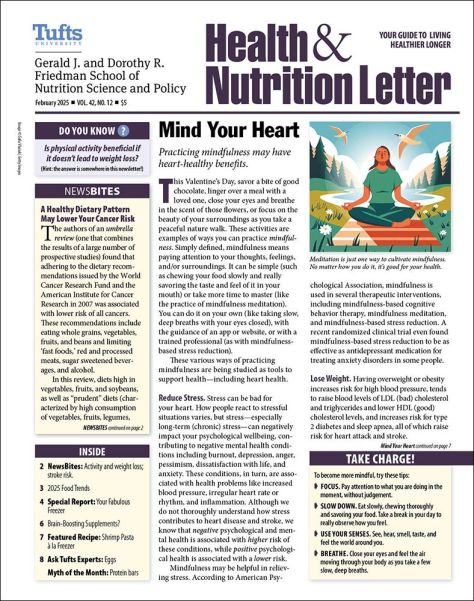
Mind Your Heart

Practicing mindfulness may have heart-healthy benefits.

This Valentine’s Day, savor a bite of good chocolate, linger over a meal with a loved one, close your eyes and breathe in the scent of those flowers, or focus on the beauty of your surroundings as you take a peaceful nature walk. These activities are examples of ways you can practice mindfulness

2025 Food Trends

Some emerging food trends have potential health benefits—with some caveats.

Brain-Boosting Supplements?

Most of the promises made about these products lack proof.

About 25 percent of adults over 50 take a supplement that promises to improve cognition or cognitive health. As long as these products don’t say they improve or treat diseases like Alzheimer’s or other dementias, they are allowed to make any claims they want—without having to prove they work. So, which marketing claims should you believe?

THE NEW YORK TIMES — Saturday, Dec. 28, 2024

Image

Trump Backers Battle Online Over Skilled Immigrants

A fierce dispute erupted in the president-elect’s camp between immigration hard-liners and tech industry leaders including Elon Musk.

The War Killed Her Dreams. To Survive, She Treated Its Fighters.

Trapped in Sudan’s brutal civil war, a young woman chose to work in a clinic on the front line, treating civilians and combatants. She had to navigate suspicion from both sides.

Syria’s Alawite Minority, Favored by the Assads, Looks Nervously to the Future

Amid an outcry for justice and accountability and threats online, a once-dominant group is feeling deep anxiety after the ouster of Syria’s dictator.

Video Shows Prison Officers’ Fatal Assault of Inmate in ‘Shocking’ Detail

Robert Brooks died after a savage attack at a New York prison this month that was captured by several officers’ body-worn cameras.

The New York Times — Sunday, December 15, 2024

Image

Syria Shudders as Assad’s Prison Atrocities Come Into the Light

At the country’s most notorious prison, Syrians confront their worst fears: that they will never know what happened to the loved ones who disappeared.

South Korea’s President Is Impeached After Martial Law Crisis

Some members of President Yoon Suk Yeol’s own party helped remove him from office. But the political uncertainty is far from over.

What Ever Happened to the Lady Jaguars?

When we met them a dozen years ago, they were teenagers in trouble, playing for a basketball team that always lost. Did they find a way to win at life?

Gas Could Mean Billions for Indigenous People in Canada. Some Fear a Cost.

New export terminals along the rugged Pacific coastline have reignited a generations-old debate over identity and environmental stewardship.

The New York Times — Thursday, Dec. 12, 2024

Image

How U.S. Firms Battled a Government Crackdown to Keep Tech Sales to China

An intense struggle has unfolded in Washington between companies and officials over where to draw the line on selling technology to China.

Joy Buoys Syria’s First Friday Prayers Since Assad Ouster, but Hardships Loom

In an impoverished, war-ravaged country, the first prayers after the fall of a brutal regime drew jubilant crowds, even in areas seen as regime strongholds.

The Fall of al-Assad Quickly Infuses Europe’s Debate Over Asylum

Nearly a million Syrians in Germany alone have made new lives. But after the fall of Bashar al-Assad, some politicians across the continent have suggested that refugees could return home.

McKinsey to Pay $650 Million in Opioid Settlement With Justice Department

A former senior partner will also plead guilty to obstruction of justice after destroying company documents.

The New York Times — Thursday, Dec. 12, 2024

Image

Syria’s New Leaders Balance Huge Struggles Amid Disorder

The rebels who seized control called for foreign help in prosecuting atrocities, while trying to restore order in a fractured country.

Power, Intimidation and the Resurrection of Trump’s Support for Hegseth

The president-elect became convinced that letting Pete Hegseth fail would set off a feeding frenzy among senators. What followed was a MAGA swarm that helped salvage his bid, at least for now.

Recent Immigration Surge Has Been Largest in U.S. History

Under President Biden, more than two million immigrants per year have entered, government data shows.

The Gold Rush at the Heart of a Civil War

Heavily destroyed streets.

Famine and ethnic cleansing stalk Sudan. Yet the gold trade is booming, enriching generals and propelling the fight.

The New York Times — Wednesday, Dec. 11, 2024

Image

Suspect in C.E.O. Killing Withdrew From a Life of Privilege and Promise

The suspect, Luigi Mangione, was an Ivy League tech graduate from a prominent Maryland family who in recent months had suffered physical and psychological pain.

How a Realtors’ Nonprofit Quietly Funds Conservative Advocacy Groups

The National Association of Realtors has created a nonprofit that gives more heavily to one side of the political aisle and to groups that have little to do with real estate and housing.

What to Know About Syria’s Notorious Sednaya Prison

Amnesty International described it as a “human slaughterhouse,” where, other rights groups say, tens of thousands of people were detained, tortured and killed during the 13-year civil war.

Rage Grows Over a Spate of Brutal Murders of Women in Kenya

Almost 100 women have been killed in the span of three months, the police say. Rights groups want President William Ruto to declare femicide a national crisis.